The must-have coverage grid: which of your contracts is missing a protection.
Your team knows the clauses a good contract should carry: a price cap, an exit right, a liability limit. The question nobody can answer quickly is which of the hundreds you already signed are missing them. A coverage grid runs your must-haves across the whole estate and shows the gaps as a matrix.
Most organizations know what a well-protected contract looks like. It caps the annual price increase, it grants a way out, it limits liability, it holds the vendor to a service level with teeth. Your legal and procurement teams could recite the list of protections they insist on in a new deal without hesitation. The problem is not knowing what good looks like. The problem is that this standard is applied to new contracts, at the moment of signing, and almost never applied backward to the hundreds of contracts already in the estate, signed by different people, at different times, under different levels of diligence.
So the uncomfortable and usually unanswered question is: which of the contracts we already hold are missing the protections we now insist on? Somewhere in the estate are agreements with no price cap, no exit clause, unlimited liability, or no notice window, signed years ago and forgotten, and they represent real exposure that nobody has quantified because nobody has the time to open every contract and check. A coverage grid answers that question by running your must-have clauses across the whole estate at once and showing, as a matrix, exactly which contracts fall short.
Your standard, applied to the whole estate
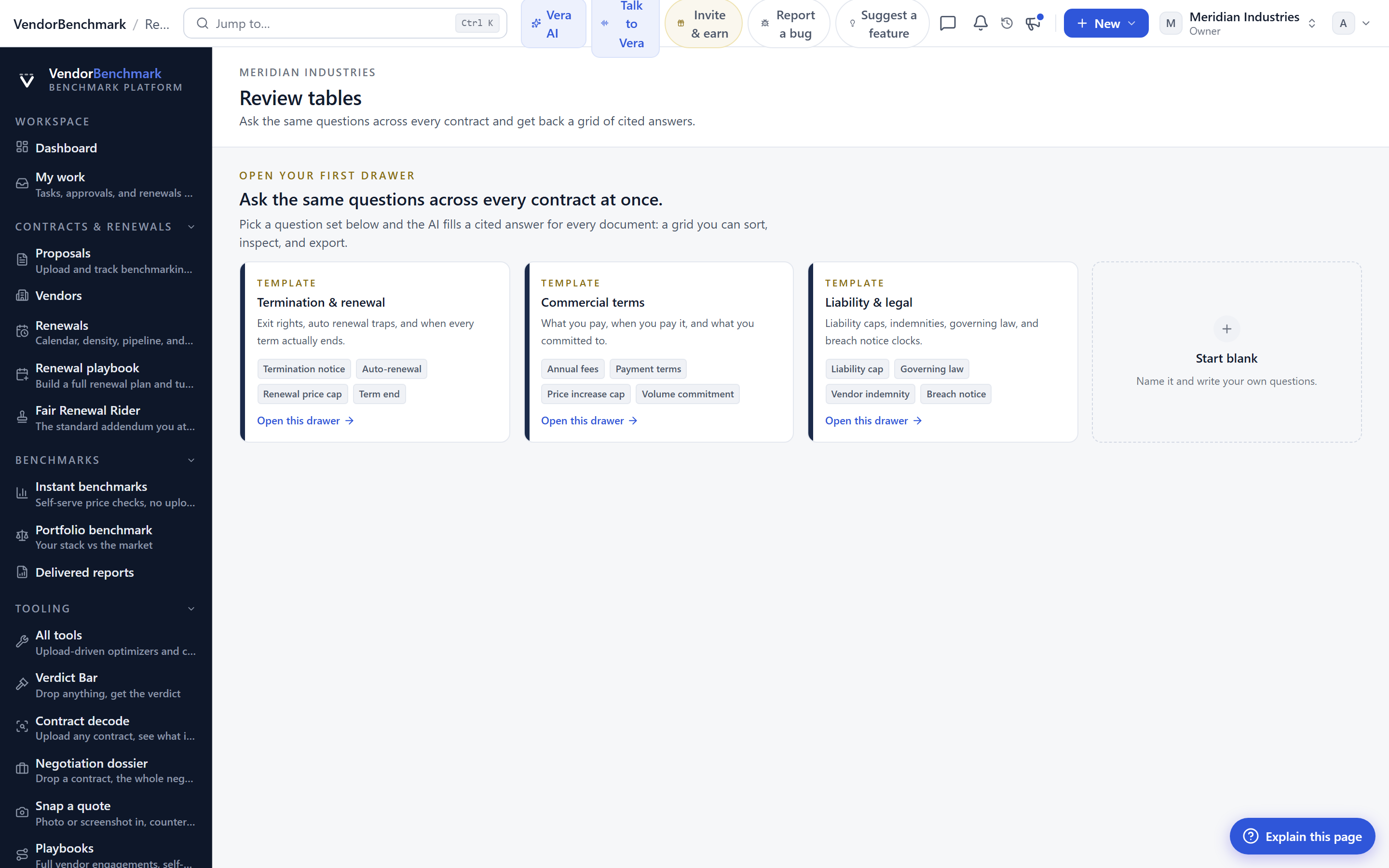
A coverage grid starts from your standard, the set of clauses your organization has decided it must have, drawn from your own clause playbook. These are not generic best practices but your specific positions: the protections you require, in the wording you prefer. The grid then takes that standard and checks it against every contract in the estate, contract by contract, clause by clause, so that the question "do we have a price cap here?" is answered for all of them at once rather than one file at a time. What comes back is a matrix: your must-haves down one axis, your contracts down the other, and in each cell a verdict on whether that contract carries that protection.
The power is in the completeness. A single contract review tells you about one agreement; a coverage grid tells you about the whole book against a consistent standard, which is the only way to find systemic gaps. It turns a vague worry that "some of our older contracts probably lack protections" into a specific, sortable list: these eleven contracts have no uplift cap, these six have unlimited liability, these four have no exit right. The exposure stops being a general anxiety and becomes a finite set of named contracts you can actually work through.
The gaps are the exposure, ranked
A gap in the grid is not a curiosity, it is quantified risk, and different gaps carry different weight. A missing price cap is a financial exposure that compounds every year the contract renews. A missing exit clause is a lock-in that limits your leverage on everything else. Unlimited liability is a legal exposure that could dwarf the contract's value. Seeing the gaps as a matrix lets you triage them, focusing first on the missing protections that matter most on the contracts that matter most, rather than treating every empty cell as equally urgent. The grid does not just find the gaps; it lets you rank them by what they actually put at risk.
This ranking is what makes the grid actionable rather than alarming. An estate of hundreds of contracts will always have gaps, and a flat list of every missing clause would be paralysing. But a missing uplift cap on your largest, fastest-growing vendor is a different priority from a missing exit clause on a small commodity tool you would never leave, and the grid, combined with what you know about each vendor's spend and strategic weight, lets you sort the exposure into a work queue. You address the gaps that carry real risk first, in the order that protects the most, rather than trying to boil the whole estate at once.
Want to be updated when major licensing and pricing changes land? One analyst brief a week: the price rises, metric changes and audit campaigns that move software costs. Work email only.
Fix them at the moment you have leverage
A found gap is only useful if it gets closed, and the natural moment to close it is the renewal, when the contract reopens and you have leverage. A coverage grid that is tied to your renewal calendar turns the exposure list into a preparation list: this contract lacks a price cap and renews in ninety days, so the cap goes on the ask for that negotiation. Instead of discovering a missing protection during a dispute, when it is too late, you go into each renewal already knowing which of your standard clauses this particular contract is missing, and you fix the gap while you hold the pen.
This is the difference between the grid as a risk register and the grid as an operating tool. As a register it tells you where you are exposed, which is valuable but static. Tied to the renewal cycle, it becomes a rolling program of remediation: every time a contract comes up, its coverage gaps are on the table, and over a couple of cycles the estate converges toward your standard without a single disruptive, all-at-once campaign. The gaps get closed at the cheapest possible moment, when the contract was going to be renegotiated anyway, which is exactly when a missing clause costs the least to add.
From standard to protected estate
The grid finds the gap, a lawyer closes it
A coverage grid identifies where a protection is absent; it does not decide whether the absence matters in a given case or draft the clause that closes it. Some missing protections are genuinely fine, a commodity tool with no exit clause you would never exercise, a small contract where unlimited liability is more theoretical than real, and a good remediation program distinguishes the gaps worth fixing from the ones not worth the negotiating capital. The grid surfaces the exposure; the judgment about which exposures to act on stays with your legal and procurement teams.
What it removes is the impossibility that let gaps persist. Applying your contracting standard backward across a whole estate was, by hand, simply too large a task to do, so it did not happen, and the older, weaker contracts sat unexamined until one of their missing protections became a problem. A grid that checks the whole book against your standard at once turns that impossible audit into a sortable matrix, so the exposure is known, ranked, and closable at the renewals to come, rather than discovered in the dispute where it costs the most.
Fredrik has spent more than twenty years in enterprise software, with time at Oracle, IBM, SAP, and Salesforce before moving to the buy side. He structured and priced the kind of large agreements most buyers only see once or twice in a career, which taught him where the leverage sits and how far a vendor will actually move. He started VendorBenchmark to hand that knowledge to every sourcing team.
The week in enterprise software buying, in one email.
What shipped on the platform, and the pricing and licensing moves worth knowing before your next renewal. One email a week, to your work address. Unsubscribe any time.