Writing from the buyer's side of the table.
AI agents in procurement, benchmarks built on modelled deal cohorts, renewal craft, and vendor-specific playbooks. Precise, quantified, and written by our cofounders, Fredrik Filipsson and Morten Andersen.
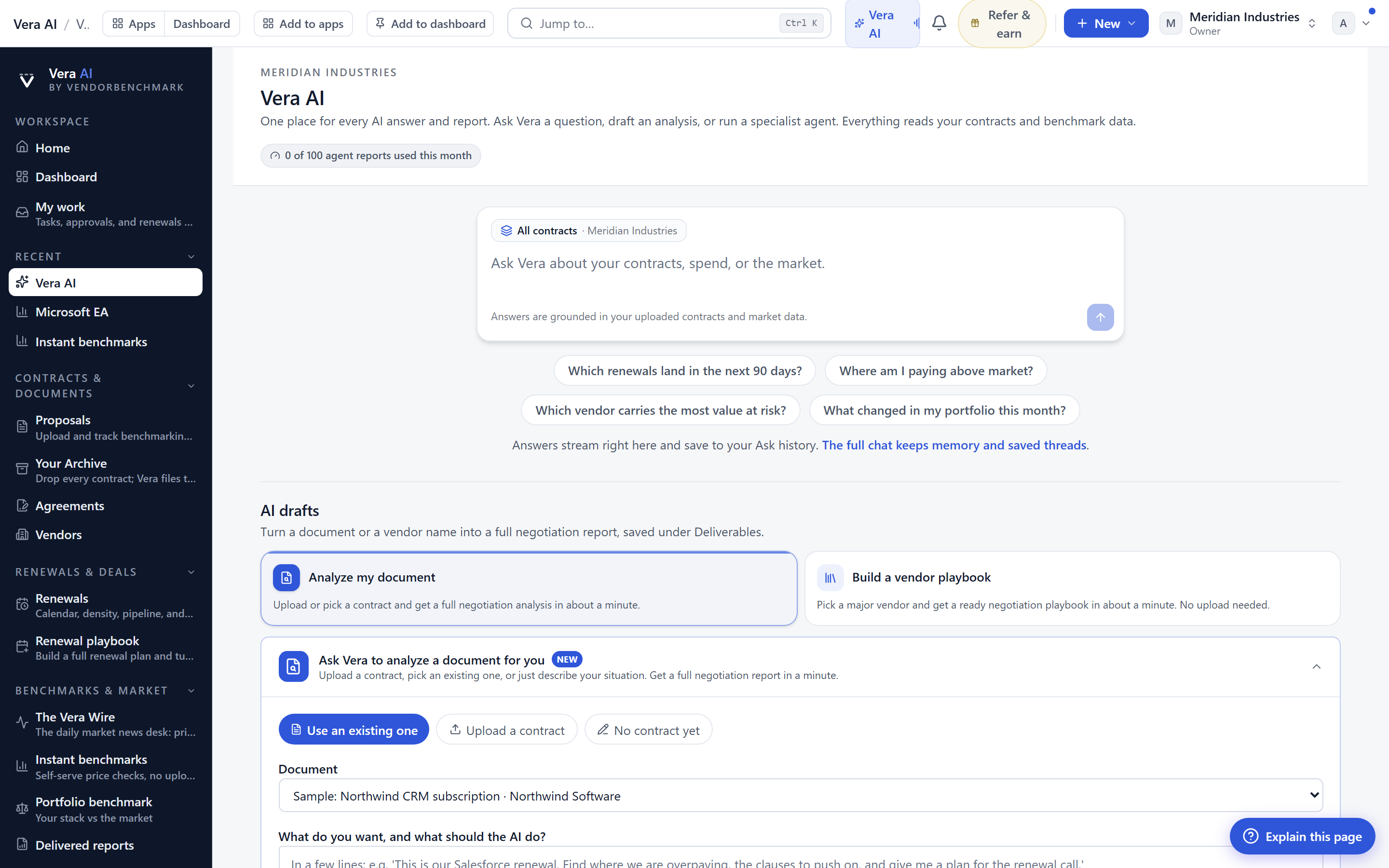
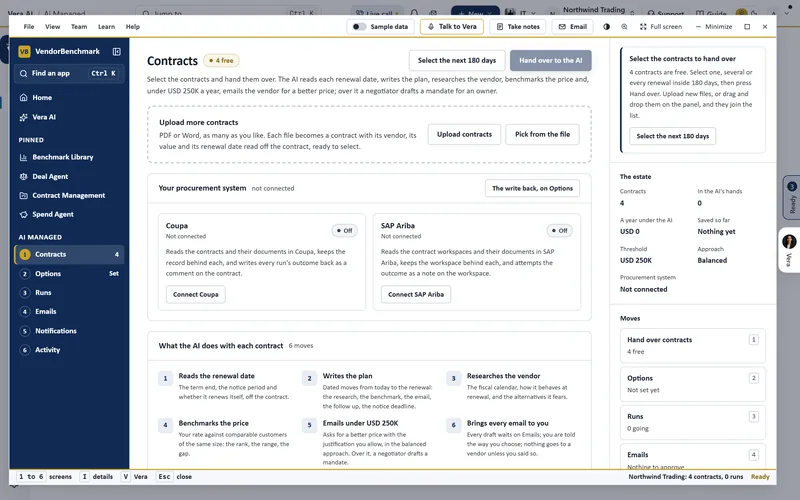
An AI agent can read the renewal date, write the plan, research the vendor, benchmark the price and ask the vendor for a better one. It must never sign, never serve notice and never claim a fact it has not confirmed. Here is how that works in Vera AI, across your whole estate.
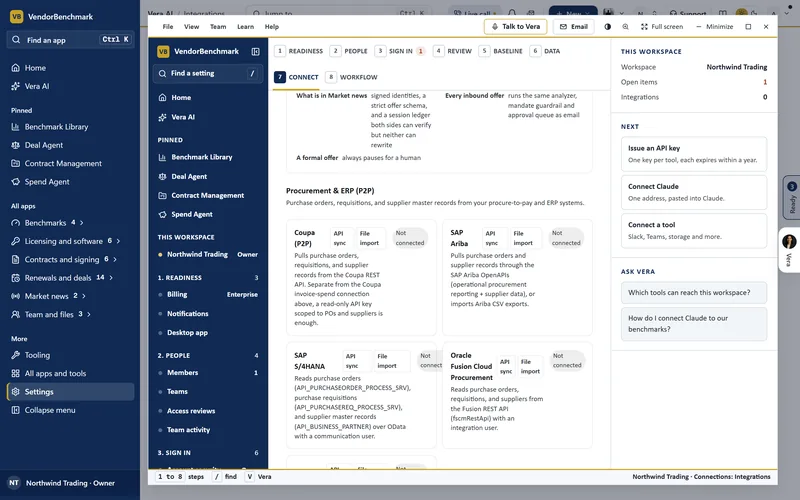
The contract workspaces and their documents come in through the SAP Ariba open APIs, the supplier data and the purchase orders fill in the vendor research, and each AI managed renewal attempts its outcome as a note on the workspace.
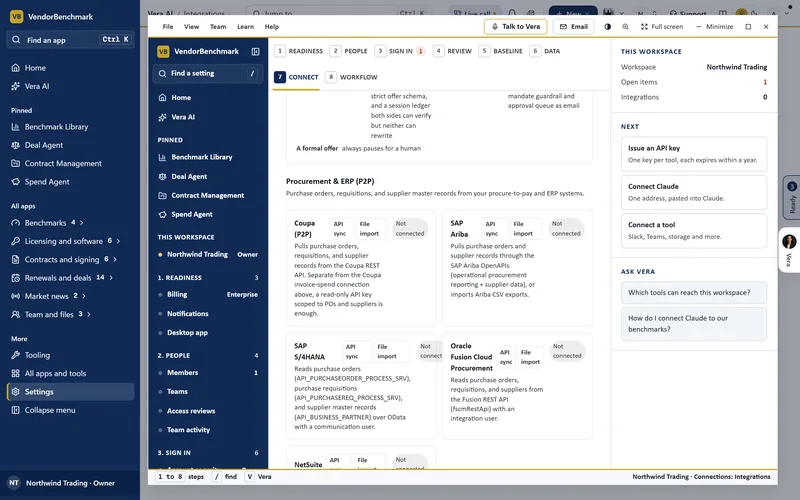
Three Coupa connections and one switch: the contracts and their documents come in, the supplier master and the purchase orders fill in the research, and each AI managed renewal writes its outcome back as a comment on the Coupa contract.
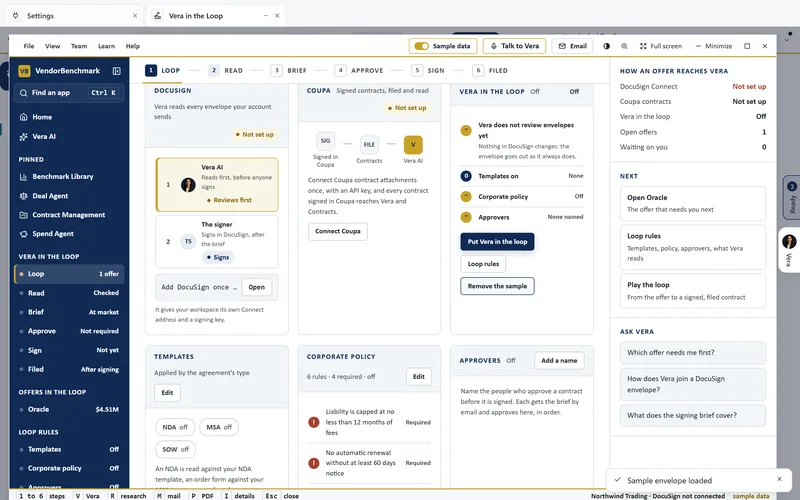
Three connections, each a few minutes: the signed copy files itself, your Agreements app sends for signature, and Vera reads every envelope before a signature goes on it.
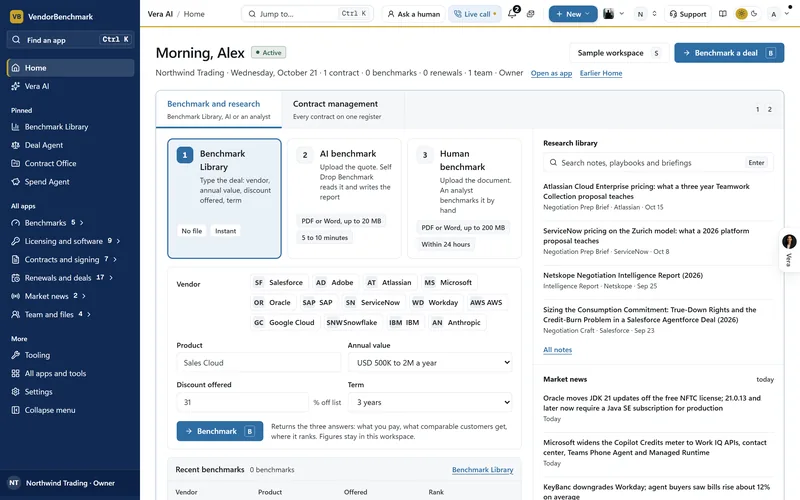
Load the terms your legal and procurement teams insist on, and every contract the platform reads gets scored against them the moment the read lands.
Some counterparties want the result, not the negotiation. Now you can hand them a clean document that agrees with your redline by construction, and send it under your own name.
The renewal desk moves onto the Agent Desk with the same rail, the same book, and the same one sentence head. Here is what changes for a buyer and where the limits sit.
The renewal desk now reads a single agreement as a path. Seven phases, each on its own instrument, from the first want to the signature, with the plan as step zero.
A view that tells you what it found but not what to do with it leaves the hardest work undone. Every agent view now ends with a short list of moves you can actually take.
Your team did the work and reached the right answer. The approval still sits in a queue, because nobody translated the analysis into something an executive can sign in the time they actually have.
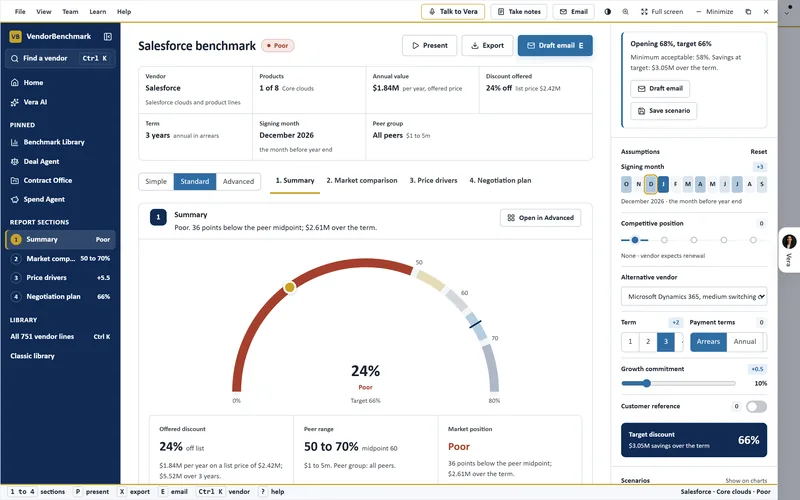
The Negotiation Agent now gives you two levers, a discount to settle at and a term to settle on, and the whole reading column recalculates against your deal while the documents argue for the exact numbers you set.
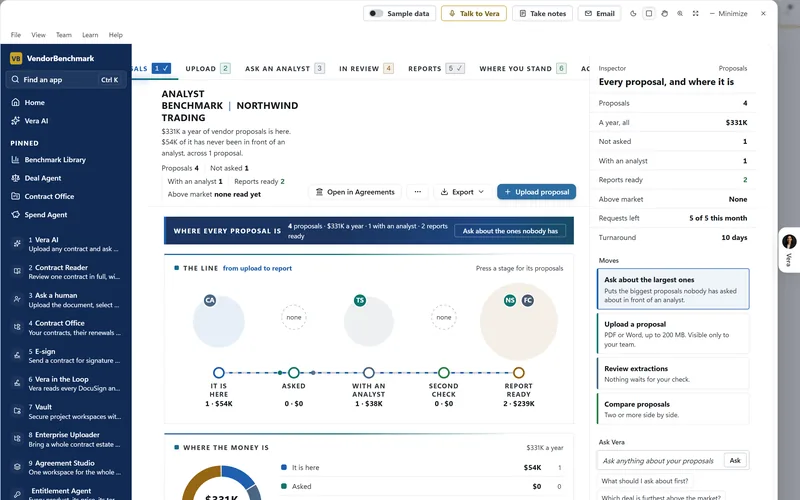
Approvals only count if they apply to the same document. When each stakeholder reviews a draft pulled from a different email thread, you collect signatures against an agreement that does not exist.
We rebuilt the single renewal file so it matches the desk around it. The same verbs, the same sections, the same four step stage, no new place to learn.
Prior approvals are evidence. When they are invisible, your scarcest reviewers repeat work they already finished, and the timeline pays for it.
We rebuilt the reading column so the case beside the book reads like the desk itself. Same tabs, same groups, same next steps, no window switching.
The approval did not fail. It just sat. And nobody counted the days until the deadline forced the question.
The wire stops being a scroll of headlines. It opens as a desk, indexed by the vendors you hold and the day each change takes effect.
A committee can agree the price is worth debating and still lose the deal, because the debate outlasts the offer. The fix is not faster arguing. It is an instant read on whether the number is any good.
We moved the Negotiation Agent onto the shell the Research Agent already wears. The deal opens as an application, states itself in one sentence, and prices four options from the paper.
Every time a deal changes hands, the next person reconstructs what the last one already knew. That rebuild is where your cycle time quietly disappears.
The report is no longer a page you scroll. It opens on the same desk the agents work at, with a tree, five sheets, an inspector, and a ledger grouped by runway.
Every sign-off chain carries reviewers who pass the deal through untouched. This post shows how to tell them apart from the ones who change the outcome, and how to remove the rest.
The renewal book now wears the same desktop shell the agents wear. One stage, one board, one case, and the seven phases of a plan laid out as thread squares under each agreement.
We shifted the rail, the title bars and the stage from near-black to graphite. It is the ground only. Green, gold and every status colour are unchanged.
Wave 2 turns the Contract Management Portal from a place you read contracts into a place you run them. Here is what changes for a procurement buyer, and where the edges still are.
We shipped the resilience wave of Contract Office 2.0. Here is what changes when the estate is large, the network is bad, and you are working fast.
A quiet ceiling was hiding research you had already paid to collect. We lifted it, and the wall count now matches the shelf.
A shelf full of research is only useful when you can find the one paper that answers your question. There is now a button that asks Vera, and she can only name papers the library really holds.
Your spreadsheet register answers to no one when the auditor arrives. This one carries entitlement, deployment, priced delta, evidence, and sign-off on the same row. Bring the file you already keep.
Every spoken line in the war room now runs on a duplex model. Here is what changes for a buyer at the table, how it fits your prep, and where it still stops short.
A guided tour that moves at your pace, not the demo's. Vera opens one screen, explains one part, and asks before moving on.
The report stopped being a popup and became a workspace. Here is what that changes for a procurement buyer, and where the limits still sit.
The analyst desk stopped being a one quote at a time tool. Drop several quotes together, set each one once, and let the queue run while you do something else.
The report you sent now tells you who read it and when. The Activity tab keeps the trail, and Settings becomes a room you open with a keystroke.
Fragmented vendor engagement burns the group's scarcest resource and manufactures the contradictions you spend the next week untangling. Here is how to run one session instead.
The desk now responds the instant you act and reverses on demand. Here is what that means for the way a buyer works through a queue.
Verbal agreement feels like progress. If legal never set the boundaries first, it is a draft you will have to reopen in front of the vendor.
The request form for a human benchmark is no longer a page. It shares one title bar, one command bar and one brief pane with the agent, and nothing you type is lost.
Committee sprawl scales with deal size. The fix is a fixed core team plus a consult list, not an ever-widening room.
The voice line just got its second version. Here is what the analyst does on a live call now, where it fits your workflow, and where it still stops short.
A committee is not slow because it is crowded. It is slow because everyone in it assumes someone else holds the final call.
Under Specialists, Make a seat lets you build a named analyst taught on the vendors, papers and documents you choose. It takes calls like any house seat, and remembers its own.
The requirement your decision depends on lives in one busy head. The process should ask for minutes of correction, not a blank page and a workshop invite.
The plan turns a stated quarter into workstreams, owners and gated dates on your renewal clocks. You approve it once, the team works it, and the audit log names every act with the version you signed.
Finance pushes for the lowest number while the business pushes for the fastest go-live. The deal freezes between them. The fix is a common set of numbers, not another meeting.
The Document Agent is now one room with one job: find what your papers say and take it away. No menus, no phrasing, no model between you and the page.
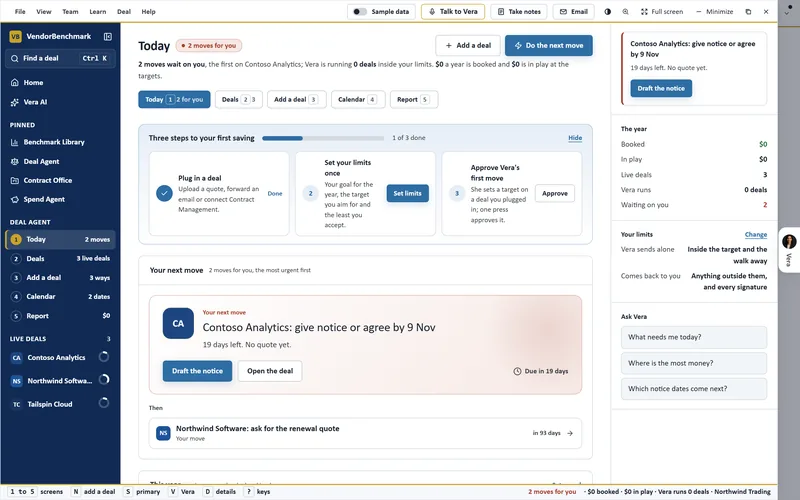
Four sign-offs, one notice window, and no room to move at the usual pace. The problem is your cycle time, not the contract. Here is how to start the chain early enough to clear it.
The benchmark sheet answered the three questions in a second. Now it hands you a route to act on the answer, three ways.
The answer you already know is unchanged. What is new is the frame around it, the renewal book on the rail and the standing stated in a word before you read a line.
We shipped a report that behaves like an application. The stake sits at the top in four figures, the answers sit on the paper, and your colleagues sit in the window with you.
One fixed workbench, a search line that suggests as you type, and rooms that fill the window. The ledger is the only thing that scrolls.
The decode stops being a report you scroll and becomes a desk you work. Four rooms, one command bar, and a key on every verb, so a buyer moves through the asks instead of hunting for them.
We rebuilt the sheet in the Benchmark Library so it reads like the verdict and works like an application. The vendor's own Negotiator's Guide now sits on the sheet.
We shipped the finished shape of the Document Agent. One command table behind every menu, real Undo, a token search language, and comments that sit beside the clause they concern.
We shipped a decode window that reads as the deal you would sign. Positions, the reader, the room, a must-have sheet, and a rate ladder for statements of work.
We shipped calendar invites for seats. The negotiator, the market, the room, and Vera herself each have an email address you can add to a meeting.
The call room now carries a third lane. Drop a live meeting link, pick who attends, and Vera waits at the door until your host lets her in. Here is what it means for a procurement buyer.
Every guide answers the same nine questions in the same order, from the three things that decide the outcome to the clauses to check before you sign. Here is what changes for a buyer.
Fifty six research notes are replaced by their September 2026 editions, arguing from what moved this quarter and closing with the bottom line. The web page, the Word download and the reader PDF are all the new edition.
The decode no longer sits next to the contract. It marks the contract. Strikeouts on the page, replacement wording in the margin, and a note on every mark.
The AI is fast and grounded, but on the deals that matter you can now hand the paper to a person. Drop the contract, brief it in ten optional questions, choose what you want back, and get a dated receipt.
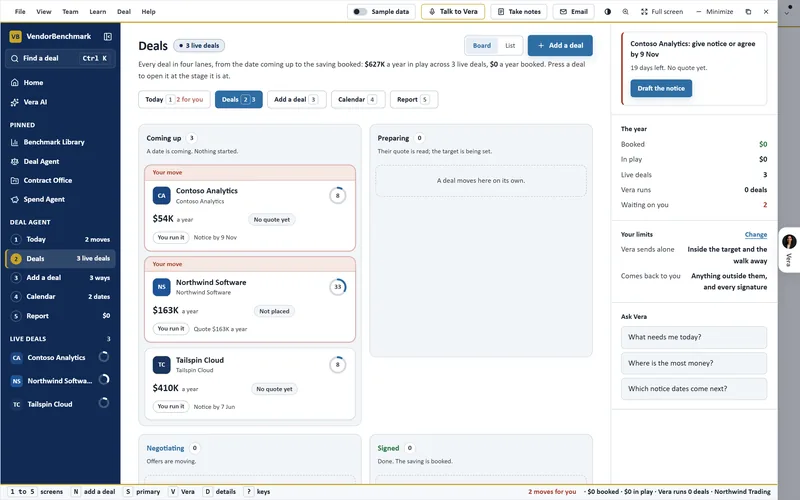
One person holds the vendor relationship and the internal narrative. They take planned leave, and the negotiation quietly parks itself until they return.
You no longer wait for a spinner and hope. The brief appears as it is written, a stalled run says so in plain words, and a shorter read sits one button away.
When a business owner and a security lead hold opposing views in side conversations, the group signs a consensus nobody built. The cost arrives after signature.
The interruption on open is gone. The work returns exactly as you set it down, and setting a session aside no longer means losing it.
The quote clock runs while one executive's calendar pushes the meeting a week at a time. The fix is to make most of the call before the meeting starts.
Ninety one new guides join the shelf, including nineteen suppliers that never had a benchmark page of their own, and each one now reads as a research paper that turns up in search and in an answer from Vera.
Consensus on the logo hides a quiet fracture on the quantity. That fracture is where the money leaks. Evidence, not opinion, is what closes it.
We rebuilt the renewal desk as an application you work inside, not a report you read. Here is what changes for a procurement buyer and where the limits still sit.
When the security lead arrives in week six, they do not inherit your reasoning. They reopen it. The fix is a record they can read, not a meeting they can attend.
Every renewal record now opens as a working room inside the desk. The stage, the terms, the paper, the benchmark and the run sit together, and Vera can take the whole thing into a case without a single tab change.
The pricing case should be built as the deal progresses, not reconstructed under time pressure once everyone has moved on. Here is how to make it a byproduct of the work.
We shipped the Negotiation Agent as a full Windows application. Eight rooms on the number keys, every room a grid, and a scenario tab that prices moves on your own figures.
Renewals used to start with a blank page and a due date. Now they start with a decision, and the research and the steps arrive attached to it.
A finance or security sign-off sits untouched for days because the approver only sees it when the calendar clears. The fix is not chasing. It is making the pending decision small enough to answer in the gap between two meetings.
The research shelf answers questions about a vendor. The Renewal Library answers one thing only: how this vendor's renewal behaves when you have a date in front of you.
Twelve vendors now have a benchmark page and a discount curve banded on their real billing meter. The research library gained the negotiation half at the same time.
Vera's chat used to lose your negotiation research the moment you opened a new thread. Now every exchange has a name, a place in the list, and a share link. Here is the buyer's read.
The document pane was always the home for a brief you revise line by line. The new file lane is for when you want the finished artefact itself, formulas and slides intact.
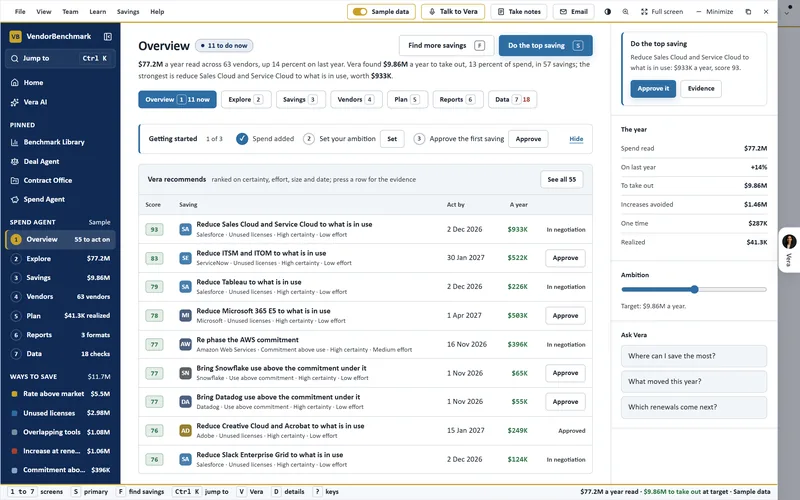
Press e and the estate sheet reads your whole book at once, priced against today's curve. Four more moves ship in the same window. Here is what changes for the buyer, and where it stops.
The desk reads the same rows as your stage pages but keeps them all in one view, so a weight change and a target discount move the ranking, the close and the award together.
The context menu now carries the entity you clicked, its doors, and a curated gallery of everything the library knows about it. Here is what that changes for a buyer.
The room now holds the full award, from the first structured price sheet to the signed agreement and the term on your renewals calendar. Here is what changes for the buyer and where the limits sit.
Events used to be islands. Now each supplier holds a standing record behind them, so qualification, documents, and compliance carry from one RFP to the next.
Every answer the reader gives now points at the exact line it came from, on the exact page it sits on. No more taking the tool's word for it.
The large events can run inside the platform now. Here is what changes for a buyer, how it fits the workflow, and where the honest limits sit.
A specification that ignores what it displaces produces duplicate tooling and parallel contracts long after go live. Here is why it persists, and the platform motion that captures the savings the new deal was supposed to deliver.
Sourcing now wears the same glass as the rest of the desk, and the work after the award finally has somewhere to live. Here is what changes for a buyer.
When an intake describes needs in terms that assume a delivery model, it quietly commits you to a cost structure you never selected. Decode it, then decide it.
Sourcing finished its polish pass, and the wider conversion has begun. Analyst Benchmark and Obligations are the first two pages to open as proper windows with their own menus.
Every unchallenged wishlist item you mark mandatory is money you pay for shelfware. The fix is a weighting step at intake, not a cull at evaluation.
Ask how an Oracle ULA exit works and you now get the mechanism explained, not a summary of your own contract. Answer length and format now follow the question.
Splitting a shared need across two intakes is one of the quietest ways to overpay. The volume was always there. The negotiation just never saw it as one number.
The entitlement office grew a menubar, keyboard navigation, tables that sort three ways and a sixth room that records who touched what and when. Here is how it fits the buyer workflow.
Intake records a certification need as a single checkbox, and vendors answer yes to a question you never actually asked. The cost lands in legal review, weeks later.
The library wore the window dress since August. The vendor tools behind it did not. Now they all open the same way, so moving between a vendor's product lines no longer sends you back to the shelf.
Assuming a paid capability is included understates the deal and sets a number the market will not honour. Contract decoding and closed-deal benchmarking put the line item back where it belongs.
Uploads used to run the moment a file touched the window. Now they stage first, so you fix the filing before the read runs, not after.
A guessed usage figure is a commitment nobody validated. The gap between the guess and reality lands as an overage bill or an unused prepay, and both cost you.
The platform was built around IT and software, and everything else you buy borrowed an IT desk. Now eight standard indirect categories each get their own view, switched from the header.
The library stopped being a search box. Ask it what a vendor committed to, and it answers from every meeting your workspace has filed, with citations you can walk back to the conversation.
A five minute rehearsal against a briefed analyst, out loud, before you dial. She has read the prep, knows your goal, and will argue the vendor side back at you.
Point The Desk at your scanner output, your legal shared drive, or your downloads folder. Signed contracts arrive on the platform on their own, deduplicated by content, with the nearest notice deadline kept in view.
Two things we promised were not yet true. The paper you attach now reaches her, and she can stay for a full renewal call rather than a third of one.
A meeting used to cost you twice, once in prep and once in write up. Second Chair now handles both ends and leaves the send decision with you.
We repainted the workspace to match the desktop app and moved Main Apps under Home. Meaning colours did not move. Here is what changes for a procurement buyer, and what does not.
Six documents, one run, and nothing leaves your tenant. Here is what changes for the buyer walking into a first call, and where the file still needs your judgment.
The recorder starts itself at the top of any real meeting and stops when it ends. Above the prep, a new box turns a plain question into a cited brief you can read before the call.
Type the discount they just said out loud. The room tells you whether it is Poor, Below market, At market, Good or Top of the market, and prices the gap over the term.
When the specification anchors to a snapshot, the contract outgrows it fast, and every path out of that gap favours the vendor.
Prep, coaching, minutes and the seat now work on a Mac exactly as they do on Windows. The one difference is how a Mac captures the call, and it is worth knowing before you rely on it.
Without a baseline for the status quo, every request looks worth funding and none can be ranked against another. Here is how to force the missing number to the surface.
Borrowed vocabulary encodes an unstated preference. It quietly excludes vendors that solve the problem differently, and it costs you at signature. Here is how to translate it back into outcomes.
We stopped organising the tools around our product and started organising them around your desk. Nothing moved, nothing was renamed, and the Verdict Bar now tells you what comes back before you upload.
A submitter name is not an accountable owner. When procurement needs a requirement clarified and finds nobody with the authority or context to answer, the whole timeline stalls.
We turned scattered agent launchers into a desk you come back to. Each agent has a face, a job, a leash you set, and a history that stays put.
When requirements are a list of undefined features, every vendor interprets the vague ones to its own advantage. You end up scoring interpretations, not products.
Agents used to forget the runs you watched them do. Now each one carries a record of what it wrote and whether it finished, and you can hand a finished piece of work to another agent with one button.
A request for an entire tool category usually hides a single broken step. Sizing the purchase to the category, not the problem, is where the money leaks.
The desk of agents was useful but hard to trust. This release gives it sources, receipts, memory you can clear, and a leash that is now actually enforced.
The reason you scoped 400 seats and a premium support tier is not written down anywhere. So next year you renew all of it, because nobody can prove which parts you still need.
The verdict used to hand a winning deal the same repair chapter as a losing one. Now the ahead state gets its own arc, built around protecting the rate you already hold.
Responsiveness is not fit. When a quote answers the spec line by line, the spec itself goes unexamined, and the gap between what you asked for and what you needed gets priced in.
The conversation with Vera used to read like a poster. Now it reads like a page. Here is what that changes for a procurement buyer, and where it stops.
For months the brief you wrote sat in the panel while the run opened on defaults. That is fixed. Here is what changes for a buyer, and where the limits still bite.
We closed the gap where a refresh, a timeout, or a wrong tab could erase your progress. Your answers, drafts, uploads and edits now persist across every screen.
One Media menu, one gallery, no email gate. Five ninety second films at the top, the recorded webinars and podcasts below. Here is how it fits a buyer's day and where it stops.
Comparing a renewal against an intake run used to cost you one of the two. The window now carries three, each named, each closable on its own, and switching between them restarts nothing.
The verdict view now starts with a picture. The documented peer range as a band, your offer as the gold dot, the ask as the diamond, and the distance priced in money over the term.
One console for benchmarking. Your own vendors sit next to the full shelf, every tile shows its live depth, and dropping a quote still starts the three minute read.
The moves you already know from your desktop now work across every archive view, so filing a contract stops being a separate skill you have to learn.
We reshaped roughly 1,347 per vendor benchmark pages so each one opens as a reading. The verdict is stated, the money on the table sits under the gold rule, and your deal is a dot you can drag.
Double-click any paper and the reading window becomes a workbench. Dates, notes, and runs live on one record, so renewal prep stops scattering across tabs.
We rebuilt the Agent Center around a simple question buyers kept asking: what does this agent actually do before I trust it with my renewal? Now you can see the wire.
Unreconciled stakeholder conflict at intake does not disappear. It reappears as a stalled negotiation and a fractured internal position the vendor can read from across the room.
A five minute spoken brief on your vendor estate, recorded on the 2nd of each month, chaptered so you can skip to the part you need. The ready note stays strictly opt in.
Copying a prior spec carries forward needs that no longer apply and misses ones that now do. The fix is benchmarking against current closed deals and a fresh intake, not against your own memory.
The first read used to fire once per organization. Now it fires on every real contract you add, at no cost to your decode allowance.
A requirement with no success metric guarantees a renewal argued on habit instead of results. The fix is not a better renewal meeting. It is a measurable definition captured at intake.
Your CFO does not want the whole report. They want the discount, the peer comparison, the rank, and the summary. Now they can have exactly that, and nothing else.
When intake gets bypassed, requirements get written backward to fit a signed deal. That is not sourcing. Here is how to run the renewal properly even when the first buy was not.
The decode allowance is retired. Every plan can now read a document without watching a counter tick down. Written AI reports still draw on your analyses allowance.
A rushed spec reflects the calendar of one busy stakeholder, not the need of the business. The AI analyst does the requirements legwork so the busiest person stops being the bottleneck.
Commitment length is a requirement in its own right. Leave it undefined and the vendor sets it for you. Benchmarks turn duration back into a deliberate choice.
Vera has always drafted your emails. Now they land somewhere. Mail is a private inbox, sent, drafts and trash for every note the platform writes for you, and it stays yours until you file it.
Deferred criteria let a predetermined choice masquerade as a fair evaluation. Fixing weighted, benchmarkable criteria before anyone sees a price removes the room for that.
The live number problem, solved with a voice in your ear that only speaks figures grounded in your own record. Fifty minutes to start, ten per call, nothing recorded.
The request says it plugs into what you already run. Nobody checked. Here is why that gap costs money and how estate visibility closes it before scoping.
Take the vendor call with Vera in your ear. She follows every word, answers from your agreements and benchmarks, and files the memo the instant the call ends.
We shipped benchmark coverage for the AI coding category, where metering changes mid subscription and the protection clauses are worth more than the discount. Here is what changes for a buyer.
Nine curve documents join the discount curve program across thirteen tools. The through line is consolidation, and how quickly a merged vendor can erase a two paddle record that you can still lock today.
Six curve documents join the discount program and cover the AI stack buyers are quoting today. Here is what changes at the table and where the numbers stop.
Clicking a document in Your Archive no longer dumps a bare file in a new tab. It opens a reading window that keeps the paper, the archive, and the working numbers on one screen.
We shipped an Explorer view inside your Archive. It treats your contract estate the way you already think about it, as folders you can open, tidy, and act on.
The reading pipeline that fills in vendors, terms, and lifecycle judgments on intake now runs on documents you filed before it existed. And a contract you are reading no longer dead-ends.
License management tools have long produced reports nobody consumed. Vera Licensing takes them three ways, files every arrival into a ledger, and returns four exec reads computed from your own rows.
Two friction points removed at once. The image only PDF that used to be a dead end now reads itself, and the cloud archive you kept meaning to import comes across in one pass.
Familiarity bias in requirements produces a single-source outcome dressed up as a competitive process. The fix is neutral criteria and priced alternatives, not more diligence.
Your estate ledger gains a Read log that traces every captured figure back to the passage it came from, and capture is now yours to configure.
Fake urgency at intake strips procurement of the one thing a proper process needs, which is time. Here is how to separate the real deadlines from the manufactured ones.
The onboarding gap between buying the platform and using it well just got a structured path. Twelve chaptered courses, two levels, one instructor voice.
A request lands for a capability your company is already entitled to under a live contract. Nobody checked the estate first. Here is why that keeps happening and how to stop paying twice.
The training library now covers the person who stands the workspace up and keeps it healthy. Ten courses, an implementation half and a management half, each with an assignment and a two question check.
An internally consistent requirements set can still describe a product that no vendor will sell at any sane price. Here is how comparable closed deals catch it early.
One window now runs every tool over the page you are reading, with a left navigation, a Jump to palette, and a dock chip that parks it without losing your place.
A budget invented without evidence is a fiction that anchors your whole negotiation. Replace it with a market range calibrated to documented market evidence before the requirement is finalised.
Studio is a second layout for the workspace. It keeps the same navigation, shortens the menus, and hands the extra pixels back to the work in front of you.
Data residency, security review, and compliance terms arrive at signature instead of intake, and the deal you thought was closing starts again. Here is why the pattern repeats and how to break it.
We shipped a home page for the studio layout. It opens light, puts a working ask bar at the top, and shelves everything Vera has delivered so you stop hunting for your own work.
A frozen RFP scores vendors against a need that no longer exists. Keep the deal record current so evaluation reflects the requirement as it stands, not as first written.
The research library stopped serving embedded files and started serving pages. 377 papers render this way today, and every new paper publishes this way from now on.
Overlap you cannot see is overlap you pay for. Spend visibility surfaces duplicate tools across the estate before a second signature lands.
The application window is now chrome only. Here is what changes for a procurement buyer working benchmarks, contracts, and renewals under deadline.
The coverage grid used to hand you a grid and leave you to interpret it. It now states the verdict in one sentence, counts the figures up beneath it, and plays the sweep in a fullscreen theatre while it runs.
A renewal is one job that usually lives in eleven places. The Deal File renders the whole negotiation as a single case file, with a what-if desk that reprices every page as you move scope, term and ambition.
A navy stage states the book in figures, the landing paper is the queue of what actually needs a person today, and the console underneath is unchanged.
We rebuilt the managed renewals desk around the two questions a buyer actually asks: what needs me right now, and is this program paying for itself. Here is what shipped, and what it still cannot do.
The intro room was a modal you visited. It is now a workspace you work in, with five pages on one rail, a floor view that reads the whole board at a glance, and the anonymity ladder always in view.
Three watch surfaces used to be three tabs. They are now one application with one masthead, and a workroom that turns the last 90 days into four papers you can hand to a CFO.
The date was never the hard part. Holding your notice deadline against the vendor's quarter close, on one screen, in the same second, is. That is what shipped.
Renewal uplifts are common knowledge in every user group chat and evidence in none of them. The new price increase board turns that chatter into a tally you can cite, on the condition that you vote before you look.
The runway used to be a single drag and drop board. It is now an application with four views of the same underlying work, a shareable file for every task, and keyboard control.
Vera no longer behaves like a chat page you scroll. It opens as a working desk with four stations, one document in the middle, and your position one click away for the whole session.
The agent surface stopped being a long page and became an application. Five views under one masthead, a rail that keeps coverage and pending approvals in sight, and forwarded links that land where you meant them to land.
One long scroll became an application with four views, a rail that keeps the pulse and the sign offs beside you, and a payoff instrument that states the hours a steady pace gives back a quarter.
A request form with every field filled in still tells you nothing about what the tool is for. The missing field is the one that makes a request benchmarkable.
A decode used to end with a list of findings and a document you had to go and find again. It now ends with the source stored, the contract record created and the benchmark already requested.
An estimate typed into an intake form becomes the anchor for tier, discount and term. By the time anyone checks it, the quantity is already a commitment.
Two questions that used to produce hedged answers now produce numbers. Vera reads the benchmark library for coverage, and the same cohorts the interactive tools rank against for what a good discount actually looks like.
When the spec mirrors the demo, the scoring model is already decided. Here is how a demo shaped requirements list forms, why it survives review, and how to make it vendor neutral before pricing lands.
We shipped a single use-case index that maps 111 features to 217 real situations, phrased the way a buyer would say them. Ask Vera, open the palette, read the Verdict Bar or jump to chapter 14, and you get the same one answer with the exact link.
Scope, budget and a go-live date arrive as a finished package, and procurement is asked to execute rather than test. The fix is early market evidence, not louder objections.
A finished decode no longer sends you to a separate theatre. The working report, the priced findings, the paste-ready language and the next press all live on one page.
Unquantified requirement language is the cheapest thing to fix before signature and the most expensive thing to argue about afterwards. The fix is a reading discipline, not a lawyer.
Open Negotiations from the brief and Vera has already ordered the day: one move per vendor, deadline first, evidence cited to the record it came from. Nothing sends to a vendor from the brief.
A requirements document with no ranking is not a specification, it is a wish list with a compliance column. It reliably produces a shortlist of one, and a shortlist of one has no price.
Vendor sending is live for one narrow case. Here is what the five rules block, what they allow, and where a buyer still has to do the work.
Requirements written by proxies decay the moment their author moves on. The fix is not a better template, it is a persistent deal record that keeps the reason attached to the requirement.
Six agent roles, one vendor at a time, and a room that keeps every page the agent writes. The first page is your contracted position, assembled from your own records, and every AI written page after it carries a byline telling you what was checked and what is directional.
A named solution at intake is not a requirement. It is a conclusion someone else reached in a demo, and it quietly sets your ceiling before the first quote lands.
The agents now take instructions before they start, show their working while they run, and hand you a room the rest of the team can use. Here is what shipped, and where it still stops short.
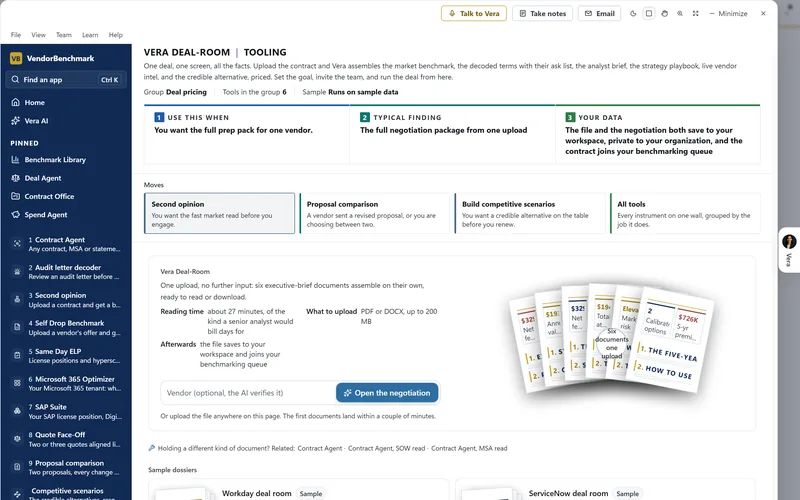
Drop a contract in the lobby and the curtain rises: overture, ask ladder, war plan, and a curtain call desk that drafts your emails from the live numbers.
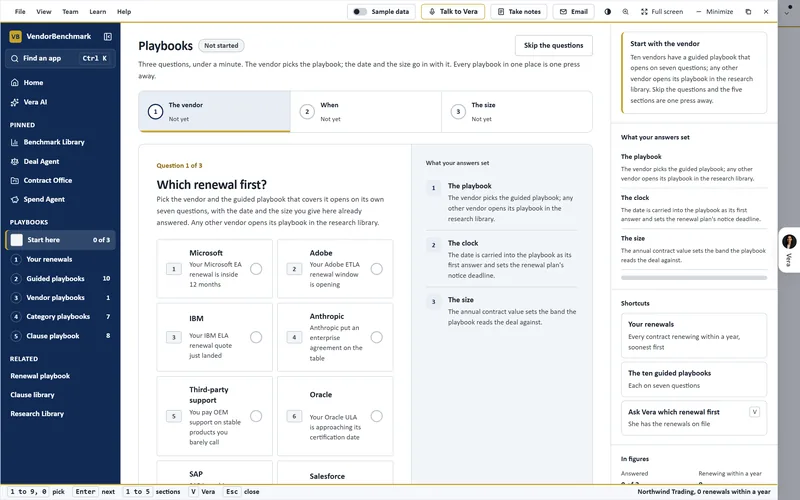
Playbooks, reports, briefs, the QBR, advisory sessions: one stage, one set of keys, presenter notes, and a print packet, everywhere you present.
Worst case waterfall, price history since 2012, the E5 heatmap, Copilot credit math, and the corridor: your Microsoft position in three presentable acts.
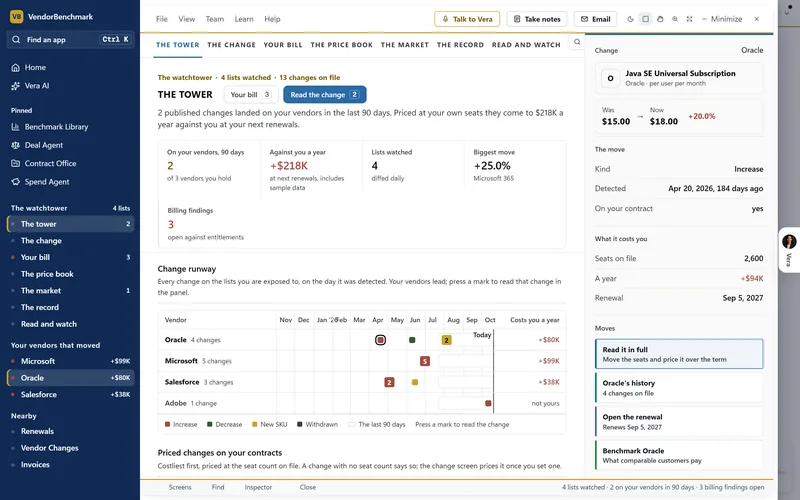
28 policy documents diffed daily and staged: the 90 day pulse, vendor tiles that glow on material changes, and diff replays of the exact lines.
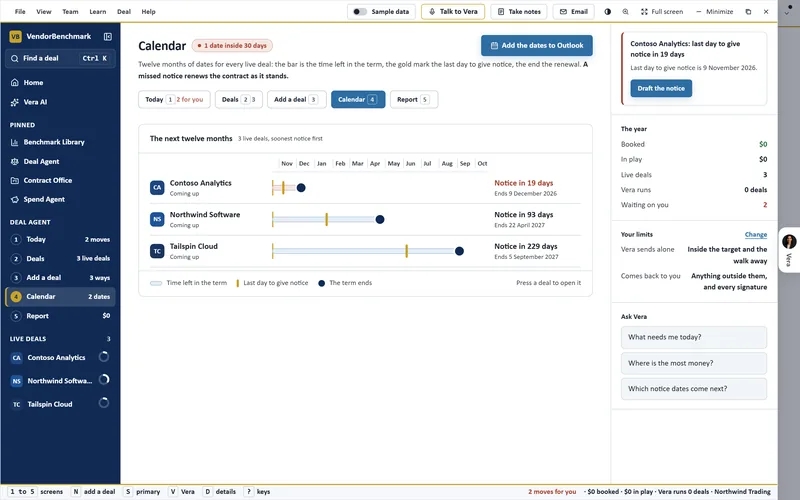
Quarters bucketed by notice deadline, each deal with status and exposure, presented from the live calendar with a print packet at the end.
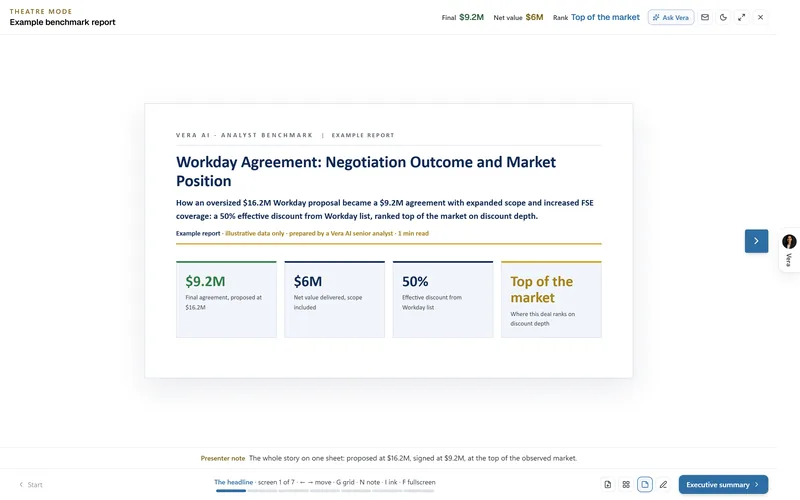
Your delivered benchmark walks screen by screen: verdict, market position, the metrics, the recommendations, and a packet for the room.
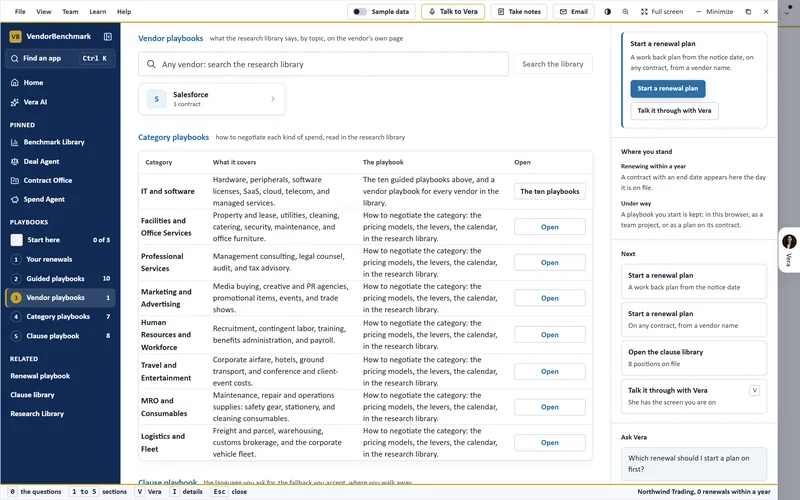
Interview, AI generated plan, confirm: the MS EA playbook opens tailored to your deal, with a left rail, bigger explain tips, and zoom everywhere.
RISE, Oracle ULA, and IBM ELA reach MS EA depth: consultant reads, a live cost corridor, the classification heatmaps, and a six email desk.
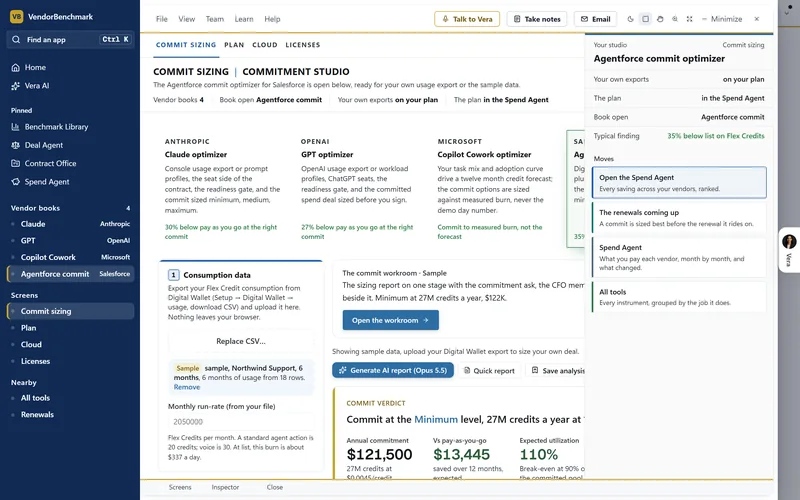
Eight questions, a forecast, and three commitment sizes priced against it, with Digital Wallet anchoring and what ifs for the scenarios that matter.
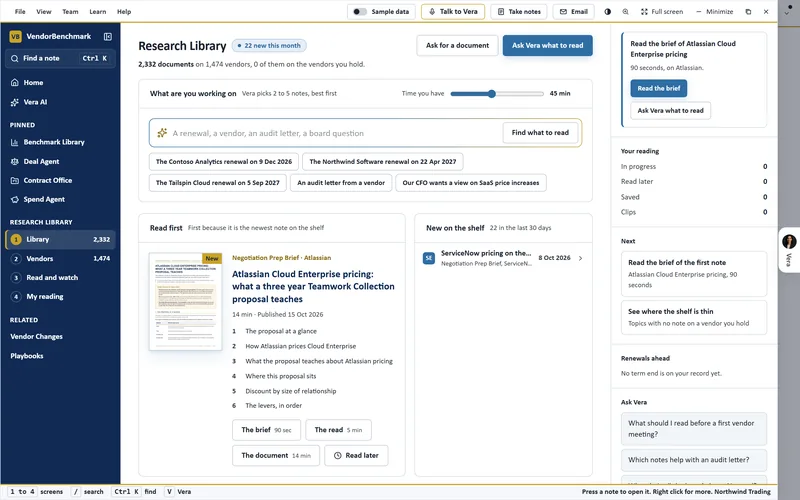
Ten disciplines of the negotiator's method, each worked on the vendor whose 2026 situation makes it concrete, with figures from real benchmark files.
The last screen of every tool is now a desk: emails drafted from your live numbers, with targets and corridors kept out of vendor facing drafts by rule.
The annual uplift is the most under-negotiated term in software, and it compounds. What an uncapped increase does to a three-year deal, and how to cap it.
Claude, OpenAI, Agentforce, Copilot: every AI vendor sells a commitment sized to your projected growth. One method sizes it from your real usage instead.
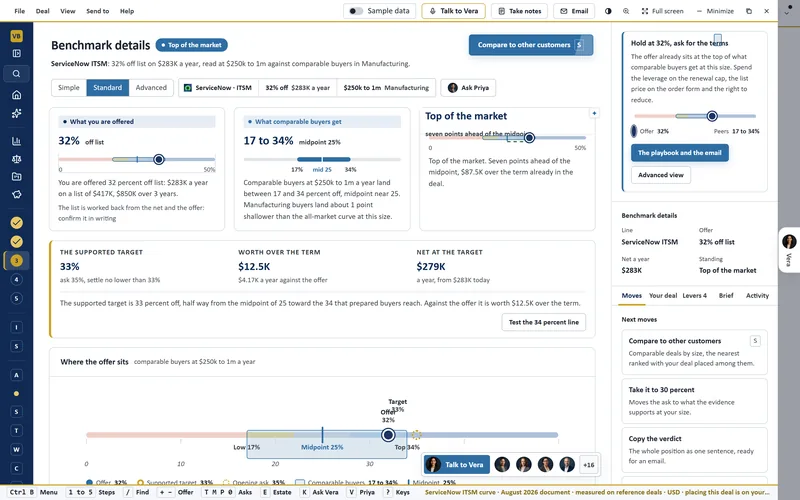
Data platform bills grow with every query and job, and the commit rewards overshooting into penalty rates. Size it from real workload, tame usage, benchmark the credit.
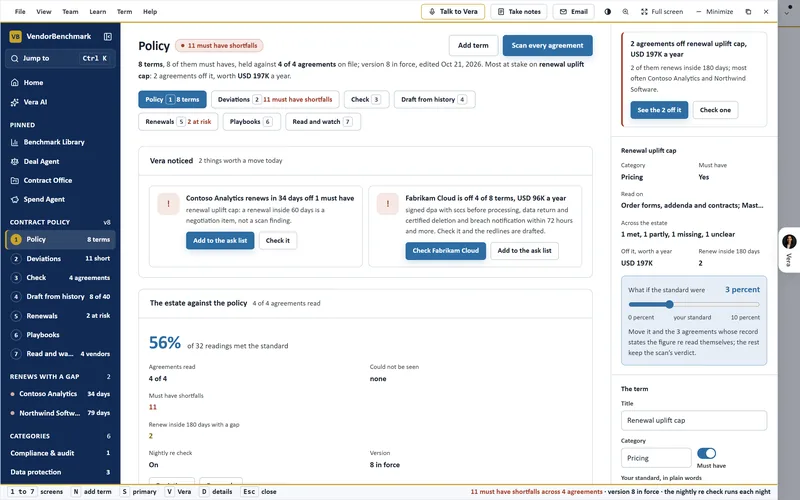
Generic contract AI flags what any lawyer already knows. The review worth having argues your organization's own positions, in your wording, and shifts where your time goes.
Onboarding is not a feature tour. It is getting one real result: a benchmarked, saved deal on your own numbers. The shortest path to that first win.
AI model spend is now a real enterprise line item, priced by tokens and sold on committed spend. Right-size the mix, pull the levers, and benchmark the commitment.
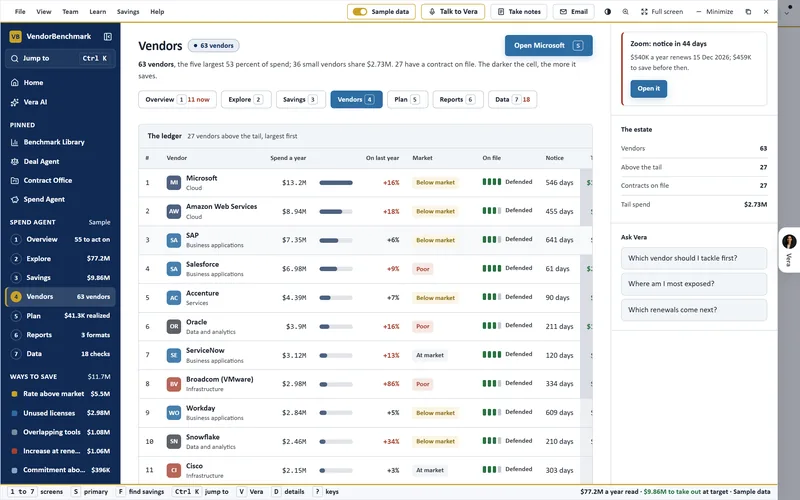
A Cisco EA wraps networking, security, and collaboration into one number that is hard to unpick. See what you use, price it, and benchmark before you renew.
You know which clauses your contracts should contain. A coverage grid checks your whole estate against your must-haves and shows which are missing them.
Most negotiation knowledge evaporates when a deal closes. A structured debrief captures what worked and what the vendor conceded, and feeds the next one.
On a platform holding your contracts and prices, a record of who did what and when is both a security control and a governance asset. What a real audit trail captures.
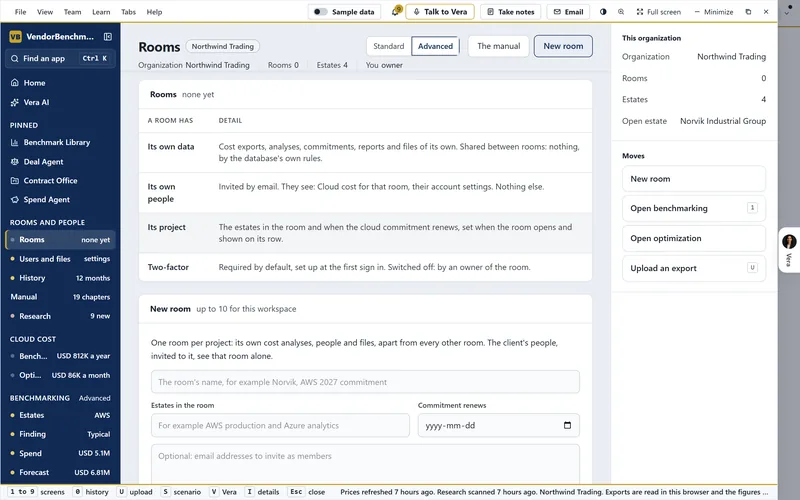
You may never leave AWS or Azure, but pricing a credible Google Cloud commit changes your renewal anyway. A third bidder moves your incumbent.
Salesforce prices Agentforce by consumption and sizes it from a growth story. Size it from real intent, benchmark the rate, keep it from riding in unpriced.
The Microsoft renewal comes with a hard Copilot push, priced per seat. Size it from a real pilot and adoption, and keep it from becoming shelfware.
A platform that holds your contracts and pricing owes a real answer to "where does the data go, and who can reach it?" Encryption, private storage, kept out of code.
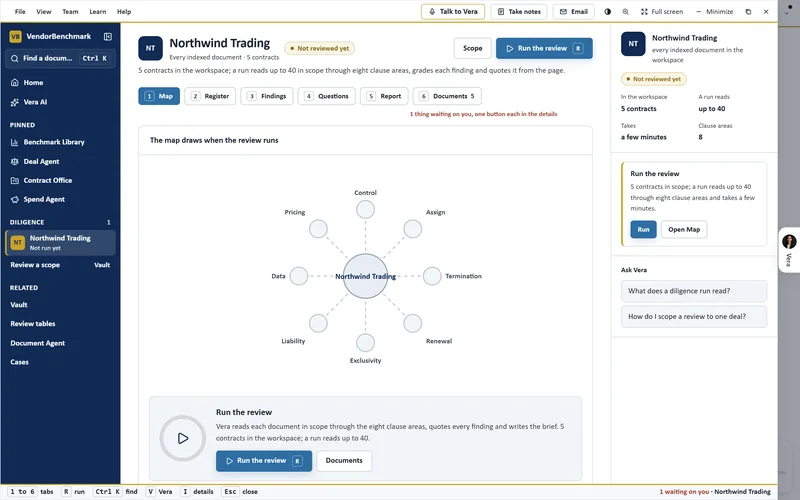
In an acquisition, the target's software contracts hide both the surviving liabilities and the justifying synergies. It is usually the least examined part of the deal.
SAP wants you on RISE, and the migration is where the pricing is decided. Model the stay-versus-move crossover and keep your installed-base leverage.
A MACC trades a multi-year spend promise for a discount and punishes an overshoot with forfeiture. Size it from real drawdown, and count what actually burns it down.
A vendor announces a mid-term increase and most buyers absorb it. Your contract usually caps or forbids it. Find the clause and send the reply that cites your paper.
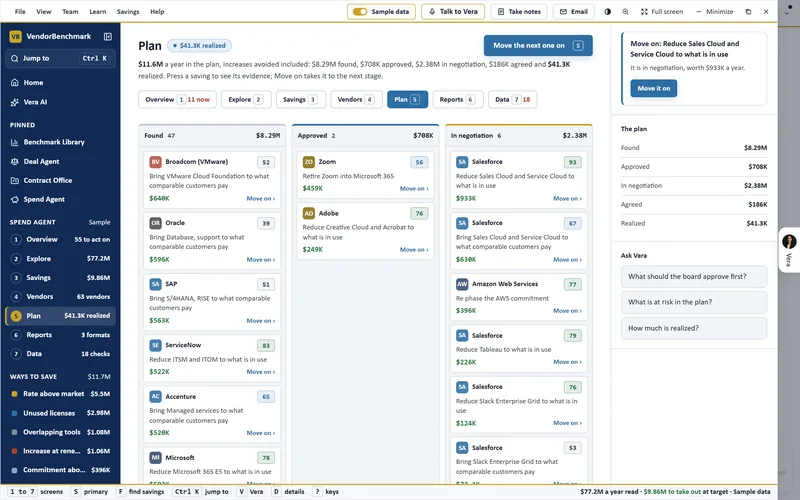
Every vendor knows your switching cost and prices your renewal against it. Most buyers never calculated their own. Measure lock-in before the vendor uses it.
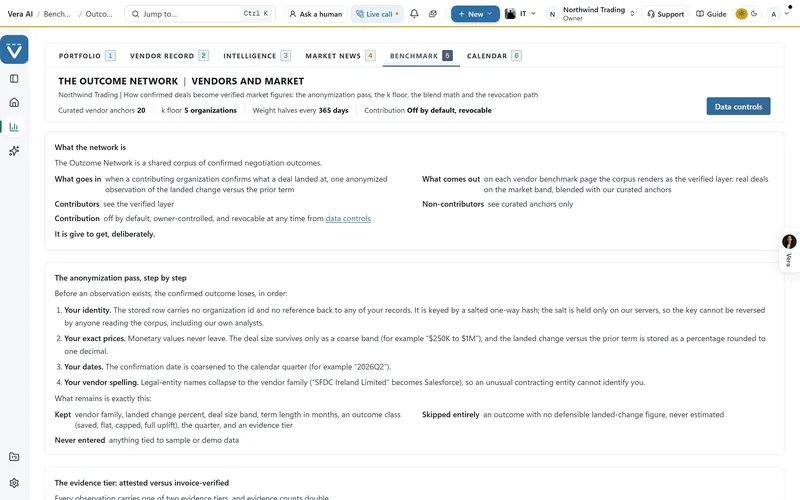
A huge dataset of old deals is worse than a smaller set of recent ones. How recency weighting and a verified peer layer keep a benchmark honest.
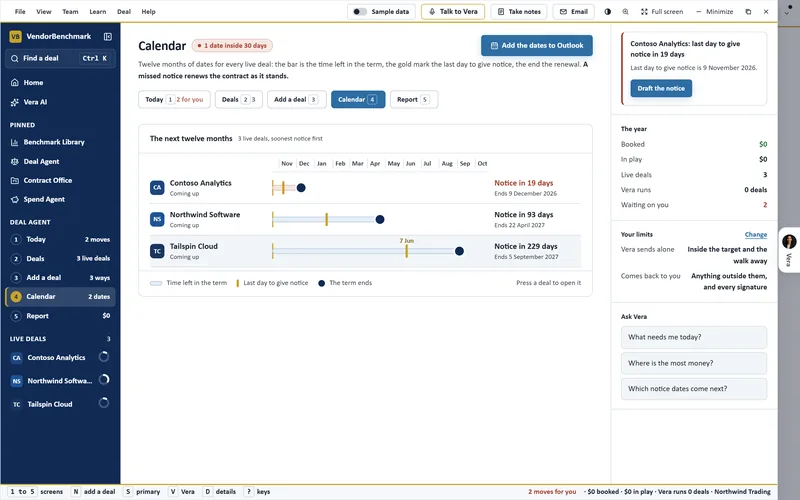
Folding every renewal onto one date looks tidy and can quietly cost you leverage. When co-terming pays, when it hands the vendor a single cliff.
You have a quote and one question: are we overpaying? A free price check answers it for the flagship vendors, no account, against modelled deal cohorts.
FinOps optimizes usage; procurement negotiates the commit; they rarely talk at the right moment. The cloud commitment should be sized and negotiated together.
Observability bills grow quietly across hosts, modules, custom metrics, and logs, with an on-demand cliff past the commit. Read it line by line, benchmark the rate.
A benchmark is a photograph of a moving market. The strong deal you saved in March can be mid-pack by September. Alerts tell you when a position moves against you.
The Adobe renewal is decided by idle seats and over-profiled licences, not the price talk. Reclaim the waste, right-profile the rest, build the VIP walk away.
An IBM ELA is bundles inside bundles, support on products you stopped using, and a sub-capacity metric that decides audit exposure. Normalize it first.
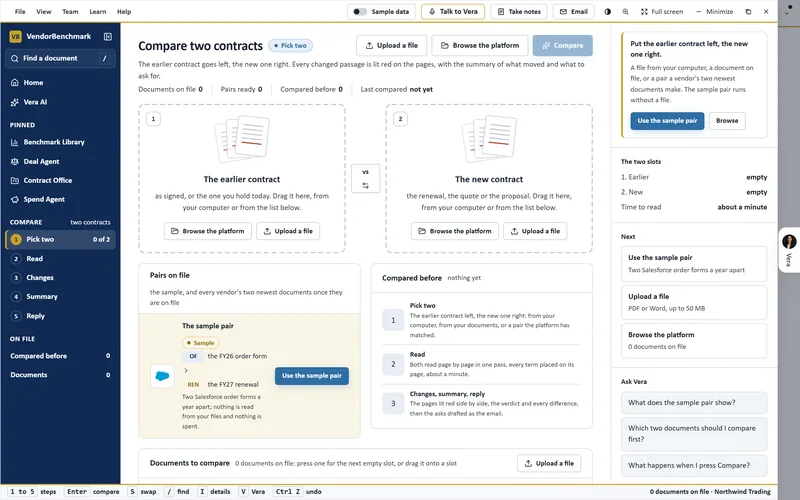
The renewal looks like last year's, so it gets signed like last year's. A difference scan surfaces every term, pricing, and obligation change, and who it favors.
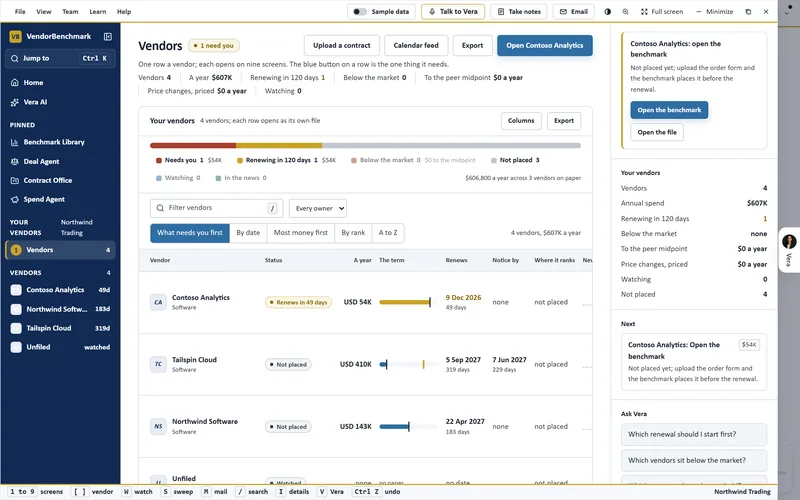
When your best negotiator leaves, so does what they knew about every vendor. An organizational memory keeps the history, the outcomes, and the buying posture.
A vendor who inflates the list price hands you a bigger discount and a worse deal. Why the discount percentage misleads and net unit price is what to benchmark.
A software audit letter is engineered to induce panic. Drop it in and get the vendor, the real deadline, the scope, and the do-not list, from a curated library.
A deal that needs five approvals usually gets them by forwarding a thread and hoping. A sign-off chain routes it in order, each approver handed a brief.
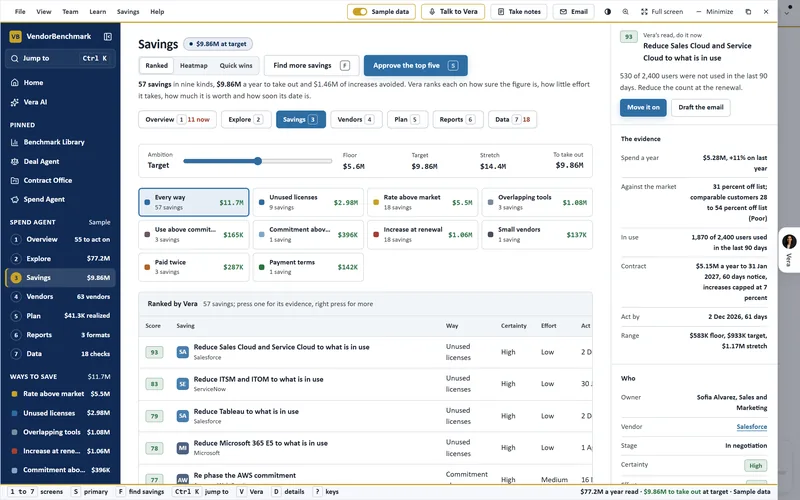
Procurement claims savings; finance quietly discounts them. Reconcile every negotiated saving against the invoices that arrive, and the number gets believed.
How is your data kept separate from every other customer's? The honest answer: row-level security at the database, not filtering hoped for in app code.
The same deal signed in March or a vendor's December year-end can carry very different discounts. How knowing each vendor's fiscal calendar turns timing into leverage.
An EDP commit is a multi-year bet on your own growth. Size it from your real run rate and your own scenarios, and keep the discount honest.
Third-party support can halve a maintenance bill, but only if you play it right. Never disclose your OEM price, tender everyone, re-tender the incumbent.
One or two people run most software procurement against hundreds of vendors. How a solo desk uses agents to do the work of a team without becoming one.
A platform is judged on its first two weeks. How the getting-started course turns a new account into a loaded estate, a first benchmark, and a first saved deal.
A benchmark is only as good as the deals behind it and the honesty of the comparison. How the library is built from modelled deal cohorts, normalized and graded.
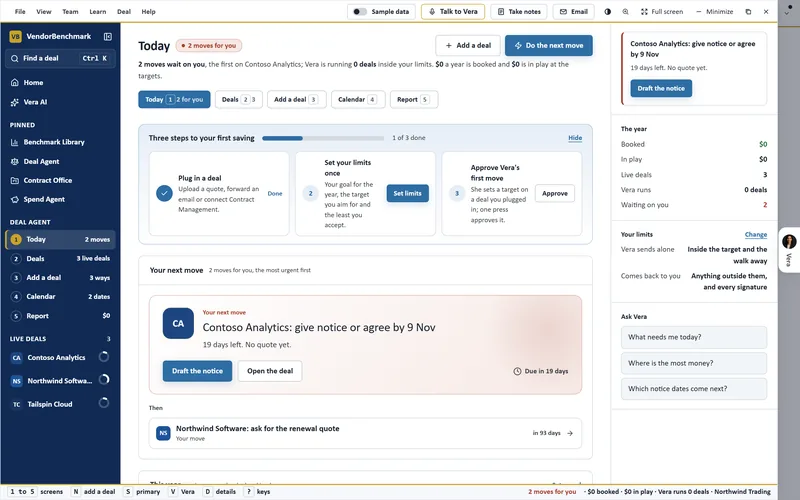
Hand a renewal to the desk and pay a fee only on savings verified against your invoices. Why kickoff still needs your signature.
A target's contracts are the liabilities and the synergies. A clean-room desk underwrites what it can defend, flags the rest, and destroys the data on a clock.
A flat line times last year is not a budget. A 24-month forecast projects each vendor from market drift, your caps, and the uplifts you actually realized.
No figure without a source, agents draft and humans send, vendor text is never trusted, everything is logged. The guardrails, made explicit.
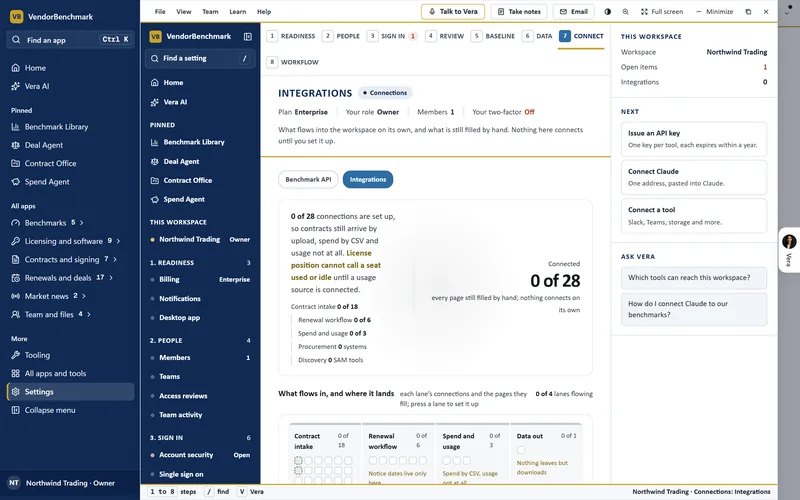
A platform that makes you re-key everything is another silo. Ticketing, procurement, identity, e-sign, storage, and a warehouse feed, no copying.
Vendors edit price lists quietly and buyers find out at renewal. Terms Watch diffs the price book and prices the change against your seat count.
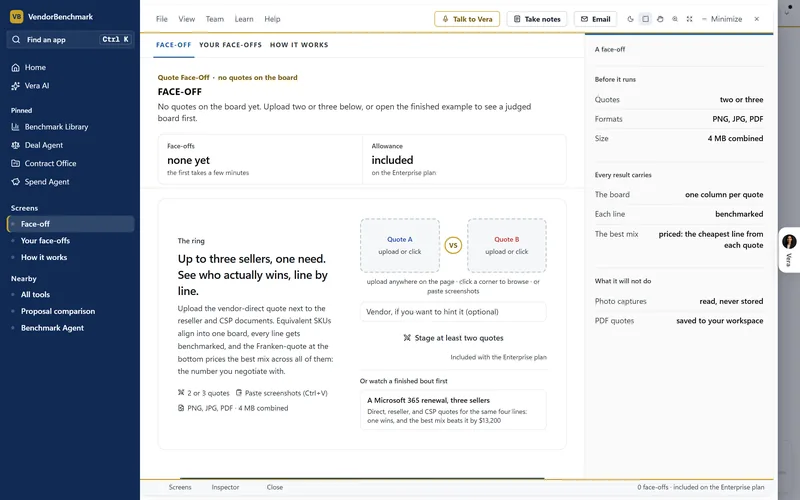
Direct, reseller, and CSP quotes never line up. Quote Face-Off aligns them line by line, benchmarks each price, and builds the best-mix quote.
A memo is homework. A redline is a fight. AI reads the vendor paper, quotes the exact clause, and hands back tracked changes in your approved wording.
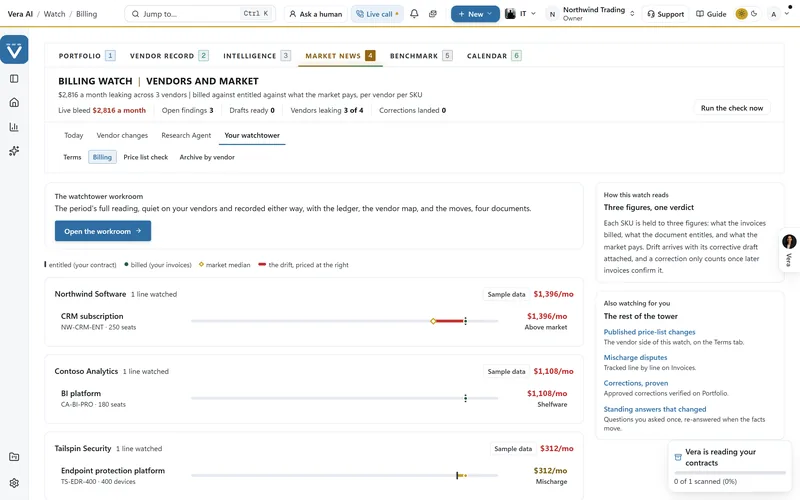
Nobody reads the invoice. Billing watch checks every line against entitlements and the market, daily, and drafts the correction when it finds a gap.
Tokens, seats, and consumption commits, priced on a growth story. Size the commit from your own usage, pull the caching levers, right-size the mix.
A threat to leave only works if it is costed. The break-even month, the switching cost, and the memo the vendor has to take seriously.
Your position, your pre-approved wording, and your walk away per clause. Every AI review argues from it, and a coverage grid shows the gaps.
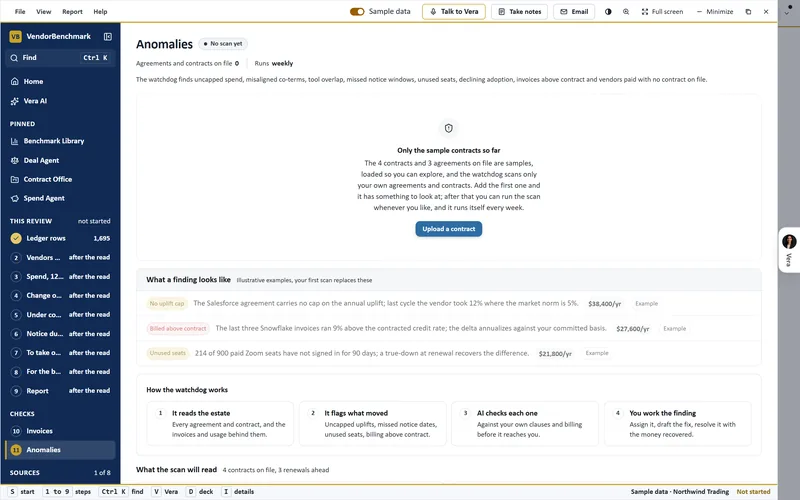
Uncapped uplifts, shelfware, billing over rate, co-term drift. Detected by rule, confirmed by AI against the evidence, and priced by exposure.
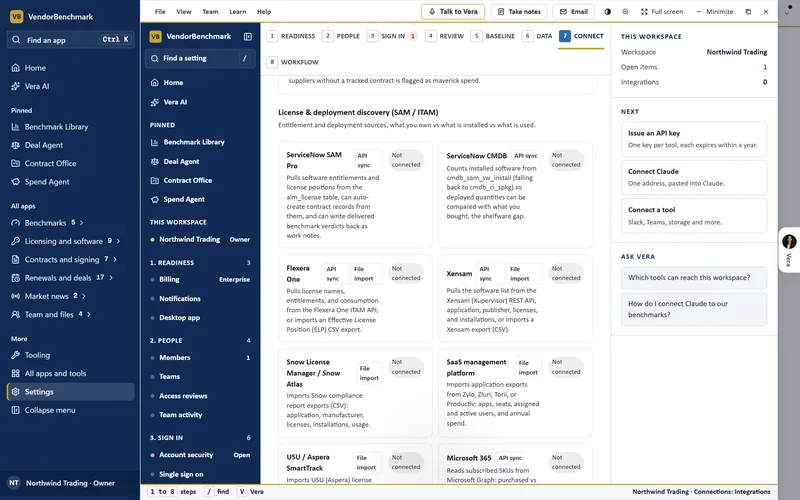
Eleven connectors turn entitled versus deployed versus active into priced leverage. The SAM truth that finally reaches the negotiation.
Ask about a vendor in the channel and get a grounded verdict, two to four cited figures, and one deep link, or an honest refusal when data is thin.
Signed identities, declared mandates, structured offers, and a hash chained ledger neither side can rewrite. Why the protocol is open.
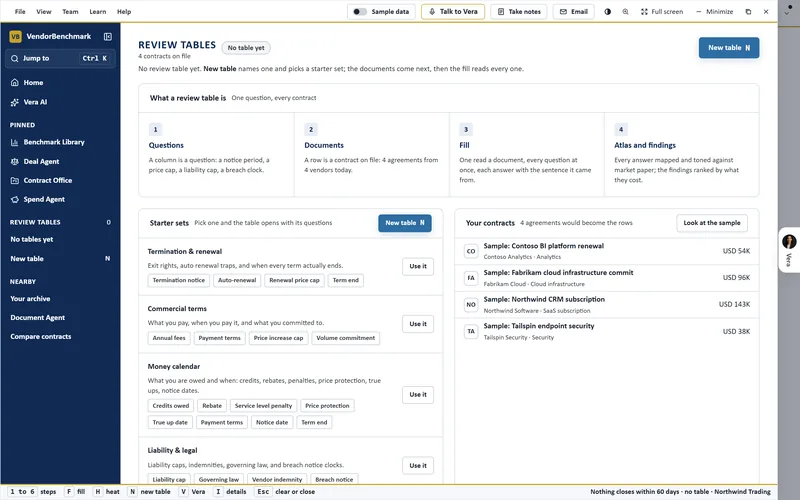
Ask "what is our liability cap?" across the whole estate at once. Columns are questions, rows are contracts, and every cell cites its source.
Top vendors by spend and renewal timing, turned into about twenty prioritized moves, each with an owner, a window, and a number.
E3 or E5, the security add on push, and Copilot at renewal. How to right size Microsoft seats with usage evidence before you sign.
The whole stack on one canvas, ranked by distance from market, risk, and consolidation opportunity. The CIO portfolio view.
Litigators moot, athletes scrimmage, negotiators wing it. Now there is someone safe to practice against.
Every vendor a tile, sized by spend, colored by verdict. The picture that gets the campaign funded.
Lands discounted, renews ratcheted. The honest count, module discipline, and caps while you hold the pen.
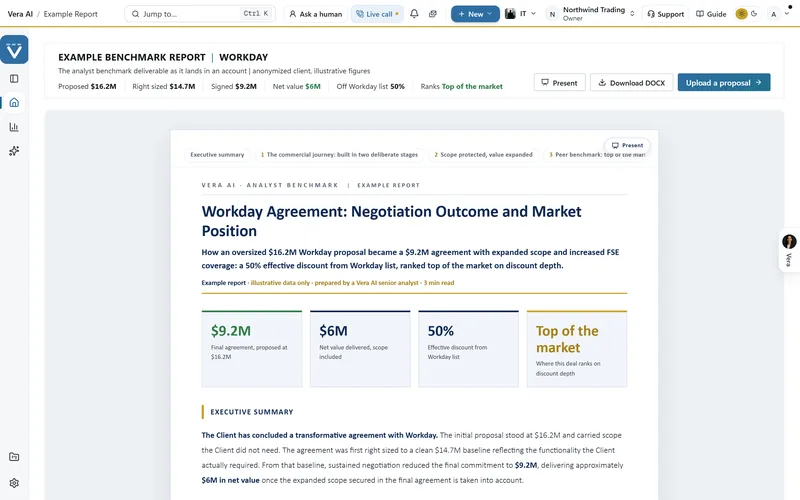
Forward a quote, get a cited verdict. No login, no new habit, and an analyst in every inbox.
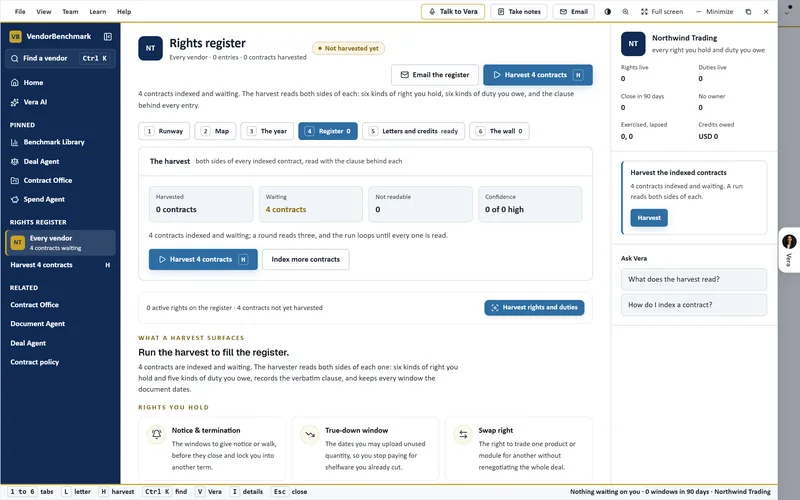
Negotiated rights are options with expiry dates. The register is where they stop dying in drawers.
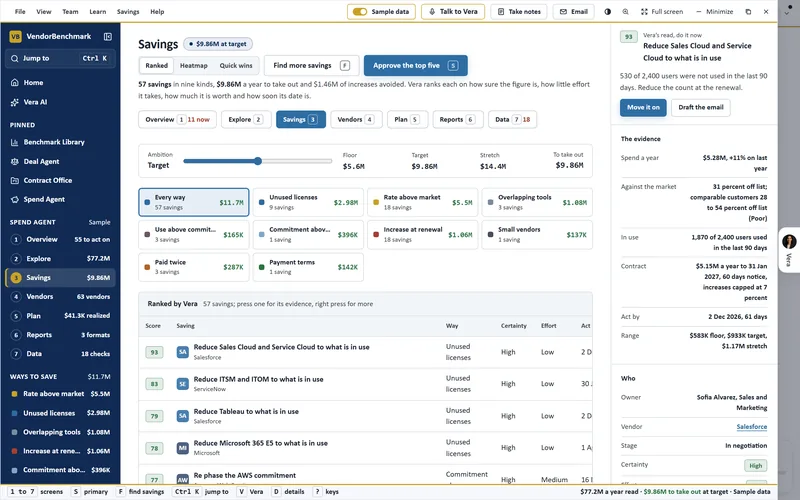
Waste first, price second, scope third, capability last, and the ninety-day version in five moves.
Saved positions replayed against the live market, ranked by recoverable dollars, sequenced by the calendar.
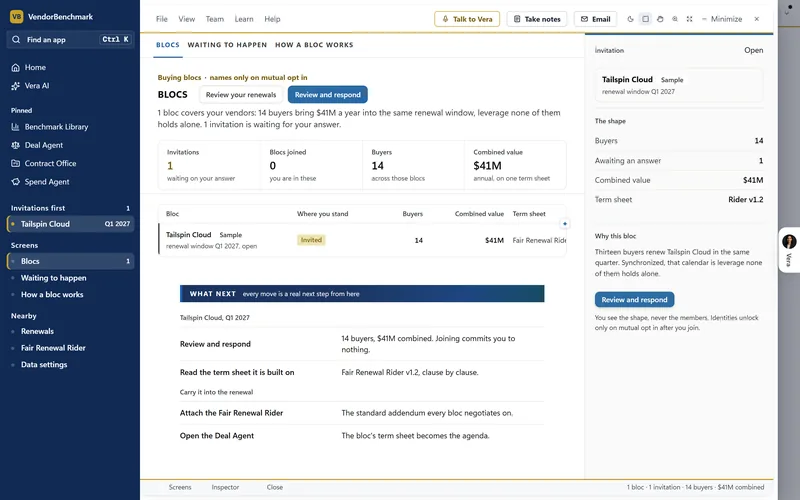
A shared term sheet, a shared window, anonymity until reveal, and every company keeping its own mandate.
The headcount tax, the grandfathered contracts worth protecting, and the OpenJDK walkaway that is usually true.
The whisper rail, the tactic flags, and the fact you need at the moment the claim is made.
Savings by workstream, the executive brief, and the tracked plan, run before every commit renewal.
What is still negotiable, the future-for-relief trade, and making this the last window that closes silently.
Quarterly, dated, and public: the reference for board papers, budget assumptions, and vendor pushback.
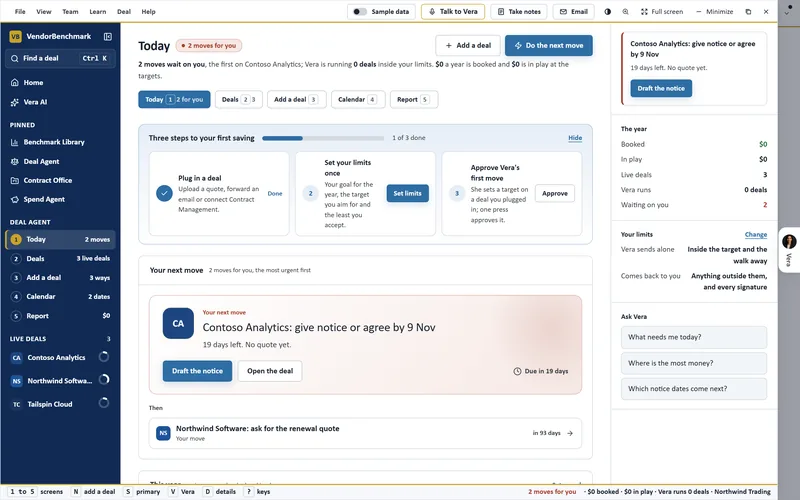
Five protection families, versioned once, merged into any renewal as tracked changes on the vendor's paper.
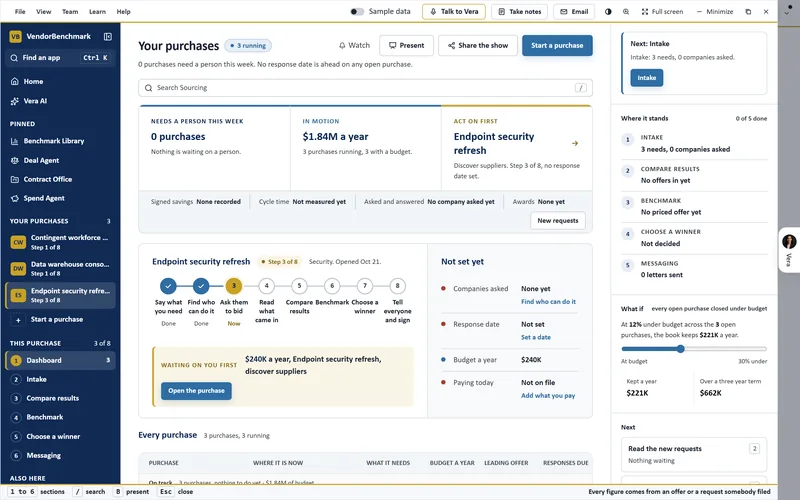
A front door faster than the credit card, AI triage that spots the duplicate, and amnesty for the sprawl.
Chat's mistakes die in the scroll. A document's get laminated, so documents get a higher bar.
Claims recorded at signature, verified against invoices, and the erosion caught while it is still recoverable.
Net per worker against real deals, the count as the real negotiation, and the services contract nobody negotiates.
The normalizations behind the cohort, turning an address into an agenda, and four questions to ask any percentile.
The tactic named, the ledger kept, and the reply drafted from the deal state. You edit and send, always.
Net per user against real deals, the edition right-size, and why January 31 is your week.
Deals are lost on state, not arguments. The five things that live in the room, and the agents that keep them current.
Entitled versus deployed versus active, priced from your own contracts, with four plays for the gap.
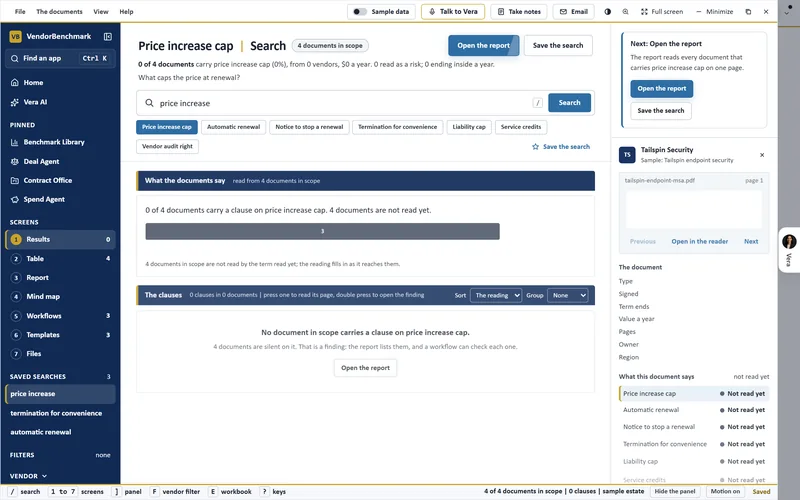
Decode the letter, appoint one voice, count independently, answer narrowly. And the do-not list.
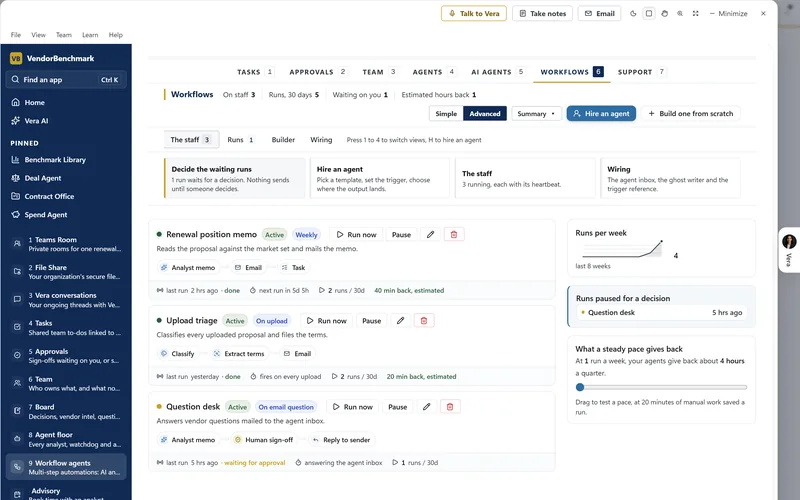
The specialist roster, the seventh chair that answers vendor email, and which agent gets which work.
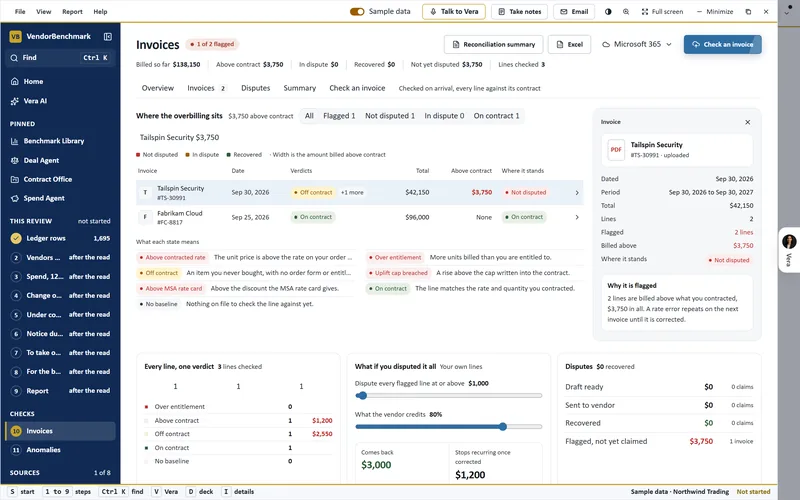
Rate drift, off-contract items, cap breaches, and the daily billing watch that catches them before payment.
The role mix is the price, the leverage cliff at signature, and the five moves before you sign.
Give to get, verified outcomes, the five peer floor, and realized uplift instead of remembered discounts.
How the evergreen trap compounds, and the three layers that dismantle it: calendar, coverage, and paper.
The portfolio page, the 24 month forecast, and the savings ledger the audit committee can lean on.
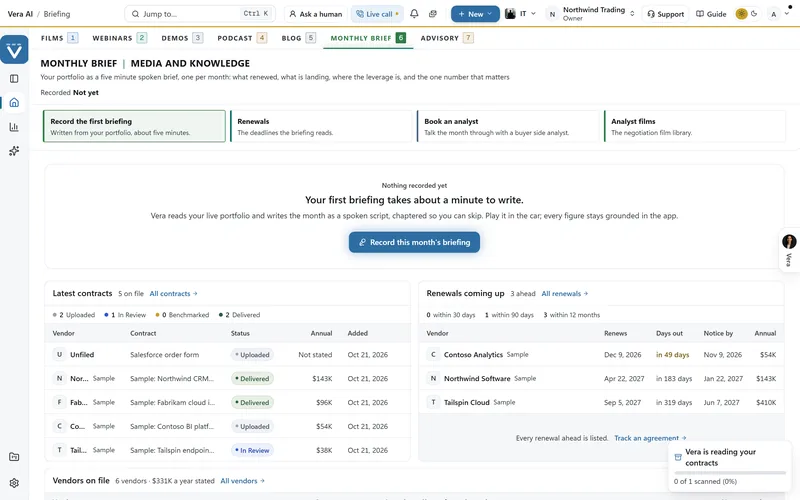
Deadline, money, market, and hygiene watches, converging into one Monday briefing.
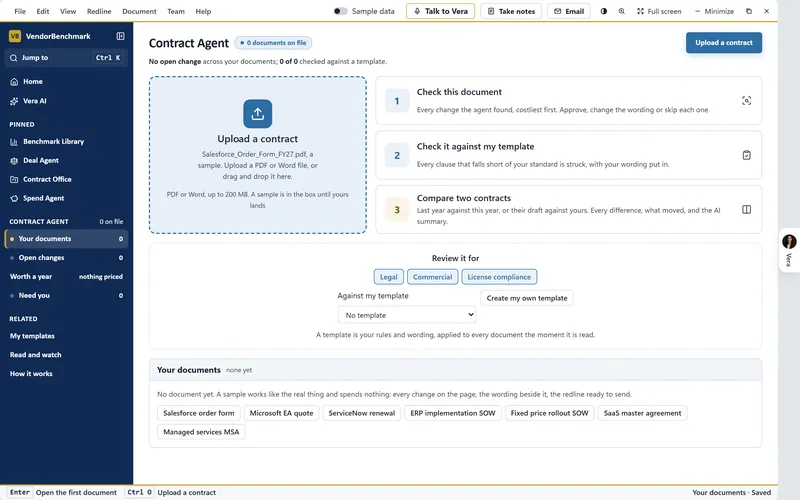
Plain English, the terms that hurt, paste-ready asks, and the four clauses where the money hides.
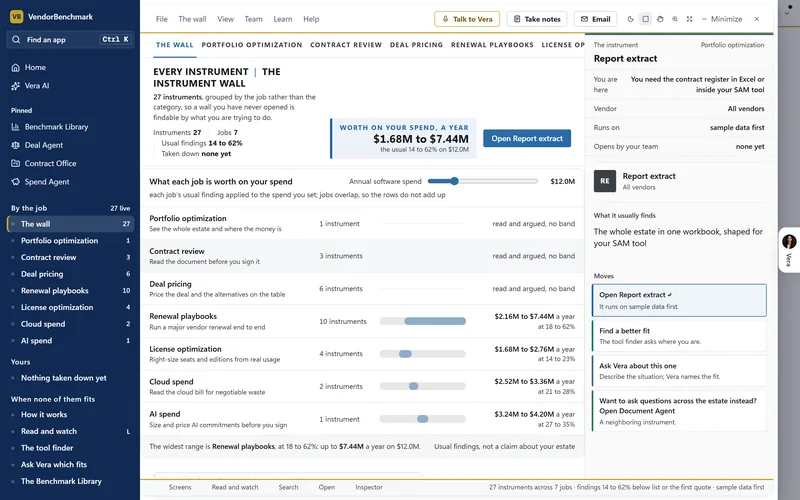
Reprice from your own RVTools file, shrink the core base, and bring a funded walk away.
Citation tags, groundedness checks, refusing thin data, and four checks before any AI number leaves the building.
One upload becomes the benchmark, the asks, the brief, the playbook, and a priced walk away.
The renew or certify arithmetic, the counting discipline, and the twelve month exit in five moves.
Why self reported pricing data fails at the table, and what modelled deal cohorts change.
Notice windows are where budgets quietly die. The shape of a desk that stops it.
Net value per seat, the E5 and Copilot pressure, and the timeline from T minus 12.
246 articles on what enterprises actually pay.
The complete reference behind the analysis: discount benchmarks, contract term data, TCO models, and negotiation playbooks across Oracle, Microsoft, SAP, Salesforce, AI platforms, cloud, and the rest of the 1,471 vendors the library covers.
AI & GenAI Pricing 10
How AI is transforming enterprise software pricing models in 2026. From seat-based to consumption-based pricing, AI copilot surcharges, and what.
Enterprise benchmark guide to ServiceNow Now Assist AI pricing. Per-user-per-month add-on costs, pricing by module (ITSM, CSM, HR, Creator).
Benchmark data on what enterprises actually pay for OpenAI, ChatGPT Enterprise per-seat costs, API committed spend discounts, and contract terms.
Benchmark data on enterprise AI contract terms, SLAs, data usage rights, price escalation, audit rights, and indemnification clauses achievable at.
Enterprise build vs buy AI cost benchmark analysis. Total cost of building proprietary AI models vs buying commercial API access, with break-even.
Benchmark data on what enterprises pay for Anthropic Claude, API committed spend discount tiers, Claude.ai Teams vs Enterprise pricing, AWS Bedrock.
Side-by-side AI token pricing comparison across all major platforms: OpenAI, Anthropic, Google, AWS Bedrock, Mistral, Cohere, Meta Llama, and more.
Total cost of ownership benchmarks for enterprise AI platforms. GPU costs, inference hosting, fine-tuning, orchestration, and hidden costs that.
Benchmark data on enterprise AI infrastructure costs, GPU compute pricing, inference hosting, fine-tuning economics, and vector database costs.
The definitive enterprise benchmark guide to AI and GenAI platform pricing. Token costs, contract structures, discount ranges, and TCO benchmarks.
Oracle 14
How to present pricing benchmark data to Oracle's account team and escalate to executives. Tactics for Oracle Database, Fusion Cloud, and ELA.
Benchmark data on Oracle license compliance costs. What Fortune 500 companies pay in Oracle audits, settlement amounts by product and deal size, Java.
SQL Server enterprise pricing benchmarks: Real-world data on SQL Server 2022 costs, per-core vs. Server+CAL, EA pricing, and Azure SQL comparisons.
SAP S/4HANA vs Oracle Fusion Cloud ERP total cost of ownership benchmark. Real enterprise data comparing licensing, implementation, maintenance, and.
Oracle Annual Support pricing benchmarks, the 22% rule, third-party support alternatives, negotiation data, and what enterprises actually pay vs.
Comprehensive Oracle pricing benchmark data, ELA discount ranges, database licensing, Java costs, OCI pricing, support fees, and audit settlement.
Oracle Java SE licensing cost benchmarks, per-employee pricing impact, subscription vs perpetual data, audit risk exposure, and what enterprises.
Oracle ELA pricing benchmark data, actual discount ranges by deal size, product mix impact, fiscal year timing, and what terms the best-prepared.
Enterprise benchmark data: Oracle Database vs PostgreSQL total cost of ownership. Compare licensing, support, migration costs, and TCO over 3 years.
Oracle Database licensing benchmarks, Processor vs Named User Plus cost comparison, virtualization impact, Oracle's cloud licensing rules, and what.
How to negotiate Oracle contracts effectively, database, ERP, Java SE, ULA, and OCI. Proven tactics, common traps, and benchmark pricing data for.
Oracle Cloud Infrastructure (OCI) pricing benchmarks, actual enterprise discount data, Universal Credits vs pay-as-you-go, BYOL savings, and OCI vs.
Oracle audit settlement benchmark data, typical settlement sizes by product area, audit trigger patterns, negotiation strategies, and how to defend.
Complete ERP pricing benchmark guide for SAP, Oracle, and Microsoft Dynamics. What Fortune 500 companies actually pay for ERP licensing, maintenance.
Microsoft & Azure 19
Enterprise benchmark data on Azure pricing: EA discount tiers, MACC commitment ranges, Reserved Instance savings, and Hybrid Benefit data. From.
How to use pricing benchmark data in Microsoft Enterprise Agreement, MACC, and Copilot negotiations. Tactics for timing, framing, and escalating.
How to use pricing benchmark data in cloud negotiations with AWS, Azure, and GCP. EDP, MACC, CUD structures, discount ranges, and how to present.
Serverless pricing benchmarks from 450+ enterprise environments. AWS Lambda vs Azure Functions vs GCP Cloud Run cost comparison, cost per million.
Salesforce vs HubSpot vs Dynamics 365 pricing benchmarks, side-by-side comparison of enterprise CRM costs, hidden fees, and what each platform.
Real Microsoft true-up cost benchmarks from enterprise agreements. Discover average overage rates, common true-up triggers, and negotiation.
Benchmark analysis of Teams vs Zoom enterprise pricing, negotiation data, and TCO analysis for 2026. Real pricing ranges and cost comparison.
Microsoft Security and E5 pricing benchmarks, Defender suite, Sentinel, Purview compliance costs vs alternatives. What enterprises actually pay for.
Microsoft enterprise pricing benchmarks, EA, MCA, Microsoft 365, Azure, Copilot, and Dynamics 365 pricing data from comparable enterprise contracts. What Fortune 500.
How to negotiate a Microsoft Enterprise Agreement effectively, M365, Azure EDP, Dynamics 365, and the EA renewal cycle. Benchmark pricing data and.
Microsoft Enterprise Agreement pricing benchmarks by tier, discount ranges, true-up mechanics, and what Fortune 500 companies actually negotiate. EA.
Microsoft Copilot for M365 pricing benchmarks, what enterprises actually pay, early adopter discount data, and whether the $30/user/month price.
Microsoft 365 E3 vs E5 enterprise pricing benchmarks, per-user cost data, discount ranges, and the real cost-benefit of upgrading. What Fortune 500.
Enterprise pricing analysis comparing Google Workspace and Microsoft 365 total cost of ownership. 2026 benchmark data, EA pricing, hidden costs, and.
Dynamics 365 pricing benchmarks, Sales, Customer Service, Finance, and Supply Chain module costs, discount data, and Salesforce vs Dynamics TCO.
The definitive enterprise benchmark guide to AWS, Azure, and Google Cloud pricing in 2026. Commitment discount ranges, support tiers, reserved.
Cloud backup pricing benchmark comparing AWS Backup, Azure Backup, Google Cloud Backup, and cloud object storage costs, per-TB monthly pricing.
Cisco Enterprise Agreement pricing benchmarks. Discount ranges for Cisco EA, DNA, SASE, and Meraki, what Fortune 500 enterprises actually pay after.
Azure Microsoft Azure Consumption Commitment (MACC) benchmark data, commitment tiers, discount ranges, and how MACC interacts with EA pricing. What.
SAP 9
How to deploy pricing benchmark data against SAP's account team and escalation hierarchy. Tactics for SAP S/4HANA, RISE, BTP, and maintenance pricing.
SAP S/4HANA migration cost benchmarks from 80+ enterprise projects, consulting, licensing, infrastructure, and total implementation costs by.
SAP RISE with SAP pricing benchmarks from enterprise deals. Per-user rates, discount ranges, TCO data, and negotiation tactics for cloud ERP.
SAP maintenance pricing benchmarks, what enterprises actually pay vs SAP's 22% standard rate, third-party maintenance alternatives, and negotiation.
SAP pricing benchmarks for enterprise buyers, RISE with SAP, S/4HANA, indirect access, maintenance, and BTP. Actual discount data from 200+ SAP.
SAP indirect access and digital access pricing benchmarks. Document type rates, negotiated settlement data, and how to audit and manage your indirect.
Real SAP indirect access cost benchmarks from enterprise contracts. Understand document-based pricing, settlement ranges, and how to negotiate.
How to negotiate SAP contracts effectively, S/4HANA migration, RISE with SAP, ECC renewals, and indirect access. Benchmark pricing data and proven.
SAP Business Technology Platform (BTP) pricing benchmarks, credit cost per unit, service consumption rates, CPEA model data, and negotiation tactics.
Salesforce 8
Salesforce edition pricing benchmarks for Sales Cloud, Service Cloud, and Marketing Cloud. Discount ranges by deal size and what Fortune 500.
Salesforce renewal pricing trends benchmarked. What the renewal notice says vs. what enterprises actually pay, escalation tactics, hold strategies.
Salesforce multi-cloud bundle pricing benchmarks, how bundling Sales Cloud, Service Cloud, Marketing Cloud, and Data Cloud affects your net price.
The complete Salesforce pricing benchmark guide for enterprises. Real data on what Fortune 500 companies pay for Sales Cloud, Service Cloud.
Edition-by-edition Salesforce pricing benchmarks for Sales Cloud, Service Cloud, and Platform. What enterprises pay at each tier, upgrade economics.
Salesforce discount ranges benchmarked by deal size, from SMB to Fortune 500. Real data on what discounts are achievable at each spend tier, and how.
Salesforce Data Cloud pricing benchmarks, credit consumption, profile volumes, and real enterprise costs. How Data Cloud pricing compares to.
How to negotiate Salesforce contracts effectively, Sales Cloud, Service Cloud, Marketing Cloud, and multi-cloud deals. Benchmark pricing, renewal.
ServiceNow 6
ServiceNow pricing benchmarks by module. ITSM, ITOM, HR Service Delivery, SecOps, and Now Assist AI pricing. What Fortune 500 companies pay per user.
Compare ServiceNow vs Jira Service Management pricing, features, and TCO. Data-driven benchmark for 100-500 agents. 26% average savings potential.
ServiceNow renewal discounts benchmarked against real market data. Discover what organizations actually achieve vs. vendor proposals. Fight price.
Enterprise ServiceNow pricing benchmarks for ITSM, ITOM, CSM, HRSD, and ELA. What organizations actually pay vs list price. Updated 2026 benchmark.
ServiceNow ITSM pricing benchmarks for Fulfiller and Requester licenses. Compare list price vs negotiated rates, discount ranges, and renewal.
Enterprise ITOM pricing benchmarks: node-based costs, discovery counting rules, cloud complexity. See what you're really paying vs market rates.
Workday & HR Tech 7
Workday HCM and Financials pricing benchmarks by employee count. PEPM data for core HCM, Payroll, and Financials. What enterprises actually pay in.
Head-to-head pricing comparison: Workday HCM vs SAP SuccessFactors. PEPM costs, negotiation benchmarks, TCO analysis, and decision framework.
The definitive Workday and HCM platform pricing benchmark guide. Per-employee pricing, module costs, implementation benchmarks, and how Workday.
Detailed Workday per-employee pricing benchmarks by company size, module breakdown, and negotiation strategies for 2026. Real data for enterprises.
Benchmark Workday implementation costs by organization size. Real data on SI partner fees, timelines, and ROI for enterprise HCM.
Compare HCM platform TCO: Workday vs SAP vs Oracle. 2026 pricing data, implementation costs, hidden expenses. Total cost of ownership benchmark.
ADP vs UKG enterprise HCM pricing benchmarks. Vantage vs Pro negotiation data, PEPM comparison, implementation costs, and competitive negotiation.
Cloud, Data & Infrastructure 49
Cloud ERP vs On-Premise: 5-year TCO comparison for SAP, Oracle, Microsoft. See real pricing benchmarks and total cost breakdowns.
Real Google Cloud pricing benchmarks: Committed Use Discount ranges, Marketplace rates, support tier costs, and BigQuery/AI pricing. Based on real enterprise pricing data.
Benchmark data platform pricing for Snowflake, Databricks, BigQuery & Redshift. Real negotiation tactics, TCO models, and cost optimization.
Real AWS pricing benchmark data for enterprise customers: EDP discount ranges, Reserved Instance savings, support tier costs, and egress fees. Based.
The cloud pricing war between AWS, Azure, and Google Cloud is intensifying in 2026. Benchmark data shows which services are deflating, where pricing.
Reserved Instance vs On-Demand cloud pricing benchmarks for AWS, Azure, and GCP. Real discount ranges by commitment term, coverage rates, and the.
Side-by-side multi-cloud pricing comparison for enterprise 2026: AWS vs Azure vs GCP compute, storage, database, and AI service costs. Real benchmark.
Cloud support plan pricing benchmarks for AWS, Azure, and GCP: list prices vs enterprise negotiated rates, what's included, when to negotiate, and.
Cloud egress pricing benchmarks for AWS, Azure, and GCP: internet egress rates, inter-region transfer costs, enterprise negotiated rates, and.
Compare AWS EDP, Azure MACC, and GCP CUD enterprise commitment programs. Real discount ranges, commitment thresholds, flexibility differences, and.
Enterprise iPaaS pricing benchmarks for MuleSoft Anypoint, Boomi, Workato, Informatica, Informatica, and Celigo. Real vCore and consumption costs.
Side-by-side Veeam vs Commvault pricing benchmark with real enterprise deal data, licensing models, discount ranges, renewal increases, and.
VMware pricing benchmarks after Broadcom acquisition. License changes, subscription migration costs, discount ranges, and what enterprises are.
VMware pricing changed dramatically after Broadcom's acquisition. Benchmark data on VCF tiers, what enterprises actually pay in 2026, and negotiation.
Snowflake vs Databricks TCO benchmark for enterprise data platforms. Compare true total cost of ownership including compute, storage, licensing, and.
Snowflake vs Databricks pricing benchmark for enterprise data platforms. Credits, compute costs, discount ranges, and what Fortune 500 teams actually.
Snowflake credit pricing benchmarks for enterprise buyers. Discover actual discount ranges, credit consumption rates, and negotiation strategies.
Reserved vs on-demand ratio benchmarks from 700+ enterprise cloud environments. Optimal RI coverage rates by provider, industry, and spend tier. How.
Complete enterprise observability platform pricing benchmarks for Datadog, Dynatrace, New Relic, Splunk, and alternatives. Real contract data, host.
Nutanix vs VMware pricing benchmark comparison 2026. Full TCO analysis, migration cost estimates, what enterprises pay for NCI vs VCF, and when.
Detailed MongoDB vs Redis Enterprise pricing comparison with TCO analysis. Atlas, Enterprise Advanced, Cloud, and self-managed pricing benchmarks for.
Message queue pricing benchmark: Confluent Kafka vs RabbitMQ Enterprise vs AWS MSK. Complete TCO analysis, 3-year cost comparison, and enterprise.
Kubernetes cost benchmarks from 500+ enterprise environments. Average cost per cluster, cost per pod, node utilization rates, and the FinOps.
Complete benchmark data for enterprise IT infrastructure pricing: servers, networking, storage, hyperconverged, and SD-WAN. What Fortune 500 teams.
Benchmark data on HashiCorp Terraform, Vault, and Consul enterprise pricing post-IBM acquisition. What enterprises pay, how OpenTofu changes the.
The definitive FinOps benchmark guide: cloud waste rates, reserved instance ratios, FinOps maturity benchmarks, tool costs, and cloud cost per.
FinOps tool pricing benchmarks: Cloudability, Apptio Cloudability, VMware CloudHealth, Spot.io, and alternatives. Real enterprise pricing data.
FinOps maturity benchmarks segmented by company size, revenue, and cloud spend. Compare your FinOps program against 600+ organizations and identify.
Enterprise storage per-TB pricing benchmarks covering All-Flash Arrays, hybrid storage, NAS, SAN, and object storage from NetApp, Pure Storage, Dell.
Head-to-head pricing comparison: Dynatrace vs Datadog vs New Relic. Enterprise benchmark data showing what Fortune 500 companies actually pay for.
Side-by-side Dell PowerEdge vs HPE ProLiant server pricing benchmarks. What enterprises actually pay, how discounts differ by configuration, and.
Detailed Datadog pricing benchmarks for every module: infrastructure, APM, logs, synthetics, security, and RUM. Real enterprise contract data with.
Databricks DBU pricing benchmarks for enterprise data teams. Actual discount ranges, DBU consumption by workload type, and negotiation strategies.
Complete database and middleware pricing analysis for enterprise buyers. Oracle, SQL Server, MongoDB, Redis, Kafka pricing benchmarks with.
Data warehouse vs lakehouse pricing benchmark for enterprise buyers. Compare TCO, pricing models, and cost structures across Snowflake, Databricks.
Data protection platform pricing benchmarks for Rubrik, Cohesity, Zerto, Druva, and Commvault, with per-TB TCO, license model comparisons.
Data integration platform pricing benchmarks for enterprise buyers. Discover what companies pay for MuleSoft, Informatica, Talend, Fivetran, and.
Benchmark data on enterprise container platform pricing: Docker Business, Red Hat OpenShift, Rancher Prime, and Kubernetes distributions. What.
Cloud waste benchmarks from 700+ enterprises: average unused spend, waste by provider, workload type, and industry. See how much organizations.
Enterprise cloud spend benchmarks 2026. AWS, Azure, GCP allocation data. Cloud spend as % of IT budget, by company size, industry, and optimization.
Cloud cost per employee benchmarks from 700+ enterprises. Average annual cloud spend per FTE by industry, company size, and business model. The.
BigQuery vs Redshift vs Synapse pricing benchmark for enterprise buyers. Compare actual costs, discount ranges, and contract structures across all.
Comprehensive backup and storage pricing benchmark data covering Veeam, Commvault, Veritas, NetApp, Pure Storage, Dell EMC, cloud backup costs.
What enterprises actually pay after migrating from Atlassian Server or Data Center to Cloud. Benchmark data on Jira, Confluence, JSM pricing and how.
Adobe Experience Cloud pricing benchmarks: Analytics, Target, Campaign, AEM Sites, Real-Time CDP. What enterprises pay vs. reference pricing and.
Adobe Document Cloud and Acrobat enterprise pricing benchmarks: Acrobat Pro, Acrobat Standard, and Adobe Sign discount data vs DocuSign. What Fortune.
Adobe Creative Cloud vs ETLA pricing benchmark: compare VIP, VIP Pro, and ETLA economics by user count. Which Adobe licensing model saves enterprise.
How to negotiate AWS pricing effectively, Enterprise Discount Program (EDP), Reserved Instances, Savings Plans, and cloud commitment optimization.
Enterprise APM platform pricing benchmark comparing Dynatrace, Datadog APM, New Relic, and AppDynamics. Real per-host and per-agent costs with.
Security & Identity 7
Enterprise SIEM pricing benchmarks: what organizations actually pay for Splunk, Microsoft Sentinel, IBM QRadar, and Elastic Security. Per-GB ingest.
Head-to-head pricing benchmark: Palo Alto Prisma Access vs Zscaler ZIA/ZPA for enterprise SASE. Real per-user costs, discount ranges, and when each.
Enterprise log management pricing benchmark data for Splunk, Elastic, Datadog, Sumo Logic, and Cribl. What Fortune 500 organizations pay per GB at.
Enterprise IAM pricing benchmarks: what organizations actually pay for Okta Workforce Identity vs Microsoft Entra ID. Per-user cost comparison with.
Endpoint protection pricing benchmarks across all major EDR/XDR vendors: CrowdStrike, SentinelOne, Microsoft Defender, Palo Alto Cortex XDR, and.
Benchmark data on cybersecurity software pricing: CrowdStrike, Palo Alto, Zscaler, Okta, Splunk, and the rest of the category. What Fortune 500 enterprises.
What enterprises actually pay for CrowdStrike Falcon per endpoint. Benchmark data by tier, seat count, and contract length, with real discount.
SaaS & Business Applications 33
Real ERP implementation cost benchmarks per user. SAP, Oracle, Microsoft pricing data. Learn typical ranges by company size and industry.
Spend management platform pricing benchmarks: what enterprises pay for Coupa, SAP Ariba, Ivalua, Jaggaer, and Basware. Annual cost ranges, per-user.
SaaS management platform pricing benchmarks: what enterprises pay for Torii, Zylo, Productiv, BetterCloud, and Zluri. Annual cost ranges, per-app.
How open source software is reshaping enterprise software pricing, creating negotiation leverage against commercial vendors, and changing the TCO.
Pricing benchmarks for intake-to-procure platforms including Zip, Vendr, Pando, Zluri, and Spendflo. Annual cost ranges, per-user pricing.
Asia-Pacific enterprise software pricing benchmark data. How Japan, Australia, Singapore, India, and Southeast Asia pricing compares to US.
Cisco Webex enterprise pricing benchmark 2026. Real pricing data, EA discounts, comparison to Zoom and Teams, contact center pricing, and negotiation.
Complete UCaaS pricing benchmark for 2026. RingCentral, 8x8, Vonage, Microsoft Teams Phone, Zoom Phone enterprise pricing with negotiation strategies.
Head-to-head UiPath vs Automation Anywhere pricing benchmark with real enterprise contract data. Discount ranges, licensing models, TCO comparison.
The behavioral dynamics behind vendor pricing defense and how enterprise buyers use benchmark data to accelerate concessions. Understanding the.
Real Slack Enterprise Grid pricing benchmark data, negotiation tactics, and TCO analysis. See what Fortune 500 companies actually pay in 2026.
Enterprise benchmark data on shadow IT spending. How much Fortune 500 organizations spend on unauthorized software, the hidden cost of SaaS sprawl.
Authoritative SaaS pricing benchmark data for enterprise buyers. Per-seat costs, discount ranges, escalation trends, and hidden costs across 50+ SaaS.
How much does SaaS pricing jump from free to enterprise? Benchmark data on step-up pricing, tier multipliers, and the hidden cost of enterprise.
SD-WAN platform pricing benchmarks 2026. Cisco Meraki vs Fortinet vs VMware VeloCloud vs Palo Alto Prisma, what enterprises pay per site and how to.
Enterprise process mining pricing benchmarks for Celonis, UiPath Process Mining, SAP Signavio, IBM, and Microsoft Process Advisor. Real cost data and.
NetSuite pricing benchmark with real enterprise and mid-market contract data. What companies actually pay for NetSuite ERP, CRM, and modules in 2026.
Enterprise low-code platform pricing benchmarks for Appian, Mendix, OutSystems, Pega, Salesforce Platform, and Power Apps. Real contract data.
Benchmark data on GitHub Enterprise vs GitLab Ultimate pricing. What enterprises actually pay, discount ranges, Copilot vs Duo AI add-on costs, and.
The definitive guide to enterprise software contract negotiation. Learn proven tactics for Oracle, Microsoft, SAP, Salesforce, and AWS negotiations, .
How does enterprise SaaS pricing differ from mid-market? Benchmark data on discount rates, contract terms, and pricing gaps across Salesforce.
Real ERP maintenance and support cost data for SAP, Oracle, and Microsoft Dynamics. Benchmark your renewal costs against negotiated rates from 500+.
Benchmark data on what enterprises actually pay for DevOps tools: GitHub, GitLab, Atlassian, CI/CD platforms, container tools, and more. Real pricing.
2026 enterprise collaboration platform pricing benchmarks. Real data on Microsoft Teams, Zoom, Slack, Google Workspace, Cisco Webex. Negotiate better.
Cisco EA pricing benchmarks: what enterprises actually pay for network switches, routers, wireless, and security bundled in a Cisco Enterprise.
Benchmark data on enterprise CI/CD platform pricing: GitHub Actions, CircleCI, Harness, Jenkins/CloudBees, Azure DevOps. What enterprises actually.
Enterprise benchmark data for build vs buy software decisions. TCO comparison data, real cost benchmarks for custom development vs vendor platforms.
Comprehensive automation and RPA platform pricing benchmarks covering UiPath, Automation Anywhere, Blue Prism, Microsoft Power Automate, ServiceNow.
Enterprise benchmark data on SaaS auto-renewal clauses, notice windows, and vendor-specific tactics. Learn how to negotiate 180-day notice windows.
Adobe ETLA pricing benchmarks for enterprise Creative Cloud and Acrobat. Discount ranges, what Fortune 500 teams actually pay, and negotiation.
Complete Adobe enterprise pricing benchmarks: ETLA data, Creative Cloud discounts, Acrobat, Experience Cloud, and Document Cloud. What Fortune 500s.
Adobe ETLA pricing benchmark discount data: exact per-seat ranges by user tier, industry, and product scope. What enterprises actually achieve vs.
API management platform pricing benchmark: Apigee, Kong, MuleSoft, AWS API Gateway, Azure APIM. Complete TCO analysis and negotiation tactics for.
Negotiation, Contracts & TCO 35
Vendors almost always challenge benchmark data in negotiations. Here is how to handle every objection, data quality, cohort mismatch.
How M&A and vendor consolidation is reshaping enterprise software pricing in 2026. Benchmark data on post-acquisition pricing changes from.
The complete guide to deploying pricing benchmark data in enterprise software negotiations. How to present percentile data to Oracle, Microsoft, SAP.
Enterprise software contract benchmarks: auto-renewal, price caps, SLAs, termination clauses. Data from Fortune 500 deals. Negotiate smarter.
Comprehensive benchmark data on enterprise software compliance and licensing costs. Oracle audit settlements, Microsoft true-ups, SAP indirect.
Comprehensive benchmark data on enterprise SLA terms: uptime standards (99.9%-99.99%), service credit structures, penalty clauses, and.
Complete guide to procurement technology for enterprise software buying: intake-to-procure platforms, CLM tools, SaaS management, spend management.
Uncapped price increases are costing enterprises millions. See real benchmark data on price increase caps: what's achievable (3-7% hard caps), vendor.
Benchmark data on liability caps in enterprise software contracts: typical cap multiples, indemnity carve-outs, negotiation leverage, and.
Benchmark data for technology costs in corporate carve-outs: TSA pricing, software separation timelines, vendor renegotiation windows, and standalone.
Contract lifecycle management platform pricing benchmarks: what enterprises pay for Icertis, Ironclad, DocuSign CLM, Conga, and Agiloft. Per-user.
How to build a formal negotiation presentation from software pricing benchmark data. Slide-by-slide structure, cohort framing, dollar gap.
Every response to vendor objections when they challenge your software pricing benchmark data. Scripts, tactics, and the psychology of vendor pushback.
How enterprise procurement teams use software pricing benchmark data to win better deals. Tactics, scripts, timing strategies, and real-world.
How to build transparent total cost of ownership models for enterprise software using benchmark data. TCO frameworks for cloud, SaaS, ERP, and.
Real third-party software support cost benchmarks. Compare Rimini Street, Spinnaker, and vendor support costs for Oracle, SAP, and IBM. Average.
Benchmark data on termination for convenience clauses in enterprise software contracts. Learn negotiation strategies and vendor-specific terms.
Real software audit settlement benchmarks across Oracle, SAP, Microsoft, IBM, and Adobe. Average settlement amounts, duration, negotiation outcomes.
What should enterprise SaaS renewals cost? Benchmark data on renewal pricing outcomes, negotiation tactics, and what organizations with market.
Benchmark data on annual SaaS price increases at renewal. What Salesforce, ServiceNow, Workday, and Microsoft actually charge at renewal, and how to.
What discounts are achievable on enterprise SaaS contracts by deal size? Benchmark data covering the category's vendors at every tier from 100 seats up.
How to use benchmark data to evaluate vendor pricing in RFPs. Stop accepting vendor-set price anchors. Use market data to score, compare, and.
Step-by-step guide to integrating pricing benchmark data into your enterprise IT procurement process. How to embed market intelligence into RFPs.
The complete guide to IT procurement best practices using pricing benchmark data. How Fortune 500 procurement teams buy enterprise software, cloud.
Exact language, meeting structure, and presentation tactics for introducing software pricing benchmark data in vendor negotiations. Proven frameworks.
A practical step-by-step guide to benchmarking enterprise software contracts. Learn the process, tools, data sources, and how to translate findings.
Benchmark analysis of hidden costs in enterprise SaaS contracts. Professional services, API fees, storage overages, integration costs, and true-up.
Healthcare IT compliance costs are rising fast. Benchmark data on EHR, HIPAA, cybersecurity, and cloud costs per bed and per employee.
Enterprise benchmark data on data portability clauses in SaaS contracts. Only 23% of deals include explicit terms. Learn what top negotiators achieve.
How to build an IT procurement center of excellence that uses benchmark data as a core capability. Staffing, technology, processes, and governance.
How to translate a software pricing benchmark report into an executable negotiation strategy. Step-by-step framework for enterprise procurement teams.
Benchmarking and negotiation are not the same thing. Understand how they relate, why order matters, and how to use benchmark data to drive.
Master multi-vendor negotiations using benchmark data. Learn competitive pressure tactics, consolidation strategies, and parallel negotiation.
How to use software pricing benchmark data as negotiating leverage at every stage of the renewal cycle. Pre-renewal intelligence, mid-negotiation.
How to automate the benchmark data workflow in enterprise IT procurement. Renewal alerts, auto-scoring, contract monitoring, and AI-assisted analysis.
IT Spend & Budget Benchmarks 22
How PE funds create measurable enterprise value through software pricing benchmarking: EBITDA improvement levers, case studies, LP-ready reporting.
Benchmark data for technology synergy quantification in M&A deals: software consolidation savings, cloud deduplication, back-office tool.
Software cost benchmark data specifically for private equity due diligence: per-employee spend standards, vendor pricing comparables, cloud cost.
Complete guide to private equity technology benchmarking for due diligence, portfolio management, and value creation. Software cost benchmarks, IT.
IT spend benchmark data for private equity portfolio companies: industry-specific spend ratios, per-employee standards, software vs. cloud splits.
2026 software spend per employee benchmarks by company size and industry. Enterprise to SMB pricing data, SaaS trends, and negotiation strategies.
Benchmark data on sustainable and green IT spending in enterprise organizations. What Fortune 500 companies invest in sustainable technology, how.
2026 SaaS spend per employee benchmarks by company size. Discover enterprise, mid-market, and SMB spending on SaaS subscriptions with.
How to build peer comparison reports for IT spend by industry. Benchmark your technology costs against sector peers, financial services, healthcare.
How to justify IT spend to the board using independent benchmark data. Frameworks, presentation structures, and data strategies for making a credible.
IT spending varies dramatically by industry. Deep-dive benchmark data for financial services, healthcare, manufacturing, retail, and 4 more sectors.
Benchmark data on recession-proofing enterprise IT budgets. How leading organizations protect essential technology investment during economic.
Comprehensive IT spending benchmarks for 2026. Compare your IT budget against industry standards across software, cloud, SaaS, and infrastructure.
2026 IT spend benchmarks by industry. Enterprise average is 4-6% of revenue. Financial Services: 8-12%, Tech: 12-18%+. Complete breakdown by company.
IT spending varies dramatically by industry. See benchmark data for financial services, healthcare, manufacturing, retail, technology, and more. 2026.
How do enterprise IT leaders allocate budgets between infrastructure, software licenses, cloud services, and personnel? Benchmark data from 500+.
Step-by-step guide to creating a board-level IT spend report. Templates, slide structures, benchmark data sources, and formatting best practices for.
Higher education IT spending benchmarks: what universities and colleges pay for ERP, LMS, cloud, and cybersecurity. Data-driven benchmarks for campus.
Executive-level benchmark data on IT spending trends for 2026. CIO and CFO intelligence on budget allocation, vendor cost optimization, and.
Benchmark data on CIO budget priorities for 2026. Where Fortune 500 IT budgets are allocated, which categories are growing, and how leading CIOs are.
Complete guide to CFO and board-level IT spend reporting with benchmark data. How to structure IT cost reports, peer comparisons, and justify.
How CFOs can turn software pricing benchmark data into actionable cost reduction decisions. Frameworks, metrics, and reporting structures for.
Industries & Regions 9
Benchmark data comparing US and European enterprise software pricing. How much more do European enterprises pay? Vendor-by-vendor regional price.
Comprehensive global benchmark data on enterprise software pricing by region. How US, Europe, APAC, and Middle East pricing differs, what drives.
Benchmark data on enterprise software pricing in the Middle East. UAE, Saudi Arabia, Qatar, Kuwait pricing analysis. How MENA enterprises compare to.
Why enterprise software pricing benchmarks must be adjusted for company size and industry vertical. How peer cohort segmentation determines your true.
How currency fluctuations affect enterprise software pricing. FX risk in software contracts, invoice currency strategy, USD vs EUR vs GBP.
Retail companies spend 1-3% of revenue on IT. Benchmark data on POS, e-commerce, supply chain, and analytics software costs for enterprise retailers.
Manufacturing IT/OT convergence is driving new costs. Benchmark data on ERP, MES, IIoT, and OT security software spend for industrial enterprises.
Insurance IT spending runs 3-6% of earned premiums. Benchmark data on core systems, claims, underwriting, and InsurTech software costs.
Financial services firms spend 7-12% of revenue on IT. See detailed benchmark data for banking, trading, compliance, and cloud technology costs.
Benchmarking Methodology & Guides 18
How percentiles, medians, and statistical normalization make enterprise software pricing benchmarks reliable. The math behind benchmark confidence.
Comprehensive analysis of enterprise software pricing trends and market predictions for 2026. AI-driven pricing shifts, cloud commitment evolution.
Track actual enterprise software price increases in 2026 by vendor. Oracle, SAP, Microsoft, Salesforce, Workday, ServiceNow, AWS, CrowdStrike, and.
Learn how VendorBenchmark normalizes raw contract data across vendors, deal sizes, verticals, and regions to produce comparable pricing benchmarks.
Learn how VendorBenchmark collects and validates enterprise software pricing data from 1,471 vendors. Discover the methodologies behind reliable.
Enterprise software is shifting from subscription to consumption-based pricing. Benchmark data shows what this means for IT budgets, contract.
How often enterprise software pricing benchmarks need to be updated to remain accurate. Why stale data costs more than you think, and which vendors.
A complete definition of software pricing benchmarking: what it means, how it works, what it isn't, and why enterprise procurement teams use it to.
Deep-dive pricing benchmarks for the enterprise software vendors that consume most of your IT budget. Oracle, Microsoft, SAP, Salesforce, AWS.
How to build vendor scorecards that incorporate market pricing benchmark data. Move beyond feature comparisons to value-adjusted scoring that.
Everything enterprise procurement teams need to know about software pricing benchmarking: methodology, data sources, vendor tactics, and how to use.
A complete guide to software pricing data sources: transactional contract data, market surveys, analyst data, public procurement records, and how to.
Complete guide to software pricing benchmark methodology. Learn how data collection, normalization, statistical analysis, and vendor adjustments.
A practical comparison of self-service and advisory software pricing benchmarking approaches. When each makes sense, the real cost difference, and.
Enterprise benchmark data on SaaS pricing models. Per-seat, consumption-based, and platform licensing compared, with negotiation implications for.
How frequently should enterprise procurement teams benchmark software pricing? The answer depends on vendor, contract type, and market conditions.
A practical framework for building the business case for software pricing intelligence. Includes ROI calculation templates, stakeholder arguments.
The most common software benchmarking mistakes enterprise procurement teams make, and how each one costs real money. Data from real benchmarked contracts.


