The consensus that was never real
When a business owner and a security lead hold opposing views in side conversations, the group signs a consensus nobody built. The cost arrives after signature.
Think back to your last approval meeting. The vendor was chosen, the room nodded, the sign-off went round. But you already knew, because you had the corridor conversation, that the security lead was not comfortable with the data residency clause, and that the business owner had privately decided he would live with it because the launch date mattered more. Neither said so in the room. The group recorded a consensus that was never real. Six weeks later, when the security lead escalated in writing, the disagreement you all knew about became a change request, a delayed go-live, and a renegotiation from a weaker position.
False consensus is worse than an open fight
Open disagreement is uncomfortable and slow. It is also cheap, because it happens before signature, when you still have leverage and options. False consensus is the opposite. It feels fast and smooth in the room, then surfaces after the ink dries, when the only remaining moves are expensive ones. The problem is not that people disagree. Stakeholders are supposed to disagree, because they are optimising for different things. The problem is that the disagreement goes underground and the paperwork pretends it was resolved.
You have seen this pattern before in a different costume. When finance wants the floor, the business wants everything, and the spec pretends they agree, the contradiction is baked into the requirements before anyone even talks to a vendor. False consensus is the same failure one stage later, at the decision point, where the positions are known but never written down side by side.
Why the disagreement stays in the corridor
Three forces keep positions off the record. The first is social cost. Contradicting a peer in front of the group feels like an attack, so people defer and settle it later, or convince themselves it will sort itself out. The second is speed pressure. A launch date or a renewal deadline makes anyone who raises a blocker look like the obstacle, so the quiet ones stay quiet and let the meeting close. The third is structural. Most sign-off processes ask for a yes or no on the whole package, not for a position on each contested dimension. A binary approval hides the fact that someone said yes with a caveat they never wrote down.
The result is that the meeting produces a signature but not a shared understanding. Everyone leaves believing a slightly different version of what was agreed. The deal sign-off chain exists precisely to make each approver state a position with a brief attached, rather than nodding along to a summary they half read.
The motion that forces it into the open
Vera logs each stakeholder's stated position as a separate record against the deal, not as a lump vote. When the business owner accepts the residency clause and the security lead rejects it, those are two positions on the same dimension, and Vera flags them as a conflict rather than averaging them into a phantom agreement. The flag is visible to everyone before the sign-off completes. The disagreement you already knew about becomes a thing on the screen that the group has to resolve or explicitly accept, on the record, while it is still cheap.
This matters most when the vendor has quietly moved the terms. If you have run a comparison of what the vendor changed since last year and the residency wording shifted, the security lead's objection is not obstruction, it is a correct read of a real change. Surfacing it against the benchmark turns a corridor grumble into a defensible negotiating position.
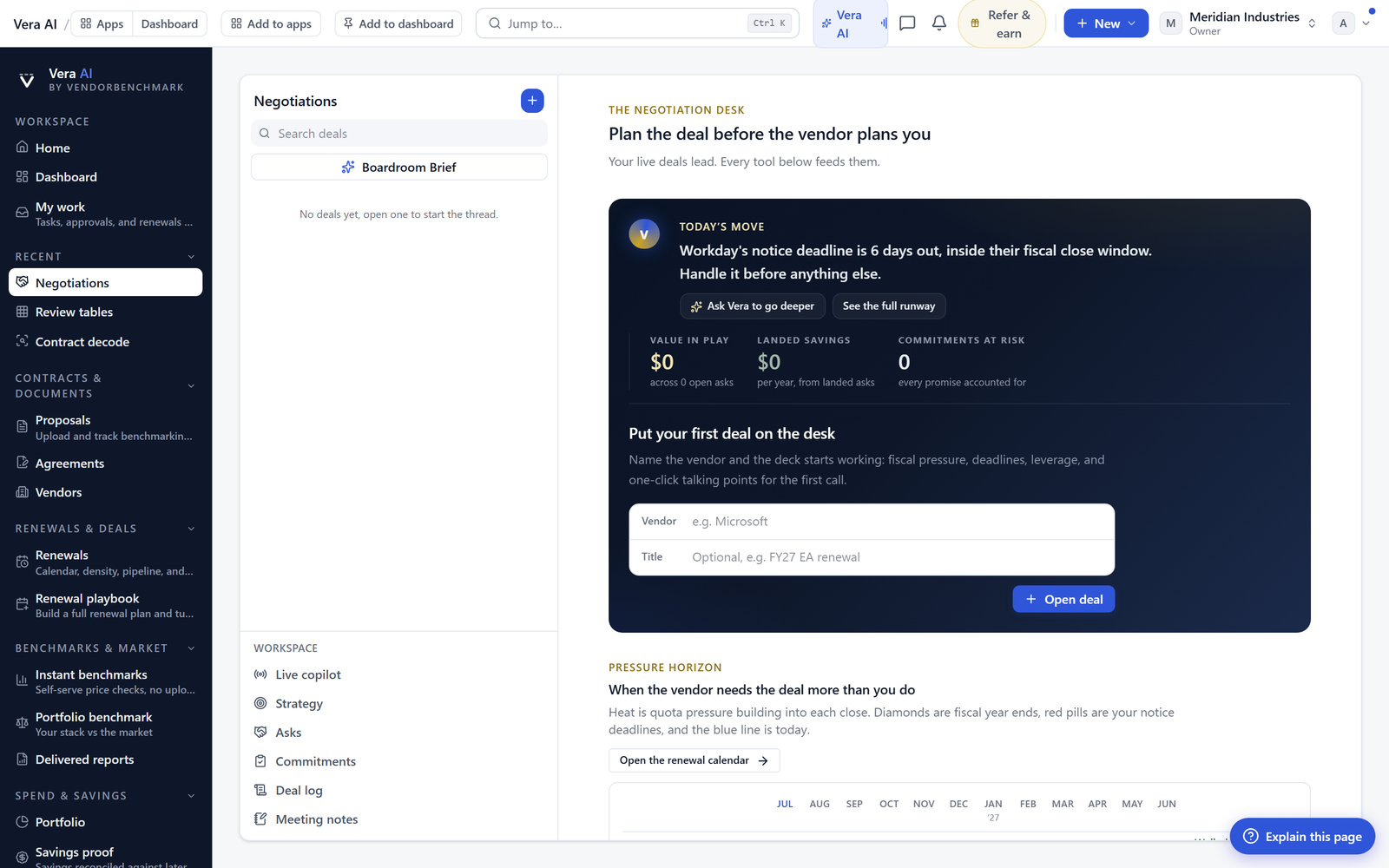
If you want to pressure test a position before it goes on the record, you can talk it through with Vera before the call, which lets the security lead or the business owner see how their stance holds against comparable deals rather than arguing it cold in the room.
What a resolved position looks like
What this does not solve
Vera surfaces the disagreement. It does not adjudicate it. If your security lead and your business owner hold genuinely incompatible views, the flag forces the choice into the open, but a human still has to make it. The platform will not tell you whether the launch date or the residency clause wins. It only guarantees that you decide that on purpose, with both positions visible, rather than discovering the trade-off after signature.
It also cannot capture a position nobody enters. If a stakeholder attends the meeting, stays silent, and never logs a stance, there is nothing for Vera to flag. The tool reduces the friction of stating a position and removes the excuse of never having a place to record it, but it does not read minds. What it does reliably is make the recorded consensus a real one, so that the agreement you sign is the agreement you actually have, and the corridor conversation stops being a separate reality from the meeting minutes.
Fredrik has spent more than twenty years in enterprise software, with time at Oracle, IBM, SAP, and Salesforce before moving to the buy side. He structured and priced the kind of large agreements most buyers only see once or twice in a career, which taught him where the leverage sits and how far a vendor will actually move. He started VendorBenchmark to hand that knowledge to every sourcing team.