Finance wants the floor, the business wants everything, and the spec pretends they agree
Unreconciled stakeholder conflict at intake does not disappear. It reappears as a stalled negotiation and a fractured internal position the vendor can read from across the room.
You have read this document. Finance wrote a line saying the annual commit must not exceed a fixed ceiling. The business unit wrote a list of forty capabilities, every one marked required. Somewhere in the middle a procurement lead stitched the two together into a single specification that reads as if both parties are satisfied. They are not. The spec did not reconcile the conflict between the lowest commit and the largest feature set. It papered over it. And a paper wall holds until the first vendor quote lands and pushes on it.
This is the sourcing problem nobody logs, because it does not look like a problem at intake. It looks like a finished document. The trouble is that the document contains two incompatible instructions signed off as one, and the person who has to carry it forward is you.
Why the conflict hides inside the spec
Intake is optimised for speed and sign-off, not for honesty. When Finance and the business unit disagree, the fastest path to a completed spec is to include both positions and let the future sort it out. Nobody wants to be the person who tells the business it cannot have the premium tier, and nobody wants to tell Finance the ceiling is fantasy. So the tension gets encoded as text and passed downstream.
The mechanism is familiar. When every capability is marked mandatory, the document loses the one thing a negotiator needs, which is a rank order of what to trade. We have written before about how everything becoming mandatory collapses your shortlist to one. The commit ceiling is the same failure viewed from the money side. Finance sets a number without knowing what the feature list actually costs at market, and the business sets a feature list without knowing what it does to the number.
So the spec is internally contradictory and nobody has priced the contradiction. It reads clean. It is not clean.
Where the buried conflict resurfaces
The conflict does not stay buried. It has a predictable resurfacing point, which is the first serious vendor quote. The quote respects the feature list and blows the ceiling, or respects the ceiling and strips the features. Either way it lands on your desk and reopens the internal fight, except now it is happening in public, mid negotiation, with a vendor watching.
That is the worst possible moment to discover your side never agreed. The business insists the stripped features were the whole point. Finance insists the ceiling was a hard line. You are now negotiating two counterparties at once, one of them on your own team, and the vendor can see the seam. A negotiator on the other side reads a fractured internal position the way a card player reads a tell. When your own stakeholders contradict each other on a call, your leverage evaporates.
This pattern rhymes with others in this series. It is close kin to the spec that adds up but nobody sells, where the requirements are internally coherent but unbuildable. Here the requirements are not even internally coherent. The money and the scope point in opposite directions and no one has done the arithmetic to prove it.
The platform motion: price the conflict before the vendor does
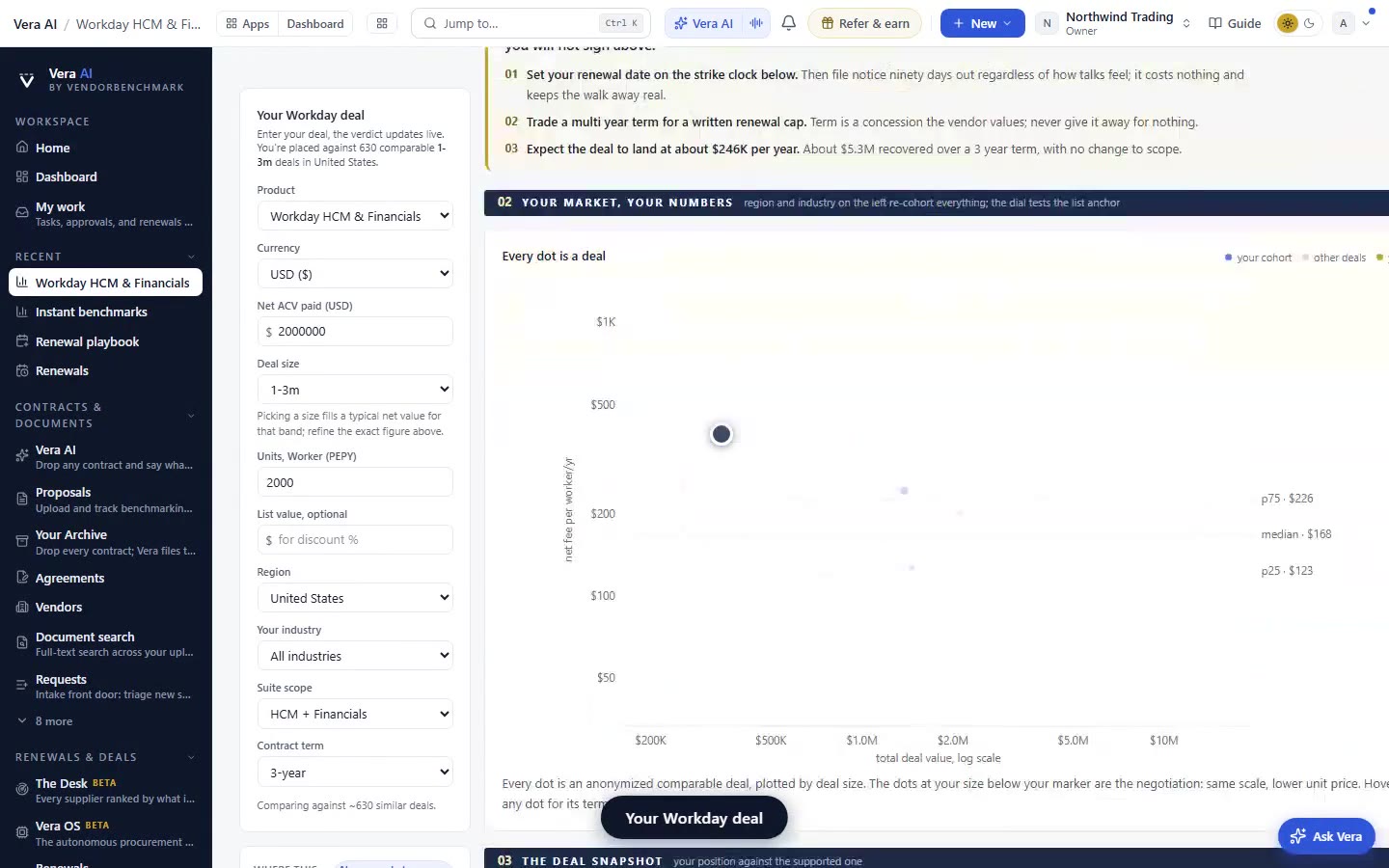
The fix is not a better meeting. It is putting a number on the trade-off early enough that stakeholders argue about facts instead of preferences. This is where Vera changes the sequence. When the spec loads, Vera reads it against the commit ceiling and surfaces the specific requirements that cannot coexist with the budget. Not as an opinion. As benchmarked cost.
Each conflicting requirement gets priced against comparable closed transactions, so the business can see that the premium tier it marked mandatory adds a concrete percentage to the annual commit, and Finance can see that the ceiling it set forces out three specific capabilities. Now the conversation is real. Someone has to choose. But they are choosing with market evidence in front of them, not defending a position they never quantified.
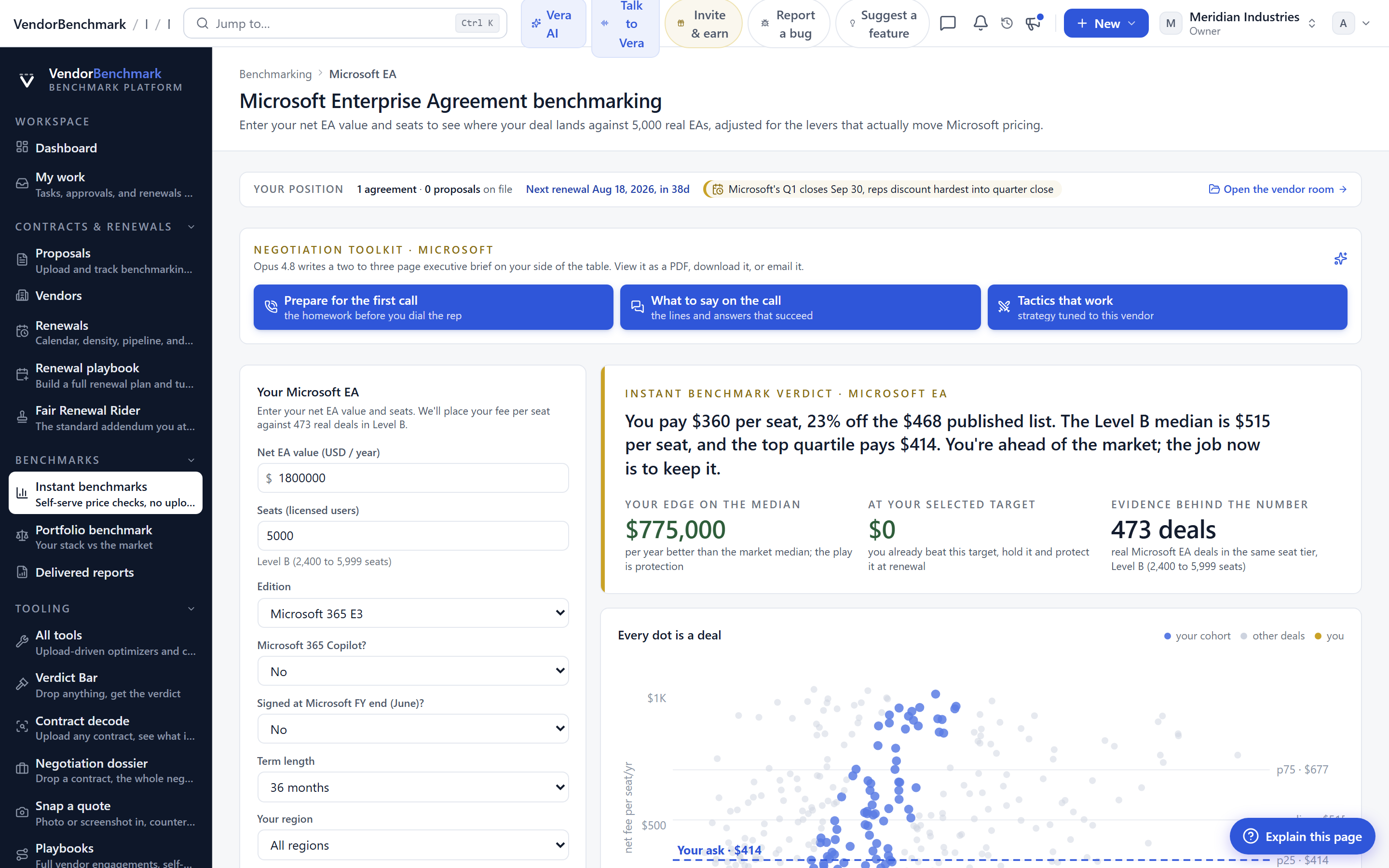
Vera runs on benchmarks across 1,471 vendors, with a modelled peer cohort available to frame any single event. Six specialist agents work the analysis in the background, and the output is not a verdict. It is a set of trade-offs you can take into a room and force a decision on. The point is that the decision happens on your side of the table, before the vendor is involved.
Once the internal position is reconciled, it feeds forward cleanly. The What Next desk can turn the settled position into the drafted requests, and the negotiation war room inherits a single coherent set of priorities instead of two contradictory ones.
What a reconciled intake looks like
What this does not solve
Be honest about the limit. Vera prices the conflict and lays the trade-off out with market evidence. It does not make the decision for you, and it cannot make an unwilling CFO or an unwilling business owner accept a cut. If the two sides refuse to choose even when the arithmetic is undeniable, that is an organisational problem, not a data problem, and no platform fixes a stakeholder who will not be moved by facts.
There are also conflicts Vera cannot see at intake because they were never written down. If security and legal requirements were left out entirely, benchmarking the feature list against the budget will not surface them. That is a different failure, and we covered it in the spec that skipped compliance. Vera reconciles the conflicts present in the document. It does not invent the ones you forgot to record.
What it does do is remove the specific failure named at the top. The gap between the lowest commit and the largest feature set stops being a hidden contradiction and becomes a priced, ranked decision made on your terms, before a vendor gets a vote. That is the difference between a stalled negotiation and a short one.
Fredrik has spent more than twenty years in enterprise software, with time at Oracle, IBM, SAP, and Salesforce before moving to the buy side. He structured and priced the kind of large agreements most buyers only see once or twice in a career, which taught him where the leverage sits and how far a vendor will actually move. He started VendorBenchmark to hand that knowledge to every sourcing team.