The good decision your executive will not approve in five minutes
Your team did the work and reached the right answer. The approval still sits in a queue, because nobody translated the analysis into something an executive can sign in the time they actually have.
BENCHMARKING · FROM THE ANALYST DESK. Here is the week you recognise. The working team spent three weeks on a category. You pulled quotes, you compared line items, you argued the trade-offs, and you landed on a defensible answer that you believe in. Then it went up for approval. And it stopped. Not because anyone disagreed, but because the person who has to sign it opened a forty-slide deck and a spreadsheet with nine tabs, gave it four minutes, and put it back in the queue with the note can we talk through this at some point. The decision was good. It was just not signable in the time your executive had to sign it.
The decision is not the bottleneck. The summary is.
We keep telling ourselves that approvals stall on merit. They rarely do. By the time a recommendation reaches an executive, the merit question is usually settled inside the working team, which has seen the quotes, the peer data, and the alternatives. What arrives at the top is not a decision to be re-made. It is a decision to be ratified. And ratification has a hard constraint that analysis does not: the reviewer has five minutes, maybe less, and no appetite to reconstruct your reasoning from raw material.
So the failure is a translation failure. The team produced something rich and complete for itself, and then handed that same artefact up the chain unchanged. An executive cannot approve a process. They can only approve a conclusion, provided the conclusion carries just enough evidence to make signing it feel safe. When that one-page conclusion does not exist, the reviewer defaults to the only safe action available to them, which is to delay and ask for a meeting. The delay is not doubt. It is the absence of a document they can act on alone.
Why competent teams keep shipping unsignable work
This persists for a reason that has nothing to do with skill. The team that does the analysis is the team least able to compress it, because they know too much. Every caveat feels load-bearing. Every alternative they ruled out feels worth showing. The instinct to prove the work is exactly what makes the work unreadable at the top. A procurement lead who spent two weeks in the numbers cannot easily throw away nineteen of the twenty things they learned, even though the executive needs precisely one page.
There is a second reason. The evidence that makes a recommendation approvable is external. An executive signs faster when the page says this price sits at the market median for this category and cohort than when it says we negotiated hard. But that market context usually lives outside the team's own files, so the summary either omits it or the team burns another day assembling it by hand. The result is a page that is either fast and unconvincing, or convincing and late. Both fail the five-minute review. This is the same gap that appears when finance needs the price justification the day before the board meeting, on a deal that closed weeks earlier.
The motion that removes it
The platform answers this by separating two jobs that teams wrongly do together: the analysis, and the executive summary of the analysis. The working team still does the reasoning. What changes is that the AI analyst reads that reasoning, pulls the market position from the benchmark library, and writes the one-page recommendation an executive can approve without reopening anything underneath it.
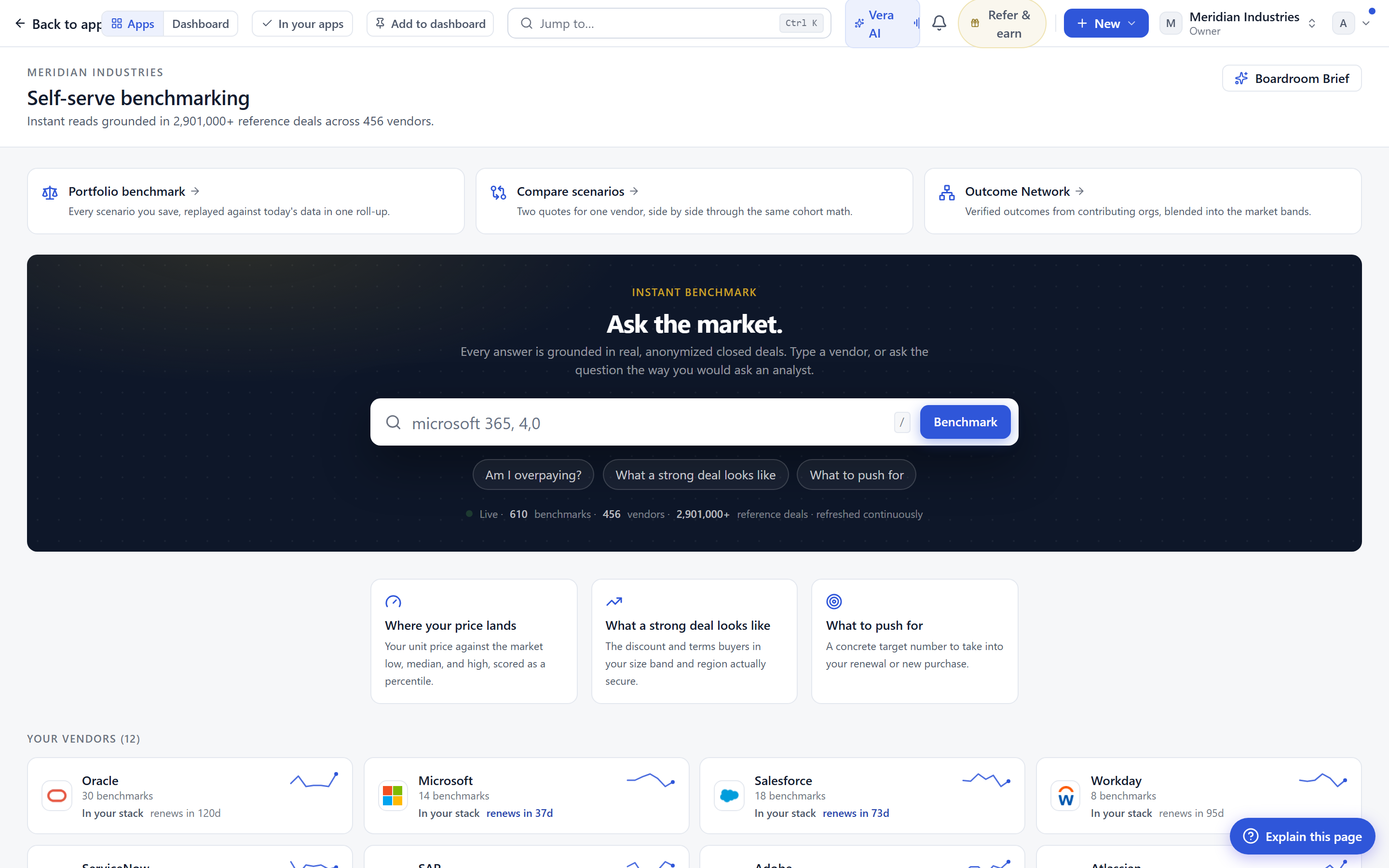
The page leads with the conclusion, states the recommended action, and carries the market evidence directly beneath it, sourced from the same benchmark library that covers 1,483 vendors. An executive reading it does not have to trust the team's judgement in a vacuum. They can see the percentile, the cohort, and the citation, and sign on that basis alone. Because the argument is benchmark-backed, it also holds up when the direction reverses, which is the point we make in the benchmark verdict that argues your side in both directions.
When the market position itself needs to be citable rather than asserted, the same evidence draws from the Software Price Index, so the number on the page is one a reviewer can point a colleague at. The recommendation is not a slide. It is a deliverable, produced by the analyst desk that runs six specialist agents and pulls from more than 25 report types.
What the one-page recommendation actually carries
What this does not solve
Be honest about the limits. A one-page recommendation cannot rescue a decision the team got wrong. If the reasoning underneath is thin, the summary will be a clean page proposing a bad idea, and a good executive will still stop it. The platform makes sound decisions signable. It does not make weak ones look strong, and we would not want it to. Where we hold that line is set out in what we will not let the AI do on your deals.
It also does not remove the executive's judgement, and it should not. Some decisions genuinely warrant a conversation, because they carry strategic weight beyond the numbers on the page. The point is not to eliminate every meeting. It is to stop losing decisions that never needed a meeting to a review process that only knew how to schedule one. When the page is legible, the executive spends their five minutes on the decisions that deserve their scrutiny, and ratifies the rest in the time they always had.
The decision was good. Now it reads that way to the person who has to sign it.
Fredrik has spent more than twenty years in enterprise software, with time at Oracle, IBM, SAP, and Salesforce before moving to the buy side. He structured and priced the kind of large agreements most buyers only see once or twice in a career, which taught him where the leverage sits and how far a vendor will actually move. He started VendorBenchmark to hand that knowledge to every sourcing team.