The Software Price Index: a citable record of enterprise pricing.
Consumer prices have an index. Producer prices have an index. Enterprise software, one of the largest and fastest moving cost lines in the modern company, has had rumors. The Software Price Index is the fix: a quarterly, dated, publicly citable record of where enterprise software pricing actually moved, built from modelled deal cohorts.
There is a category of document where private evidence, however good, does not work. A board paper justifying next year's software budget cannot footnote "our benchmarking tool." A CFO's guidance to divisional leaders needs a reference both sides can open. A pushback email to a vendor asserting that "the market has not moved 9 percent" lands very differently when the sentence ends with a link instead of a feeling. These documents need what every other cost category already has: a public index with a date on it.
The absence has had a real price. In the vacuum, the de facto index of enterprise software has been the vendors' own announcements, list increases presented as industry norms, "standard uplifts" quoted as if they were weather, and every buyer left to discover privately that the norm was negotiable. When one side of a market publishes all the reference points, the reference points serve that side.
What the index is, and what makes it citable
It is built from transactions, not sentiment. The index derives from the same foundation as the benchmark library, 1,471 vendors and modelled deal cohorts, aggregated into quarterly snapshots of where net pricing moved by category. No surveys, no vendor announcements, no analyst mood. The closed-deal discipline that makes the private benchmarks defensible is exactly what makes a public index worth quoting.
It is dated and versioned. Each quarterly snapshot is fixed when published. The figure you cite in October's board paper says what it said when you cited it, which is the property that separates a citation from a screenshot of a dashboard that may read differently tomorrow.
It is public. The index pages sit on the open web, no account required, because a reference only works if the person you send it to can open it. Your CFO, your vendor, and your auditor all see the same page you cited.
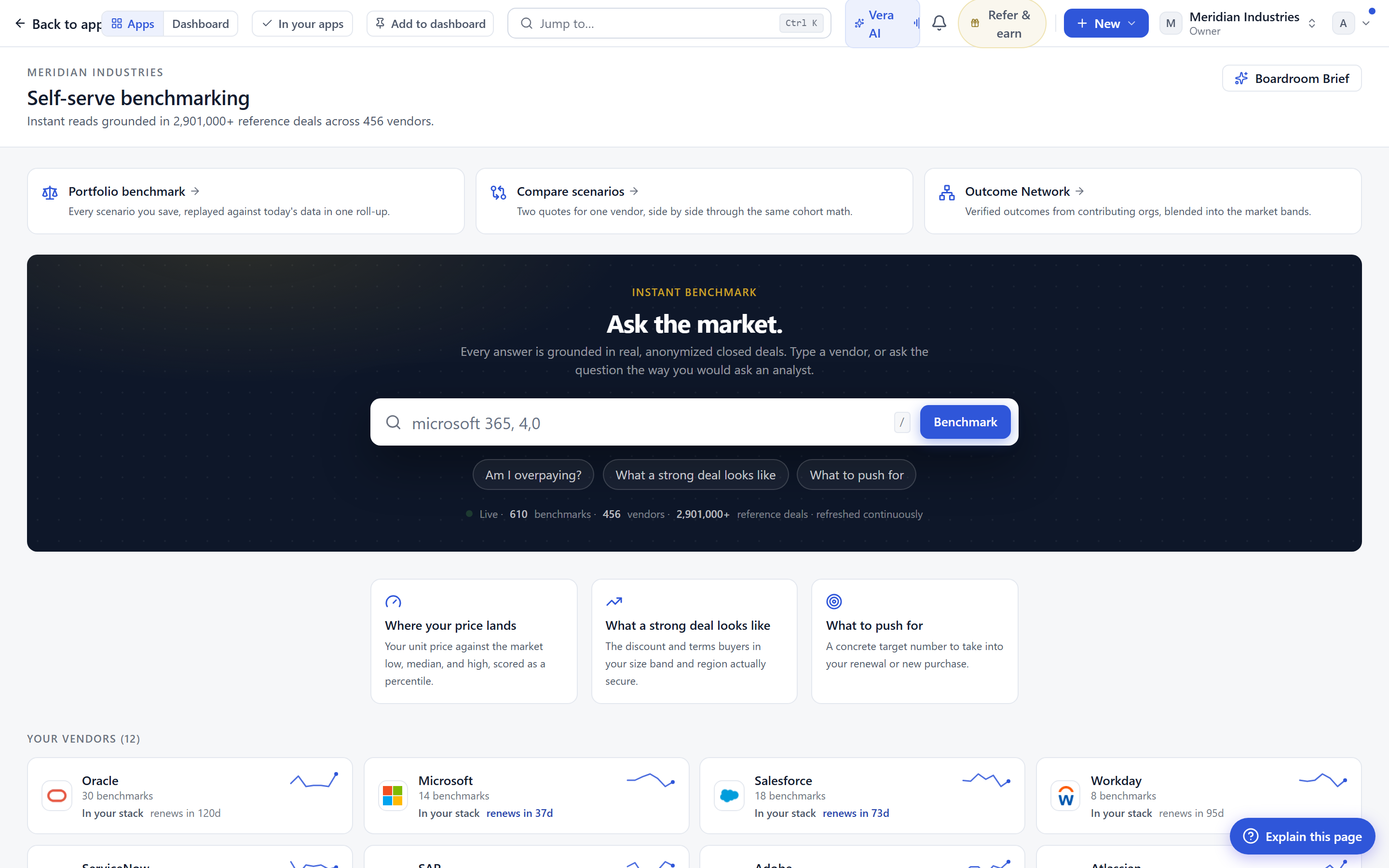
Four documents the index belongs in
What the index is not: the aggregate and the address
An index is an average with credentials, and averages have honest limits. The index tells you where the market moved. It cannot tell you where your deal sits, because your deal has a size, an edition mix, a term, and a vendor whose category the index deliberately smooths over. For that question you want the percentile: your position in the cohort of deals shaped like yours.
The two work as a pair, and the pairing is the point. The index sets the public frame, what direction the market moved and by roughly how much, and survives being quoted to people who will never log in. The benchmark sets the private target, what your specific renewal should cost, and arms the negotiation itself. A budget paper cites the index. A counter-offer cites the cohort. Confusing the two produces either a negotiation argued from an average, which is weak, or a board paper argued from a private percentile, which is unquotable.
The quiet ambition here is bigger than any single document. Markets behave better when both sides can see them. Enterprise software pricing has spent thirty years as a market where one side had the data and the other side had impressions, and every recurring theme on this blog, the closed-deal benchmarks, the Outcome Network, the index, is the same correction applied at a different altitude. The index is simply the altitude a board can see from.
Fredrik has spent more than twenty years in enterprise software, with time at Oracle, IBM, SAP, and Salesforce before moving to the buy side. He structured and priced the kind of large agreements most buyers only see once or twice in a career, which taught him where the leverage sits and how far a vendor will actually move. He started VendorBenchmark to hand that knowledge to every sourcing team.
The week in enterprise software buying, in one email.
What shipped on the platform, and the pricing and licensing moves worth knowing before your next renewal. One email a week, to your work address. Unsubscribe any time.