The Benchmark Agent Now Opens on the Wire Desk
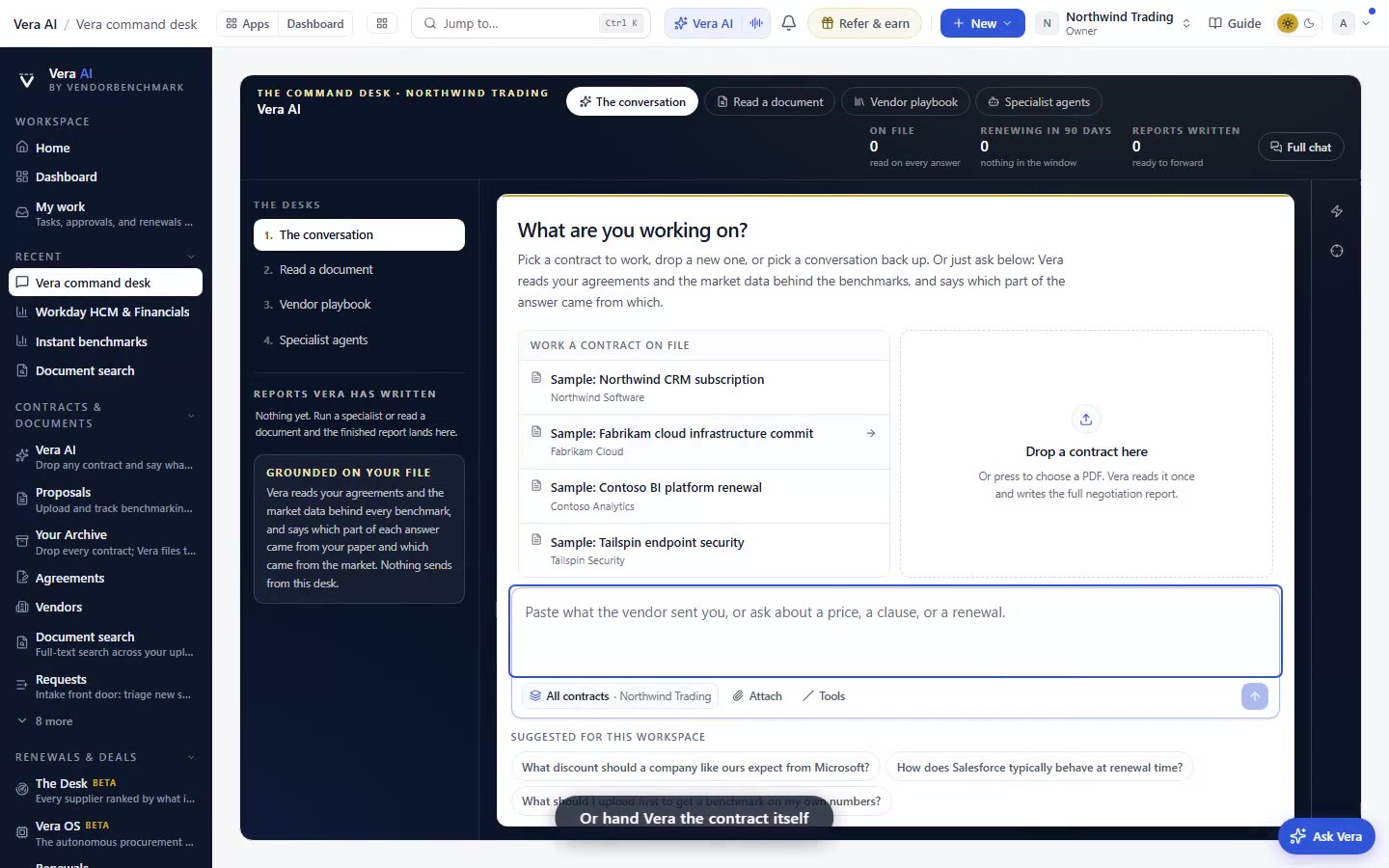
The report is no longer a page you scroll. It opens on the same desk the agents work at, with a tree, five sheets, an inspector, and a ledger grouped by runway.
Here is the problem most procurement teams recognise. You have a benchmark, a contract, a spreadsheet of your own spend, and an email thread where someone asked what any of it is worth. Four artefacts, four windows, and no shared frame. By the time you have lined them up, the renewal is a week closer and the number you wanted to quote in the meeting is still an estimate. The benchmark told you where the market sits. It did not tell you where this paper sits, inside your estate, against buyers who signed something comparable.
So we moved the benchmark onto the shell our other agents already wear. If you have used the Benchmark Agent as a Windows application or seen how the Agent Center opens as an application, the layout will read immediately. The report is now a desktop application: menus on the title bar, a tree with this report, your estate and the ledger, five sheets, and an inspector that carries the facts, what moving a line is worth, the moves and the levers.
The desk, and why the frame matters
The old benchmark read like a document. It had a top, a middle and an end, and you navigated it by scrolling. The desk reads like a workspace. The tree on the left is the index of everything in scope: the report you are in, the estate it belongs to, and the ledger that tracks the runway. The five sheets across the middle are the working surfaces. The inspector on the right is where a selection becomes a decision, because it holds the fact, the value of moving it, and the levers available to move it.
The point of the frame is that a benchmark on its own is context without an object. When the report sits next to your estate and your ledger in the same tree, a percentile stops being trivia and becomes a distance you can price. This is the same principle behind the report as a workspace: the paper opens beside every answer, so the answer never floats free of its evidence.
The stage, the ladder, and the ledger
Three surfaces do the heavy lifting. The stage states the placement in one sentence over the peer band, so the headline is written for you before you open a spreadsheet. It says, in plain language, where this paper sits and by how much. That sentence is the thing you can read aloud in a meeting without a caveat, because it is generated from the report, the estate and the ledger together, not stitched by hand.
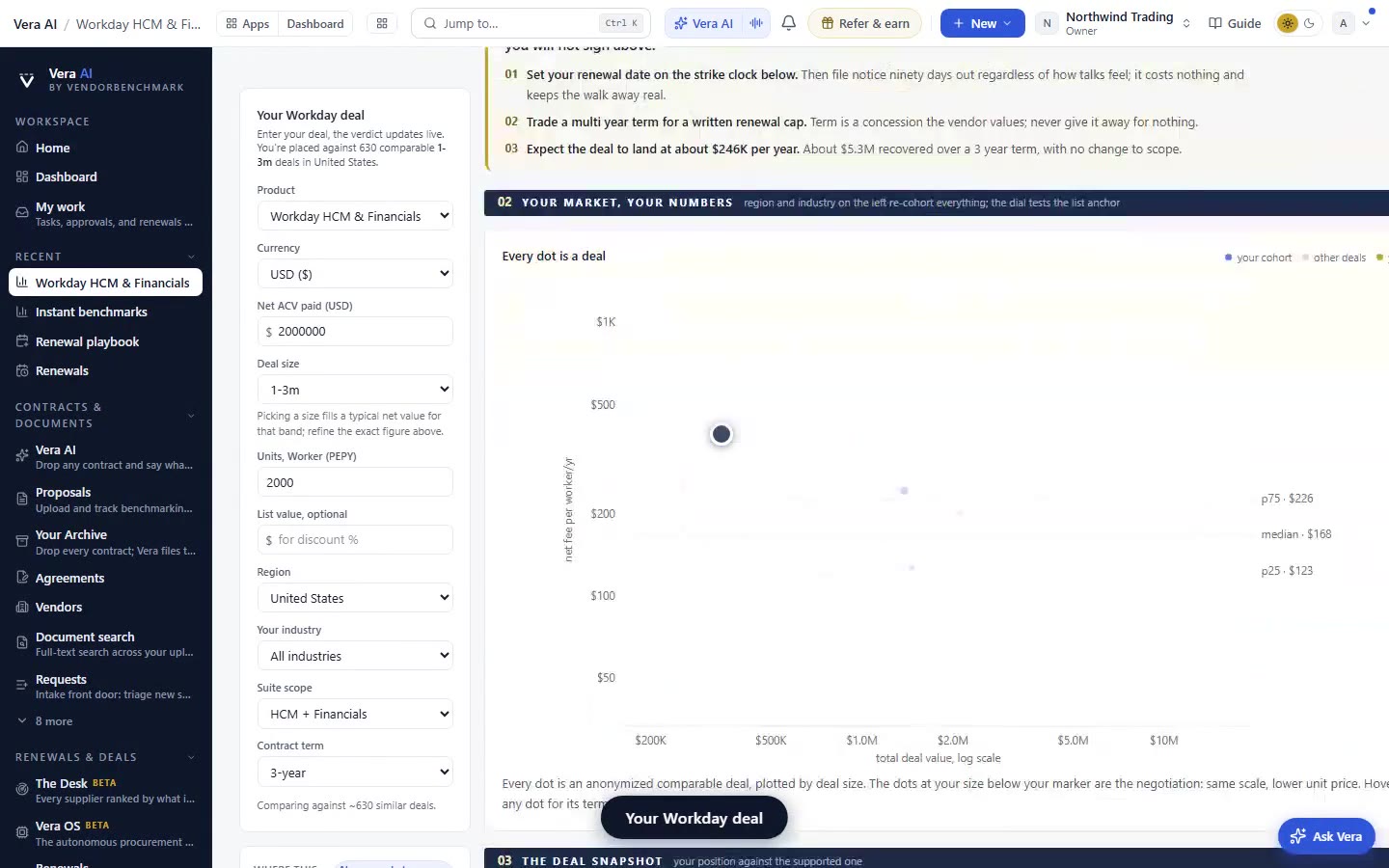
The ladder shows comparable buyers with this paper inside them. Not the whole market, not a generic cohort, but organisations that signed something structurally similar to what you are holding. This is closer to how the Agent Negotiation Protocol thinks about counterparts: comparability is a property of the paper, not a demographic guess. When you can see who else carries this clause structure and where they landed, your target stops being aspirational and starts being observed.
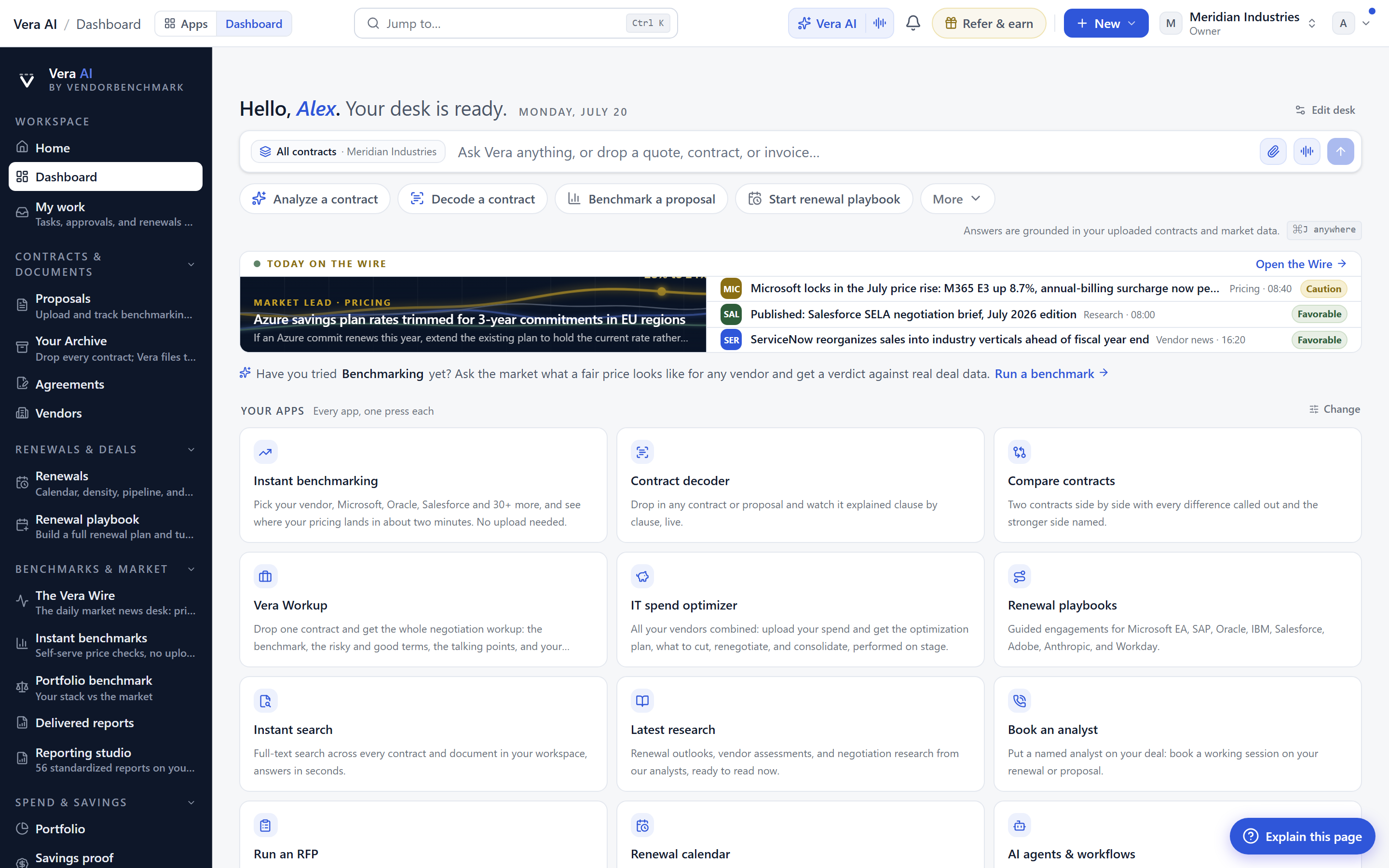
The ledger is a board grouped by runway. Each report sits on its stage, and the ones to open today are surfaced by how much runway is left before a renewal, a price list change or a decision point. It is a queue that respects the calendar rather than the alphabet. If you have worked with the renewal desk as a Windows application, the ledger will feel like its sibling: one book, sorted by what is urgent.
The inspector, where a line becomes a move
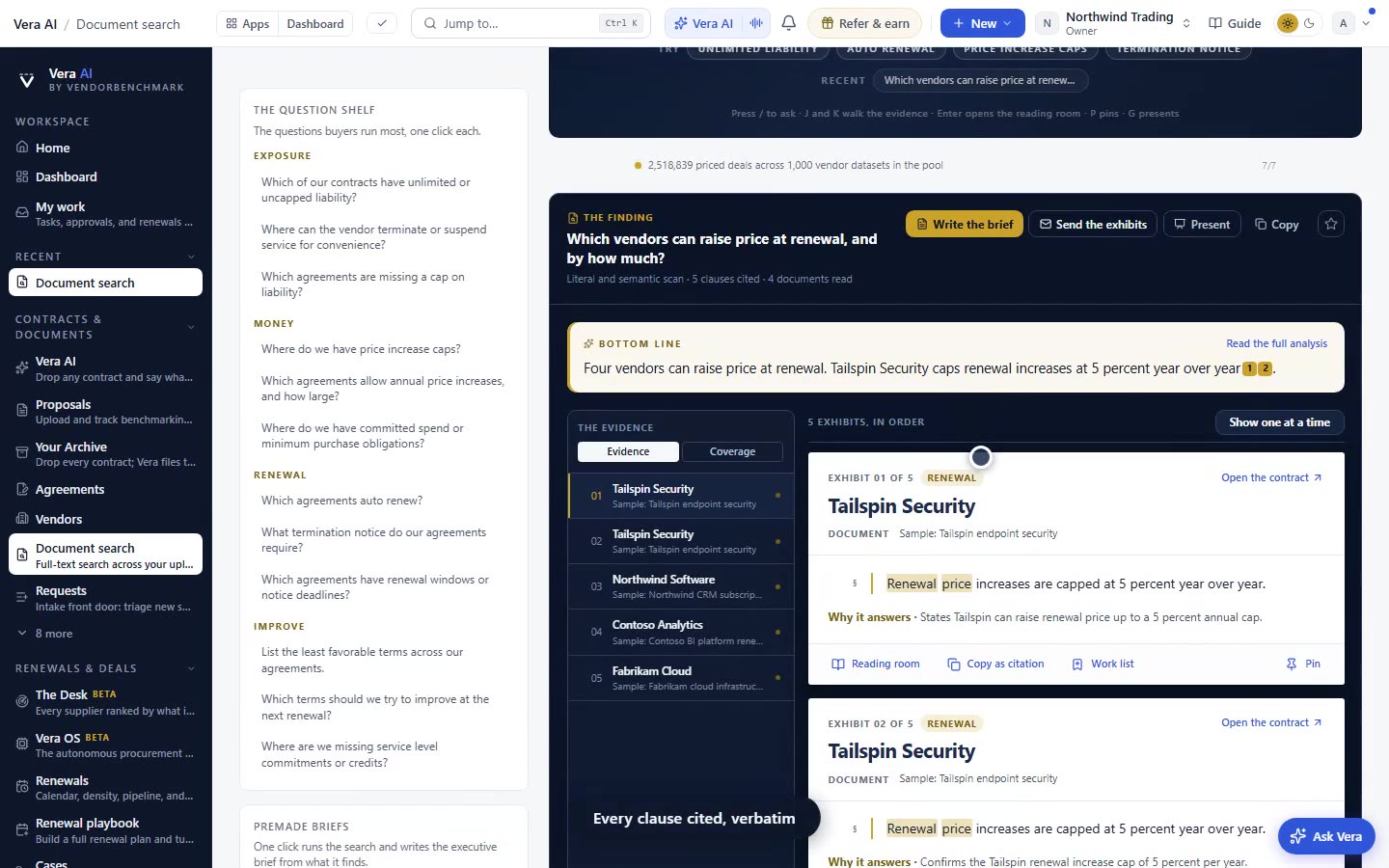
The inspector is the difference between reading a benchmark and acting on one. Select any line on a sheet and the inspector fills with four things. First, the facts: the raw figures behind the line, cited so you can trace them. Second, what moving it is worth: the arithmetic of closing the distance to the peer band, framed as a range so you are not quoting a false precision. Third, the moves: the concrete asks that would shift the line. Fourth, the levers: the terms and conditions you can pull to make a move stick.
This is the same design that runs through the Negotiation Dossier, where a counter offer is a document rather than a claim. Here the inspector is the bridge from the report to that dossier. You place a line, you see its worth, you take the move, and the move carries into the negotiation with its evidence attached. The library behind all of this covers 1,483 vendors, and the desk draws on six specialist agents to fill the four inspector panels, so the facts, the worth, the moves and the levers arrive together rather than in four separate lookups.

What changes for a buyer
Honest limits
Three limits are worth stating plainly. First, the ladder is only as good as the comparability of the paper it finds. If your contract is genuinely bespoke, with structure no other buyer in the library shares, the ladder will show fewer rungs and the placement sentence will widen its range accordingly. That is correct behaviour, not a fault, but it means an exotic contract will get a more cautious quote than a standard one.
Second, the value of moving a line is arithmetic, not a guarantee. The inspector prices the distance to the peer band. It does not promise the vendor will close that distance, and it cannot model a relationship dynamic that lives outside the paper. Treat the worth figure as the ceiling of a reasonable ask, not a forecast of the settlement.
Third, the ledger sorts by runway using the dates it can see. If a renewal date lives only in someone's inbox and never reached your estate, the report will sit lower in the queue than it should. The desk runs 30 background jobs to keep the estate current, but it cannot ingest a date it was never given. The fix is boring and reliable: get your contracts and renewal dates into the estate so the runway is real. When you do, the queue tells the truth. You can start any of this at the benchmark tool, and place your first vendor against its peer band the same afternoon.
Fredrik has spent more than twenty years in enterprise software, with time at Oracle, IBM, SAP, and Salesforce before moving to the buy side. He structured and priced the kind of large agreements most buyers only see once or twice in a career, which taught him where the leverage sits and how far a vendor will actually move. He started VendorBenchmark to hand that knowledge to every sourcing team.