Agent to agent: how the Agent Negotiation Protocol works, and why it is open.
The first round of a renewal is about to happen at machine speed. When your agent and the vendor's agent trade offers, the hard part is not the haggling. It is proving who said what, under whose authority, in an order nobody can quietly rewrite later.
A vendor deal desk has always been a machine wearing a person's name badge. It prices thousands of transactions a quarter, knows its discount floor to the dollar, and increasingly runs the whole exercise through software. In 2026 the person is starting to drop away entirely. The first automated seller agents are already quoting, countering, and holding firm without a human in the loop until the very end.
That leaves the buyer with a choice. Answer a machine with a spreadsheet and a slow email chain, or put a machine of your own on the other side of the table. The moment both sides are automated, a new problem appears that neither side had before. When two agents trade a dozen offers in a few seconds, who can prove what was actually said, under whose authority, and in what order?
The Agent Negotiation Protocol exists to answer exactly that. It is an open, MIT licensed standard for buyer and vendor agents to negotiate on the record. Not a smarter chatbot, a set of rules for keeping an automated negotiation honest.
Four things every automated offer needs
A human negotiation carries a lot of trust implicitly. You know who is in the room, you know they can approve the number they just said, and if they deny it tomorrow, there are witnesses. Strip the humans out and all of that has to be made explicit, or the negotiation is worthless as evidence.
The protocol builds each exchange from four parts. First, a signed identity, so every message is cryptographically tied to the party that sent it and cannot be forged or repudiated. Second, a declared mandate, the authority the agent is operating under: the ceiling it may accept, the terms it may concede, the point past which it must stop and fetch a human. Third, a structured offer in machine readable form, price, term, metric, and conditions as data rather than prose, so there is nothing to misread. Fourth, a place for all of it to land that cannot be edited after the fact.
The mandate is the part that matters most to the person who signs. Your agent never gets a blank cheque. It negotiates strictly inside the envelope you set, and the boundary is part of the record, so the vendor's agent cannot claim your side agreed to something it had no authority to agree to. The judgment call that commits the company stays where it belongs, with a person.
The ledger neither side can rewrite
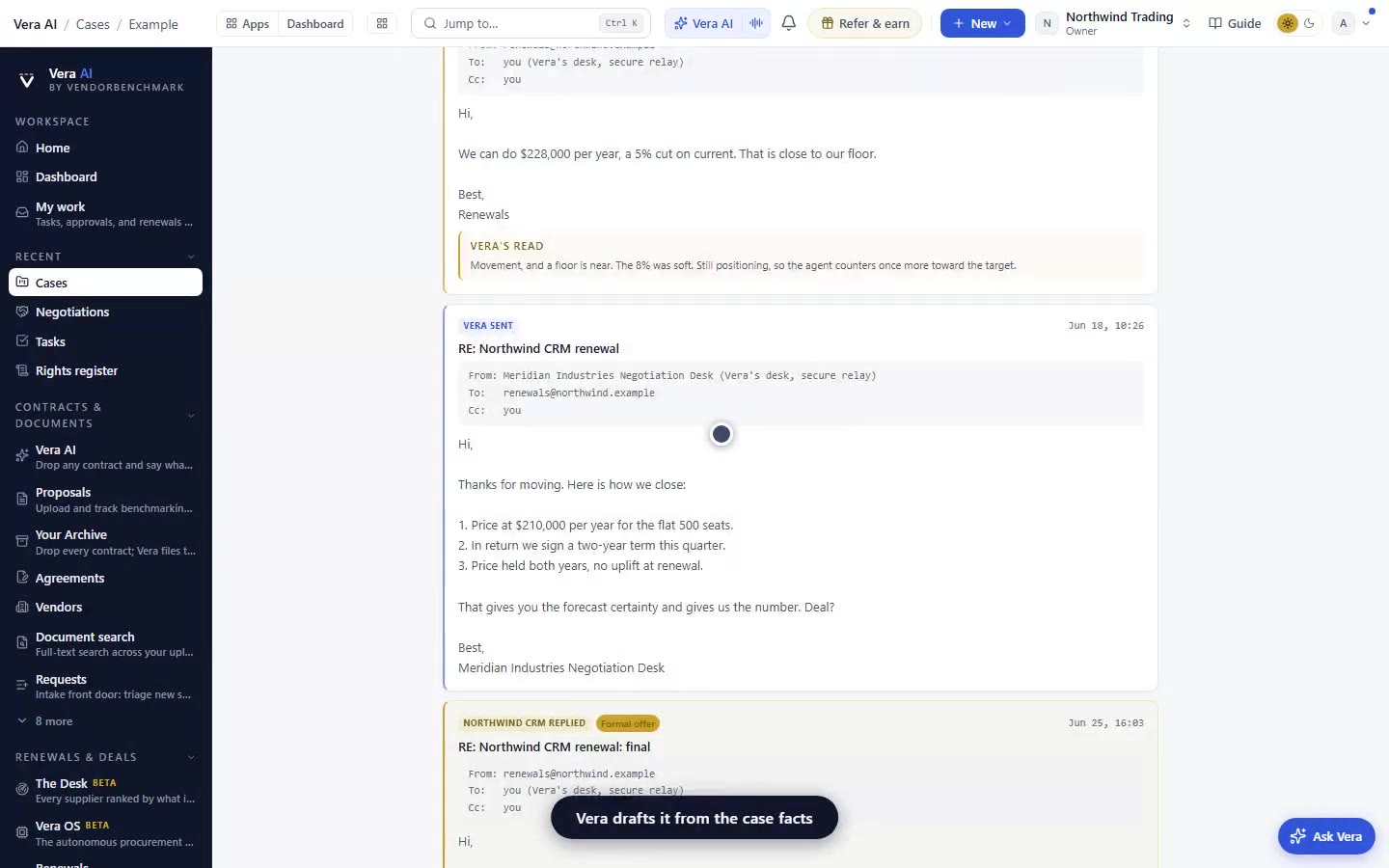
The centrepiece is the session ledger. Every message, offer, counter, acceptance, and walk away, is written into a hash chained record where each entry seals the one before it. Change any earlier line and every later hash breaks, so tampering is not just against the rules, it is visible on inspection.
This is the quiet revolution. Negotiations have always been a swamp of "that is not what we agreed" and half remembered phone calls. A hash chained ledger turns the whole exchange into a single source of truth that both parties hold and neither can quietly edit. When the contract is drafted, the terms trace straight back to the offers that produced them.
None of this runs unsupervised on your live deals. Agent to agent rounds happen in a sandbox, a contained space where your agent can explore the vendor's position, test where the floor really is, and surface a recommended landing zone, all before a human decides whether to take it forward. The machines do the fast, repetitive opening exchanges. The person reads the transcript and makes the call.
Want to be updated when major licensing and pricing changes land? One analyst brief a week: the price rises, metric changes and audit campaigns that move software costs. Work email only.
Why an open protocol, and not ours alone
A negotiation standard that only one vendor can read is not a standard, it is a moat. The protocol is deliberately open and MIT licensed so that any buyer agent and any seller agent can speak it, whether or not either was built here. A closed protocol would let whoever controls it also control the terms, which is precisely the asymmetry buyers are trying to escape.
Openness is also what makes the ledger credible. If the format is public, a court, an auditor, or the counterparty's own tooling can verify the chain independently. Evidence that only one side can read is not evidence. The protocol is a public good on purpose, because trust between adversaries only works when the referee is neutral.
There is a longer game here too. Standards win by adoption, not by fiat, and a buyer side protocol only disciplines vendor agents once enough of the market speaks it. Keeping it open is how that happens: no license to negotiate, no gatekeeper to pay, nothing stopping a vendor from adopting it except the fact that it makes their agent accountable. The asymmetry buyers have lived with for a decade does not close because one platform got clever. It closes when the rails everyone negotiates on are ones nobody privately owns.
What the protocol guarantees
Machines negotiate, people commit
The protocol does not hand your renewal to a robot. It automates the part that was always mechanical, the opening exchange of numbers, and makes it provable. The relationship, the trade offs, and the signature stay human. What changes is that the human now starts from a complete, tamper evident transcript instead of a vague memory of a call.
That is the whole design goal. The first round gets faster and better documented, the record becomes something you can actually rely on, and the decision that binds the company remains a person's to make. You can read the standard, and run the first signed round, from the agent protocol page.
Fredrik has spent more than twenty years in enterprise software, with time at Oracle, IBM, SAP, and Salesforce before moving to the buy side. He structured and priced the kind of large agreements most buyers only see once or twice in a career, which taught him where the leverage sits and how far a vendor will actually move. He started VendorBenchmark to hand that knowledge to every sourcing team.
The week in enterprise software buying, in one email.
What shipped on the platform, and the pricing and licensing moves worth knowing before your next renewal. One email a week, to your work address. Unsubscribe any time.