The Negotiator's Guide now opens on thirty seven vendor benchmark sheets
Every guide answers the same nine questions in the same order, from the three things that decide the outcome to the clauses to check before you sign. Here is what changes for a buyer.
You know the feeling. A renewal quote lands, the number is higher than last year, and the account executive has a reason ready for every objection you have not made yet. You are negotiating against someone who does this every day, on your side of the table for the first time in twelve months. The information asymmetry is the whole game. The Negotiator's Guide exists to close it. Last week the guide opened on five vendor benchmark sheets. Today it opens on thirty seven.
Adobe, ADP, Accenture, Adyen, Addepar, Agfa HealthCare, Abnormal Security, A&O Shearman, ABBYY, ABM Industries, AFRY, Accela, Accelya, accesso, Accor, Accuris, Aclara, Acquia, Acronis, Actabl, ActiveFence, ActiveViam, Acturis, Addison Lee, Adform, Adjust, AdsWizz, Aerospike, Agiboo, Abridge, 6sense and 8x8 join Salesforce, 3M, 1Password, 4imprint and 120Water. A vendor without a guide still says coming soon and keeps its benchmark. A vendor with one tells you where its number bends.
The named problem: you get the price, not the reasons
Most buyers walk into a negotiation holding a benchmark and nothing else. The benchmark tells you the number is high. It does not tell you why it is high, which of the six factors behind it you can actually move, or when in the vendor's fiscal year your leverage peaks. So you argue the total and the seller defends the total, and the conversation never reaches the parts that are soft.
The Negotiator's Guide is built for the reasons, not the number. Every guide answers the same nine questions in the same order. The three things that decide the outcome. The six factors that set the number. The vendor's fiscal calendar and where the leverage sits in it. The twelve month runway. The benchmarks line by line. The five tactics that work. The ten step playbook, with what to say and what to hold out for. What most buyers miss. The clauses to check before you sign. Same structure on every vendor, so once you have read one you can read any of them fast.
Where the leverage actually sits: the fiscal calendar
The single line buyers underuse is the fiscal calendar and where the leverage sits in it. A seller chasing a quarter-end quota will move on price in ways they will not move on in week two of a new quarter. The guide names those windows per vendor, then the twelve month runway tells you when to start so you arrive at the soft window with your position already built.
That runway also protects you from the quiet trap of letting the vendor pick the timing. Aligning renewal dates for convenience can quietly hand back everything you gained, which we walked through in the co-term trap. The guide flags it so you decide the calendar rather than inherit it.
How it fits the workflow you already run
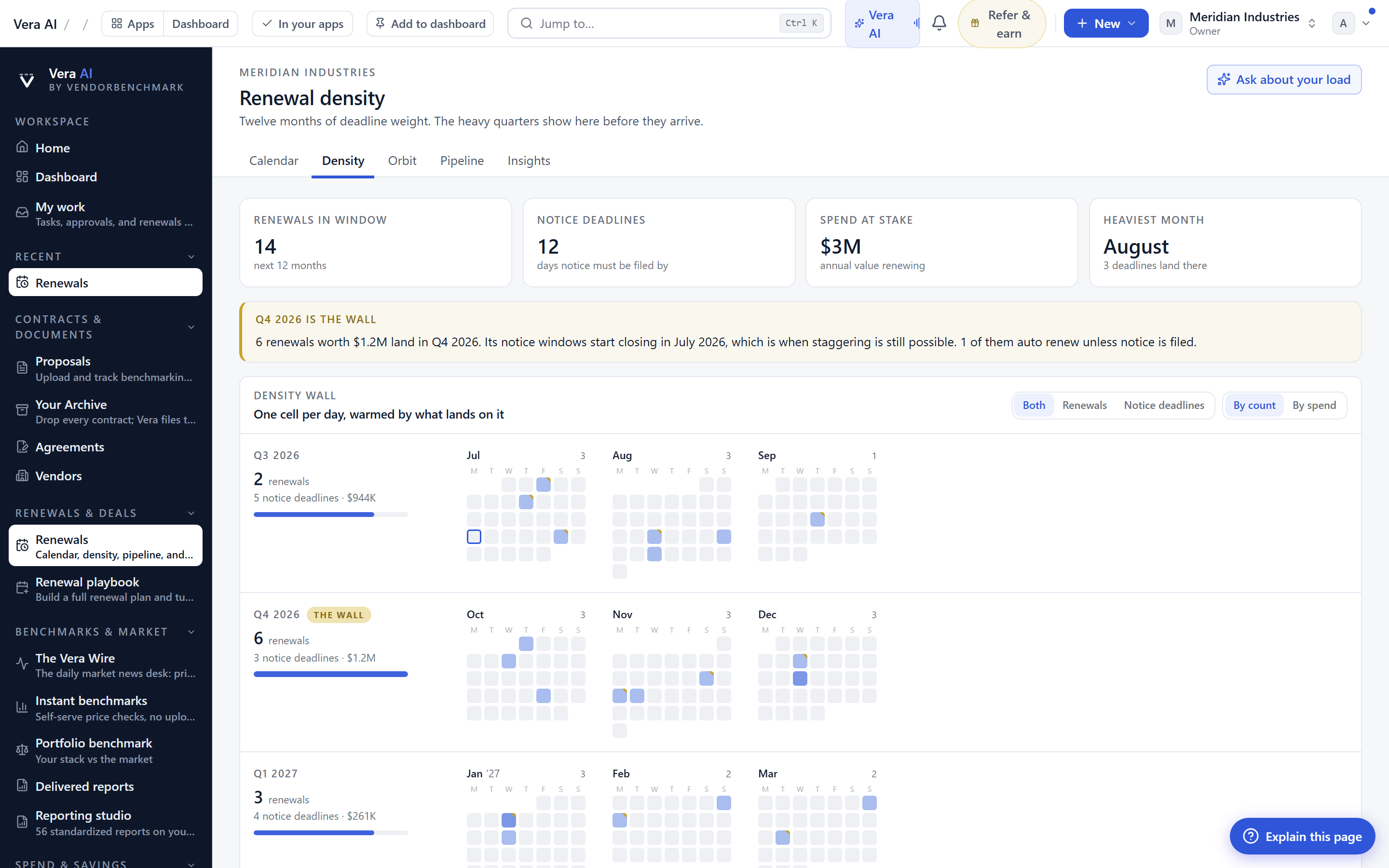
The guide is not a separate destination. It opens from the benchmark sheet you are already reading, the same way every vendor benchmark now opens as a window. Read the percentile bars, click into the guide, carry the ten step playbook into your counter offer without switching context. When the guide names a clause to check, the clause library holds the position you should take, and the review tables let you ask whether that clause already appears across your existing contracts.
If you negotiate as a group, the same guide underpins a shared position without exposing individual numbers, which is the mechanism behind buying blocs. Everyone reads the same nine sections and pools the leverage, not the pricing.
Honest limits
Thirty seven guides is not all of them. A vendor without a guide says coming soon and keeps its benchmark, which means for those vendors you still have the number and the percentile bars but not the nine section breakdown. We would rather ship a guide we stand behind than paper over a gap, so the list grows deliberately rather than all at once.
Second limit. The guide encodes what moves a number in the general case for that vendor. It cannot see your specific spend, your contract history, or the internal politics of your renewal. It gets you to the table informed. It does not replace the judgement of the person sitting there. The fiscal calendar tells you when the seller is soft. It does not tell you how badly your own business needs the deal closed this quarter, and that pressure is yours to manage.
Third limit. Benchmarks reflect closed deals, and markets move. A guide read six months before your renewal should be reopened when you actually negotiate, because price lists change and the benchmark library refreshes underneath it. Treat the guide as a live document, not a printout.
Within those bounds, the change is simple. You used to walk in with a number and an argument you built yourself over two weeks. Now you walk in with the reasons behind the number, the timing that favours you, the language for each step, and the clauses to check, on thirty seven vendors today and more each week. Open the vendor you are negotiating and read the guide before your next call.
Want to be updated when major licensing and pricing changes land? One analyst brief a week: the price rises, metric changes and audit campaigns that move software costs. Work email only.
Morten brings two decades of enterprise and software procurement, with stints across Oracle, IBM, SAP, and Salesforce shaping how he reads a deal. He has led sourcing through hundreds of renewals, from mid market order forms to nine figure global agreements, and learned that the buyers who win are the ones who walk in knowing the market. He built VendorBenchmark to make that pattern recognition repeatable.


