Buying blocs: pooling leverage without exposing your numbers.
Every industry that buys at scale buys together, hospitals, grocers, airlines, except the one spending the most on software, where every company faces the same vendor alone, sequentially, and in the dark. Buying blocs fix the three things that kept it that way: confidentiality, coordination cost, and the fear of doing it wrong.
Consider what the vendor side already does collectively. Deal desks share win-loss intelligence across thousands of accounts. Pricing teams study every buyer's behavior in aggregate. The rep negotiating with you on Tuesday applies lessons learned against a hundred companies like yours, and nobody calls that a cartel, because it is not one. It is one side of a market being organized while the other side stays artisanal.
Buyers stayed artisanal for understandable reasons. Sharing deal information with peers felt like leaking secrets. Coordinating asks across companies with different calendars and lawyers looked like a project with no owner. And everyone's counsel raised the same caution about talking to other buyers, better safe than sorry, so nothing happened, forever. The bloc design answers all three, and the answers are worth understanding precisely, because they are what make the whole thing usable.
The design: shared terms, shared window, separate deals
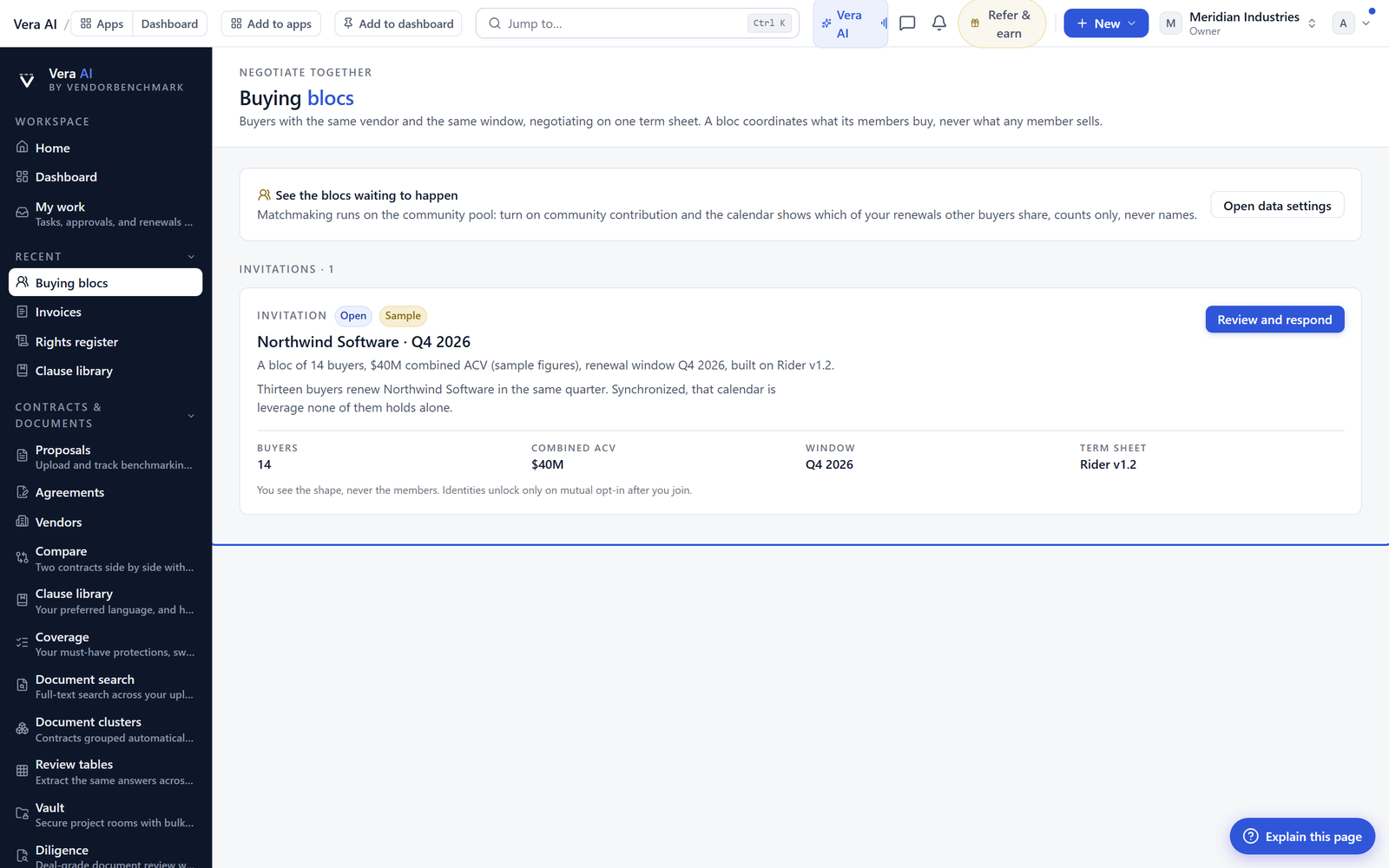
A bloc forms around one vendor. Buyers of the same vendor opt in, anonymously, and the bloc's size is visible before anyone's name is. You see that eleven companies with a combined renewal volume are aligned on Salesforce or Snowflake before deciding whether to raise your own hand.
The bloc shares a term sheet, not a price. What members align on is the standard asks, the uplift cap, the notice discipline, the audit conduct, essentially the rider families, plus a shared negotiation window: a stretch of months into which members time their renewals so the vendor meets the same positions repeatedly instead of once. Each company still negotiates its own deal, at its own price, under its own mandate. The bloc synchronizes the questions, never the answers.
Anonymity holds until both sides choose. Members are pseudonymous to each other and to the vendor until a deliberate mutual reveal, and what the bloc's concession wire shares, which asks the vendor has granted, to how many members, is aggregated under the same k-anonymity floor as the Outcome Network. You learn that the cap was granted four times this quarter. You never learn to whom, and neither does the rep.
What actually changes at the vendor's end
The bloc's power is not a boycott threat, it is precedent density. A deal desk can dismiss one buyer's request for an uplift cap as an exotic ask. It cannot dismiss the same request, in the same language, arriving from a dozen accounts inside one quarter, because deal desks run on templates and exceptions, and an exception requested often enough gets promoted into the template. Members feel this as a strange new experience: the vendor has already seen your ask, has already granted it somewhere, and knows you probably know that.
The concession wire compounds it. In the solo world, every buyer starts the "will they ever accept this?" question from zero, and vendors profit from the uncertainty. Inside the bloc, the wire answers it: the cap has been granted, the audit terms have been signed, the reduction right exists in the wild. Asks stop being brave and start being informed, which changes who blinks. And for the smaller member, the bloc is the great equalizer: the $80K customer walks in carrying the same term sheet, and implicitly the same market knowledge, as the $8M one.
Joining well, in four rules
On that last point, plainly, because it is the question every counsel asks first: blocs are buyers cooperating on standard contract terms and sharing their own outcome information, anonymized and aggregated, while each company independently decides its own purchases and prices. That is the same lawful shape as a group purchasing organization or an industry benchmark survey, structures decades old, and it is deliberately nothing like price fixing, which requires competitors coordinating what they charge their customers. Your legal team should still look, and the bloc documentation is written to be looked at.
The honest limit: blocs work where buyers share a vendor and a grievance, which means young blocs on niche vendors may sit at three members for a while, and a term sheet the vendor's whole market ignores can be ignored a little longer. The flywheel spins the other way too, though. Every granted ask on the wire makes the next one easier, every member makes the window heavier, and the vendor side taught everyone how this story goes: the organized side of a market sets its norms. For thirty years that was them. The bloc is what it looks like when it starts being you.
Morten brings two decades of enterprise and software procurement, with stints across Oracle, IBM, SAP, and Salesforce shaping how he reads a deal. He has led sourcing through hundreds of renewals, from mid market order forms to nine figure global agreements, and learned that the buyers who win are the ones who walk in knowing the market. He built VendorBenchmark to make that pattern recognition repeatable.
The week in enterprise software buying, in one email.
What shipped on the platform, and the pricing and licensing moves worth knowing before your next renewal. One email a week, to your work address. Unsubscribe any time.