The co-term trap: when aligning renewal dates costs you leverage.
Co-terming, folding every product onto one renewal date, is sold as tidiness and often bought as convenience. Sometimes it is the right move. Just as often it hands the vendor a single giant anniversary, strips your timing leverage, and turns many small negotiations into one you cannot walk away from.
Co-terming sounds like pure housekeeping. A vendor offers to align all your products onto a single renewal date, one anniversary, one invoice, one negotiation a year instead of a scattered handful. It is framed as simplification, and simplification is an easy yes, especially for a busy team drowning in renewal dates. The offer is usually sweetened with a small credit or a smooth proration to make the alignment painless. And often, quietly, it is one of the better trades the vendor will make all year, because of what you give up to get the tidiness.
What you give up is timing and optionality. Spread across the year, each product renews on its own date, which means each can be negotiated at its own best moment, benchmarked separately, and, crucially, walked away from without blowing up everything else. Fold them onto one date and you have created a single enormous anniversary where the vendor holds your entire relationship at once, on their preferred calendar, with a switching cost so large that walking away from any part means walking away from all of it. Whether that is a good trade depends entirely on your situation, and it deserves to be a decision, not a reflex.
What co-terming quietly takes away
The first cost of co-terming is timing. A vendor's discount authority peaks at certain moments, their fiscal quarter and year-end, and staggered renewals let you steer each product toward the moment it is most negotiable. Collapse them onto one date and you get one shot at one moment, which may or may not be the good one for every product in the bundle. You have traded several well-timed negotiations for a single one whose timing you no longer control.
The second and larger cost is leverage through separability. When products renew independently, each is a contained negotiation, and a credible threat to drop or re-tender one does not endanger the others. Co-termed, everything is entangled: the vendor knows that walking away from the overpriced module means unwinding the entire relationship on the same day, which almost no organization will do. The threat that gives you leverage on a single product loses its credibility when pulling it out means pulling out everything, and the vendor prices accordingly.
When co-terming actually pays
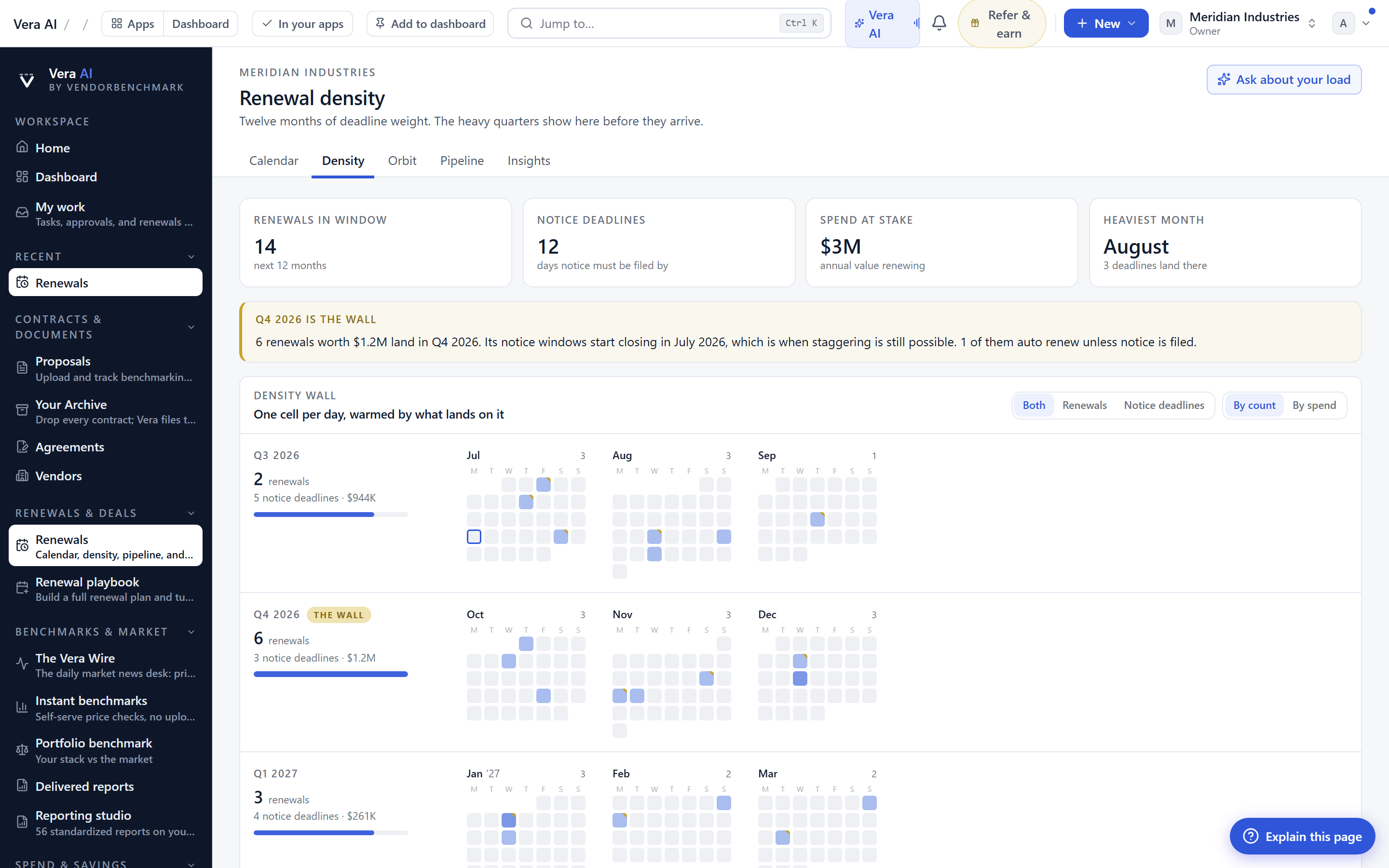
None of this makes co-terming wrong. There are real cases where aligning dates is the better move, and the trap is not co-terming itself but doing it without weighing the trade. The clearest case for it is when you are consolidating and negotiating up, not just tidying: if you are deliberately putting your whole spend with a vendor onto one date in order to negotiate a single larger deal from a position of strength, the concentration works in your favor, because now you hold a big number the vendor wants and you are choosing the moment.
Administrative cost is a legitimate factor too. A small team managing dozens of scattered renewals may genuinely lose more to missed notice windows and fragmented effort than it gains from staggered leverage, and for a commodity vendor where you have no intention of switching anyway, the timing optionality is worth little. The point is that these are specific, checkable conditions, and co-terming is right when they hold and wrong when they do not, which is a judgment you can only make if you can see the whole renewal picture at once.
See the whole calendar before you decide
The reason co-terming gets accepted without thought is that most teams cannot see their renewal calendar as a whole. The dates live in separate contracts, so the density, the clustering, the leverage points, are invisible, and a vendor's tidy alignment offer looks like a favor rather than a trade. Putting every renewal on one timeline, sized by spend, marked by notice deadline, and colored by risk, turns the abstract question of co-terming into a concrete one you can actually reason about: here is what my year looks like now, and here is what it looks like folded onto one date.
With the whole calendar visible, the co-term and consolidation decision becomes deliberate. You can see which renewals are worth keeping separate for their timing, which cluster is already creating a dangerous single point of exposure, and where deliberately aligning a set of products would strengthen a negotiation rather than weaken it. The adviser that surfaces these moves does so from the same view, so the recommendation to align or to keep apart comes with the picture that justifies it, rather than arriving as a vendor's framing you have no way to test.
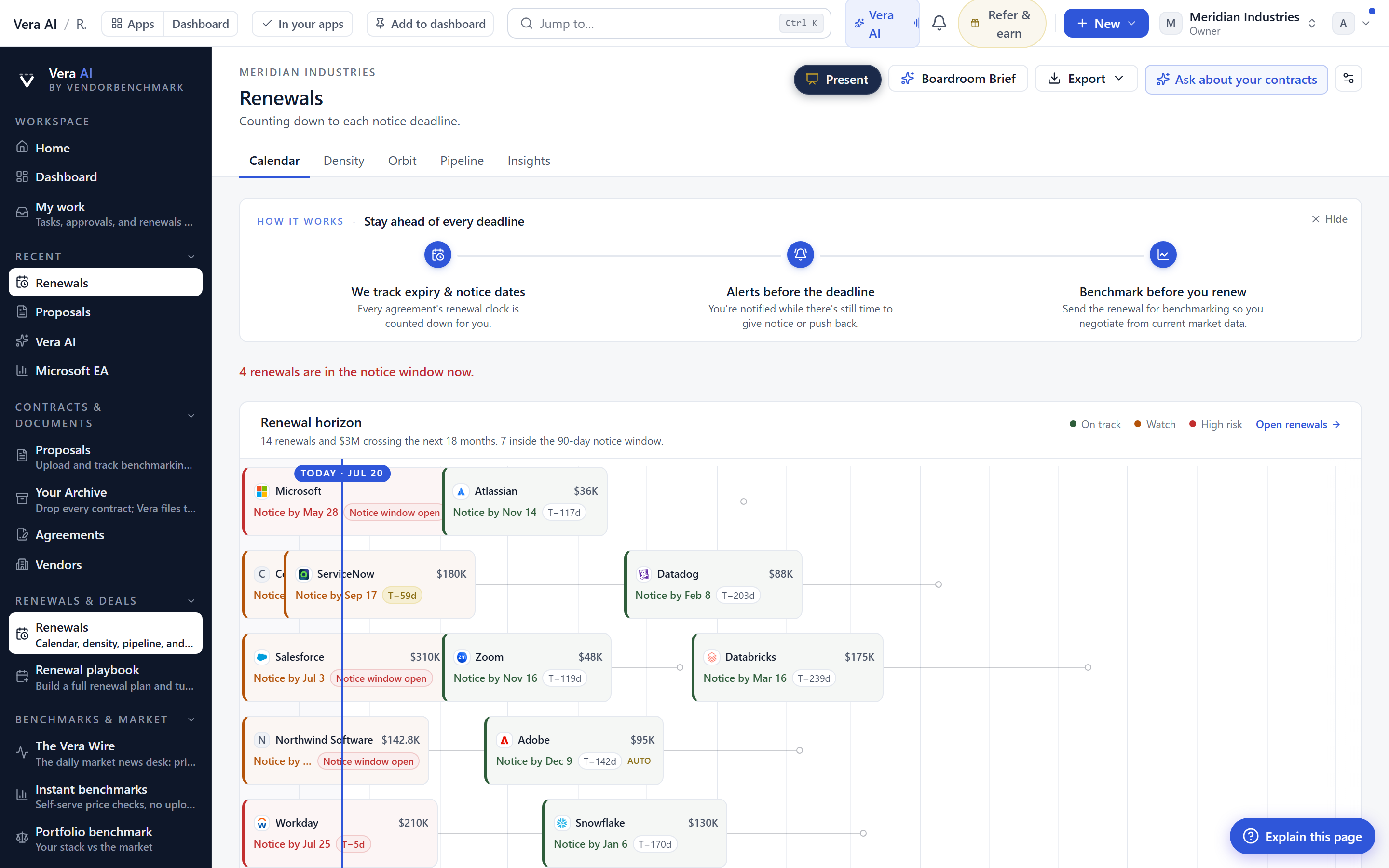
Weighing the co-term trade
Tidiness is a real benefit, just a priced one
The simplicity co-terming offers is genuine, and for some teams it is worth more than the leverage it costs. This is not an argument against ever aligning renewals; it is an argument against doing it without knowing the price. A view of the calendar tells you what that price is in leverage and timing, but the weight you put on administrative simplicity against negotiating strength is a judgment about your own team and situation that no tool makes for you.
What it removes is the reflex. Co-terming presented as a favor, accepted for tidiness, is how organizations quietly hand vendors the one thing they most want, which is your whole relationship concentrated on their calendar with the exits welded shut. Seeing the trade for what it is means you take the alignment when it strengthens your hand and decline it when it only strengthens theirs, which is the difference between simplifying your renewals and surrendering them.
Morten brings two decades of enterprise and software procurement, with stints across Oracle, IBM, SAP, and Salesforce shaping how he reads a deal. He has led sourcing through hundreds of renewals, from mid market order forms to nine figure global agreements, and learned that the buyers who win are the ones who walk in knowing the market. He built VendorBenchmark to make that pattern recognition repeatable.
The week in enterprise software buying, in one email.
What shipped on the platform, and the pricing and licensing moves worth knowing before your next renewal. One email a week, to your work address. Unsubscribe any time.