Cost corridor, heatmap, What Next desk: the flagship playbooks get the full method.
RISE with SAP, Oracle ULA, and IBM ELA now reach the depth of the Microsoft EA playbook: a built in consultant that reads your discovery answers, a live cost corridor on Mission Control, a heatmap that turns your classification argument into a picture, and a desk that drafts six emails from your numbers.
The Microsoft EA playbook earned its depth one feature at a time: a consultant that reads your situation, a corridor that frames the money, a heatmap that makes the argument visual, and a desk that turns the position into sent emails. That method is now the standard, and the other flagship playbooks have reached it. RISE with SAP, Oracle ULA, and IBM ELA each run the full pattern, tuned to their own economics.
The pattern matters because these three renewals share a shape: the vendor's opening number is a bundle that hides the real unit of negotiation. For SAP it is the FUE classification, for Oracle it is what you certify at exit, for IBM it is the gap between entitlement and deployment. Each playbook's heatmap exists to drag that hidden unit into the open.
The corridor: the whole money argument on one screen
Every Mission Control now leads with a live cost corridor. For RISE it is the move on SAP's opening proposal left unmanaged, what you pay today, and where the playbook lands the subscription. For Oracle ULA it is renewing for five more years, the fee plus support compounding on it, against certifying and exiting. For IBM it is the bundled renewal ask, last year's support plus the uplift plus the Cloud Pak padding, against the right sized run rate. One waterfall each, recomputing as you work the playbook.
A corridor does something a target number cannot: it shows the room the cost of doing nothing next to the cost of the vendor's ask next to your landing zone, which turns approve the plan from a leap of faith into a comparison of three visible bars.
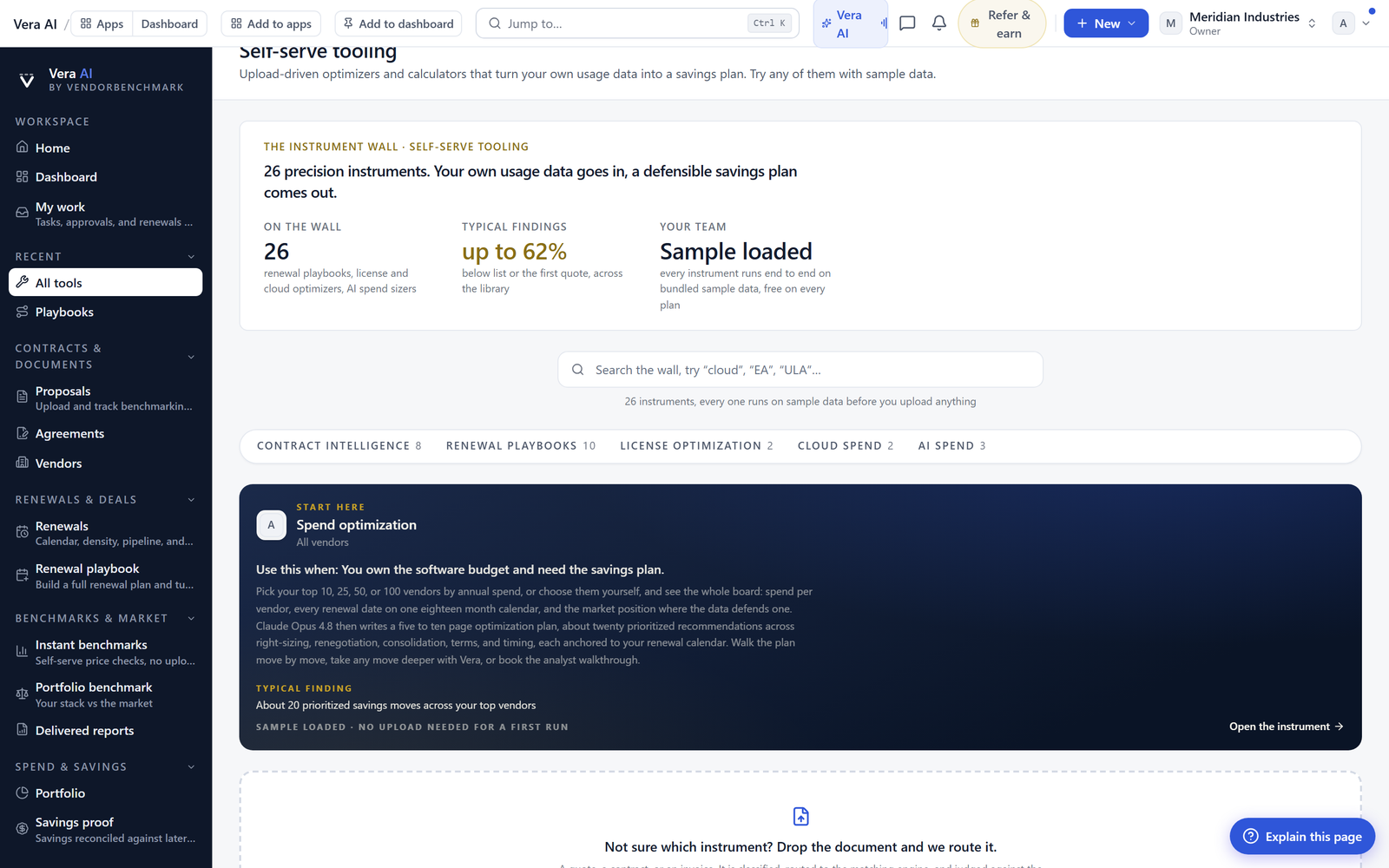
The heatmaps: your classification argument as a picture
The RISE FUE Heatmap plots SAP's four pricing bands, Advanced, Core, Self service, Developer, against how intensely each user population actually works in the system, so the approvers and requisitioners counted as Advanced users are visibly a band too high, with the reclassification value printed above the grid. The Oracle Certification Heatmap shows each option's deployed count, what you can defensibly certify it to, and the banking headroom between, flagging what to certify at its maximum and what to drop rather than renew. The IBM Right Sizing Heatmap puts entitlement, deployment, and the S&S paid on the gap side by side, product by product, and flags the heavy shelfware lines.
In each case the heatmap is the negotiation exhibit. The classification argument that dies as a spreadsheet attachment survives as a grid the vendor has to argue against cell by cell.
The consultant and the desk
Each playbook now carries a built in consultant that reads your discovery answers and opens each key screen with a posture, a leverage score, and a read tailored to your situation: your ILMT position on IBM, your VMware footprint and evidence quality on Oracle, your user activity mix on SAP. It is the difference between a tool with forty screens and an advisor who tells you which six matter for your deal.
And each ends in a What Next desk. Vera drafts six emails from your live numbers: the vendor facing ones carry only your deployment facts, never your target or the corridor, while the internal ones, the CFO brief, the procurement note, the team update, carry the full position. Digests, the management brief, and the exit ramps into the rest of the platform sit beside them.
The four parts, in every flagship playbook
The method is shared, the evidence is yours
A corridor built on guessed inputs frames a guess. Each playbook is explicit about which numbers came from your discovery answers and which came from the benchmark library, and the consultant's leverage score drops when your evidence is thin, which is itself information: it tells you what to go measure before you negotiate.
The remaining playbooks in the wall follow the same rollout, one at a time. The method replicates; the vendor economics never do, which is why each corridor and heatmap is built on that vendor's actual pricing mechanics rather than a generic template.
Morten brings two decades of enterprise and software procurement, with stints across Oracle, IBM, SAP, and Salesforce shaping how he reads a deal. He has led sourcing through hundreds of renewals, from mid market order forms to nine figure global agreements, and learned that the buyers who win are the ones who walk in knowing the market. He built VendorBenchmark to make that pattern recognition repeatable.
The week in enterprise software buying, in one email.
What shipped on the platform, and the pricing and licensing moves worth knowing before your next renewal. One email a week, to your work address. Unsubscribe any time.