Decodes keep the document, file the contract, and queue the benchmark
A decode used to end with a list of findings and a document you had to go and find again. It now ends with the source stored, the contract record created and the benchmark already requested.
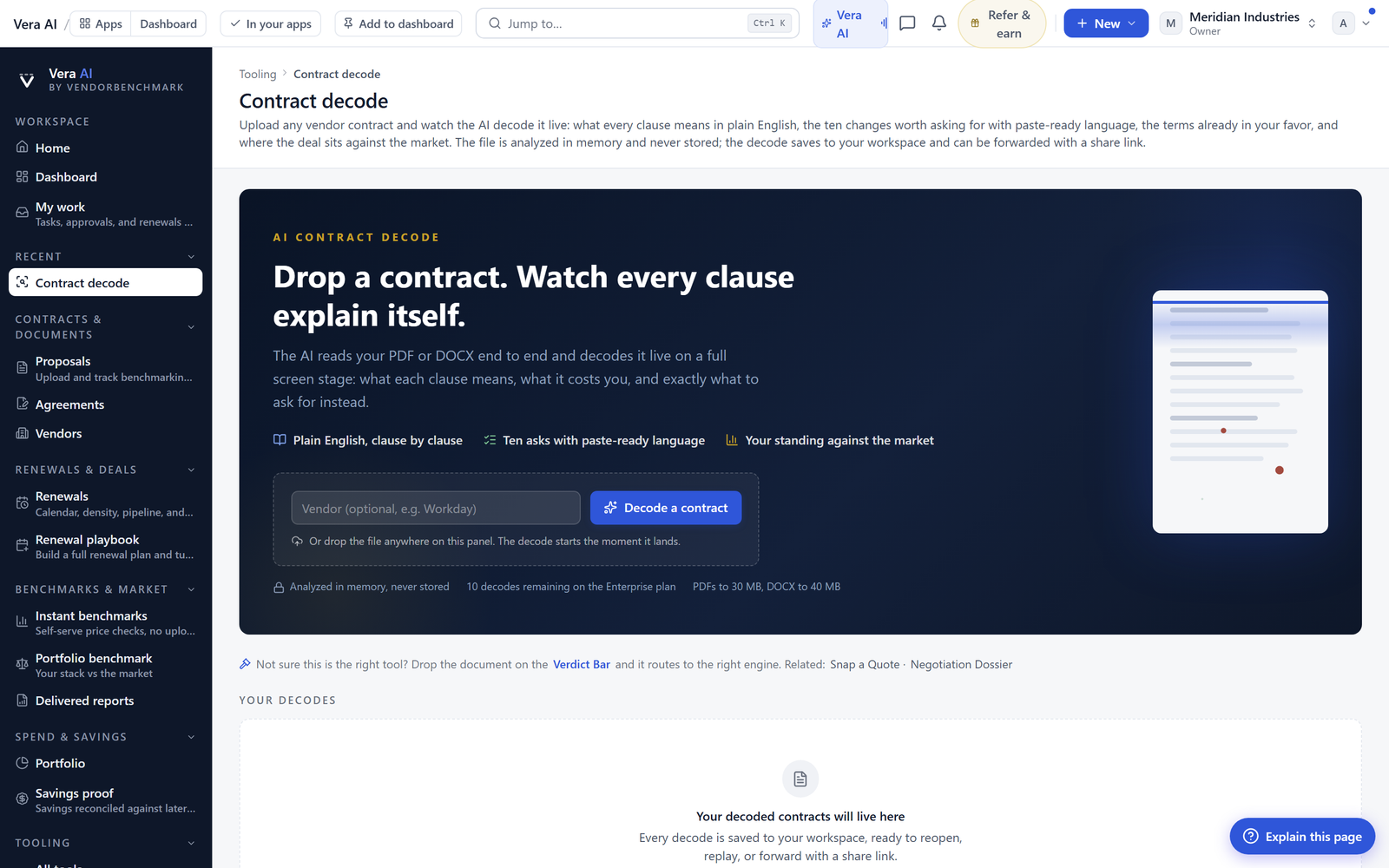
A decode is a concentrated act of attention. You hand the decoder a 62 page master agreement and, in about the time it takes to read the first schedule, you have the auto renewal mechanics, the uplift cap, the termination notice window and the indemnity carve outs, each pinned to the clause it came from. That part has worked for a while. What has not worked is what happened next, which was frequently nothing, because the decode lived in a browser tab, the document lived in a downloads folder, and the two of them never met again. This release closes that gap. The three decoders now keep what you hand them, file it as a contract, and put it in the benchmark queue before you have finished reading the findings.
The orphaned decode
Here is the failure mode we kept seeing in support threads and screen shares. A buyer decodes a renewal on a Tuesday afternoon. The findings are good, the call is Thursday, the laptop closes. On Thursday, on a different machine, they reopen the saved decode to prep and find a clean list of findings referring to clause 14.3, clause 22.1 and schedule 4, with no clause 14.3 anywhere in front of them. The source PDF is on the other machine, or buried in a mail thread, or in a shared drive folder named after a project that ended two quarters ago. So they hunt it down, upload it a second time, and read the findings and the paper in two separate windows, flipping between them.
That is the first tax. The second is filing. The decode already knows the vendor, the term dates, the renewal trigger and the annual value, because it just read all of that off the page. Yet the contract record still had to be created by hand, with the same fields typed a second time into a form by the same person who had just watched a machine extract them. The third tax is the benchmark. A freshly decoded document is precisely the thing that should be benchmarked, and the request had to be raised separately, with the vendor and the category selected again from scratch, usually a day or two later, usually only if somebody remembered.
None of these steps are hard. All of them are friction, and friction at the point of highest intent is the most expensive kind of friction there is. The moment the reveal ends is the moment a buyer knows the most about a document and cares the most about it. Anything that costs effort inside that window gets deferred, and in procurement, deferred is a synonym for dropped.
The document stays with the decode
When you upload to the contract decoder, the MSA decoder or the SOW decoder, the file is now stored privately inside your workspace. It is held under the same tenant isolation as your contracts and your spend data, and it is visible to your workspace only. A saved decode therefore reopens complete on any machine you sign in from. The findings appear with the original document beside them, so a finding that cites clause 14.3 shows you clause 14.3, in the vendor's own words, on the vendor's own page. There is no second upload and no hunting for the file.
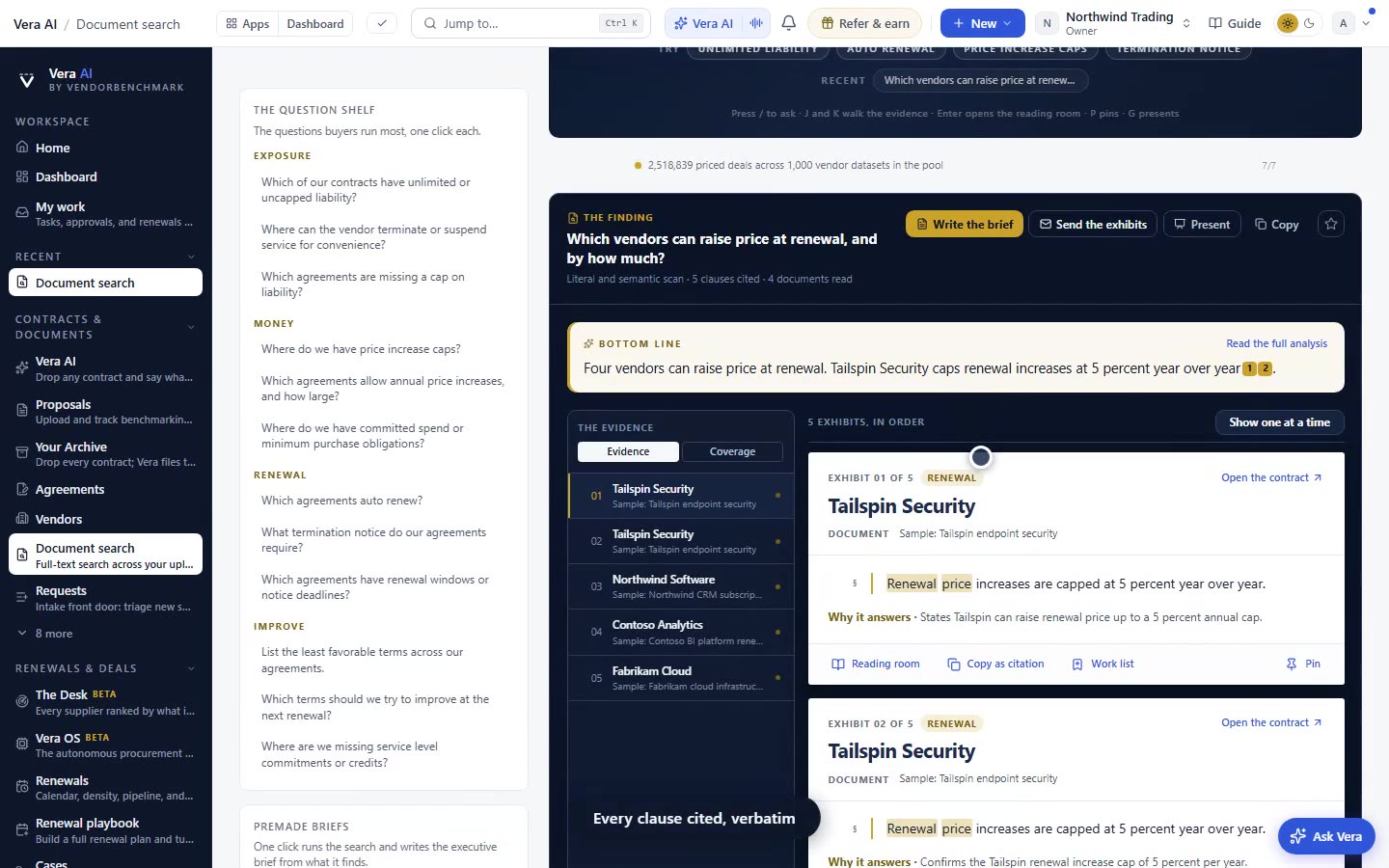
This matters more than it sounds. Half the value of a decode is that it lets you verify quickly, and verification requires the source. When you forward a finding to legal, or when you want to challenge a term in the vendor's own margins with the AI redline, the paper needs to travel with the analysis. Findings without the underlying clause are a summary. Findings with the clause open beside them are an argument you can take into a room.
The contract files itself and the benchmark queues
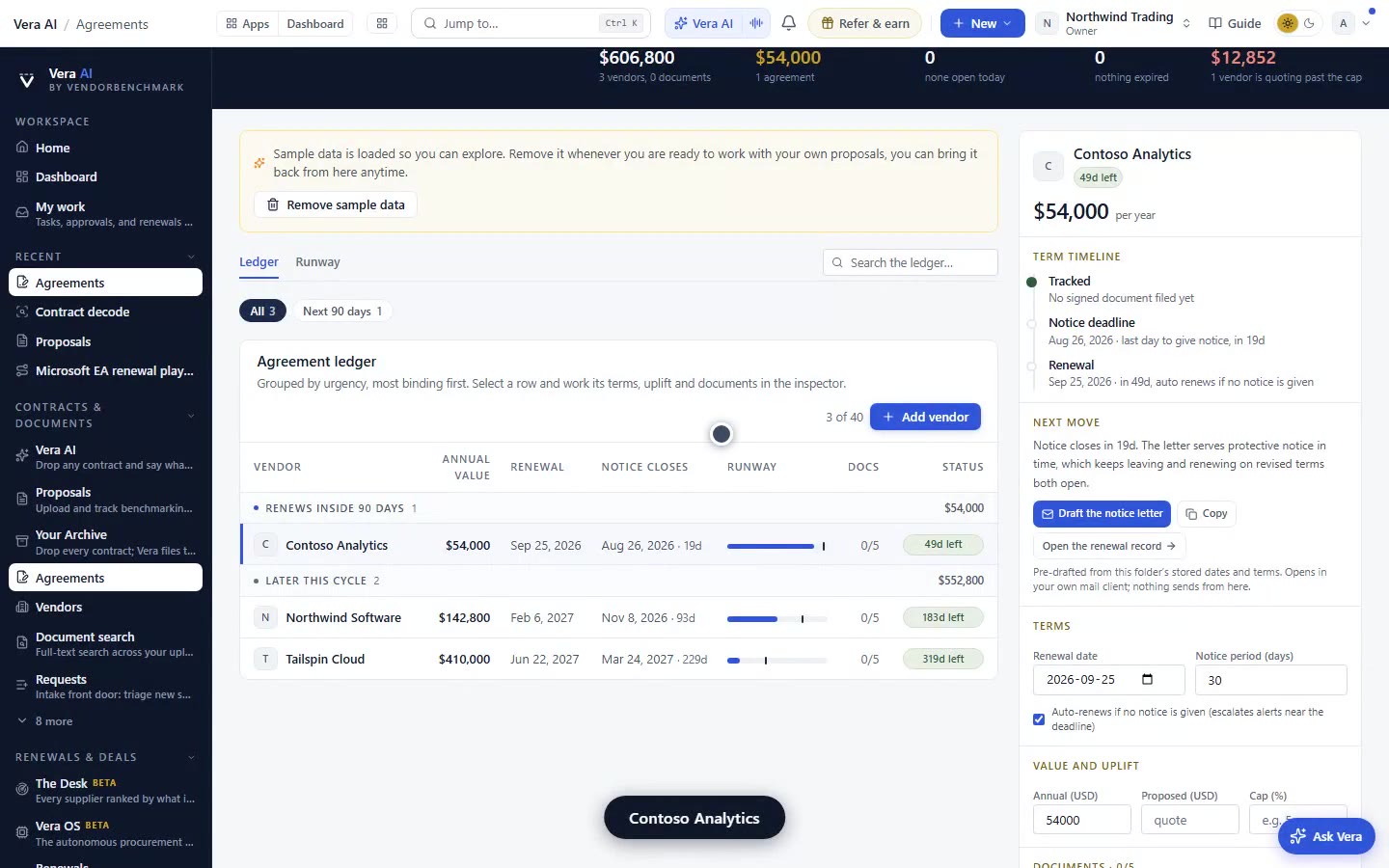
The same upload now creates a contract record, with the vendor filled in by the decode rather than typed by you. The record lands on the normal contract status path, so it appears in the renewal calendar and in review tables alongside everything else in the estate. You still own the record and can correct anything the decode inferred, but you start from a populated row rather than an empty form. The practical effect is that documents which used to sit outside the system, decoded but unfiled, are now inside it by default.
The benchmark is the third piece. When a decode completes, a benchmark request is raised automatically against your plan's allowance, using the vendor and category the decode identified. That puts the document on the analyst path the moment the reveal ends, rather than whenever someone gets around to it. The request lands against a library of 1,483 vendors benchmarked on modelled deal cohorts, which is the difference between knowing what the vendor is asking and knowing what the market actually paid. If you have ever accepted a headline discount that looked generous, the reason it looked generous is covered in discount off list is a trap. The benchmark is what converts a decoded price into a net unit price you can defend.
Downstream, this is what feeds the heavier deliverables. A decoded and benchmarked contract is the raw material for the Negotiation Dossier, and it arrives there with its source document, its clause citations and its market position already attached. Nothing has to be rebuilt.
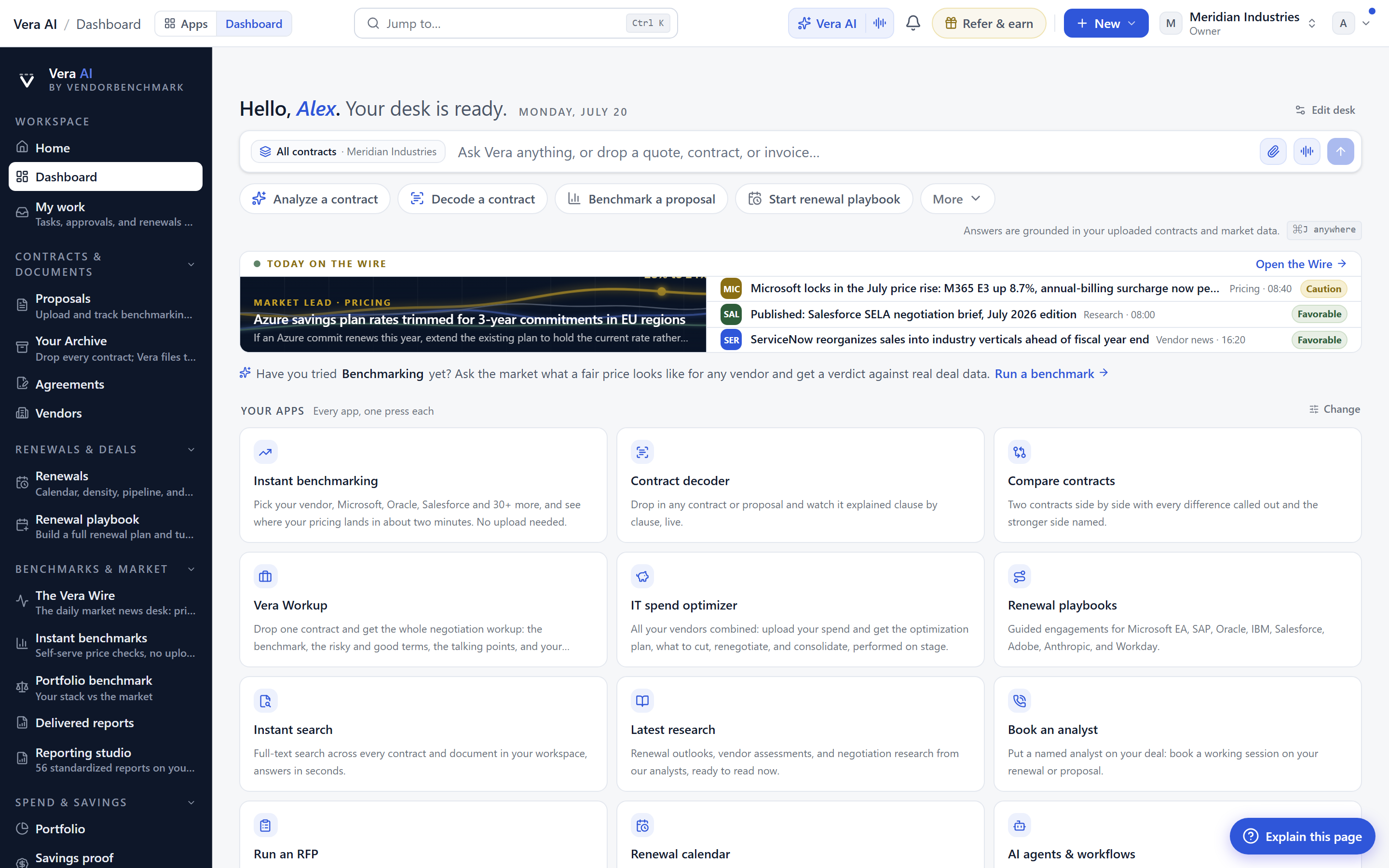
Your last actions, on the home screen
The last piece of this release is small and, judging by early usage, the one people notice first. The home screen now carries a Your last actions list holding your 20 most recent decodes, verdicts and benchmarks. One press returns you to any of them, complete, with the source document in place. It replaces the pattern of scrolling three different sections trying to remember whether the thing you were looking at on Friday was a decode or a verdict. For anyone working four or five vendors at once during a renewal cluster, it is the difference between resuming work and reconstructing it.
The limits, stated plainly
Storage is per workspace, not per person, and it follows your existing access rules. A colleague who cannot see your workspace still cannot see the document, and a colleague who can see the workspace can. If you decode something commercially sensitive that only two people should read, check your access settings before you upload rather than after. This feature makes documents easier to find, which is precisely why access hygiene matters more now than it did last week.
The automatic benchmark runs under your plan's allowance, and allowances are finite. Once yours is used, further decodes still store the document and still file the contract, but the benchmark will not queue itself until the allowance resets or is raised. If you are about to bulk decode a folder of forty agreements, expect the first tranche to queue and the rest to wait. The queue is also a queue. A benchmark request is analyst work with a turnaround, not an instant number on the screen, and it is described that way in the interface.
Vendor matching on the auto filed contract is an inference, not a certainty. Reseller paper, subsidiary entities and holding company names are the usual sources of error. If the contract is signed with a regional entity and your spend sits under the parent, the record may attach to the wrong node until you correct it. Take ten seconds to confirm the vendor on the filed record. That single check is what keeps the renewal calendar and the portfolio view honest.
The decode reads what is on the pages you give it, and nothing else. Side letters, order forms, unsigned amendments and email concessions that never made it into the paper are invisible to it. So are poor quality scans, where extraction accuracy degrades with image quality in the way you would expect. If a finding looks wrong, the source document is now right there, which is the point. Check it. The purpose of keeping the paper is to make disagreement with the machine cheap.
Finally, Your last actions is a convenience list capped at 20 items, not an audit trail. It is ordered by recency and it rolls over. If you need a durable record of who decoded what and when, use the contract record and the workspace activity history rather than the home screen list. The list is there to get you back to work quickly, and that is all it claims to do.
Fredrik has spent more than twenty years in enterprise software, with time at Oracle, IBM, SAP, and Salesforce before moving to the buy side. He structured and priced the kind of large agreements most buyers only see once or twice in a career, which taught him where the leverage sits and how far a vendor will actually move. He started VendorBenchmark to hand that knowledge to every sourcing team.