The plan was finished before procurement saw it
Scope, budget and a go-live date arrive as a finished package, and procurement is asked to execute rather than test. The fix is early market evidence, not louder objections.
It arrived as a calendar invite. Subject line: vendor selection kickoff. Attached, a two page business case that already named the product category, fixed the annual budget, and printed a go-live date in the second week of next quarter because that is when the retention window on the old system closes. Somewhere in the deck sat a slide that said procurement engaged. You were engaged the way a taxi is engaged, after the destination is chosen and the meter is running. You read the pack once and you can already see three things that will not hold. The budget assumes a discount someone half remembered from a conference. The timeline gives implementation eleven weeks when comparable rollouts in your sector routinely run longer. The scope includes a module most buyers strip out in year one. None of this is secret knowledge. It is only that nobody asked before the plan hardened into a commitment.
The plan closed before procurement opened it
The sequence matters more than the content. By the time the pack reaches you, the number has been through a steering committee, a finance review and at least one conversation with a sponsor who repeated it out loud to someone senior. It is no longer an estimate. It is a position. When you say the market clears higher, or that the timeline is short by a quarter, you are not correcting an assumption. You are asking three people to walk back something they already defended.
So the objection gets reframed as a procurement problem. If the market clears higher, negotiate harder. If the timeline is short, run the RFP faster. The scope, budget and date stay fixed and the only variable left is how much pressure sourcing can apply in the weeks remaining. That is not a negotiation strategy. That is a schedule with a person attached to it.
Why the sequence keeps repeating
The business is not being careless. It is being rational under its own constraints. A budget line has to exist before the capital request can be filed, and the capital request has a date. A go-live has to exist before the change programme can be sequenced. The people writing the case need numbers, and the fastest available source of numbers is the vendor who ran the demo. Vendor pricing guidance is not dishonest, but it is anchored to list, it assumes the reference implementation, and it prices the version of the deal the vendor would most like to sell.
Procurement's traditional answer is a policy. An intake form, a threshold, a rule that says sourcing must be involved above a certain value. Policies of that kind get followed on paper and bypassed in practice, because the business is not withholding information out of malice. It simply does not believe procurement has anything to add at the stage where a number is being invented. That belief is the actual problem. It is earned back with evidence delivered early, not with escalation delivered late.
What an untested plan actually costs
The cost is rarely a failed project. It is a series of small surrenders. The first quote comes in above the approved number, so scope gets trimmed in a hurry rather than by design. The timeline holds, so the commercial close compresses into two weeks and the terms that matter, uplift caps, ramp schedules, exit assistance, get traded away for signature speed. A multi year commitment gets signed to make the year one number fit the budget line, which converts a pricing problem into a three year lock.
None of those decisions look like errors in the moment. Each one is a reasonable response to a constraint that was never tested. Market reality did not arrive as an input to the plan. It arrived as a crisis two weeks before signature, when the only lever left was concession.
Test the number before it becomes a promise
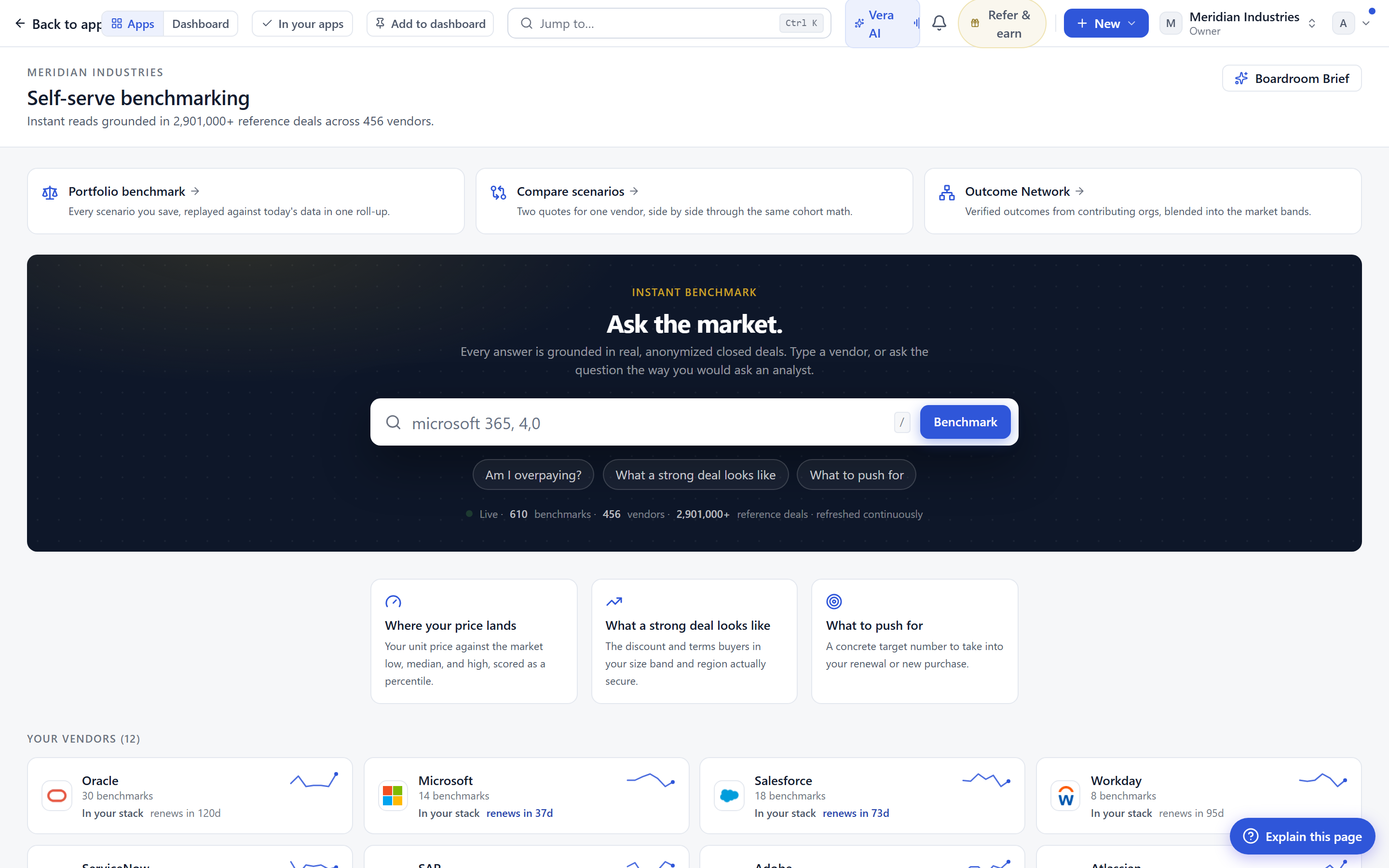
The platform motion here is narrow and deliberately unglamorous. Before the business case goes to approval, you take three inputs from it, the product family, the rough contract size and the intended term, and you check them against closed transactions. Not list prices, not analyst estimates, not what a vendor said in a demo. Deals that actually closed, with the discount, the term and the shape attached. The library holds 1,483 vendors benchmarked on modelled deal cohorts, and a typical query narrows to a cohort of comparable deals rather than a single reference point.
What comes back is a distribution, not an answer. You see where the proposed budget sits as a percentile against what peers paid. You see the term lengths those deals carried and whether the good outcomes came with three year commitments or annual ones. You see typical implementation durations attached to the same deal shapes. That last one matters more than buyers expect, because a go-live date is a commercial assumption wearing a project management costume.
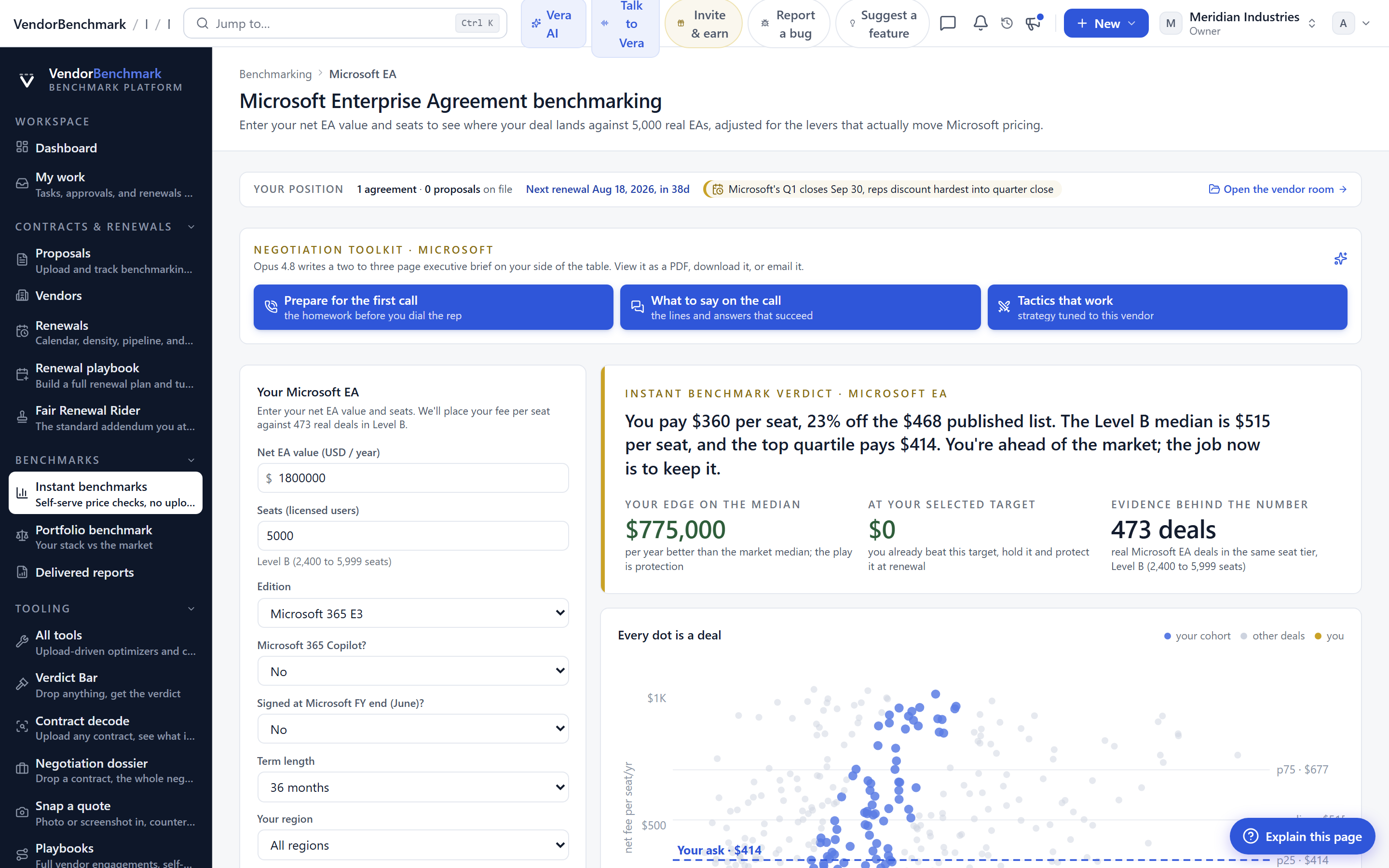
The point of returning a percentile rather than a target price is political as much as analytical. A sponsor who has defended a number in public cannot easily accept being told they were wrong. They can accept being told their number sits in the upper quartile and here is the evidence, would you like the plan to assume the median instead. That is a conversation about risk tolerance, and business leaders are comfortable having it. If you want to sanity check a single figure without any of this ceremony, the free price check does exactly that. If the pattern repeats across your estate rather than in one deal, benchmarking the portfolio is the better starting point.
What this does not fix
Benchmarks do not create authority. If your organisation has decided that sourcing signs what the business chooses, an accurate percentile will be read, acknowledged and ignored. Evidence shifts the odds in a room where the argument is genuinely open. It does not open a room that has been closed by governance design. That is an operating model problem and it is solved by the CFO, not by a data set.
Nor does a benchmark tell you what you should pay. It tells you what comparable organisations did pay for deals of a similar shape. Your leverage, your renewal timing, your willingness to walk and your consumption profile all move the number, sometimes considerably. A cohort of comparable deals is a starting position and a sanity check. It is not a target, and treating it as one produces false confidence in the other direction. Freshness matters too, which is why we write separately about how the data stays current, because a stale distribution is worse than no distribution.
And it will not recover a plan that is already committed. If the board approved the figure last month and the sponsor has told the executive team the date, benchmarking now gives you a well documented account of how far off the plan was. Useful for the retrospective. Less useful for this deal. The whole value of the motion is that it happens in the window between someone inventing a number and someone defending it, and that window is usually about two weeks wide.
Fredrik has spent more than twenty years in enterprise software, with time at Oracle, IBM, SAP, and Salesforce before moving to the buy side. He structured and priced the kind of large agreements most buyers only see once or twice in a career, which taught him where the leverage sits and how far a vendor will actually move. He started VendorBenchmark to hand that knowledge to every sourcing team.