Benchmark the portfolio, not one deal at a time.
Single-deal benchmarking has a blind spot: it optimizes whichever deal happens to be on your desk, and the deal on your desk is rarely the one costing you most. Portfolio benchmarking replays every position against today's market continuously, ranks the estate by recoverable dollars, and turns triage from a guess into a standing answer.
Procurement attention is allocated by the calendar and the squeaky wheel: the renewal that is due, the vendor that misbehaved, the deal an executive asked about. Meanwhile the estate's real losses sit quietly in positions nobody has looked at since they were signed, drifting further from market each year at 6 percent compounded, precisely because they never make anyone's week. The question that decides whether a benchmarking practice moves the total number is not "is this deal fair?" It is "which of my 300 positions is furthest from fair, weighted by what it costs me?" and no amount of deal-by-deal diligence answers it.
That is a portfolio question, and it needs portfolio machinery: every vendor's position measured the same way, refreshed as the market moves, and ranked by money rather than by noise.
Positions, not snapshots: how the portfolio stays current
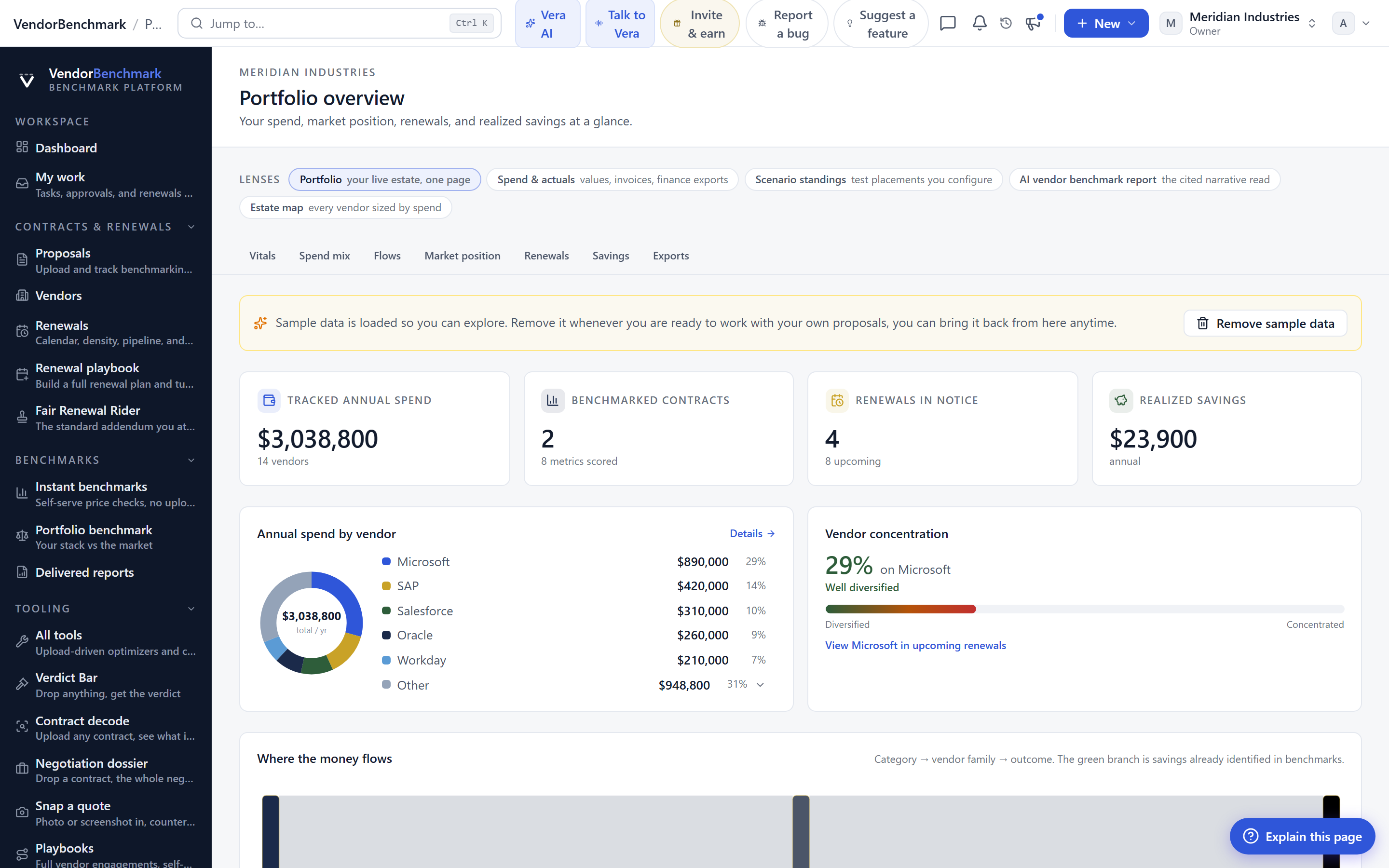
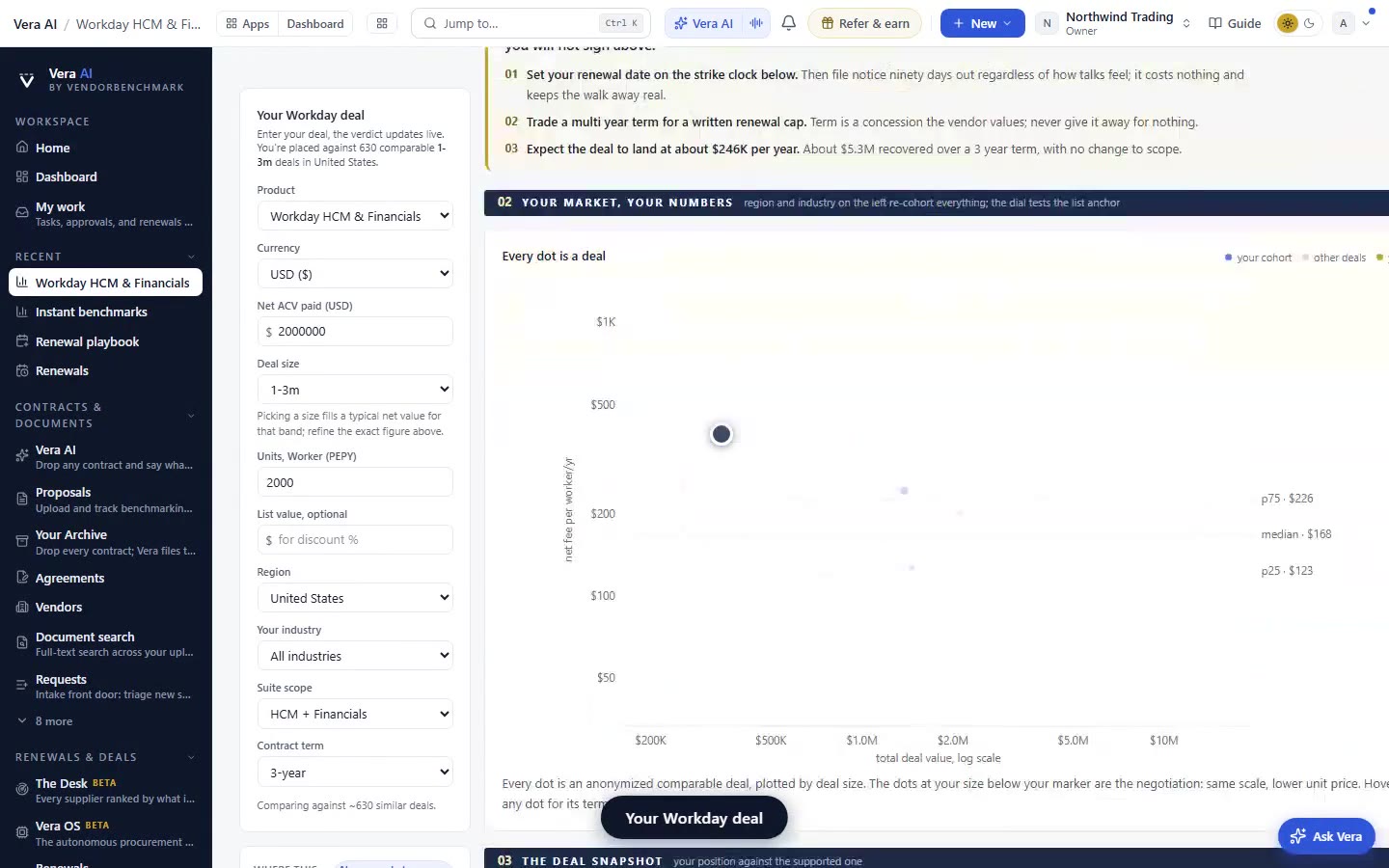
The mechanic that makes this work is that a benchmark on this platform is a saved position, not a one-time answer. Every scenario you run, each vendor's net unit price against its cohort, persists, and the platform replays the whole set against the live market as the cohorts move. The Microsoft position you measured in March is still being measured in September, against September's market, without anyone re-running anything.
Two consequences follow. First, the portfolio view is always current: every vendor's percentile, the gap to median in dollars at your volumes, and the total recoverable number across the estate, computed from live positions rather than from a quarterly exercise someone has to remember. Second, drift becomes visible. When the market moves against a saved position, new entrants price aggressively, a cohort's median falls, a vendor's list increase ripples through the cohorts, the alert fires while there is still a renewal window to aim at, which is how a benchmark stops being a photograph and starts being a watchman.
From ranking to campaign: the calendar does the sequencing
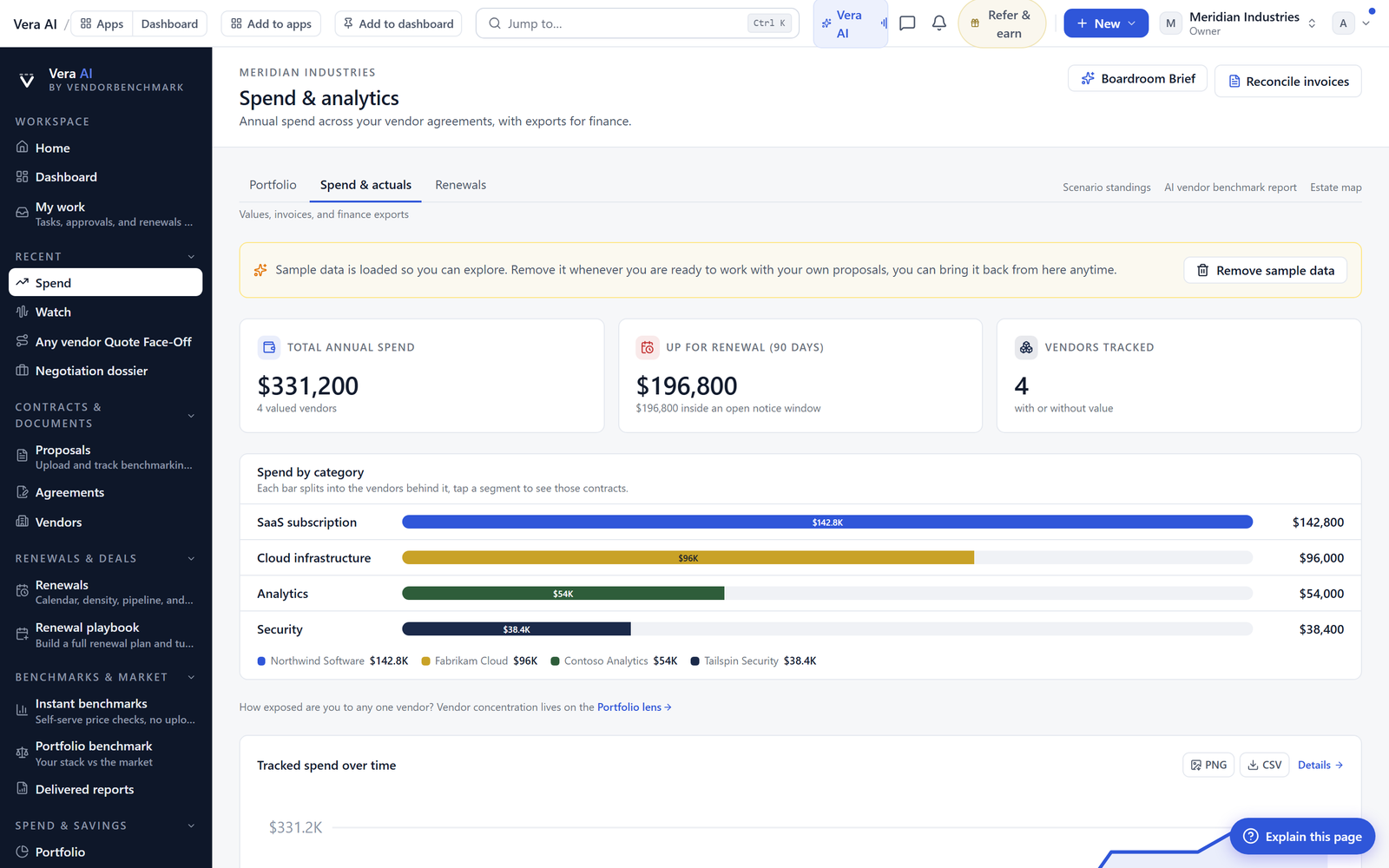
A ranked list of overpriced positions is analysis. A campaign is that list crossed with the renewal calendar, because the gap you can act on is bounded by the window that lets you act. The portfolio view attaches each position's next notice deadline, and the resulting sequence, biggest recoverable gap whose window opens soonest, is the closest thing procurement has to an optimal work order. The quiet mid-size vendor at P22 with a January window outranks the famous vendor at P48 who is locked for two years, and without the portfolio view nobody would have looked at the first one at all.
The spend layer completes the triage. Position gaps matter in proportion to the spend behind them, so the portfolio weights by annual cost and shows concentration: the ten vendors that are most of the money, the long tail that is most of the noise. That split drives resourcing honestly, war rooms and dossiers for the head, managed renewals and rider-by-default for the tail, and every position feeding the same one-page answer when finance asks how it is going.
Run it like a portfolio manager, in four habits
The honest limit: a portfolio is only as good as its inputs, and an estate view built on stale contracts or unbenchmarkable niche vendors will rank noise. The discipline that fixes it is the same one that built the view: contracts uploaded as they close, positions saved as they are measured, and the handful of vendors with no meaningful cohort marked as such instead of forced into one. What the portfolio ends is the era of attention allocated by squeaky wheel. The estate finally competes for your time on the only fair basis there is: what fixing each piece of it is worth.
Morten brings two decades of enterprise and software procurement, with stints across Oracle, IBM, SAP, and Salesforce shaping how he reads a deal. He has led sourcing through hundreds of renewals, from mid market order forms to nine figure global agreements, and learned that the buyers who win are the ones who walk in knowing the market. He built VendorBenchmark to make that pattern recognition repeatable.
The week in enterprise software buying, in one email.
What shipped on the platform, and the pricing and licensing moves worth knowing before your next renewal. One email a week, to your work address. Unsubscribe any time.