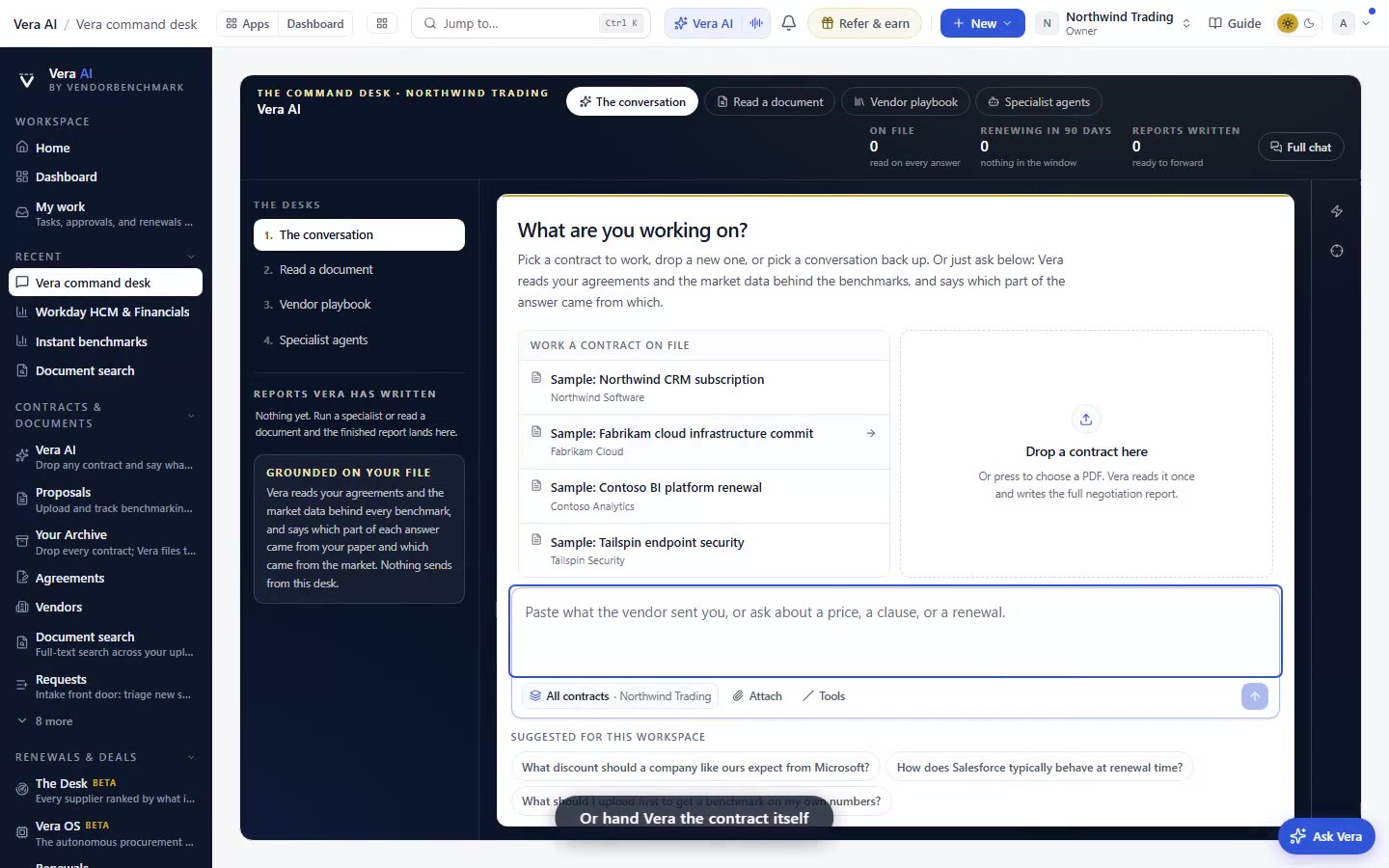
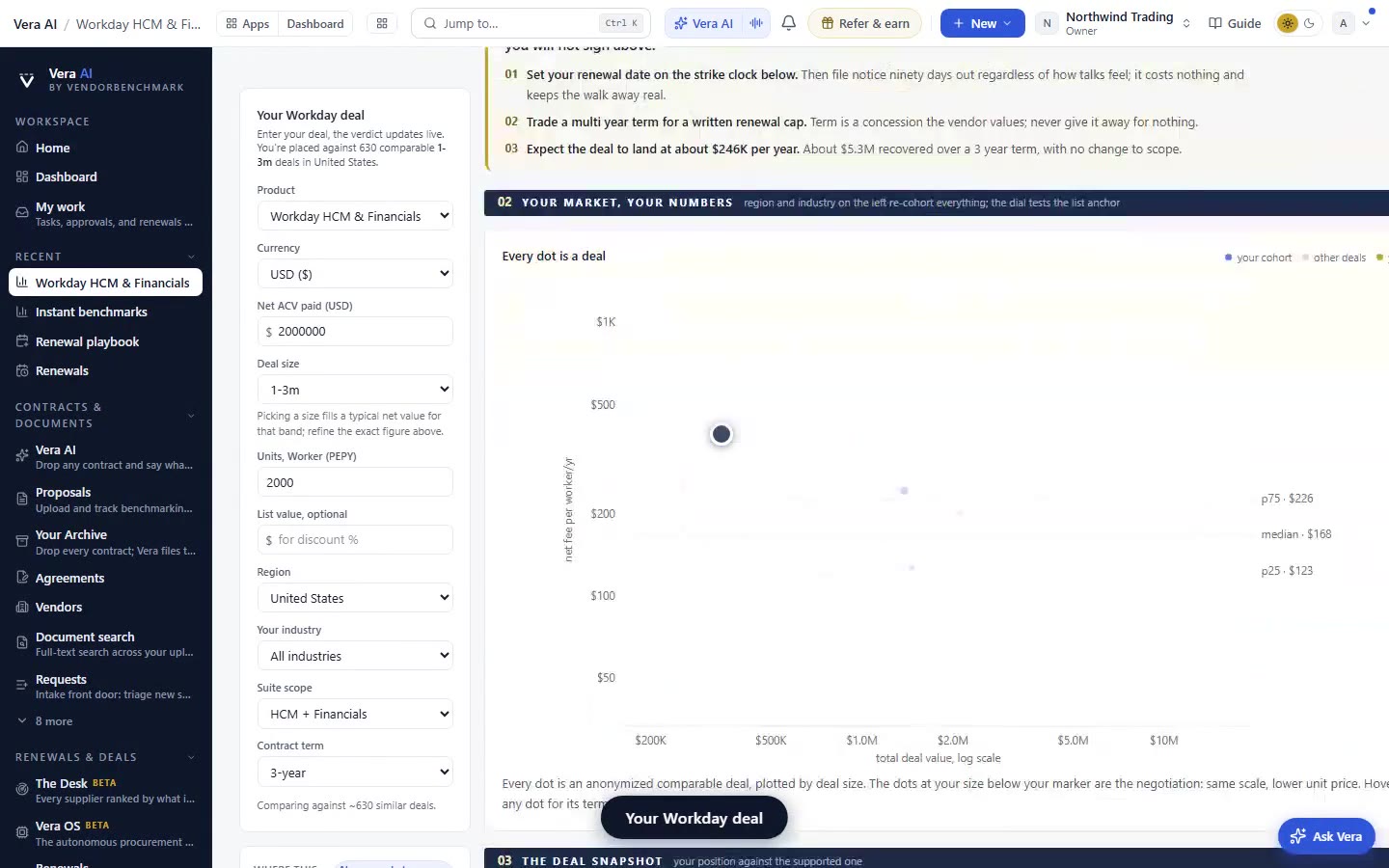
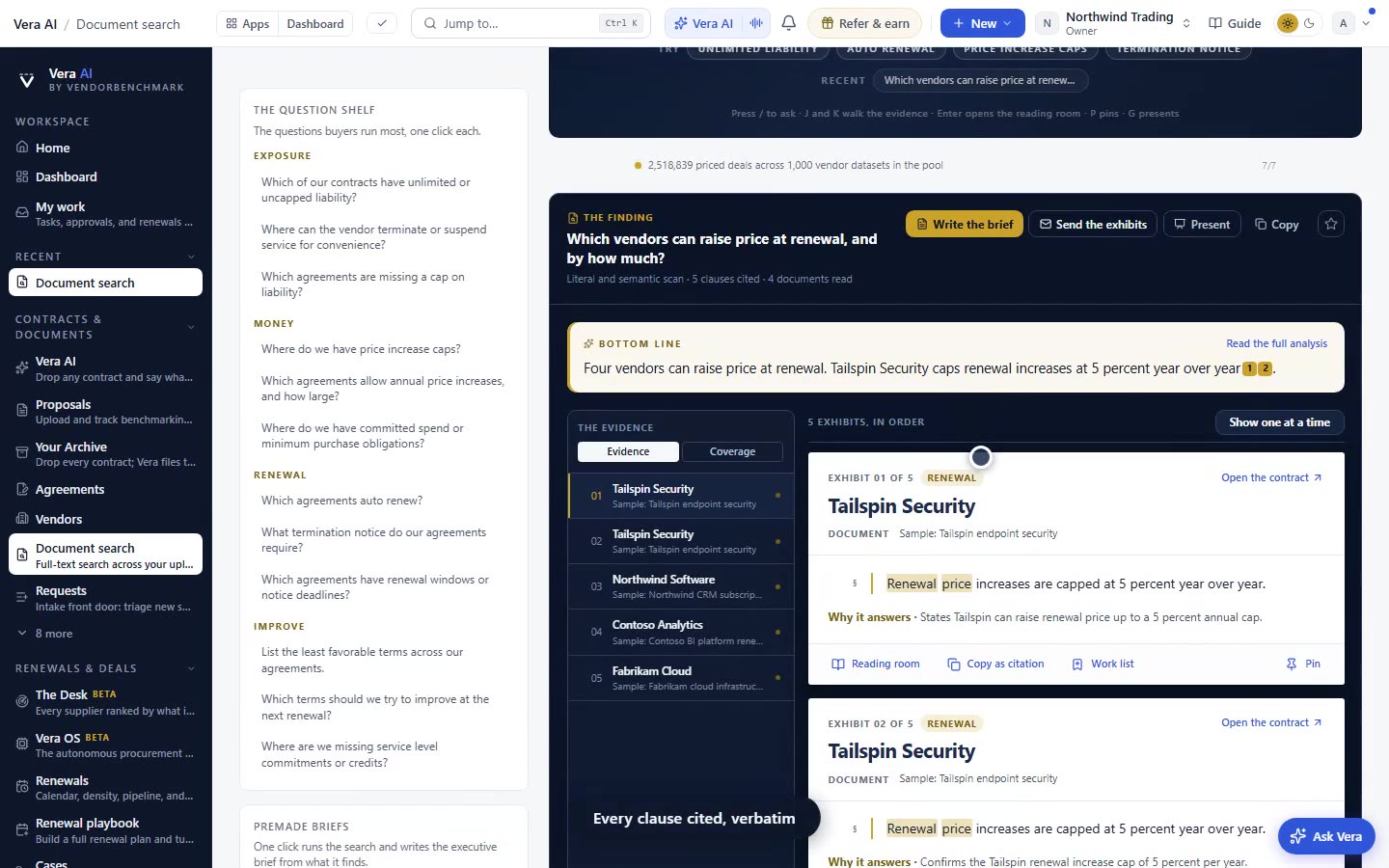
The benchmark sheet works like an application, and carries the vendor's Negotiator's Guide
We rebuilt the sheet in the Benchmark Library so it reads like the verdict and works like an application. The vendor's own Negotiator's Guide now sits on the sheet.
You know the problem even if you have never named it. The benchmark told you the price was high, and then it stopped. It gave you a percentile and a red bar and left you to build the negotiation yourself in a spreadsheet, a calendar, and three email threads. The gap between knowing the number and moving the deal was yours to close, on your time, usually the week before the call. This update closes most of that gap. The sheet in the Benchmark Library no longer just reports a verdict. It carries the walk, the vendor's fiscal clock, and the vendor's own Negotiator's Guide, on the sheet, so the reading and the plan sit in one place.
The sheet is redrawn to read like the verdict
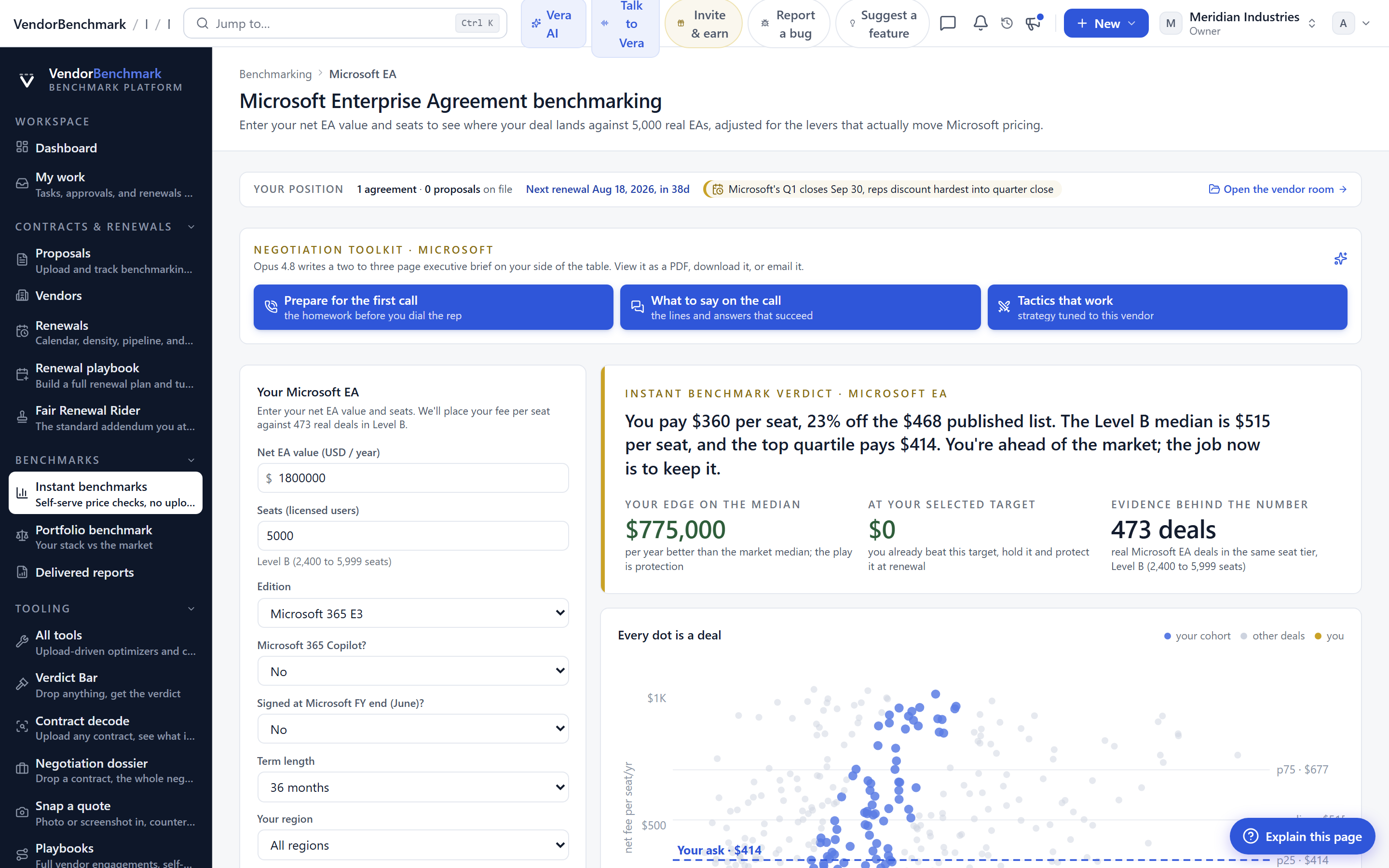
We took the sheet apart and rebuilt it as flat panes with quiet type. No chrome competing with the number. At the top, the verdict and the three questions that decide whether you act. Below that, the panes you actually use in a live negotiation. This continues the direction we set when every vendor benchmark started opening as the verdict reading, and when the benchmark opened as a window rather than a static page. The difference now is that the window does work. It holds the price walk: the offer, the term, the uplift proposed and the cap you hold, and what that cap is worth over the full term. That last figure is the one buyers forget to compute under time pressure, and it is the one that reframes the room.
The vendor's clock, the curve, and the market map
Timing is leverage, and leverage decays. The sheet now carries the vendor's year: the days to the quarter close and the days to the year end, read straight off the pane rather than reverse engineered from a fiscal calendar you had to remember. Beside it sits the curve, and beside that the market map with the ranked comparables. This is the same discipline behind drawing the verdict on the vendor's own curve: you argue with the vendor's shape, not against an abstract average. For a Salesforce renewal, where fiscal timing and the true-down decide a great deal of the outcome, this matters more than usual, and we have written separately on the true-down, the bundle, and fiscal timing.
The Negotiator's Guide, on the sheet
This is the part that changes the day. Each published guide sits on the sheet and lays out the negotiation for that specific vendor: the three things that decide the outcome, the six factors, the calendar, the runway, the benchmarks by line, the tactics that work against this vendor, the ten step playbook, what buyers miss, and the clauses to check. It is not generic advice. It is written per vendor, against the same evidence base that feeds the Benchmark Library reading your whole book. Read further opens the dossier and the curve document in the research library when you want the long form. Watch plays the vendor's films on the sheet when you would rather listen than read.
What ships today, and what says coming soon
Five guides are published today: Salesforce, 3M, 1Password, 4imprint, and 120Water. Every other vendor in the library says coming soon and keeps its benchmark. Nothing you relied on has been taken away. The percentile bars, the comparables, and the verdict remain on every vendor sheet. What is new is the guide layer, and it arrives vendor by vendor rather than all at once, because a real Negotiator's Guide is written and checked against the deals we hold, not generated in bulk. If your vendor is not among the five, you still get the full benchmark reading and the price walk. You just do not yet get the ten step playbook written for that name.
Where this fits your workflow
The sheet is the middle of the flow, not the end of it. You reach it from the library, and the library reaches across your whole estate. If you are working the portfolio rather than one deal, the ranked view of vendors by distance from market is still the place to start, as we covered in benchmark the portfolio, not one deal at a time. When the guide points you to a clause, the clause library holds your standing positions. When it points you to timing, the renewal calendar holds the dates for the rest of your book. The guide sends you outward with a plan, rather than leaving you to assemble one. Learn more about the evidence base at /benchmarking.
What this does not do
Be clear on the edges. First, coverage. Five guides are live today. The other vendors keep their benchmark but show coming soon on the guide layer, so if your renewal is a name we have not yet written, you get the reading and the walk but not the vendor-specific playbook. Second, the cap value over term is arithmetic on the figures you and the vendor put in. It is only as good as those inputs, and it does not account for scope changes, usage growth, or a mid-term amendment you have not modelled. Third, the tactics that work are drawn from patterns across closed deals, not a guarantee for your specific account, your specific rep, or your specific quarter. A guide narrows the range of good moves. It does not remove judgement, and it does not replace your read of the room. Use it as the prepared brief it is, and keep deciding for yourself which move you make and when.
Want to be updated when major licensing and pricing changes land? One analyst brief a week: the price rises, metric changes and audit campaigns that move software costs. Work email only.
Morten brings two decades of enterprise and software procurement, with stints across Oracle, IBM, SAP, and Salesforce shaping how he reads a deal. He has led sourcing through hundreds of renewals, from mid market order forms to nine figure global agreements, and learned that the buyers who win are the ones who walk in knowing the market. He built VendorBenchmark to make that pattern recognition repeatable.