The 24-month spend forecast finance can actually budget from.
Most software budgets are last year's number with a hopeful percentage on top. Finance deserves better, and so does the renewal. A 24-month forecast projects each vendor forward from real market drift, your own caps, and the uplifts you have actually been paying.
Ask most organizations how they budget software spend for next year and the honest answer is: this year's number, plus a percentage someone felt was reasonable. It is applied across the board, the same optimistic bump on the vendor that raises prices seven percent every renewal and the one whose contract caps increases at three. It is a single flat assumption standing in for a few hundred very different trajectories, and finance knows it is soft, which is why the software line is the one that always seems to surprise the budget.
A real forecast does not smear one number across the estate. It projects each vendor forward on its own path, because each vendor is on its own path. The 24-month forecast is built to be the version of the software budget that finance can actually plan against and the renewal team can actually use, because it is assembled from what is really driving each line rather than a hope applied uniformly.
Three real signals, per vendor
The forecast blends three grounded inputs for each vendor rather than one guess for all of them. The first is market drift: how prices for that vendor and its category are actually moving across the reference set, so a vendor in a hardening market is projected up and one in a softening one is not. The second is your own contract reality: the uplift caps you negotiated, which put a ceiling on what the vendor can do regardless of the market. The third is your history: the increases you have actually realized on that vendor at past renewals, which is often the truest signal of all.
Blending those three is what makes the line credible. A vendor with a hard cap cannot be projected above it no matter how hot the market runs. A vendor where you have quietly absorbed above market increases for years gets a forecast that reflects that pattern, not a flattering assumption that this time will be different. The number is built from evidence about that specific vendor, not a blanket rule.
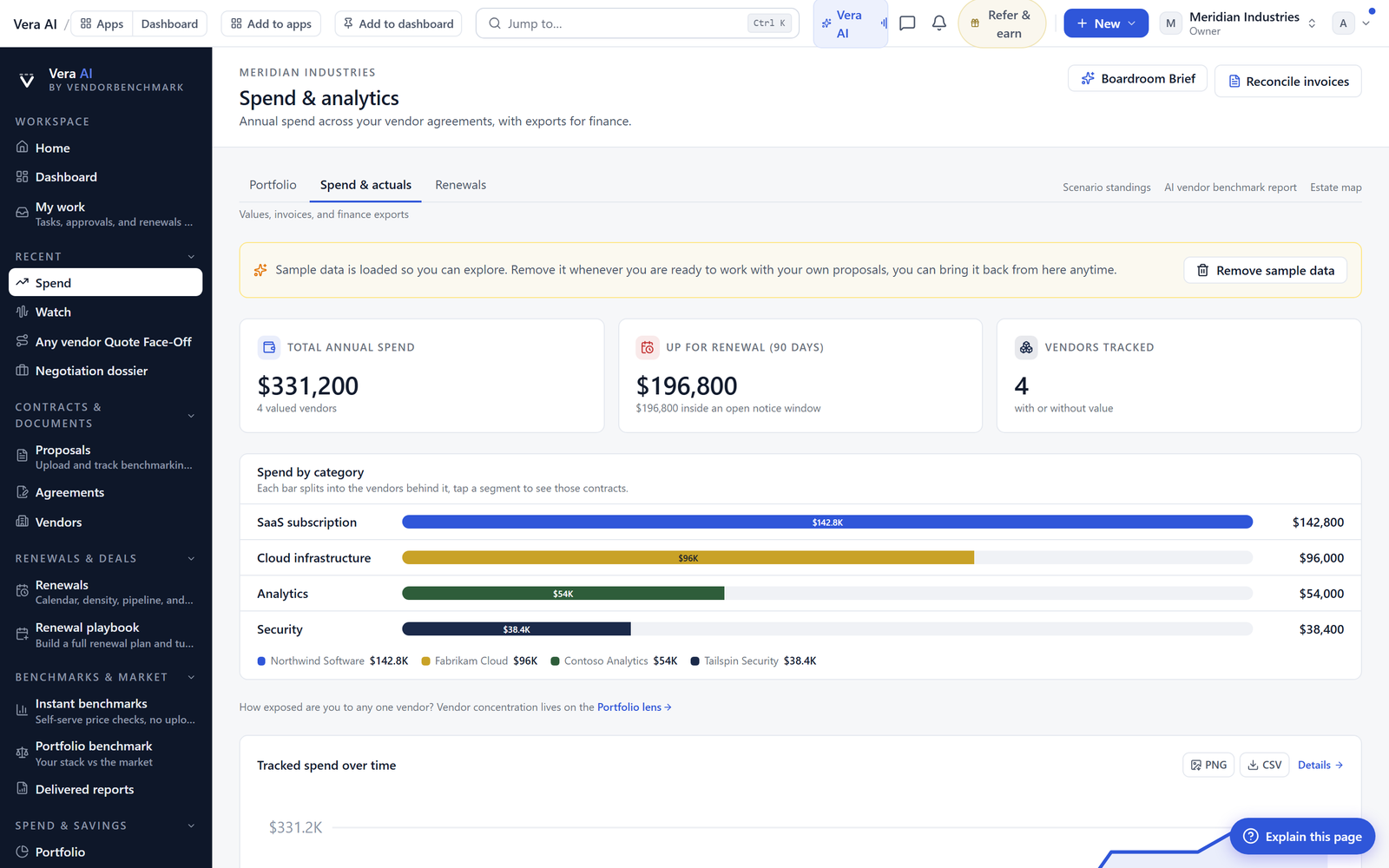
A budget line and a negotiation target at once
The same forecast serves two audiences that rarely share a number. For finance, it is a defensible budget: a 24-month projection of software spend built from real drivers, broken down by vendor, that holds up when the CFO asks where a figure came from. The answer is no longer a shrug and a percentage, it is this vendor's cap, this vendor's market drift, this vendor's history.
For the renewal team, the same projection is a target. A vendor the forecast expects to push a large increase is a vendor to prepare for early, and the gap between the uncapped market drift and your own capped path is a direct measure of what those caps are worth and where the next one is most needed. One artifact tells finance what to budget and tells procurement where to fight, which is unusual, because those two numbers are usually produced separately and disagree.
Want to be updated when major licensing and pricing changes land? One analyst brief a week: the price rises, metric changes and audit campaigns that move software costs. Work email only.
The three signals behind each line
A projection is not a promise
A forecast is a model, and a model is a set of assumptions about a future that has not happened. A vendor can break its own pattern, a market can turn, an acquisition can reprice everything overnight. The 24-month projection is the most defensible line you can draw from what is currently known, not a guarantee of what the invoices will say.
But a projection built from real drivers, per vendor, is a categorically better starting point than one number smeared across the estate. It gives finance a budget it can defend and procurement a map of where the pressure is coming from, both from the same grounded source. The software line stops being the one that always surprises, because for the first time it was actually forecast.
Fredrik has spent more than twenty years in enterprise software, with time at Oracle, IBM, SAP, and Salesforce before moving to the buy side. He structured and priced the kind of large agreements most buyers only see once or twice in a career, which taught him where the leverage sits and how far a vendor will actually move. He started VendorBenchmark to hand that knowledge to every sourcing team.
The week in enterprise software buying, in one email.
What shipped on the platform, and the pricing and licensing moves worth knowing before your next renewal. One email a week, to your work address. Unsubscribe any time.