FinOps meets procurement: the cloud commit is a shared decision.
FinOps spends the year driving cloud usage down. Procurement spends a few weeks negotiating the commit up. They are optimizing the same bill from opposite ends, usually without talking, and the vendor is delighted. The cloud commitment is where the two functions have to meet, on one number.
Two functions own the cloud bill, and they mostly work in different rooms. FinOps spends the whole year driving usage down, right-sizing instances, killing idle resources, tuning workloads, chasing efficiency. Procurement shows up for a few intense weeks to negotiate the enterprise commitment, the multi-year spend promise that earns the discount. Both are trying to reduce the same bill, from opposite ends, and they frequently do it without coordinating, which is precisely the gap the cloud vendor is built to exploit.
The problem crystallizes at the commit. A cloud commitment is a bet on future usage, and the two functions hold the two halves of the information needed to size it well. FinOps knows the real run rate and where it is genuinely heading after optimization. Procurement knows how to turn a commitment into leverage and a discount. Sized without FinOps, the commit is a guess dressed up as a forecast; negotiated without procurement, the discount is left on the table. The commit is the one decision where these two functions cannot afford to be in separate rooms.
The commit needs both halves of the truth
The vendor's pitch for a commit is a growth story: your usage is climbing, commit big now, lock in the rate. The only honest counter to that story is a real run rate, and that is FinOps's to give. What does the estate actually spend today, what is the baseline after the optimizations already in flight, which spikes are structural and which are one-off? A commit sized to the vendor's forecast overshoots; a commit sized to FinOps's measured, optimized reality is one you will actually consume. FinOps is the reason the number is grounded rather than aspirational.
But a grounded number still has to be turned into a deal, and that is procurement's craft. The commitment level, the discount tiers, the term, the flexibility to true up, the timing against the vendor's fiscal year, these are negotiation levers FinOps does not typically hold. The right commit is the intersection: FinOps sizes it from reality, procurement negotiates the best terms on that size, and neither function alone can produce it. Handed off in sequence, with FinOps optimizing then procurement negotiating months later against a stale number, the two halves never meet at the moment they need to.
One shared surface, one shared number
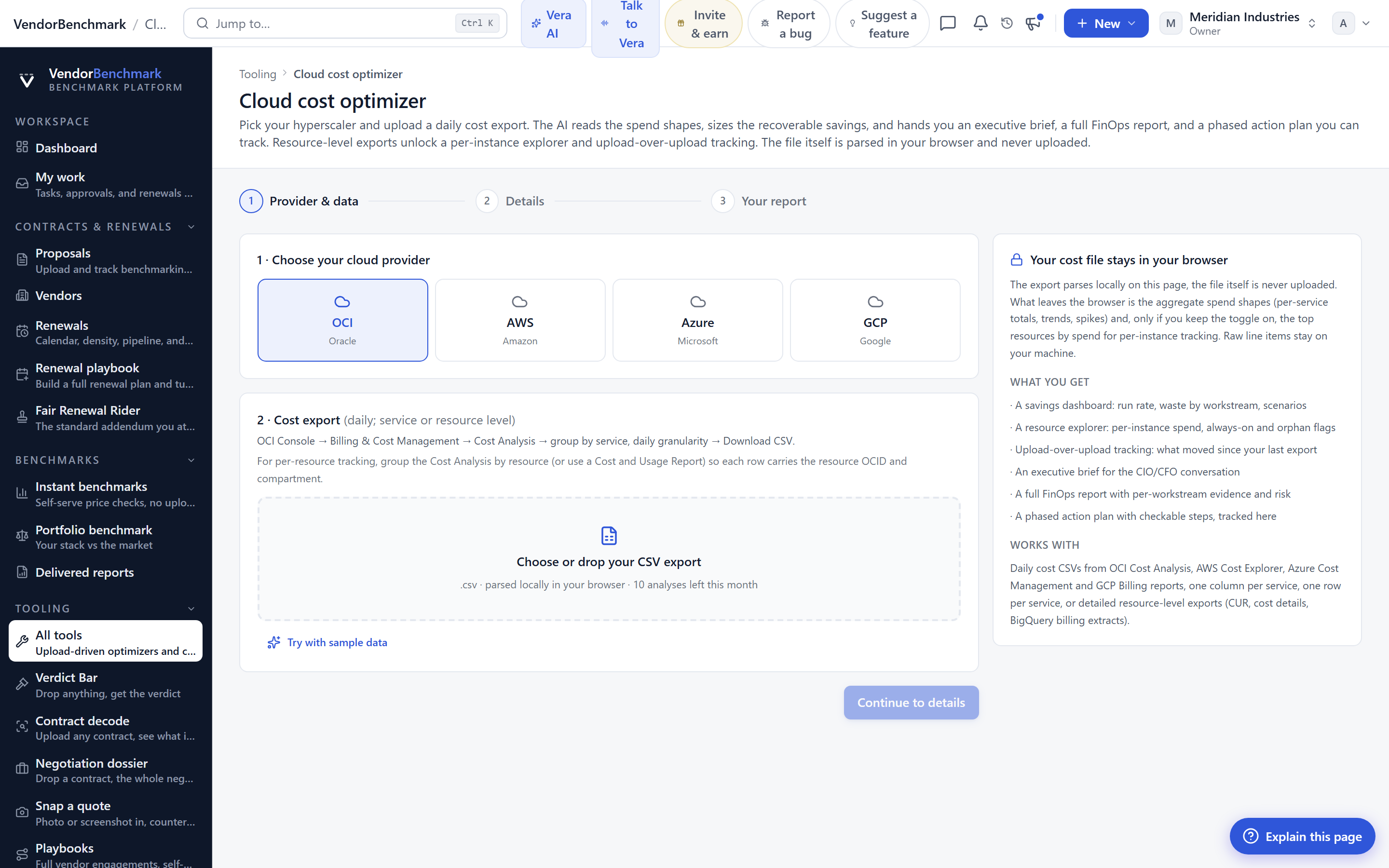
The way the two functions meet in practice is on a shared view of the same data. A cloud commit planner that starts from the actual cost export, FinOps's territory, and carries it through to commitment scenarios and discount modeling, procurement's territory, gives both sides one number to argue about rather than two they never reconcile. FinOps sees how the commit relates to the run rate they are responsible for; procurement sees how the discount changes across commit levels and terms. The conversation stops being a handoff and becomes a joint decision on a single screen.
That shared surface also settles the tension that otherwise pits the two functions against each other. FinOps, judged on efficiency, is wary of any commitment that might discourage further optimization. Procurement, judged on the discount, wants a bigger commit for a better rate. On a shared model, the trade-off is explicit: here is the commit that earns a strong discount without prepaying for capacity FinOps intends to optimize away, and here is what happens to both the discount and the overshoot risk as you move the number. The functions align on the intersection rather than each pulling toward their own metric.
Want to be updated when major licensing and pricing changes land? One analyst brief a week: the price rises, metric changes and audit campaigns that move software costs. Work email only.
Sequence it once, run it as a rhythm
The commit is not a one-time event, it is a recurring decision, and treating it as a joint rhythm rather than an annual scramble is where the compounding value is. Each cycle, FinOps brings the latest optimized run rate and procurement brings the current market and the vendor's calendar, and the commit is re-sized against reality rather than rolled over. A commitment set two years ago against a usage pattern that has since changed is its own kind of leak, and only the two functions together, looking at the current number, catch it.
This also changes how each function is measured, for the better. FinOps's optimizations become visible in a smaller, better-sized commit rather than disappearing into a number procurement negotiated in isolation. Procurement's discount is defensible because it sits on a real run rate FinOps stands behind. The bill goes down from both ends at once, on a number both functions own, which is the only configuration in which the cloud vendor stops being able to play one against the other.
Where the two functions meet
Alignment is organizational, not just a tool
A shared surface makes the joint decision possible; it does not make two functions collaborate. FinOps and procurement often sit in different parts of the org with different incentives and different bosses, and a planner does not dissolve those boundaries. The tool gives them one number and one picture; whether they actually meet over it is a matter of how the organization chooses to run the commit decision.
What it removes is the excuse that they were optimizing different things. FinOps run rate and procurement leverage are two halves of one commit, and a cloud vendor's pricing is designed around the assumption that the two halves never come together at the same table. Putting them on the same number, at the same moment, is the move that turns two functions quietly working against each other into one team working the bill from both ends, which is exactly what the vendor would prefer you never did.
Fredrik has spent more than twenty years in enterprise software, with time at Oracle, IBM, SAP, and Salesforce before moving to the buy side. He structured and priced the kind of large agreements most buyers only see once or twice in a career, which taught him where the leverage sits and how far a vendor will actually move. He started VendorBenchmark to hand that knowledge to every sourcing team.
The week in enterprise software buying, in one email.
What shipped on the platform, and the pricing and licensing moves worth knowing before your next renewal. One email a week, to your work address. Unsubscribe any time.