Vendor lock-in: measuring switching costs before the vendor prices them for you.
Your incumbent vendor has a precise number in mind for how much it would cost you to leave, and they price your renewal against it. The uncomfortable question is whether you have that number too. Measuring your own switching cost is how you stop the vendor from being the only one who has.
Vendor lock-in is usually discussed as a feeling, a vague sense of being stuck, of having too much invested to leave. Vendors experience it very differently. To an incumbent, your lock-in is not a feeling, it is a number: a concrete estimate of what it would cost you in money, time, and disruption to move to a competitor, and that number sets the ceiling on how hard they can push your renewal. A vendor confident that switching would cost you a fortune will price accordingly, because they know your alternative is not credible. Lock-in, to the seller, is simply the leverage they price against.
The asymmetry is stark and common: the vendor has calculated your switching cost with some precision, and you have not calculated it at all. You know it is high; you do not know how high, which parts of it are real versus assumed, or which parts you could reduce. That gap is exactly what the vendor exploits, because a switching cost you have never measured is one you cannot argue about, and one you cannot argue about is one the vendor gets to size in their own favor. Measuring your own lock-in is how you take that number back.
Lock-in is a sum of specific costs
Switching cost feels monolithic but it is not; it is a sum of distinct, measurable components, and breaking it apart is the whole trick. There is the migration cost, the actual project to move systems and data. There is retraining, the per-person cost of getting your people productive on the alternative. There is the parallel-running period, where you pay for both the old and the new system while you transition. And for data and cloud platforms there is egress, the sometimes substantial cost of getting your own data out. Each of these is estimable, and each is a real line in what leaving would cost.
Breaking lock-in into its parts does two things. It replaces a paralysing sense of "we could never move" with a set of numbers you can actually examine, and it reveals which parts of the cost are genuine and which are assumed. Retraining might be smaller than feared; egress might be larger; the parallel-running window might be shorter than the vendor implies. Until the switching cost is decomposed, it is just a fog the vendor can make as thick as they like. Decomposed, it is a figure you can defend, reduce, or accept on your own terms.
The crossover that tests whether staying still pays
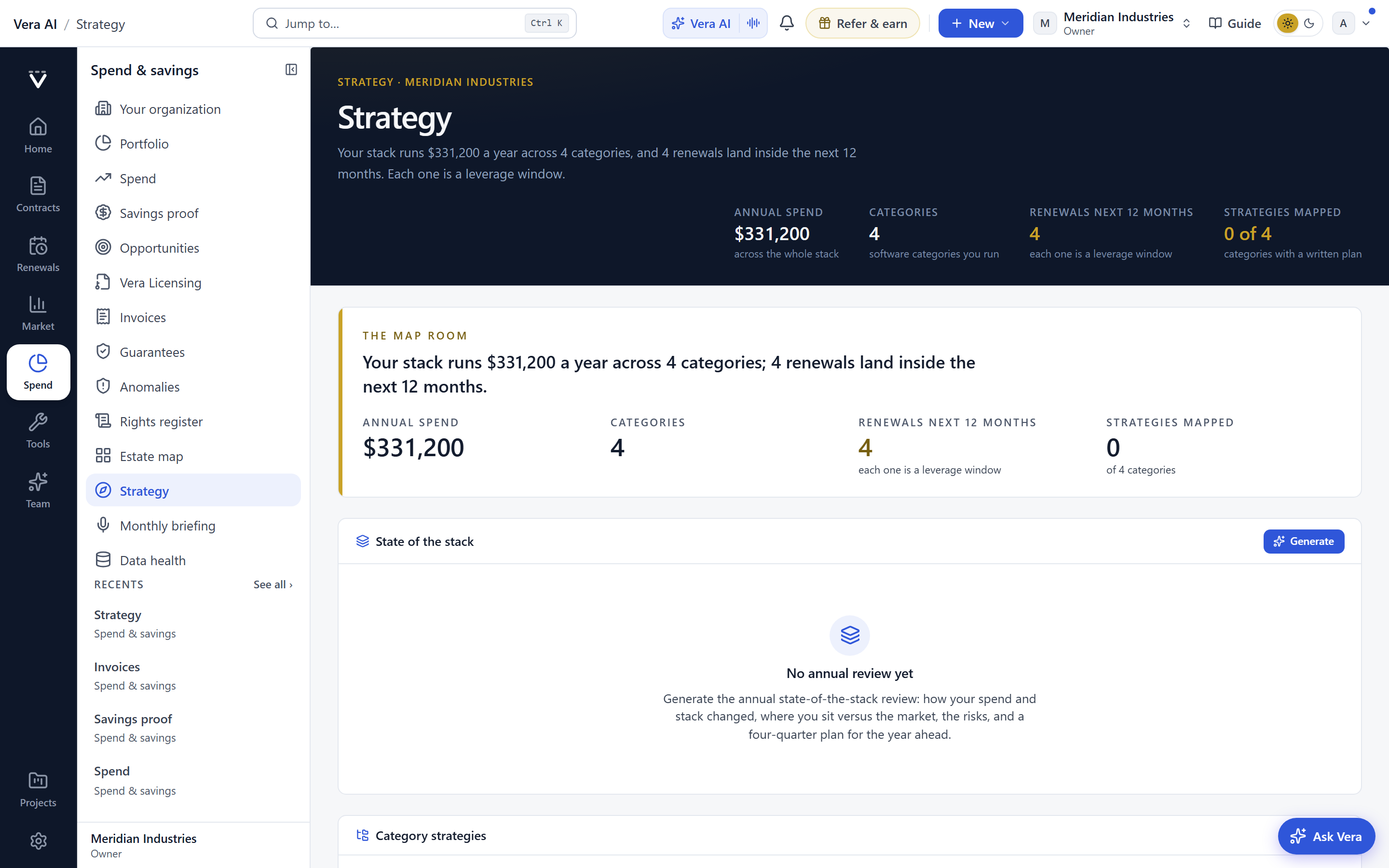
Once switching cost is a number, it can be set against the thing that matters: the ongoing cost of staying versus the ongoing cost of moving, over time. A migration is a large one-time cost followed by a lower run rate; staying is a higher run rate with no migration hit. Those two paths cross at some point, the moment where the cumulative cost of staying overtakes the cost of having left. If that crossover falls within a horizon you care about, the alternative is credible and the vendor's pricing power is limited. If it never does, the lock-in is genuine and you should know that too.
This is what converts measured lock-in into leverage. A vendor who assumes your switching cost is prohibitive prices as though you cannot leave; a buyer who can show that the crossover falls in year three has a priced walk-away that changes the vendor's calculus. The point is rarely to actually switch. It is to know, and to be able to demonstrate, whether switching pays, because a renewal negotiated by a buyer who has done that math is a completely different conversation from one negotiated by a buyer who is only guessing at their own captivity.
Lock-in you can measure is lock-in you can reduce
The final benefit of measuring switching costs is that a measured cost is a manageable one. Once you can see that a particular component, deep integration into one proprietary feature, data stored in a format that is expensive to export, a workflow built entirely around one vendor's way of doing things, is what makes leaving expensive, you can make deliberate choices to reduce it over time. Preferring portable formats, avoiding unnecessary proprietary dependencies, and keeping an exit in mind during implementation all lower your future switching cost, which lowers the leverage the vendor holds over every future renewal.
This turns lock-in from a trap you fall into into a variable you manage. Buyers who never measure their switching cost let it grow unchecked, deepening their dependency with every project until the vendor's pricing power is total. Buyers who measure it treat it as a number to keep in check, making architectural and contractual choices that preserve their own optionality. The vendor will always prefer a captive customer; measuring your lock-in is how you decline to become one more captive than you have to be.
Turning lock-in into a number you own
Some lock-in is real, and worth naming
Measuring switching costs will sometimes confirm that leaving genuinely does not pay, that the migration is too costly, the alternative too weak, the dependency too deep, and that is a valuable answer, not a failure. A buyer who knows their lock-in is real negotiates differently, and more honestly, than one who bluffs a walk-away they cannot afford. The point of the measurement is truth, and the truth is sometimes that you are, for now, better off staying.
What the measurement removes is the imbalance. Whether your lock-in is high or low, the vendor has always known, and the only thing that changes the dynamic is you knowing too. A switching cost you have decomposed, tested, and set against the cost of staying is a number you can negotiate around, reduce over time, and, when it genuinely favors you, wield. The vendor priced your captivity long ago. Measuring it is simply refusing to let them be the only one who did.
Fredrik has spent more than twenty years in enterprise software, with time at Oracle, IBM, SAP, and Salesforce before moving to the buy side. He structured and priced the kind of large agreements most buyers only see once or twice in a career, which taught him where the leverage sits and how far a vendor will actually move. He started VendorBenchmark to hand that knowledge to every sourcing team.
The week in enterprise software buying, in one email.
What shipped on the platform, and the pricing and licensing moves worth knowing before your next renewal. One email a week, to your work address. Unsubscribe any time.