The one-person procurement desk: doing a team's job with agents.
The dirty secret of software procurement is how few people run it. One or two, against three hundred vendors and a renewal every week. You cannot hire your way out of that fast enough. So the desk gets staffed a different way, with agents that do the reading, watching, and drafting, and a person who keeps the judgment.
There is a persistent myth that enterprise software procurement is run by large, well resourced teams. In most companies it is run by one person, or two, sitting behind a stack of three hundred vendors, a renewal landing somewhere every week, and a spend number in the tens of millions. The vendors, by contrast, field entire deal desks per account. The asymmetry is not just in information, it is in headcount, and no realistic hiring plan closes it.
The way a solo desk competes is not by working longer, it is by staffing itself differently. The repetitive, high volume, attention heavy work, the reading of every contract, the watching of every renewal and invoice, the first draft of every reply, gets handed to agents. The one person at the desk stops being a clerk who cannot keep up and becomes an operator directing a staff that never sleeps. That is the whole shift, and it is what makes a team's job possible for one.
A staffed desk, not a single assistant
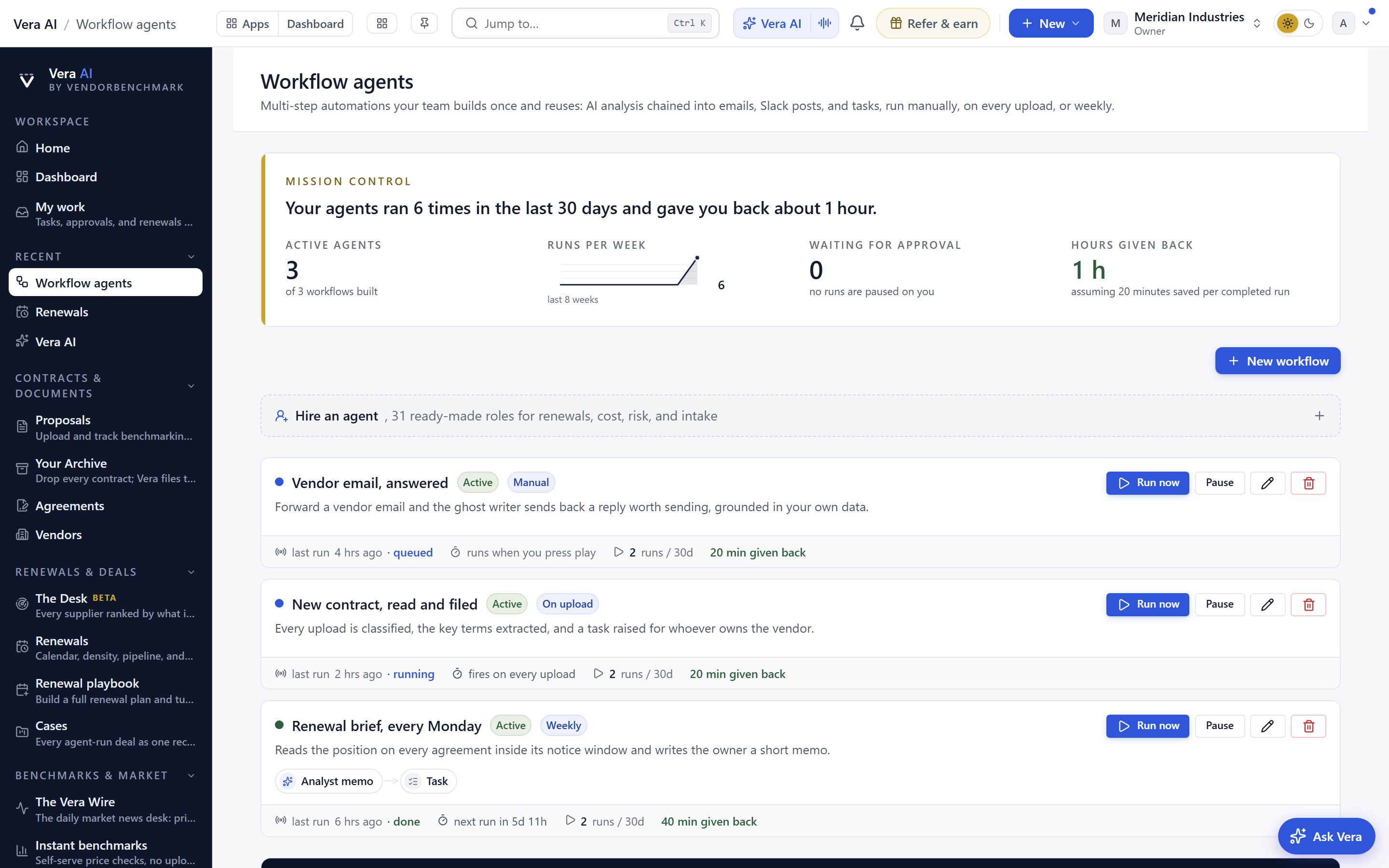
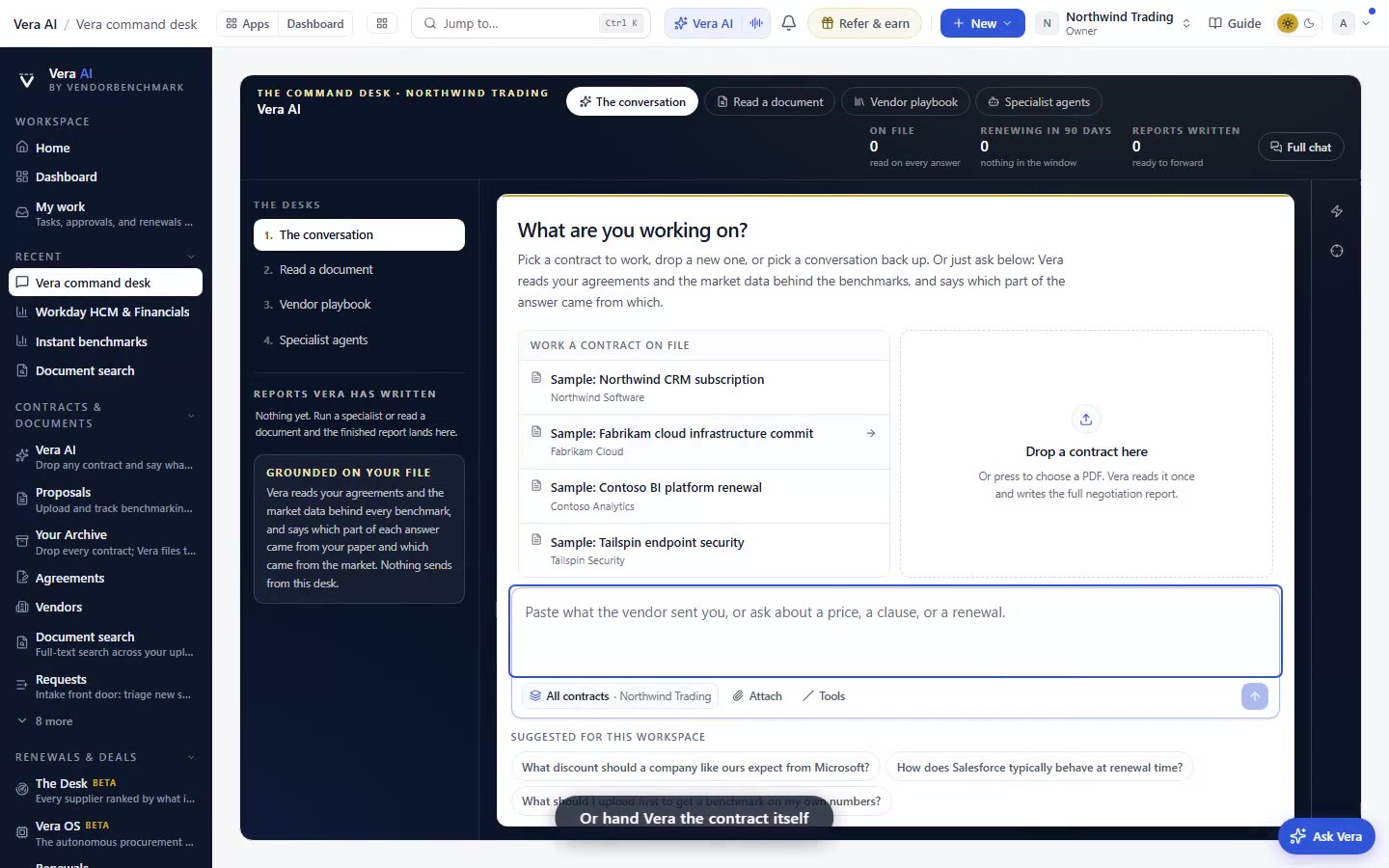
One chatbot does not change the math. A staffed desk does. Behind the analyst sit six specialist agents, covering benchmarking, legal terms, licensing, contract flexibility, executive briefs, and talking points, each doing the deep work a human specialist would in its lane. Alongside them, thirteen inbox agents you can simply forward a document to, and a ghost writer that drafts vendor replies in your voice. The one person does not do benchmarking and legal review and licensing analysis. They ask the agent that does each, and read the result.
This is the difference between an assistant and a staff. An assistant helps you do your work faster. A staff does chunks of the work and reports back, so your day stops being execution and becomes direction and decision. For a one-person desk, that reallocation of where the human hours go is the difference between drowning and running the function.
The work that happens while you sleep
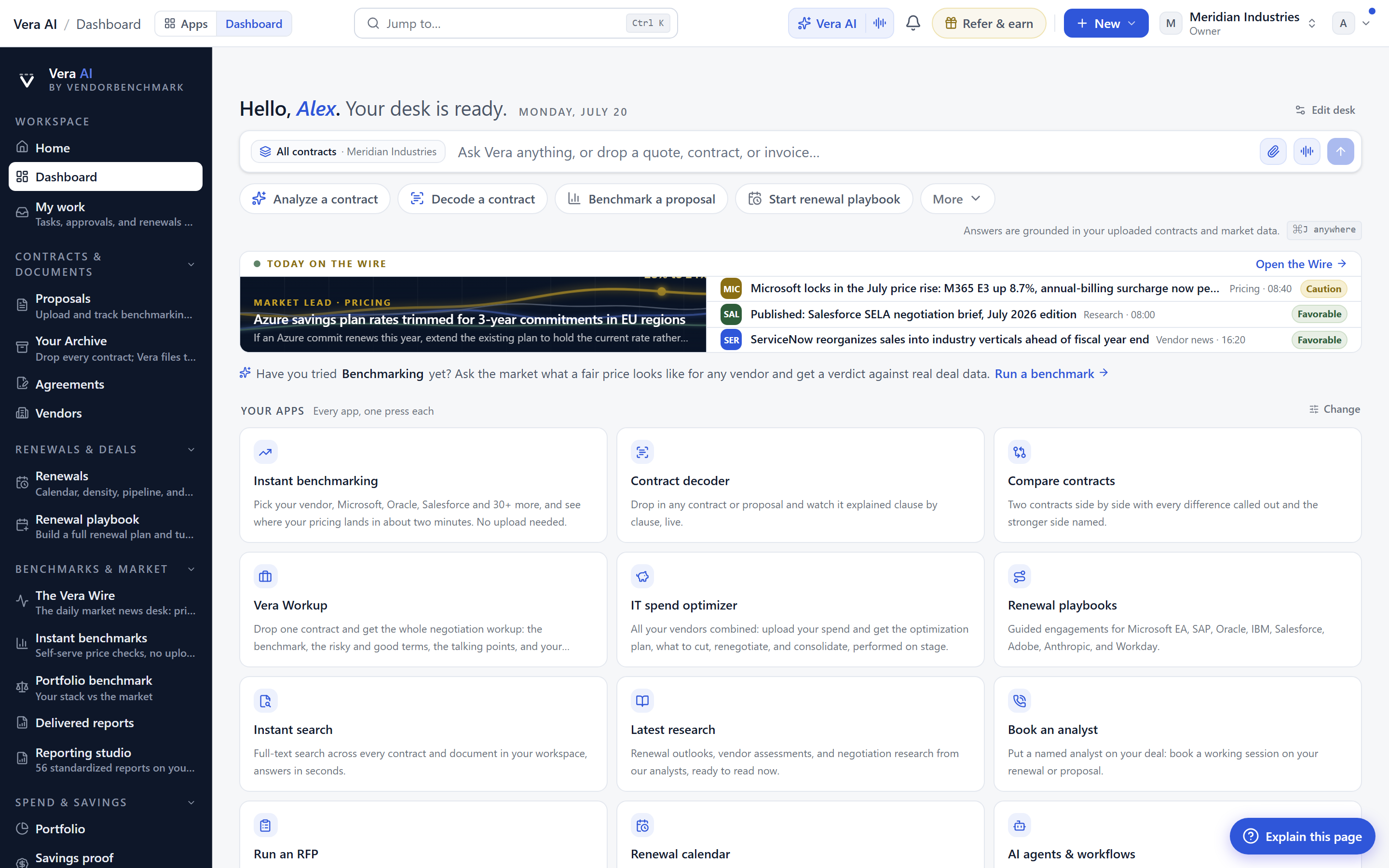
The hardest part of a solo desk is not the deals you are working, it is the ones you are not watching. A price list changes on a vendor you have not looked at in months. An invoice drifts above the contracted rate. A renewal notice window is about to pass. On a manual desk these are the things that slip, because there are only so many hours and they all go to the fire in front of you. This is where the 99 background jobs earn their place.
They run continuously, watching renewals, reconciling invoices, diffing price lists, and scanning for anomalies across the whole estate, and they surface only what needs a human. The daily queue is not everything that happened, it is the short list of what actually requires your attention, ranked. The effect is that a single person holds a three hundred vendor estate without any of it going dark, because the watching is delegated to jobs that never get tired or distracted or pulled onto something urgent.
Want to be updated when major licensing and pricing changes land? One analyst brief a week: the price rises, metric changes and audit campaigns that move software costs. Work email only.
Composed once, run every week
No two desks run the same process, so the agents are composable without code. The workflow builder chains them into automations you define once and never touch again: summarize every new contract into a channel, screen every upload for risky terms, assemble a renewal radar every Monday. A one-person desk cannot afford to do the same manual routine fifty times a year, and it does not have to. It builds the routine once and the desk runs it thereafter.
That is what turns a set of clever tools into an operating model. The reading, the watching, and the routines all run on their own, so the human time concentrates on the handful of things that genuinely need a person: the judgment calls, the relationships, the negotiations, and the signature. A solo desk does not scale by the person doing more. It scales by the person doing less of what a machine should, and all of what only they can.
Staffing a desk of one
The desk still needs the person
None of this makes the person optional, and it is not meant to. The agents draft, watch, and read, but they do not decide which battles to fight, how hard to push a strategic vendor, or when a good enough deal is worth taking to preserve a relationship. Those are the judgments a procurement professional is actually paid for, and the whole design exists to give them more room, not to replace them.
What changes is the ceiling. A one-person desk used to be capped by how many contracts one person could physically read and how many renewals they could physically track, which meant most of the estate went unmanaged. With the reading and watching delegated, the cap moves to how many decisions one good operator can make, which is a far higher number. The team stays small. The reach stops being small with it.
Fredrik has spent more than twenty years in enterprise software, with time at Oracle, IBM, SAP, and Salesforce before moving to the buy side. He structured and priced the kind of large agreements most buyers only see once or twice in a career, which taught him where the leverage sits and how far a vendor will actually move. He started VendorBenchmark to hand that knowledge to every sourcing team.
The week in enterprise software buying, in one email.
What shipped on the platform, and the pricing and licensing moves worth knowing before your next renewal. One email a week, to your work address. Unsubscribe any time.