12 · Integrations, clients & deployment
The technical chapter, written for the IT, security, and procurement-ops people who wire Vera AI into an estate. It answers three questions: how data gets in and out (the integration catalog), what runs on your machines (thin and thick clients), and where the platform itself can run (the four deployment models). Nothing here is required to use the platform; everything here makes it stronger.
How the platform is delivered
Vera AI is delivered as a managed cloud platform (SaaS). The application, database, storage, and backups are operated by us; your team signs in from a browser and maintains nothing. The technical posture, in the terms a security review asks about:
- Tenant isolation — every organization's rows are isolated at the database layer with row-level security, tested with real cross-organization attempts, not filtered in application code.
- File handling — contract files live in private encrypted storage. There are no public URLs; every download uses a signed link that expires in about a minute, and every view and download lands on the audit trail.
- Encryption — TLS in transit, encryption at rest for the database and file storage.
- Identity — SAML and OIDC single sign-on, SCIM provisioning, and TOTP multi-factor are available on the standard service (see Single sign on).
- Auditability — an exportable audit log records who did what, including file views and downloads, and can stream to your SIEM.
- Updates — continuous. Features, security fixes, and fresh benchmark data ship without any action from you.
The Trust center tells this story with live numbers, and the Security posture shows your own workspace's posture against it.
Clients: what runs on your machines
The platform is thin-client first: the browser is the primary interface and nothing needs to be installed. Around it sit a thick-client desktop app and several headless surfaces.
The browser (thin client)
Who: everyone
Any modern browser is a full client. All processing happens server side, with one deliberate exception: the browser-local calculators. Several tools (Cloud cost optimizer, VCF licensing, M365 optimization) parse your usage export as a file in the page itself, so raw usage data never leaves your machine unless a step explicitly sends approved figures for analysis; each tool states which side of that line it works on. Files sent to the AI tools follow the document keeping rule in Tooling: contract-family documents save to your workspace as contracts, private to your organization, while phone captures, XLSX rate cards, invoices, audit letters, and spend exports are read in memory and never stored. Owners can turn the saving off under Data controls.
The desktop apps (thick client)
Who: everyone · install is per user, no admin rights
VendorBenchmark Desk is the whole platform as a native application around the same account and data, for teams that live in it daily: its own window and taskbar identity, every app opening inside that window as a room, drag a contract from Explorer straight onto it, your contracts and renewals held on the machine for reading with no network, native Windows notifications for deliveries and notice windows, Vera summonable over any app, Windows Hello lock, and automatic updates. Install it from Settings › Desktop app. It is a client, not a data store: uninstalling it touches nothing in your workspace. Two apps live on that page, the Desk and Second Chair for the meetings themselves, each for Windows and for macOS 13 and later as one universal build.
Chat clients: Vera in Slack and Microsoft Teams
Who: connected by an org owner
Vera answers inside your own Slack workspace or Teams tenant: ask about a price, a clause, or a renewal without leaving chat, with every figure tagged to its source exactly as in the app. Connected under Integrations.
Email as an interface
Who: addresses are provisioned by an org owner
Five inbound rails give every teammate an integration that needs zero training, because it is just email:
- Contract email-in — forward a vendor proposal to your intake address and it lands in Analyst Benchmark.
- Deal email-in — forward a live vendor thread onto the deal record, where the negotiation ghost writer can draft the reply.
- Invoice email-in — forward invoices and they reconcile billed against contracted on Invoices.
- Purchase request email-in — teammates raise Requests by mail, straight into triage.
- Ask an agent by email — send a question plus a document and the answer comes back to your inbox.
The API, MCP, and agent-to-agent
Who: org owners only (keys)
- REST API — create keys under Settings › API; keys expire within a year and are shown once.
- MCP connector — point Claude, ChatGPT, or any MCP-capable tool at your workspace so your own AI assistants can query your benchmark data with your permissions. Connected tools can also work the agreement estate: list every agreement record with its lifecycle state, read one record with its version chain and legal next moves, and move a file along the guarded lifecycle (illegal moves are refused, every move is audited).
- Microsoft Word add-in — a task pane that compares the open document against your clause playbook and inserts your preferred language at the selection. The manifest URL and the one-line sideload instruction live under Settings › API; the pane connects with an org API key.
- E-signature sending — three rails. VendorBenchmark Sign is built in and needs no connection: the signing studio on an agreement record places the signature, initials, date and text areas on the stored PDF, routes up to ten signers in order, and each signer signs in the browser through a personal link; completion stamps the areas, appends a certificate of completion, and files the executed copy onto the record. DocuSign and Adobe Acrobat Sign connect under Settings › Integrations for orgs that sign there; the same desk sends the newest version on either rail, Word documents get their signature fields placed automatically, and the executed copy files itself the same way when signing completes.
- Agent Negotiation Protocol — the open, published protocol for structured buyer-agent-to-vendor-agent negotiation, with a hash-chained transcript; the spec and artifacts are public at
app.vendorbenchmark.com/agent-protocol.
Vera OS, the autonomous procurement companion
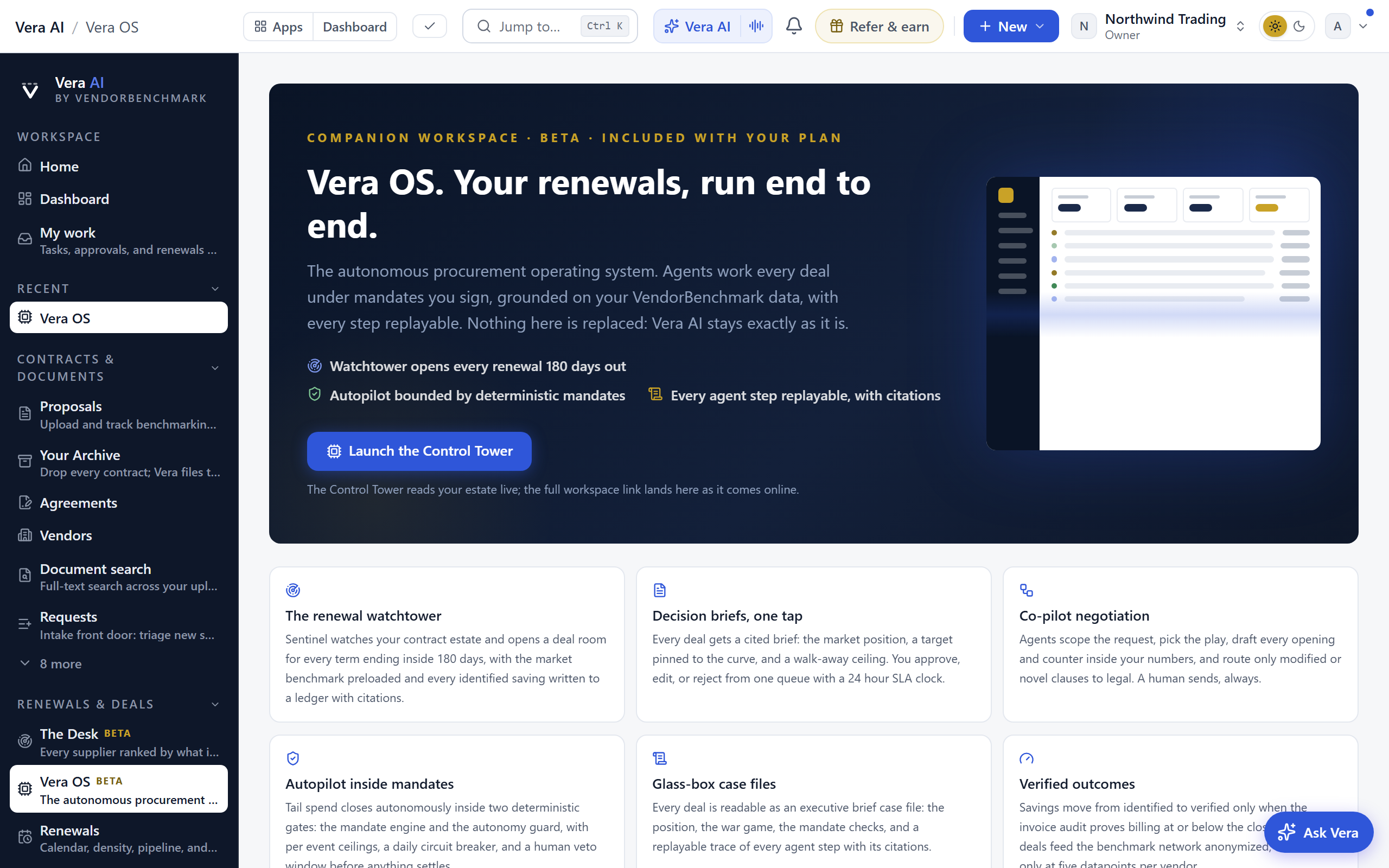
The lens now starts work as well as reading it: on the grounding screen, Queue the top gaps creates up to five open tasks titled Benchmark that vendor (never duplicated) and links your Tasks runway, and every deal row in the Control Tower and the deal rooms carries Hand to a case, opening the Vera AI-run negotiation intake with that agreement preselected.
Vera OS is a separate product: an autonomous procurement operating system that runs as its own workspace with its own sign-in. Agents there work renewals and deals end to end under mandates you sign once, evaluated in deterministic code on every step that touches money: a renewal watchtower that opens a deal room for every term ending inside 180 days with the benchmark preloaded, cited decision briefs you approve with one tap against a 24 hour SLA, co-pilot drafting where a human always sends, and an autopilot lane that closes tail spend inside two deterministic gates with a human veto window before anything settles. Every deal is readable as a case file with a replayable trace.
How it relates to this platform. Vera OS consumes your VendorBenchmark benchmarks, playbooks, and Terms Watch through the platform API, and contributes closed-deal datapoints back anonymized, released only once at least five exist for a vendor. It replaces nothing here: every view in Vera AI stays exactly where it is.
Using the page. Vera OS is open to every workspace with no access request. Opening it lands you directly on the Control Tower in your normal workspace; there is no marketing landing page and no Launch button to press first.
The Control Tower preview. · /vera-os/tower
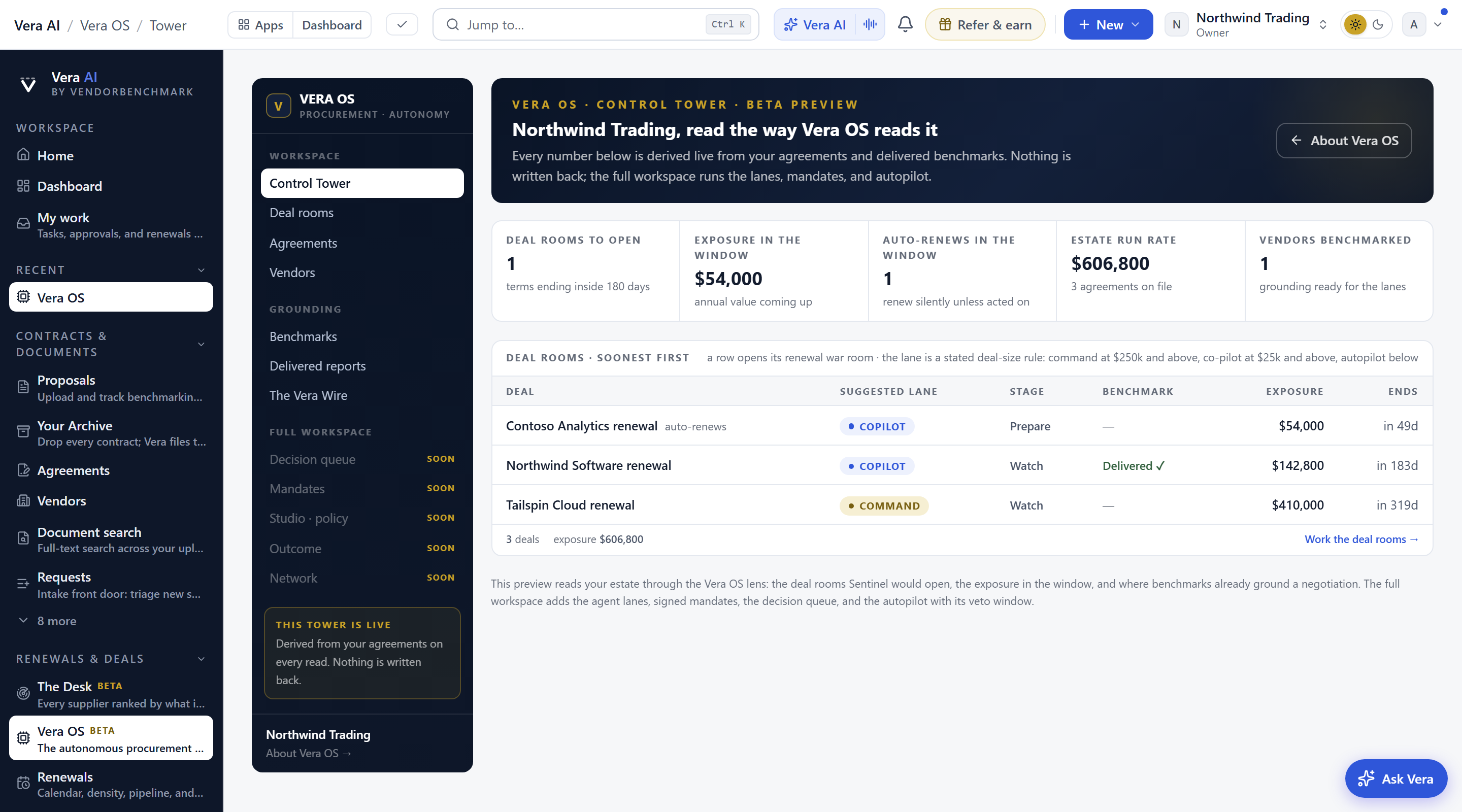
The Control Tower reads your own estate the way Vera OS reads it, live and read-only: a metric strip (deal rooms to open inside 180 days, the exposure in that window, auto-renews, the estate run rate, vendors with a delivered benchmark) over a deal-rooms table of every agreement with an expiry, soonest first. The suggested lane column is a stated deal-size rule, command at $250,000 and above, co-pilot at $25,000 and above, autopilot below, never a model's judgment, and a row opens that agreement's renewal war room. Nothing is written back. Once your full workspace link is online, an Open the full workspace button appears on both pages and opens Vera OS in its own tab.
The Vera OS screens. The Control Tower opens inside your normal workspace, so you move between the Vera OS screens from the same navigation you use everywhere else; there is no separate Vera OS rail. The screens fall into three groups.
- Workspace — Control Tower, and the three screens below.
- Grounding — what the lanes are allowed to stand on: Benchmarks and The Vera Wire. The delivered reports used to sit here as a third screen; they now live inside Benchmarks, on the vendor each one grounds.
- Full workspace — Decision queue, Mandates, Studio · policy, Outcome, Network. These five run in the Vera OS workspace itself rather than here, so they read soon until your workspace link is connected, at which point each one opens it in a new tab.
Deal rooms. · /vera-os/deals
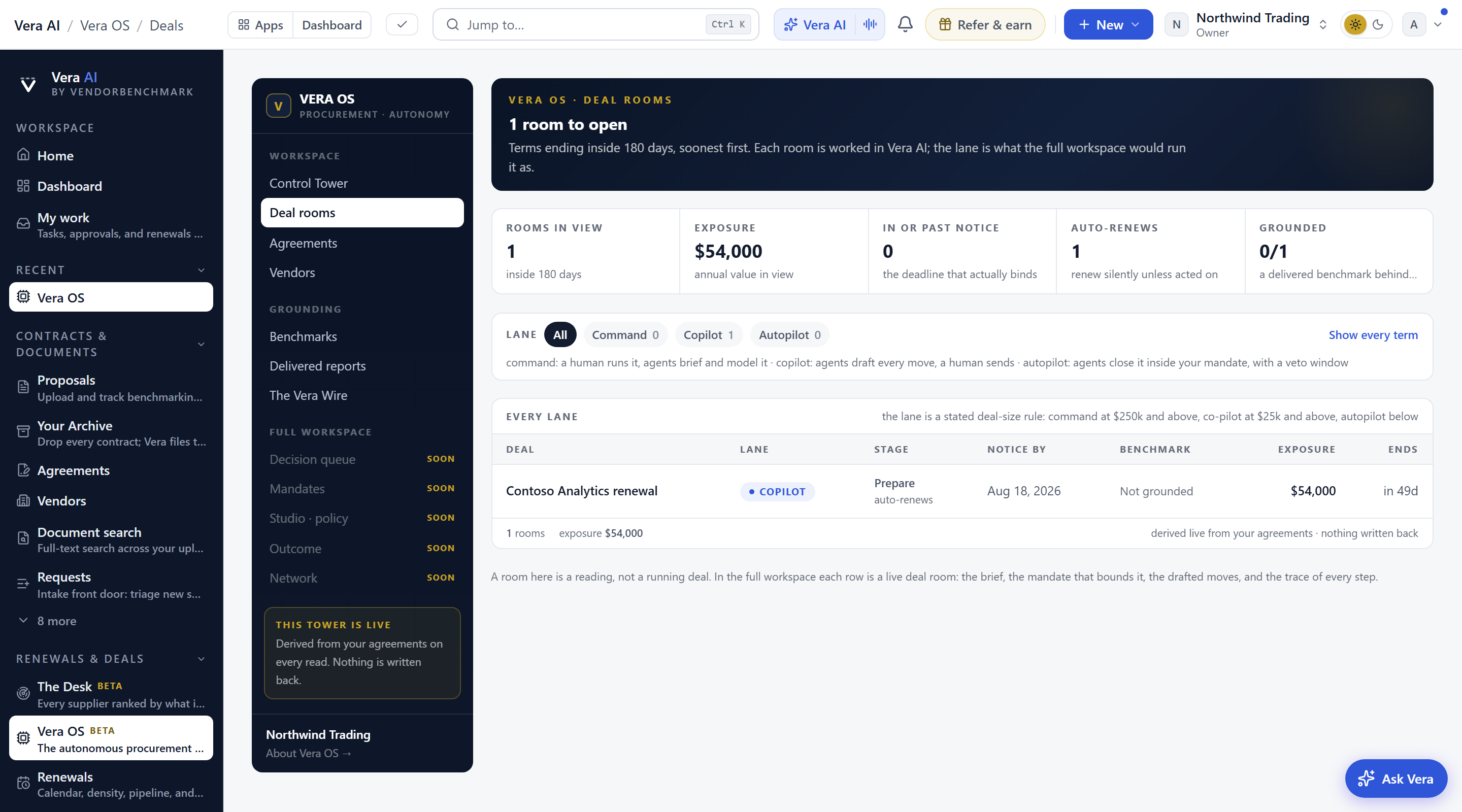
Every term Vera OS would open a room for, soonest first, with the lane its size puts it in, the notice date that actually binds, the exposure, and whether a delivered benchmark grounds it. The lane chips and the Show every term link filter the table and are written into the address, so a filtered view can be sent to a colleague. Rows open the renewal war room in Vera AI. When nothing ends inside 180 days the table falls back to the whole term book and says so.
Agreements. · /vera-os/agreements
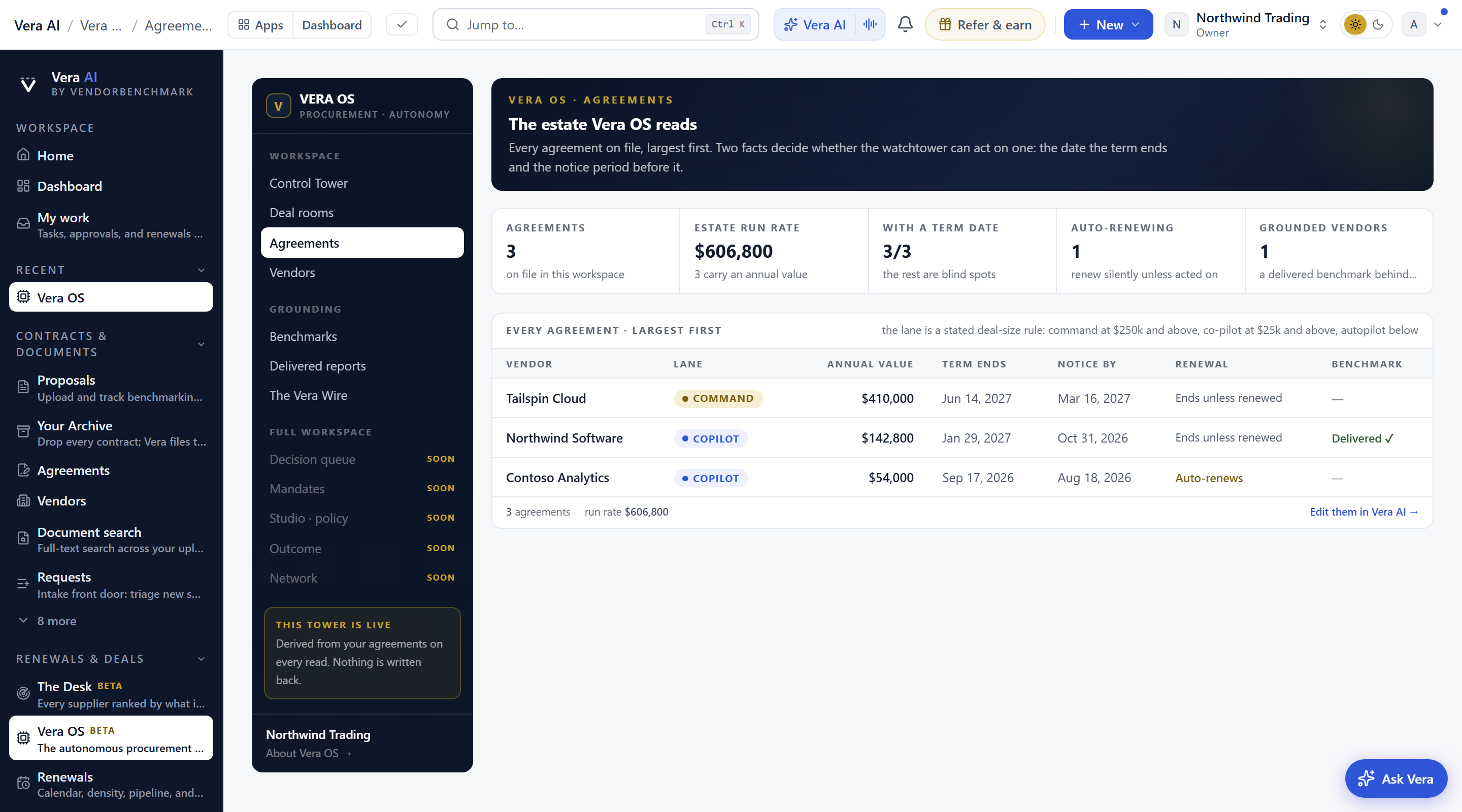
The whole estate, largest first, with the annual value, the term end, the notice date, whether it auto-renews, and the benchmark behind it. Agreements carrying no term date are marked in red and counted under the table: no room can ever open for them, so an auto-renewal on one would pass unseen.
Vendors. · /vera-os/vendors
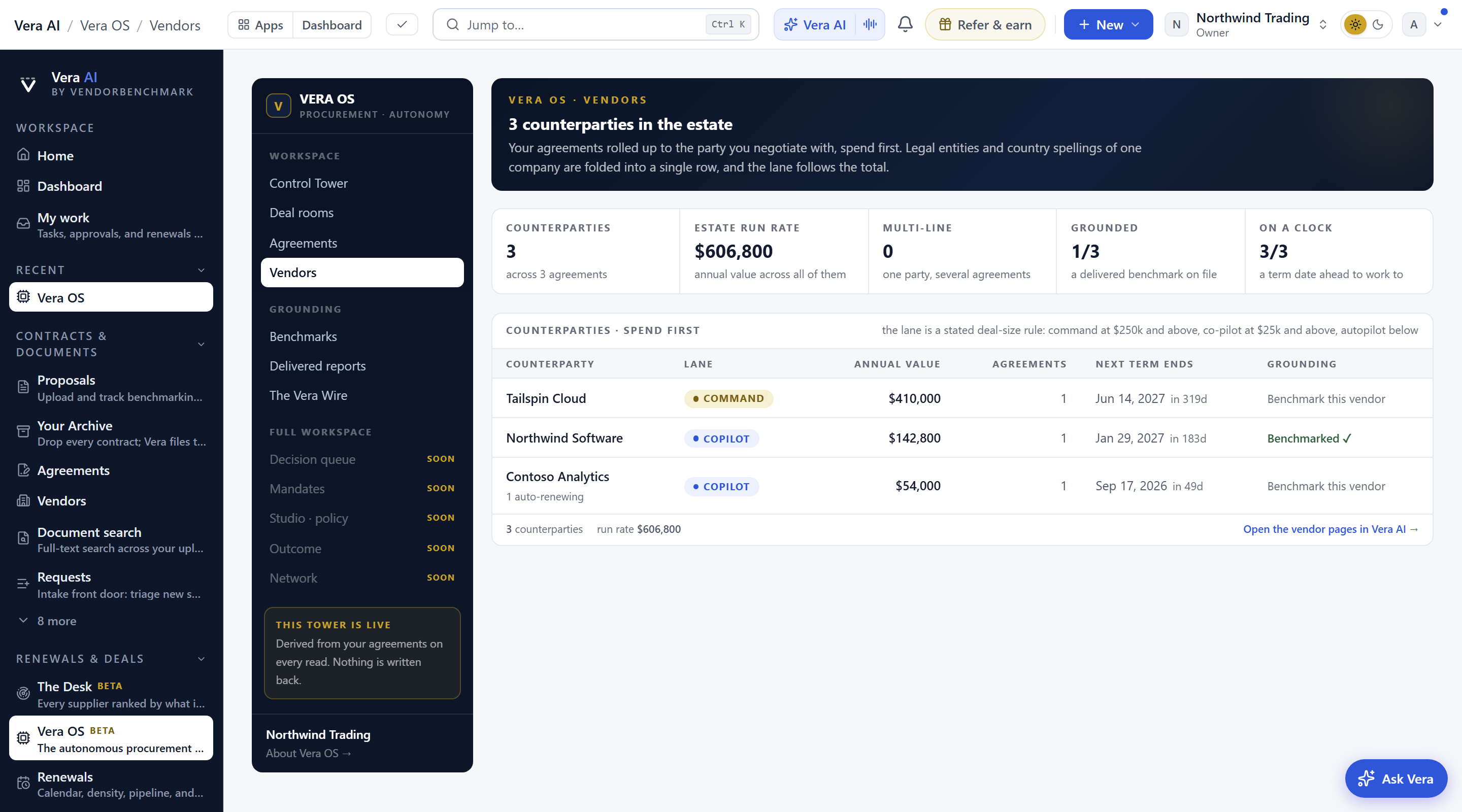
The estate rolled up to the party you negotiate with. Legal-entity and country spellings of one company (for example Salesforce, Salesforce UK Limited, and SFDC Ireland Limited) fold into a single row with the spellings listed beneath it, and the lane follows the total held with that party rather than the smallest line.
Benchmarks. · /vera-os/benchmarks
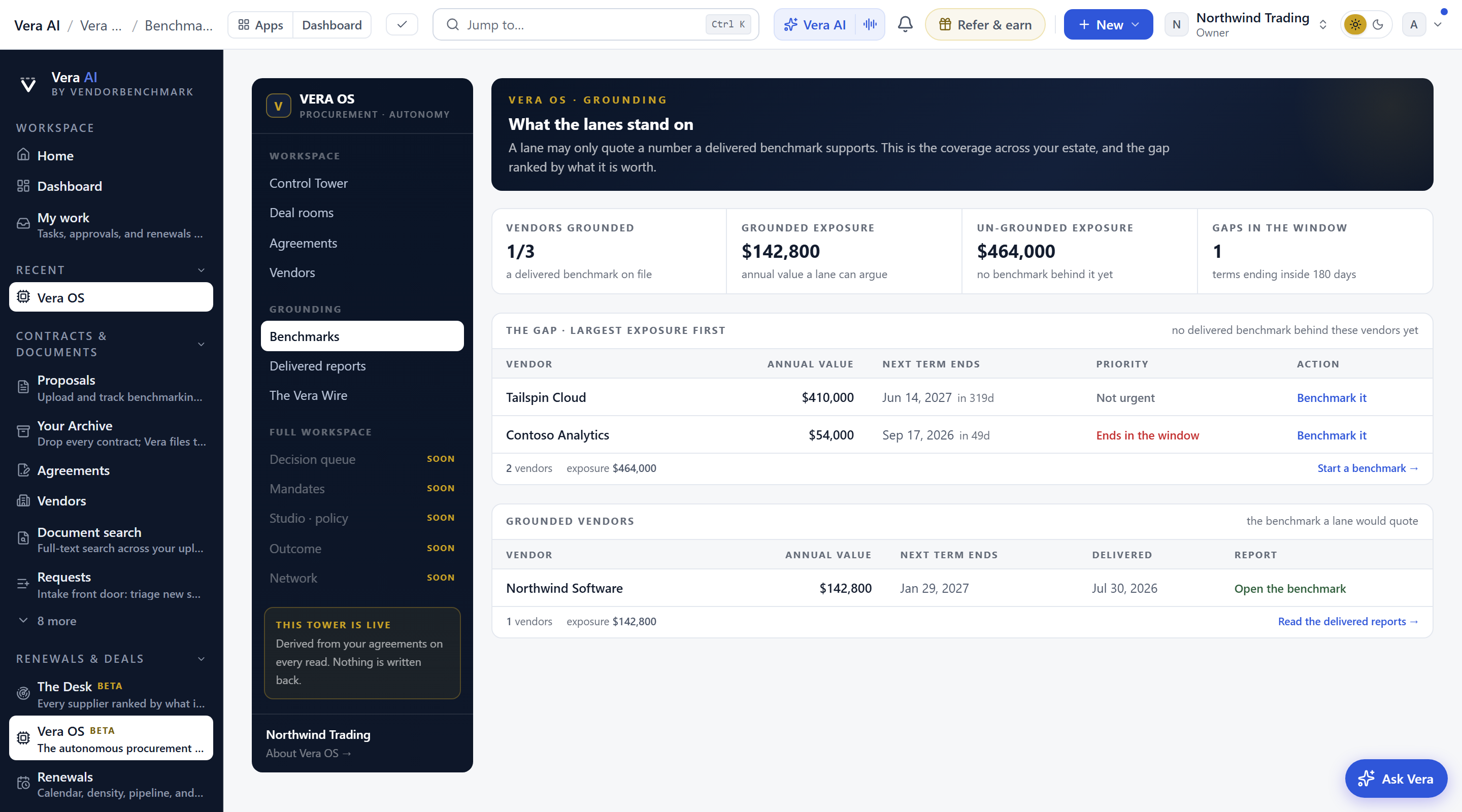
The grounding, and the gap. A lane may only quote a number a delivered benchmark supports, so this screen leads with the vendors that have none, ranked by what they are worth and flagged when their term ends inside the window.
Beneath the gap sits Grounded vendors, the delivered reports: one row per grounded vendor with its annual value, when the term ends, when the report was delivered, a link to the report itself, and the headline figure a lane would quote. That figure is the overall score the analyst gave the agreement, out of 100, or unscored where the report carries no score; it is never a price or a saving. A metric tile above counts the delivered reports this workspace holds, and drafts are never counted and never quotable. Open the document library in Vera AI goes to the full reports shelf.
This absorbed the separate delivered-reports screen. /vera-os/reports now forwards here, so an old link or bookmark still lands somewhere useful.
The Vera Wire. · /vera-os/wire
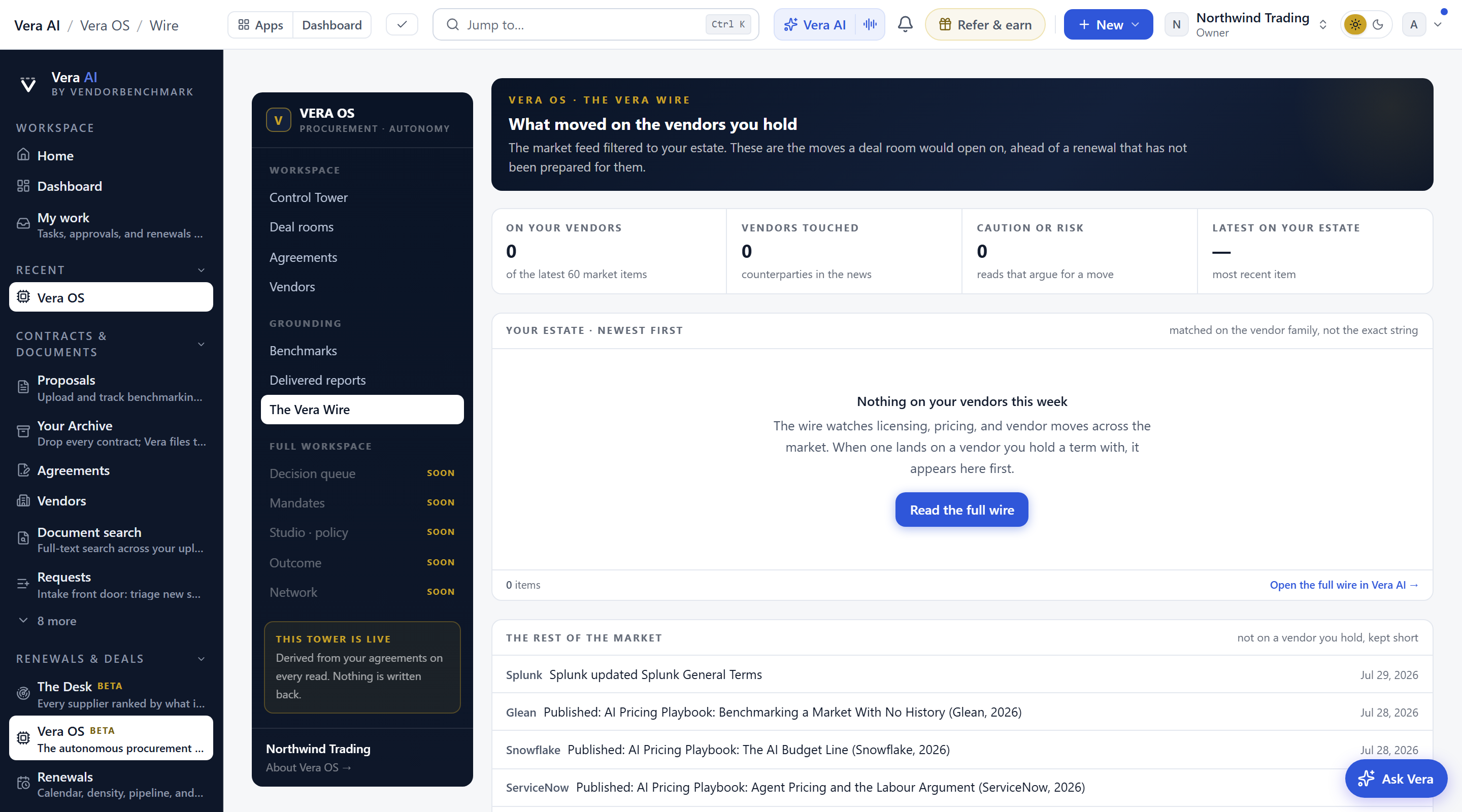
The market feed filtered to vendors you actually hold a term with, each item with its verdict, Vera's read, and the date, and the rest of the market kept short beneath it. The full feed with its lenses stays at The Vera Wire in Vera AI.
Items on your own estate carry two extras the market items do not. The deal behind it states the clock on that vendor's nearest term: how many days until notice closes or how long ago it closed, and how long the term still has to run, reading no term date on the paper where the agreement holds no dates. Open the war room goes straight from the market move to the renewal record it lands on. Both appear only where a term end is on file and not more than 30 days past, so a vendor with undated paper gets neither.
The integration catalog
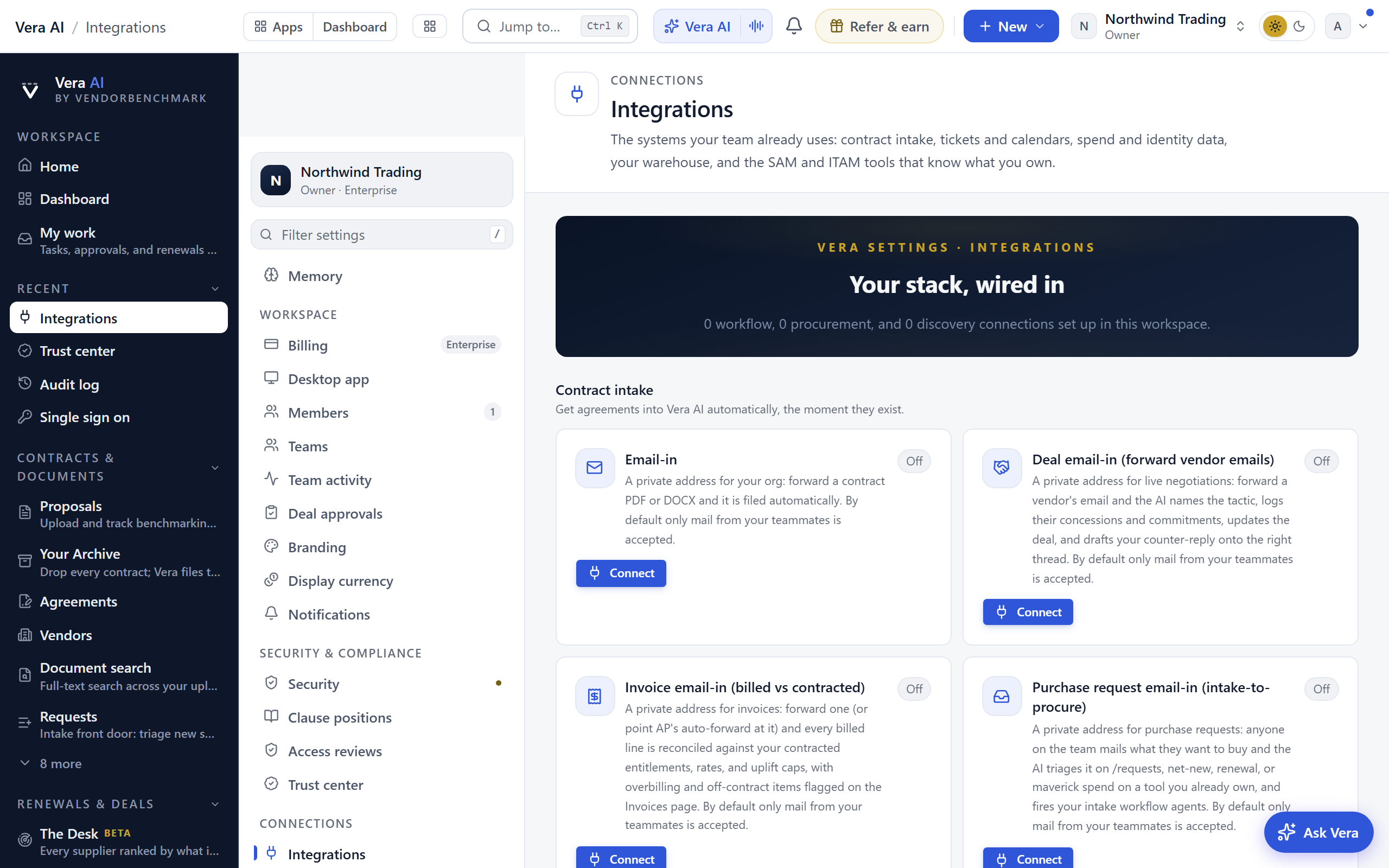
The page is one calm scroll, arranged the way this section is: contract intake first, then renewal workflow, spend and usage data, data out, and automation, with the two deep estates, procurement (P2P) and license discovery (SAM / ITAM), at the foot. Every connector ships with the same operating rules: credentials are stored encrypted and used only server side, read-only scopes are requested wherever the source system offers them, every sync is logged under Recent activity, and connector-reported entitlement figures are held for human confirmation before they can drive an alert (you will see them marked "confirm" on Billing watch). Disconnecting a source stops its syncs immediately.
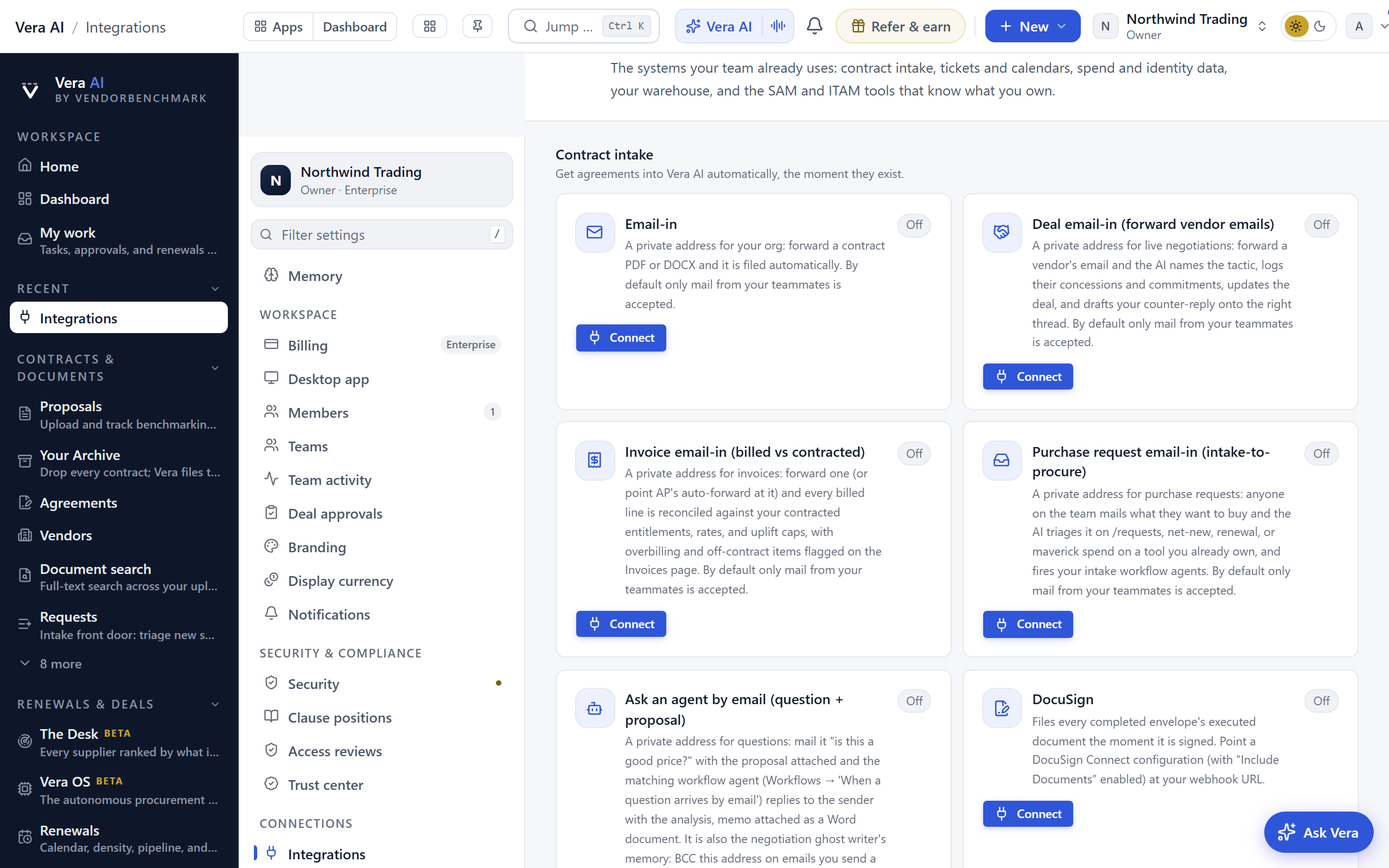
Contract intake
Get the paper in without anyone uploading by hand. Half of these connectors are just private email addresses, provisioned in one click and shared with your whole team.
| Connector | What it does |
|---|---|
| Email-in | A private intake address; forwarded proposals become tracked contracts, and the reply tells you what was read, with only the doubtful fields left to confirm in one tap |
| The vera@ prefix | The same address with vera in front of the plus sign is the concierge door: contracts file, invoice looking attachments go through the line item check instead, and a plain question with no attachment is answered by email, with follow ups in the same thread remembering what came before |
| Deal email-in | Forward a live vendor thread onto the deal record; the ghost writer can draft the reply |
| Invoice email-in | Forwarded invoices reconcile billed against contracted on Invoices |
| Purchase request email-in | Teammates raise Requests by mail, straight into triage |
| Ask an agent by email | Send a question plus a document; the answer returns to your inbox |
| DocuSign | Completed envelopes flow in as signed agreements |
| Ironclad | Executed contracts sync from your CLM |
| Google Drive folder watch | Drop files in a folder, they arrive here |
| SharePoint folder watch | Same, for Microsoft estates |
| Box folder import | Bulk import from a Box folder |
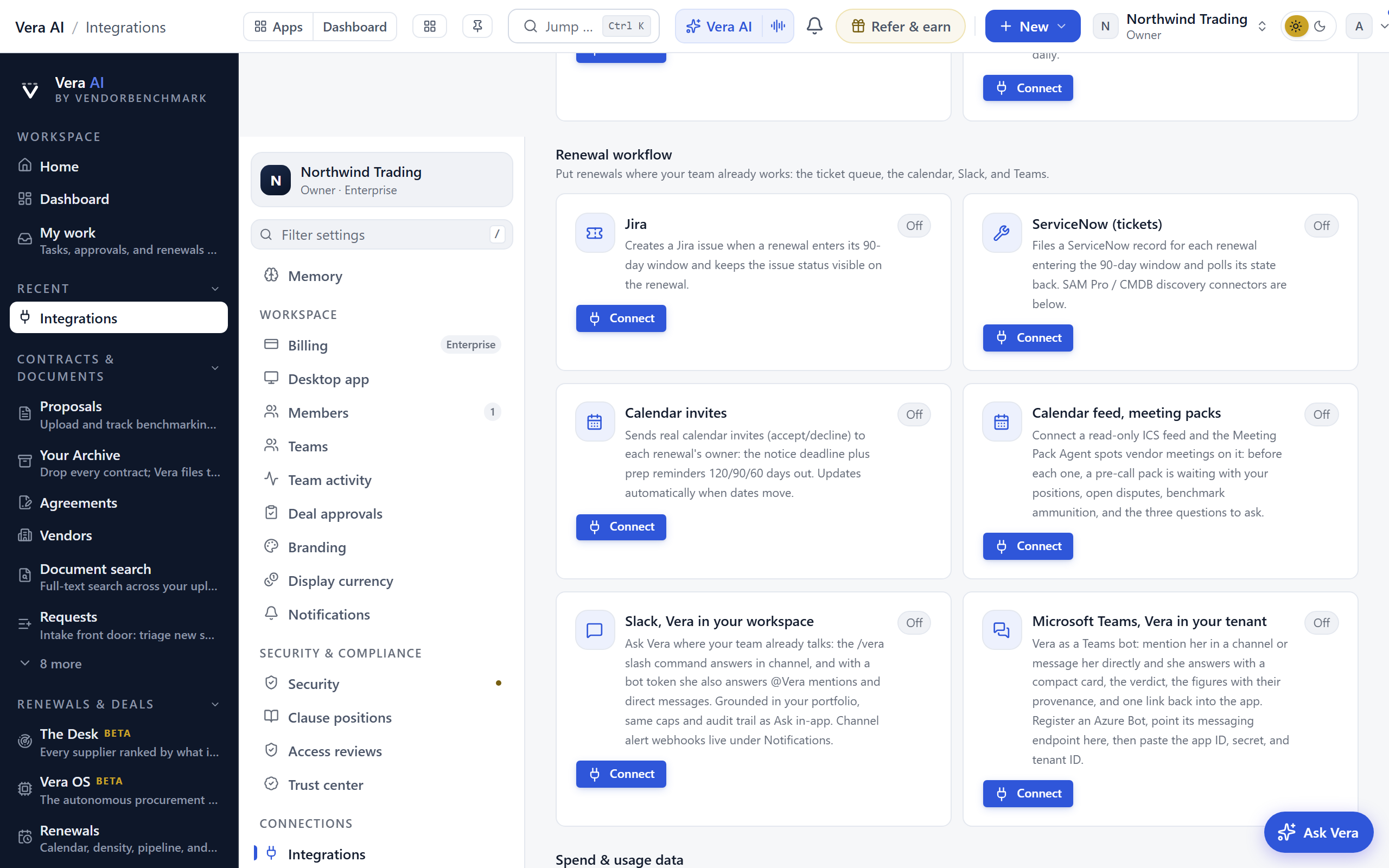
Renewal and deal workflow
Push the work to where your team already lives.
| Connector | What it does |
|---|---|
| Jira | Renewal tasks and findings as issues in your project |
| ServiceNow (tickets) | The same, as ServiceNow tickets |
| Calendar invites | Notice windows and renewal deadlines as calendar events |
| Calendar feed | A read-only ICS feed of your vendor meetings and renewal deadlines |
| Slack | Alerts to a channel, plus Vera in your workspace |
| Microsoft Teams | Alerts to a channel, plus Vera in your tenant |
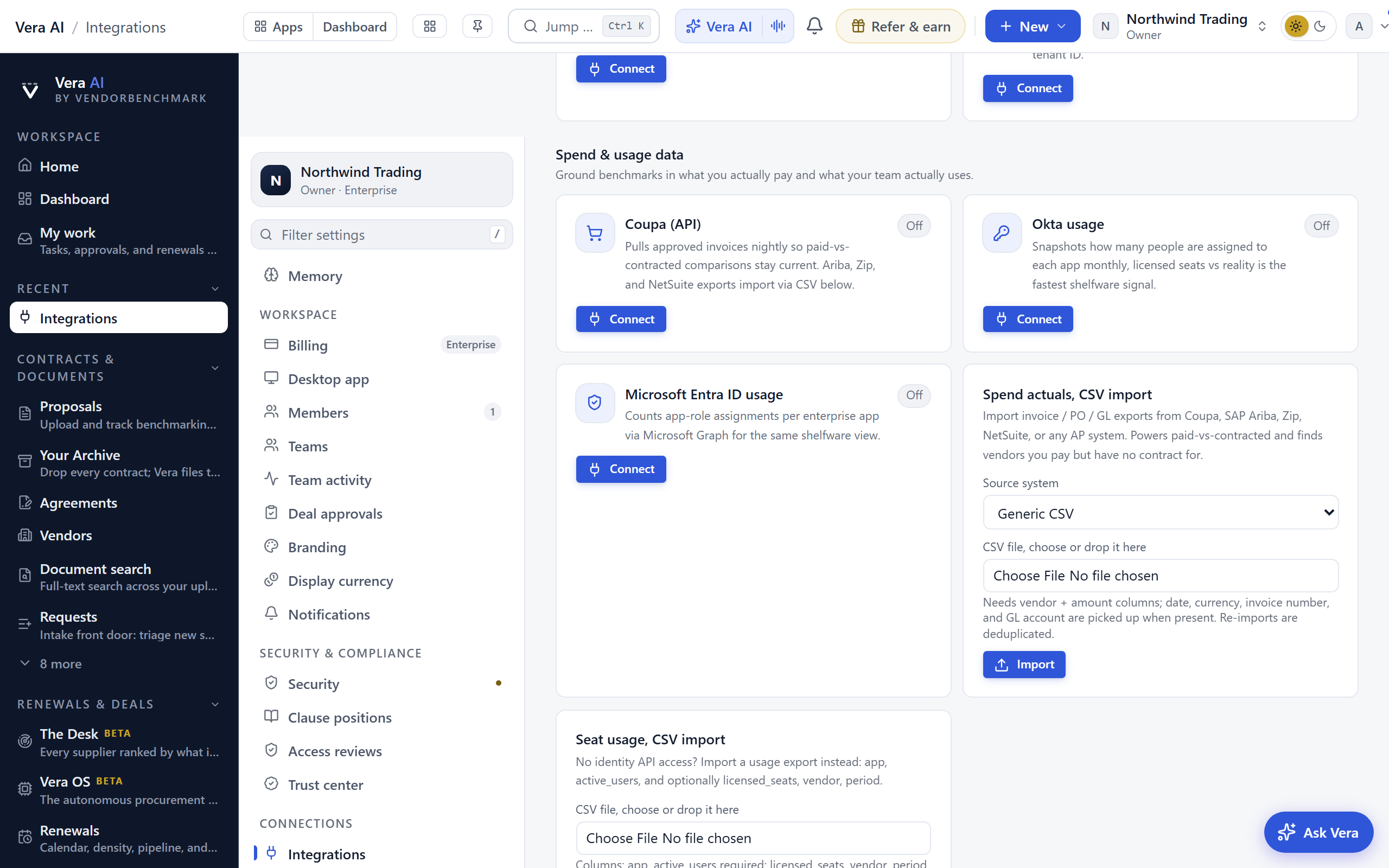
Spend and usage data
The money and the activity behind it: what you pay, and who actually uses what you pay for.
| Connector | What it does |
|---|---|
| Coupa | Spend actuals by API |
| Okta usage | Who actually signs in to which app |
| Microsoft Entra ID usage | The same, for Microsoft estates |
| Spend actuals import | A CSV from Coupa, SAP Ariba, Zip, or a NetSuite GL export, or any generic spend CSV |
| Seat usage import | A CSV of per-app seat activity |
| Smart import | One-off bulk loads: the AI reads whatever columns your export has and maps them for you |
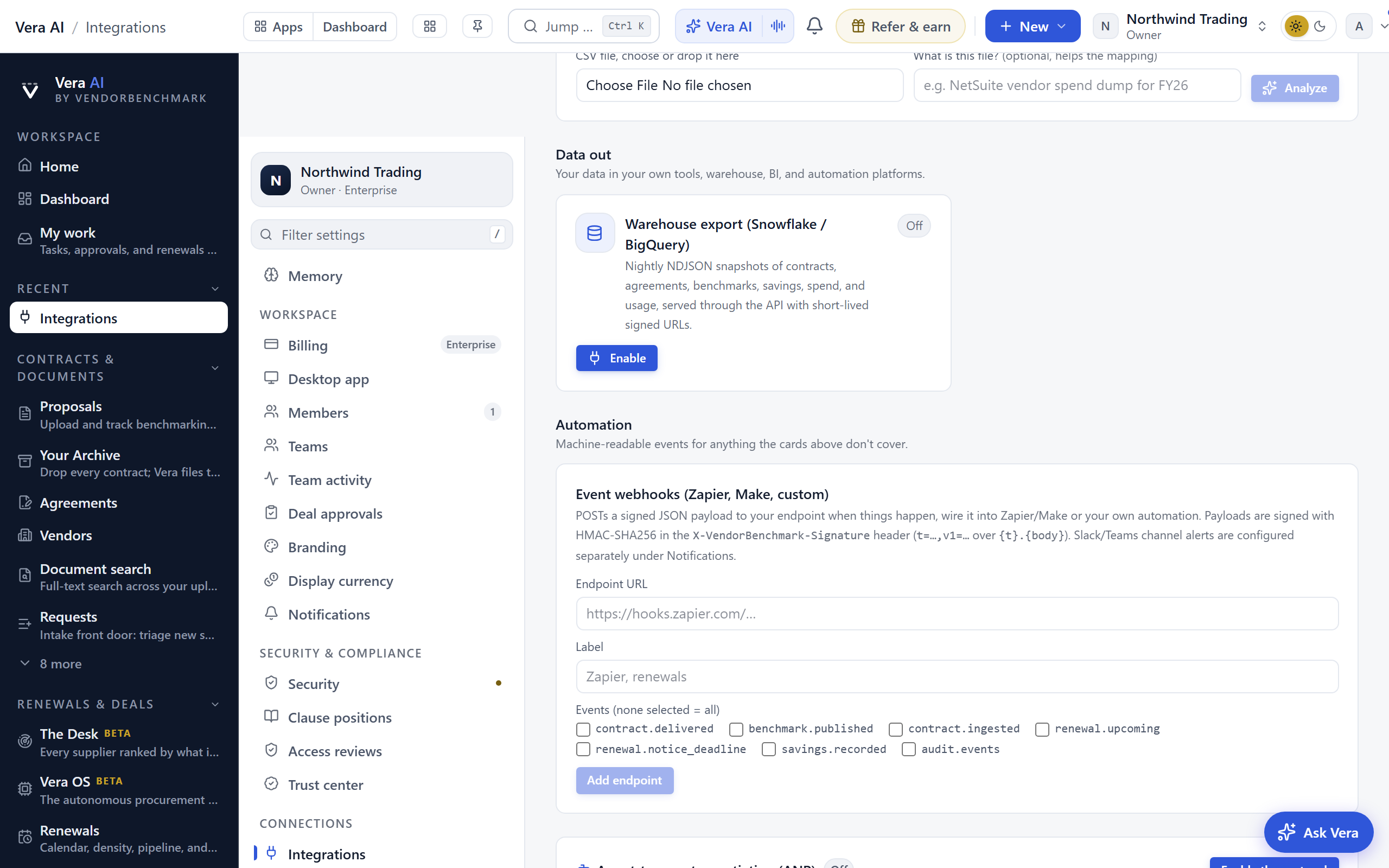
Data out and automation
Your data is yours to take with you, continuously.
| Channel | What it carries |
|---|---|
| Warehouse export | Contracts, renewals, savings, and spend tables to Snowflake or BigQuery |
| Event webhooks | Signed JSON events (deliveries, status changes, findings) to any endpoint, including Zapier or Make; verify the signature before trusting a payload |
| Audit webhook | The audit log streamed to your SIEM |
| File exports | Every report as PDF, Word, or PowerPoint; ledgers and tables as CSV or Excel |
The integrations page also carries the Agent Negotiation Protocol card: an org owner opts your workspace into structured agent-to-agent negotiation there, and the public spec lives at app.vendorbenchmark.com/agent-protocol (see The API, MCP, and agent-to-agent).
Procurement and ERP (P2P)
Purchase orders, requisitions, and supplier records, so spend that never touched a contract still shows up, with maverick spend flagged. Beneath the connector cards, the Procurement intelligence table turns the synced records into a supplier-by-supplier read.
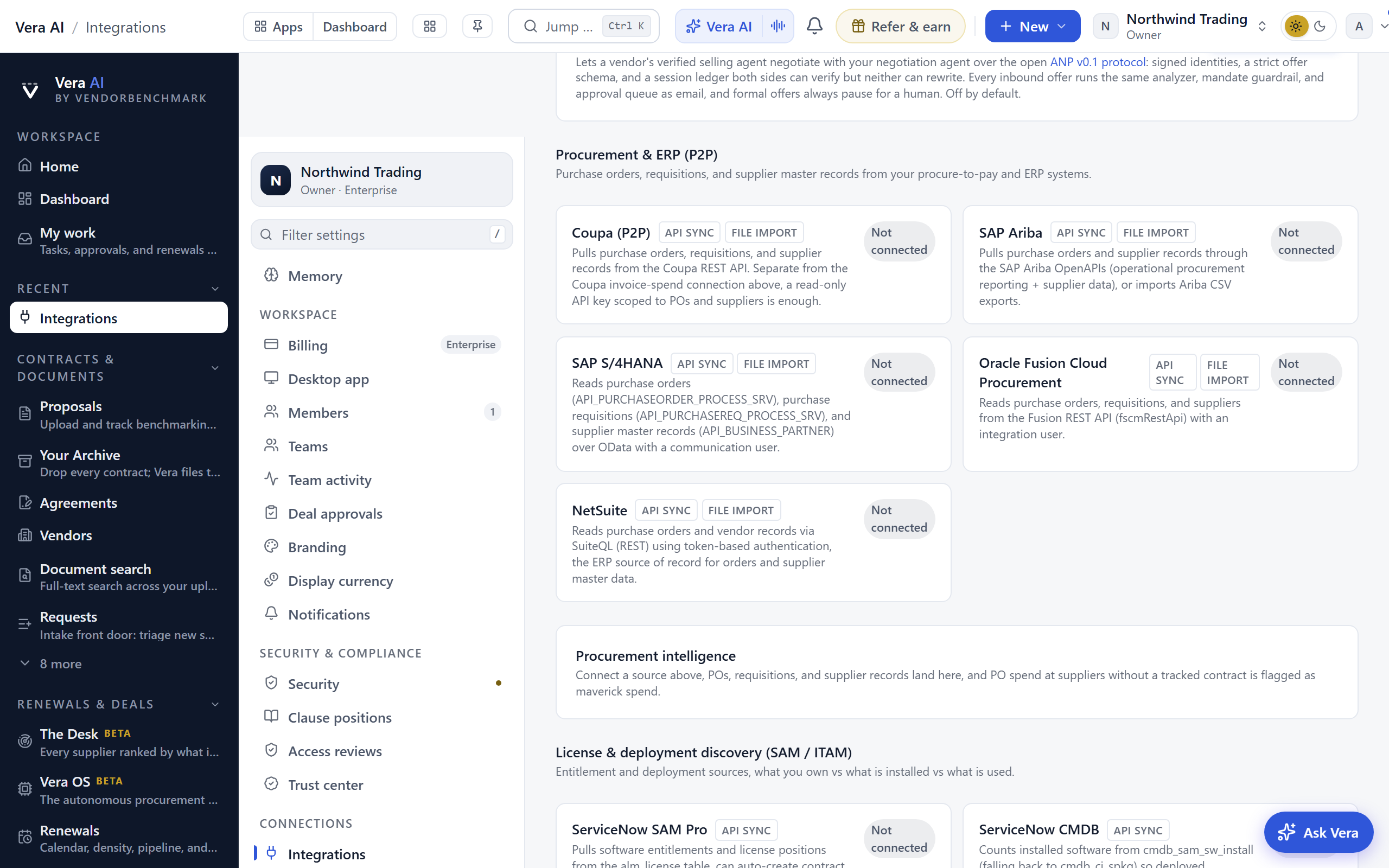
| Connector | Source |
|---|---|
| Coupa | API connection |
| SAP Ariba | API connection (US, EU, APAC endpoints) |
| NetSuite | Token-based API connection |
| Oracle Fusion Cloud Procurement | API connection |
| SAP S/4HANA | API connection |
| File exports | Coupa, NetSuite GL, Ariba, Zip, or CSV when an API connection is not approved |
License and deployment discovery (SAM / ITAM)
Connect the systems that know what you own and what is deployed; the License intelligence table beneath the cards then shows entitled against deployed against active per vendor, with estimated shelfware. This is the data that powers Data health, Billing watch, and audit exposure. Each connector card opens on a click to show its credential form and carries a mode badge: API connection, file import, or both.
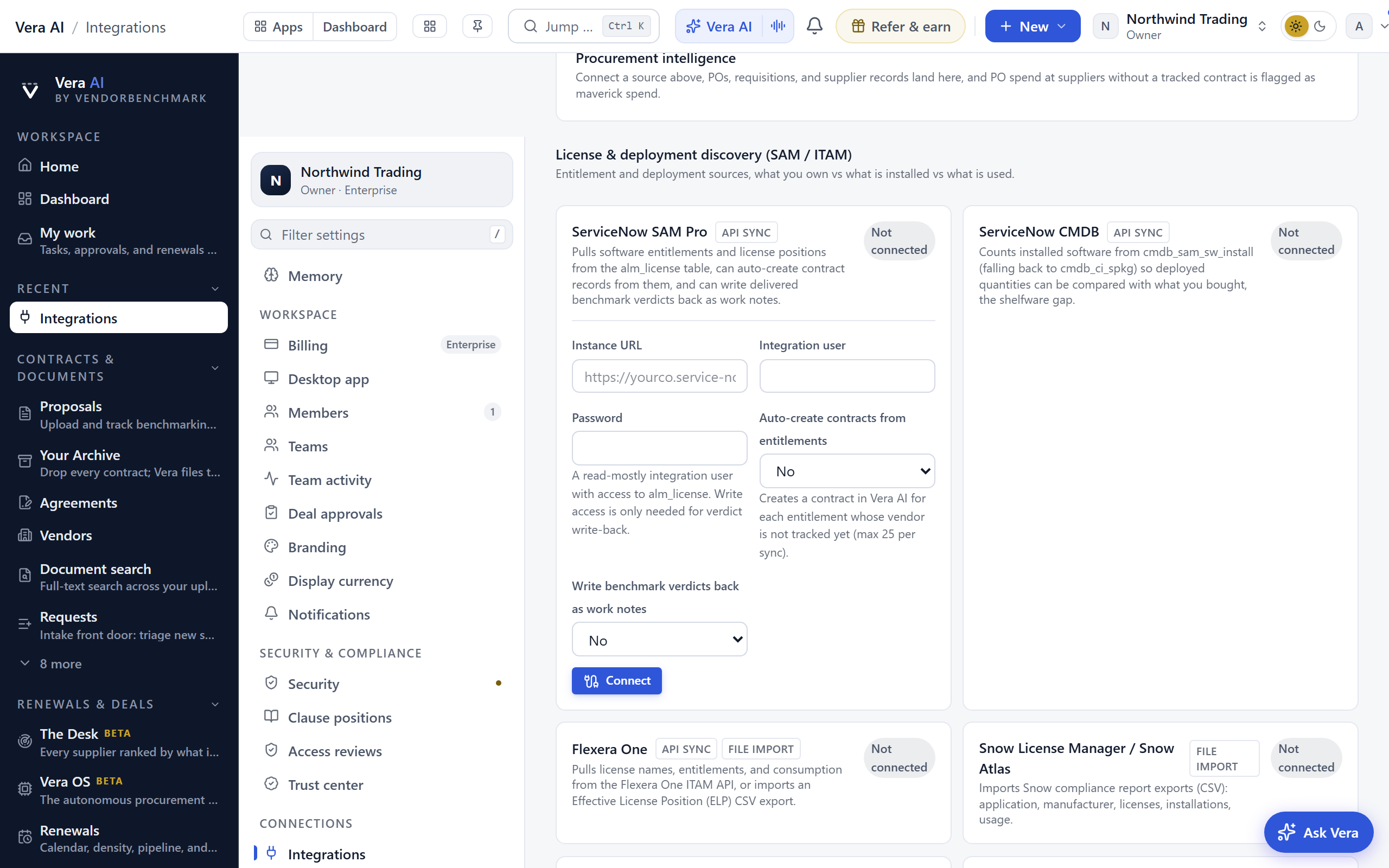
| Connector | Source |
|---|---|
| ServiceNow SAM Pro | Entitlements and license positions |
| Flexera One | Entitlements and deployments (US, EU, APAC endpoints) |
| Snow License Manager / Snow Atlas | Entitlements and usage |
| USU / Aspera SmartTrack | Entitlements |
| Microsoft 365 | Seat assignments and last-activity via Microsoft Graph |
| Microsoft Intune | Device and app inventory |
| Jamf Pro | Apple estate inventory |
| ServiceNow CMDB | Deployed software inventory |
| Oracle LMS / ULA position | Your measured Oracle deployment position |
| SaaS management platforms | Zylo, Zluri, Torii, or Productiv, via their CSV exports |
| Cloud billing | AWS Cost & Usage Report, Azure cost export, or Google Cloud billing export, feeding the Spend lens on Portfolio and the Cloud cost optimizer |
How to use it
Every connection named in this catalog has a step-by-step setup recipe, with a verification line and a teardown, in Chapter 19 · Integration recipes. The order that pays best:
- Start with identity: SSO and SCIM first, so access is governed from day one.
- Open the cheapest intake rails: email-in addresses and a folder watch cost minutes and remove the manual-upload habit.
- Connect one SAM or usage source and one spend source, then follow Data health, which ranks every remaining gap by the feature it unlocks.
- Turn on data out last: the warehouse export and the audit webhook make the platform a citizen of your data estate rather than an island.
Related: Integrations (settings reference) · API · Connect your data and close the gaps
Vera AI with your SAM tool
Who: owners connect the sources · everyone benefits from the joined data
Your SAM or ITAM platform and Vera AI know different halves of the same estate. Flexera One, ServiceNow SAM, Snow License Manager, USU, and Xensam know what you own and what is deployed: entitlements, installations, active users, license positions. Vera AI knows what it all costs and what it should cost: the contracts themselves, the prices against the market, the renewal mechanics, and the negotiation. Connect the two and each side covers the other's blind spot.
Data flows in. Under Settings › Integrations, the discovery connectors pull license positions from your SAM tool, live over its API where one is exposed (ServiceNow, Flexera One, Xensam, Microsoft 365, Intune, Jamf) or from its standard export file (Snow, USU, the SaaS management platforms). Every source lands in the same License intelligence table: entitled versus deployed versus active per vendor, priced where a unit rate is known. That is where shelfware stops being a suspicion and becomes a number. Every sync and import also files as a report in Vera Licensing, the ledger where license reports land and where Vera reads them.
Or the tool pushes. When the integration runs from the SAM side (a scheduled job, an iPaaS flow, or a script), point it at the license report push API instead of connecting a pull:
POST /api/v1/license-reports
Authorization: Bearer vbk_your_key
Content-Type: application/json

{ "title": "Weekly license position", "source_label": "Flexera One",
  "rows": [ { "vendor": "Microsoft", "product": "Visio Plan 2",
              "entitled": 400, "deployed": 310, "active": 210,
              "unit_cost": 180, "currency": "USD", "metric": "seats" } ] }
Row fields take the common synonyms a SAM export uses (purchased, installed, used, unit price and so on), snake_case or camelCase, up to 5,000 rows per report and 12 pushes an hour per key. Keys are created by an owner at Settings › API access. Every push files into the Vera Licensing ledger, updates the live license position, raises the license_report.received webhook event for your connected channels, and can be listed back with GET /api/v1/license-reports or fetched row by row with GET /api/v1/license-reports/{id}.
Data flows out. Report extract writes your contract register back the other way, in the agreement layout your tool imports: one workbook shaped for Xensam, Flexera One, ServiceNow, Snow, or USU, or your own template filled under its own headers. The ServiceNow connector goes further on its own: it can create contract records here from entitlements it discovers, and write delivered benchmark verdicts back onto the source records as work notes.
| Tool | What flows in | What flows out |
|---|---|---|
| Flexera One | License names, entitlements, and consumption over the API, or an ELP export | The contract register in the Flexera One contract layout |
| ServiceNow SAM | Entitlements from alm_license, installs from the CMDB, optional auto created contracts | The register in the ast_contract layout, plus benchmark verdicts as work notes |
| Snow License Manager | Compliance report exports | The register in the Snow agreement layout |
| USU (Aspera) | License position exports | The register in the USU contract layout |
| Xensam | The software list over the Xupervisor REST API, or a CSV export | The register in the Xensam agreement layout |
The goal when both are connected. One closed loop instead of two half informed systems.
- Shelfware gets priced, then negotiated. The SAM side proves 1,500 seats entitled and 900 active; the Vera side knows the unit price and the renewal date. Together that is a true down argument with a number on it, delivered before the notice deadline rather than after the auto renewal.
- Renewals argue from usage evidence. A benchmark says where the price should land; the deployment data says how much of the product you actually consume. A vendor hears both at once, and the second one is the harder to argue with.
- Neither register goes stale. The SAM tool stays the operational system of record for the estate; Vera stays the commercial one for what it costs. The connectors keep the first flowing in, Report extract keeps the second flowing out, and nobody re keys agreements by hand in either direction.
Start with whichever direction closes your bigger gap: pull the inventory in if you negotiate blind on usage, push the register out if your SAM tool's agreement list is empty. Most workspaces end up running both.
Related: Vera Licensing · Report extract · The integration catalog · Integrations (settings reference)
Deployment models
Who: Cloud is the standard service; the other three are Enterprise conversations
Most teams run the standard Cloud service and are live the same day. For organizations whose policies require more, three further models exist; they are scoped with your security team rather than sold as checkboxes. Bring your requirements to the Advisory desk or the team Chat, and the full comparison lives at vendorbenchmark.com/deployment.
01 · Cloud (available today)
The managed multi-tenant platform described at the top of this chapter. Live the same day, always current, full benchmark network access, Enterprise controls (SSO, SCIM, MFA, audit) on by default, and the lowest cost of the four. The trade-offs are the ones inherent to shared infrastructure: isolation is enforced in the database rather than by separate hardware, the hosting region is ours, and contract files are processed outside your network perimeter, encrypted and access-logged.
02 · Dedicated cloud (Enterprise agreements)
A single-tenant deployment provisioned and operated exclusively for you: dedicated database, dedicated file storage, dedicated encryption keys, your own subdomain or custom domain, hosted in the region your policy requires. It answers the two requirements shared multi-tenancy cannot: data residency mandates, and security policies that rule out a shared database regardless of how it is isolated. Still zero operations work for your team; updates arrive on an agreed maintenance cadence rather than continuously, and it is priced as a dedicated environment above the standard plans. Time to first benchmark: days.
03 · Hybrid connector (Enterprise early access)
For a hard "documents cannot leave the network" policy. A lightweight connector (one container) runs inside your environment and reads contracts locally: it extracts the commercial terms, shows your team exactly what it found, and sends only the figures you approve to the cloud for benchmarking. The documents themselves never cross your boundary, and you still get the full market comparison, negotiation targets, and renewal calendar. Document-centric features (clause-level review, full-text document search) run reduced or stay local, and your team operates and updates the one connector. Time to first benchmark: weeks, including your security review.
04 · Self-hosted (by arrangement)
The full platform inside your own boundary, for defense, government, and the strictest financial mandates. We deliver versioned releases your team deploys into your own cloud account or data center, with our runbooks and support; your team owns upgrades, backups, scaling, and restores, audit events stream straight into your SIEM, and market data arrives as periodic snapshots rather than a live network connection. It is the most control and the most work of the four, which is why it is scoped as a joint engagement. Time to first benchmark: months.
The four at a glance
| Cloud | Dedicated cloud | Hybrid connector | Self-hosted | |
|---|---|---|---|---|
| Best for | Most teams | Residency mandates, no shared database | Documents cannot leave the network | Air-gapped and sovereign environments |
| Who operates it | Us | Us, on your dedicated infrastructure | You run one connector, we run the rest | Your team, with our support |
| Contract files live | Our encrypted cloud storage | Your dedicated storage, your keys, your region | Inside your network, never uploaded | Your infrastructure, entirely |
| Updates | Continuous | Agreed cadence | Cloud continuous, connector by you | Versioned releases you apply |
| Benchmark network | Full | Full | Full, for approved figures | Periodic snapshots |
| Time to first benchmark | Same day | Days | Weeks | Months |
Related: Trust center · Plans, allowances & limits
Next: Chapter 19 · Integration recipes for the step-by-step setup of everything cataloged here, or back to the manual index.
Was this page helpful?
Thank you. Your note goes straight to the team that writes this manual.