09 · Record & detail pages
Lists get you to a record; the record page is where the work happens. Analyst Benchmark, vendors, agreements, and reports all open into a detail page built from the same parts, so once you know the pattern you can read any of them. This chapter covers that shared anatomy and then the three detail pages you open most.
The record page pattern
*In plain words: learn one page shape and you have learned them all.*
Every detail page in the platform is laid out the same way, top to bottom:
- Breadcrumb — where you are, and one click back to the list. Beside it sit two live controls: quiet avatar pips showing who else is viewing the record right now, and a Watch button. Watching subscribes you to the record: comments, vendor messages, sign-off activity, and Vera's work land on your notification wire; commenting or acting on the deal subscribes you automatically.
- One banner at most — when the record has something to tell you (a report correction notice, a just-submitted note, a suggested lineage link to related paper), only the most urgent one shows above the header, never a stack.
- Highlights header — a vendor logo, the record title and status, and a row of the key facts (the numbers you would read out on a call). Actions for the record sit here on the right.
- Tabs — the main content, as underline tabs (the active one carries a blue border). The same tab pattern is used everywhere, never boxed or segmented.
- Related records strip — below the tabs: one hop to everything connected, the vendor, the matching renewal, the delivered report, the contract this one renews, plus any connected workspaces.
- Right rail — supporting tools and context beside the tabs: renewal tracking, The full review of this agreement (below), AI insights, and comments, with the less frequent tools in a More for this record fold.
- Research for this vendor — where the library covers the vendor, the record carries pointers to it, led by Read before the meeting: the negotiation prep brief, three pages on what the account team is compensated to sell you, the facts about your own estate to hold before they quote, the talking points to use, and what they will say with the counter to each. Beside it sit the Negotiator's Guide (the ten step guide the benchmark sheet renders, on the vendor page since 5 September 2026, opened as the document itself), the call scripts (the three calls that decide the renewal, word for word, with the counters to what the account team will say; on the vendor page since September 2026), the renewal outlook (what the next twelve months will cost and what to lock in now) and the vendor assessment (where the vendor is taking pricing and packaging). Nothing appears for a vendor the library does not cover yet, so what you see is either right or absent. These pointers show on the contract, negotiation and renewal records, the renewal playbook, and the vendor page.
- Timeline — one chronological stream of everything that happened on the record: comments, vendor messages, sign-off requests and decisions, and Vera's work, each entry with who did it and when, refreshing live while teammates act. Under it, Discussed in lists every chat message and Board post that referenced the record, with the snippet and a jump link.
Because the pattern is fixed, the tab names change but the way you move around does not. Negotiation deal rooms open with the same highlights header (target, latest quote round, concession balance, open commitments, last activity), so a live deal reads like every other record.
The workroom
Most records carry a navy band that opens the record as a workroom: one room, the same on every screen that has it, so once you have worked in one you can work in all of them.
- The stage — the record's papers as numbered executive brief documents on a dark stage, one per screen, paged with the arrow keys, with a read meter across the top and Esc to close.
- The left rail — the document list, then two shelves: a keyword and semantic search over your own uploaded documents, and your shelf of recent and starred workrooms, so what you read last is one click away.
- ⚡ What now — the icon dock on the right edge splits the stage and puts the record's moves beside whichever paper is open: the drafts Vera composes from this record's own figures, the copies, the exports, and the handoffs into other screens. The same moves are also the last document in the file, so you can read them in the flow of the paper, and they appear in the command palette. Every move is real. Nothing in a dock is a button that does nothing. Every move is also sayable: on a call, or typed to Vera, name the move and the seat presses it for you, shown as a chip once it lands; a move that sends or signs stays your press.
- ✦ Ask Vera — the second panel in the same split, grounded on this record alone rather than on the platform in general, with one chip per document that jumps the stage. Questions asked here land in the same saved conversation every time you reopen the record.
- Drafts open in a window for you to copy or edit, and a draft never sends itself. The two exceptions send only on your explicit press over a full preview: the renewal record's Book the vendor meeting (the invite goes out from your own mailbox) and the invoice desk's Send the claim. A vendor-facing draft also asks whether it is the start of a negotiation; saying yes files it as the opening move of a tracked thread (see Major renewals).
- Driven by the bench — a record remembers the moves a specialist drove on it. The agreement file's Activity pane, the contract's Timeline card and the renewal's activity list carry a row for every driven move with its outcome, in one sentence: Yuki, for Fredrik, set the term to 36 months, verified; or, when the screen did not confirm it, tried to open the runway view, not verified, halted. The same rows owners read under Settings, Activity, shown where you look.
- The room saves itself. Opening a room records it, and the paper you are reading, so Back to the room on your dashboard takes you back to exactly where you left off, on any machine. Only you can see your own trail. Keep this room on my desk, at the foot of the What now panel, turns it off and clears what was already saved.
- The sibling desks — pills beside the record's title: Case file first, then the desks this record can hand off to. They swap what is on the stage without closing the record. The rail, the What now dock, Ask Vera, your shelf and every figure stay exactly where they are. Each desk's room says what that desk does, lists the runs you already have on it with the vendor you are working on first, so you can reopen one instead of starting cold, and carries one control that hands this work over. That last control does leave the record, because those desks read a document and run for a few minutes as their own job, but it is a press you choose after seeing what you are choosing. The way back is the Case file pill, any document in the rail, the button at the foot of the room, or Esc. On a narrow window the same pills ride the end of the document strip. The same moves in the What now dock open these rooms too, so reaching for another desk never costs you this one.
- Esc unwinds one layer at a time — the open dock panel first, then the open room, then the record itself.
Rooms have addresses: ?open=case on the record's own route, so a workroom can be bookmarked and forwarded, and the browser Back button closes it.
The screens that open a workroom: the vendor record, the renewal record, a delivered benchmark report, an invoice review, a sourcing project, a diligence review, the board record, the org estate, the Fair Renewal Rider, a Terms watch price change, the Research Agent, and every optimizer and decoder in Chapter 03.
The proposal record
Everything about one uploaded proposal, from the moment you submit it to the delivered report.
*In plain words: one proposal's whole life on one page: status, files, and eventually the report.*
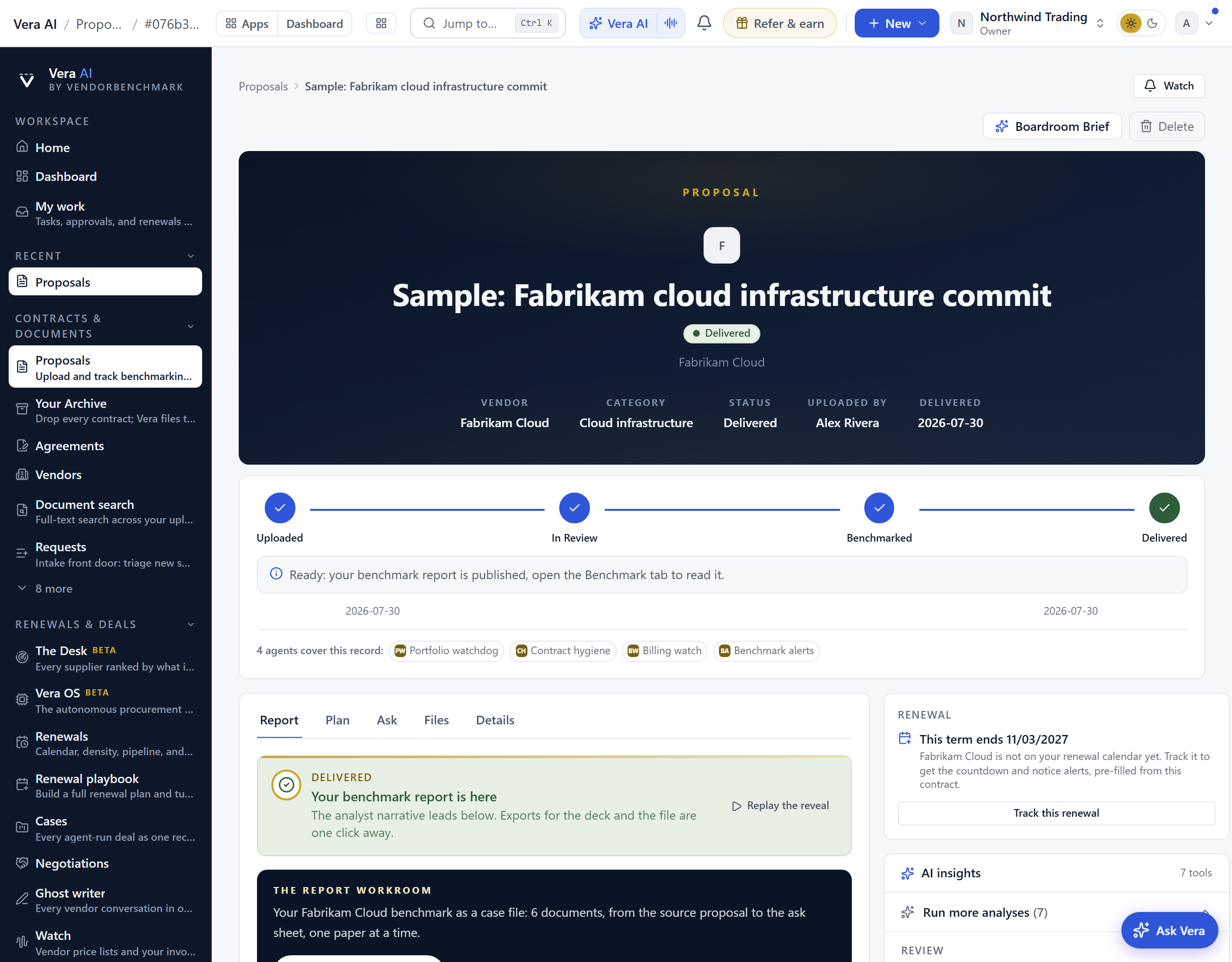
A worked example. The sample Northwind CRM proposal's record shows the pattern at its best: the status path across the top, the files beneath, and once delivered, the Report tab carrying the finding ($28,650 a year in reach) with its case file one press away. While the proposal is anywhere before Delivered, the page refreshes itself within half a minute of a status change; delivery announces itself with a toast.
On the screen
- Status path — the four-step path Uploaded, In review, Benchmarked, Delivered, with the date each step was reached and, while it is with our team, who is working on it and how long it has been in the current step. While a requested benchmark is in flight, a promised-date block leads this area: the delivery date we committed to at display size, the days remaining, when you asked, and one sentence on what is happening right now; if a report runs past the estimate, the block says so plainly.
- Highlights — vendor, category, status, who uploaded it, and the delivered date. If the AI redline found the quote below the vendor's usual discount band, a "below band" badge appears here.
- Deal brief — the one-glance read of the deal, directly below the header.
- Document brief — the analyst's reading of the paper itself, written the moment you upload: what the document is (the parties, the vehicle, the term), its commercial shape in the paper's own currency, and two to four things to check before signature, with the customer entity of record and the paper's own printed title under the headline. When the platform recognizes the publisher, the answers to that publisher's own questions (an EA's enrollment number and true-up terms, a capacity order's credit rollover) sit beneath the prose; hover an answer to see the verbatim passage it was read from.
- First read — every real upload gets the instant AI read: it appears on the record page about two minutes after the paper lands, so you have a number long before the analyst report. Included reads never spend your plan's decode allowance.
- Workspaces strip — below the tabs, with the related records: the deeper analyses that already have a result, the redline review, the SOW rate review, the walk-away alternative, and the negotiation brief. On the brief, the call prep pack now fronts itself with a cover: the asks counted, the pushbacks answered, a contents list that jumps to each section, and your first three moves lifted from the call plan; a freshly generated pack lands with a short delivery reveal. Editing the brief is truly co-edited: teammates in the editor at the same time share one live draft, a banner names who is editing with you, and each field shows who is typing in it, so nobody overwrites anyone. Saving still appends a new version.
- SOW rate review — for services documents, the review extracts every rate line and benchmarks each day rate against the market band for the role. When you have a saved MSA rate card for the vendor (see Rate Card Benchmark), a Your MSA column appears beside the market band: each line billed above your contracted rate is flagged as a contract-compliance gap, with the per-day delta and the overage across the stated volume computed in code. The market band is context; the MSA rate is the ceiling you hold. A Save as rate card button on the rate table records the extracted lines as your contracted rates in one click, and any blended or offshore-blended line carries a Deconstruct this rate panel showing the plausible senior/standard/junior mixes at that price and the margin range each read implies.
The tabs — always in the same order, Report, Plan, Ask, Files, Details, at every stage; only the tab that opens first changes.
- Report — once delivered, this opens first, and a small line points here from any other tab: the white-paper narrative, the negotiation playbook, and the metrics table with percentile bars (see The benchmark report below). Before delivery it shows the request-a-benchmark card with the estimated delivery date. A published report's actions row can also mint a read only verdict link: one page carrying your discount, the peer range, the rank, and the executive summary, nothing else, expiring after 14 days by default, with view counts and one click revoke, made for forwarding to an executive.
- Plan — the step-by-step engagement plan for this vendor, with AI guidance on each activity.
- Ask — ask questions about this specific document and get answers grounded in its text.
- Files — the PDF or DOCX files you uploaded, opened with a short-lived signed link.
- Details — the extracted fields (seats, annual value, uplift cap, term dates, source language), your notes, and what you asked us. You can re-extract or export a redline from here.
The right rail — three cards, then a fold
- Track renewal — when the record has a renewal to track, the tracking card leads the rail.
- The full review of this agreement — the long form review the agent writes over every file on the record, with a web search of the vendor's current published terms where a term depends on them: what the paper does with a table of every commercial mechanism and its assessment, the drafting defects to resolve first, the seven to ten commercial terms to change with the section and the precise ask, the ten clauses to look at, what is genuinely negotiable, what you will have to trade for and what the vendor will not move on, how to run the negotiation, and the sources consulted. Press Write the full review and a bar says how long (about four minutes); then Read the review opens it over the page in the house paper, with Save as PDF, Word and Copy, and Write it again rewrites it after the paper or the record changes.
- AI insights — the AI analyses, grouped as Review (proposal review, SOW review, second opinion, renewal vs current), Model (what-if scenarios, entitlements, credible alternative), and Compliance (audit defense, audit workbench, security & DPA check). Rows with a stored result open first; the rest sit behind one entry. In the what-if modeler you can save a scenario by name, reload it any time, compare two side by side with the levers and the difference between them, and pin the chosen case to the negotiation plan.
- Comments — a thread on the record, and you can comment on a specific metric or clause.
- More for this record — a fold below the three cards holding the negotiation toolkit, the renewal outlook, and access management (whether the proposal is visible to the whole organization or restricted to named people, managed by the owner, the uploader, or an admin).
See also: Analyst Benchmark · Delivered reports · Contract Agent
The vendor record
Your whole relationship with one vendor on a single page.
On the screen
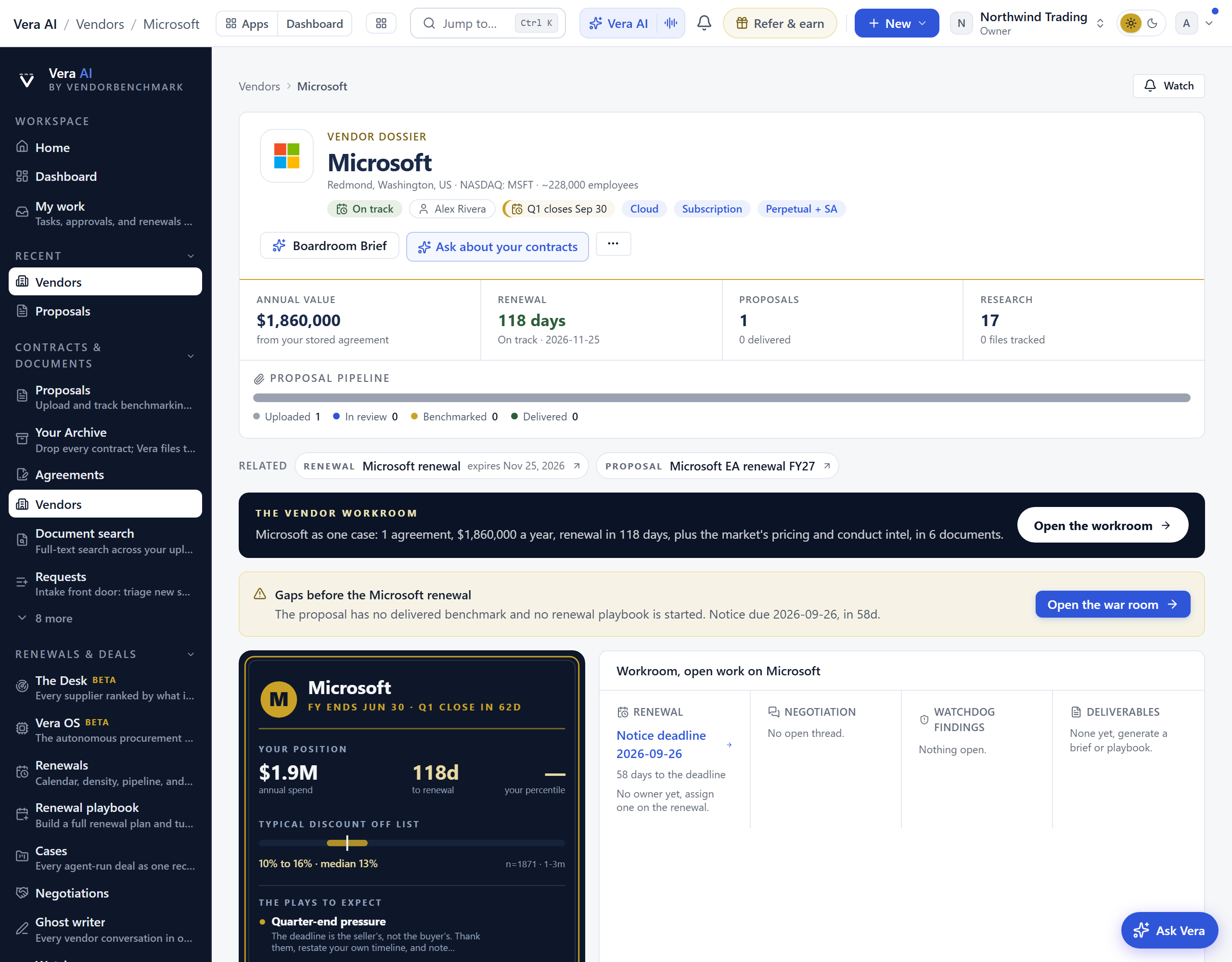
- Highlights — the record opens as a dossier: a gold kicker over the vendor name, then a gold rule over one facts strip holding the annual value, the renewal countdown and date, proposals (and how many delivered), and tracked research, with an "in notice window" badge when a deadline is close. For the 176 tracked publishers the masthead also states the company identity (headquarters, listing or ownership, headcount) and the vendor's commercial model chips (cloud, subscription, perpetual). The deeper tabs head their sections with navy bands, the same grammar as the delivered briefs.
- Company tab — the vendor intelligence card leads the record: who the vendor is, a Financials section with the latest reported revenue, margins, and segment mix (refreshed each time the vendor reports earnings) closed by a Buyer's angle read on what those numbers mean at your table, the commercial model (revenue mix, contract vehicles, true up mechanics, and an audit posture rating), the product families we track with a one click benchmark on each, and the vendor's latest signals from the Vera Wire.
- War room mode — when a renewal crosses into its notice window, the record leads with a live countdown, this week's playbook step, the negotiation brief, and the owner and approvers pinned. The same deal also jumps to the top of My work, so a live renewal never runs off screen.
- Take it to market — the renewal record's challenge control opens a competitive sourcing event with the incumbent's current annual price as the baseline. Alternative vendors bid against it, every priced response reads as a delta against the incumbent, and the best credible bid becomes the leverage line the renewal negotiation cites.
- Open the workroom — a navy band under the related records opens the vendor as a workroom. Up to six documents build from what this vendor's record holds: your agreements ledger, the pricing band at your deal size, the vendor's terms and conduct intel, a negotiation angles brief fitted to your footprint, and a What now sheet. ⚡ What now carries the moves that run on this vendor's live records: open the renewal record, open the latest proposal, read the delivered benchmark report, start tracking the agreement, open a Vera Deal Room, and copy the vendor one pager. ✦ Ask Vera answers from this vendor's own records, so a question about pricing is measured against what you actually pay rather than against the market in general.
- Proposal pipeline — this vendor's proposals across the status path.
- The vendor brief (Analysis tab) — the long form brief the agent writes across every agreement you hold with this vendor, with a web search of their current price list, uplift, cloud and audit policies: what you buy, how their paper treats you and where the papers disagree with each other, the terms to change across the book, the ten clauses that decide the relationship, what is genuinely negotiable with this vendor, and how to run them against their own calendar, with the sources consulted at the foot. Press Write the vendor brief and a bar says how long (about five minutes); then read it over the page, save it as PDF, take it as Word or copy the text.
- Vendor profile — your position stated as a rank against comparable deals (poor, below market, at market, good, or top of the market), the typical discount off list once a benchmark exists, and the plays to expect from this vendor (quarter-end pressure, high anchor, bundling misdirection, and more).
- Workroom — the renewal, any live negotiation, watchdog findings, and the deliverables on this vendor, each one click away.
- QBR pack — the quarterly business review pack for this vendor opens with a delta cover built from your published benchmarks: the three moves that matter, your position change, savings realized, and the percentile trajectory since last quarter, on one page. It reads calmly in a vendor's first quarter, before there is a history to compare. A freshly generated pack lands with a short delivery reveal before the paper opens, and it downloads as a PDF in the executive brief theme alongside the Word export.
- Deeper tabs — the tabs are the whole map: position and risk reads live under Analysis, intelligence briefs under Research, the film library under Watch, and the activity log under Log. The relationship analysis under Analysis opens as an executive brief: a vitals row computed from your own records (spend on file, estate size, days to expiry, notice deadline, with anything not captured flagged), the full estate table, an annual value chart when more than one item carries a value, and the analyst narrative in short sections.
- Watch tab — the film library filtered to this publisher, playing on the record. It opens by stating what it holds (for example "23 films on Microsoft, 112 minutes in all, including one run watched in order"), then four shelves: the analyst briefings and research films as poster cards, the series runs, the recorded sessions where a deal is worked live, and the podcast episodes that name the vendor. Playback carries chapters and an Up next rail, so one film rolls into the next without leaving the page. Search the shelf when a publisher carries more than six films. The tab only appears when a library covers the vendor, and the Research tab points at it, so a vendor with no papers yet is never a dead end. Deep link to it with
?tab=Watch. - Everywhere else this vendor lives — the related strip under the masthead is the record's map of the rest of the platform: the renewal and its date, the delivered benchmark report, the proposals on file, the self-serve benchmark tool for this publisher, the peer scorecard and its grade, the research papers, the films, and the open negotiations. Each chip lands filtered to this vendor rather than on a full list, and a chip only appears when there is something behind it. The links run both ways: filter the Analyst Briefings window or the research library to a vendor you buy from, or open its scorecard, and each offers the hop back to this record.
- Present the intel briefing — the market intel briefing's reading dialog carries a Present button for the fifteen minutes before a vendor meeting: it walks the scanned developments one at a time with the negotiation angle on each, and closes on your stance, with your annual spend, benchmark position, and the market risk read pinned to the top of the stage.
How to use it
- Read the highlights and the vendor profile to see whether this vendor looks above or below market and what plays to expect.
- Check Intelligence before a renewal for the latest pricing and licensing moves.
- Use the related records strip to jump to the vendor's renewal, proposals, delivered reports, benchmark tool, scorecard, papers, and films, or open the war room straight from the renewal alert.
- Open Watch in the ten minutes before a vendor call and play the newest briefing on that publisher.
See also: Vendors · Vendor scorecards · Terms watch
The renewal record
The renewal record is no longer a page of its own. Since 5 September 2026 it is the File room of the renewal desk: pick an agreement and press 2, or Enter, and it opens in full inside the application. Every old link to a renewal record lands there with that agreement open.
*In plain words: the record moved into the desk, so nothing about a renewal needs a second page.*
What the room holds is documented with the desk: the stage as a control, the terms with the hand that edits each, the position math, the paper, the proposals and the benchmark, the playbook, the checklist, the engage doors (Have Vera run it opens the case intake as a sheet), the autopilot, the run, last time and the activity.
Related: Renewals · The vendor record · The benchmark report
The benchmark report
The deliverable itself: a senior-analyst read of your deal against the market, not a bare table of numbers.
*In plain words: the report argues a finding; the metrics beneath it are the evidence, never the report.*
When to reach for this
- Reading a delivered report properly: finding first, evidence second, levers third (the handoff recipe turns it into the conversation).
- Explaining to a stakeholder why the deliverable is prose with a table, not a table alone.
On the screen
- The reveal — the very first time you open a delivered report, a short full screen reveal announces it: your market standing stamps in, the money on the table counts up, and a band draws where you sit between market low and high before the stage lifts onto the report. One click skips it, it respects your reduced-motion setting, and it never appears in print or PDF output. It plays once per report; replay it any time from the "Replay the reveal" control on the Delivered banner. Shared report links get the same first-open moment, once per link.
- The headline — page one answers three questions in one screen: the negotiable value found across your benchmarked terms (or "At or better than market" when there is nothing to chase), the signature position bar for your single biggest lever showing where that term sits in the cohort and the dollars on the table, and a report-level confidence chip stating how solid the data is (the deals referenced, the freshest data date, and the sources).
- The narrative — the white-paper report leads: an executive summary, your market position, section-by-section analysis, prioritized recommendations, and a bottom line. Every figure is grounded in stored data, with its sources listed at the foot of the document.
- Trust strip — an AI-generated report opens with one verification story for the whole page: the grounding state ("Figures verified against your data", or a review notice when a figure needs one), the source count, the generation date, and feedback thumbs.
- Section chips — a long report keeps a sticky row of section chips across the top of the document on every screen size, shared links included: the chip for the section you are reading stays highlighted, and tapping one jumps straight to that section. On wide screens with free margin, a slim side rail beside the document lists the sections instead and tracks where you are as you read.
- Your standing, metric by metric — inside the "Where you stand versus the market" section of the AI narrative report, a bar chart with one bar per metric: the bar's length is the share of comparable deals your terms beat, and your value is printed at the bar.
- Note from our team — on a delivered report, the analyst note renders as a signed note on a cream panel with a gold rule, "The analyst desk" byline, and the delivery date.
- Negotiation levers — your top opportunities ranked by annual dollar value, at most three so it reads as an agenda: each card states the finding in one sentence, the money, the move, and the recommended ask. Every figure repeats on the metric rows below.
- Negotiation playbook — the metrics turned into specific asks you can take into the room.
- Metrics table — each metric with your value, the market low, median, and high, a percentile, and notes. The signature percentile bar shows where each one sits: the cohort's middle half shaded, the median ticked, your deal flagged, and the dollar gap to median on the bar. You can pick the peer cohort the comparison uses. When the narrative leads the page, this section sits below it under the title "Appendix · Metric detail".
- Overall score — one number summarizing how the deal stacks up.
- Delta and trend — how the report changed against earlier snapshots, when there is a history.
- Section notes — pin a comment thread to any section of the report, reply, and resolve it before you forward. Notes stay internal to your team and never appear on a shared link, a PDF, a Word file, or the slides.
- Open the workroom — the navy band on the Report tab opens the delivered benchmark as a six document workroom: the cover, the source proposal record, the analyst brief, a metrics atlas with the market ranges and the verdict table, an ask sheet priced from the stored figures, and a What now sheet. ⚡ What now drafts the CFO brief and the vendor safe meeting request from the report's own findings, copies a chat ready summary or the one line verdict, downloads the PDF, and carries the report into the negotiation dossier, a second opinion, or an analyst booking. ✦ Ask Vera is grounded on this report, so a question about where a figure came from is answered from the report's own evidence.
- Downloads and sharing — export the report as PDF, Word, a PowerPoint deck, or an Excel workbook, hand it to a teammate, or create a share link. The PDF and the deck open with the same headline and position bar as page one on screen, so the forwarded document matches what you read.
- Present — the Present control above the report runs it as a full screen show for a live meeting: the headline and market position first, then the evidence, then the play. Arrow keys move between screens, G shows every screen at a glance, N shows a one line presenter note, and the print control produces a leave-behind of exactly the screens you walked. The show reopens where you left off on this report.
- Reading panel — once you share a report link, this panel shows how it is being read: total opens, unique readers, the sections read most, and time spent on the recommendations. It carries no IP or personal data and honors Do Not Track.
- What happened? — thirty days after your report is delivered, the Report tab asks one question: did you win a reduction, did the vendor hold, or are you still negotiating? You answer once per contract. A won reduction with an annual figure opens a reconcilable savings record against your invoices automatically, and your answer sharpens the benchmark over time.
How to use it
- Read the narrative first; it interprets the numbers rather than restating them.
- Drop to the metrics table to see the exact gaps, and switch the cohort if a tighter peer set applies to you.
- Take the negotiation playbook and the recommendations into your negotiation, and export or share the report with your budget owner.
- Pin notes to the sections your team needs to weigh in on, resolve them, then forward the clean report.
- When the prompt appears a month on, tell us what happened; a won reduction flows straight into realized savings on Portfolio.
See also: Delivered reports · Benchmark a proposal end to end
Next: Chapter 10 · Plans, allowances & limits
Was this page helpful?
Thank you. Your note goes straight to the team that writes this manual.