Agentforce: benchmarking Salesforce's AI push before it lands in your order form.
Salesforce's Agentforce is priced by consumption and pitched on a growth story: turn on the AI agents, watch usage climb, commit big. The units are new, the discipline is not. Size it from your real intent, benchmark the rate, and do not let it ride into the renewal unpriced.
Salesforce has done what every large software vendor is doing: attached an AI layer to its platform and made it the centerpiece of every renewal conversation. Agentforce, the AI agent capability, is priced by consumption, measured in the actions or conversations its agents perform, and it arrives with the familiar pitch. Turn it on, your usage will grow as the agents prove themselves, and the sensible thing is to commit to a large consumption block now while the rate is favorable. It is the same growth story cloud vendors tell, in a CRM's clothing.
And it deserves the same skepticism. A consumption commitment on an AI capability you have barely started using is a bet sized by the vendor on your behalf, and the vendor writes the odds to favor a larger commit than your real usage will justify. The units, agent actions, conversations, are genuinely new and genuinely hard to intuit, which is exactly what makes it easy to over-commit. Benchmarking Agentforce means refusing to size it from Salesforce's enthusiasm and sizing it instead from your own measured intent, before it lands as a large, hard-to-unwind line on the order form.
Size the consumption from intent, not enthusiasm
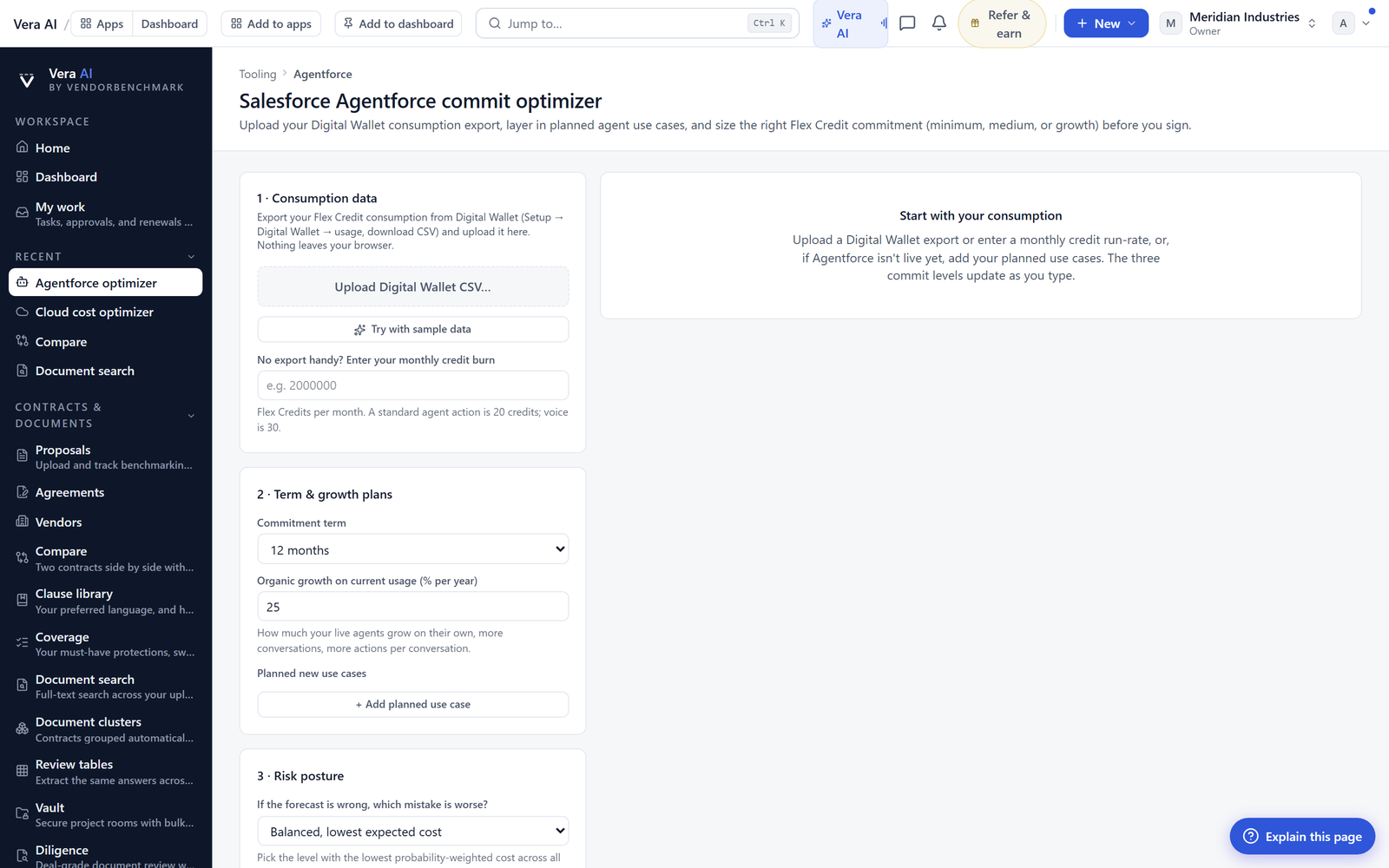
The central discipline with Agentforce is the same as with any consumption product: the commitment must be sized from a realistic model of your own usage, not the vendor's projection of it. That means starting from what you actually intend to automate, how many customer interactions or internal processes will genuinely run through AI agents, at what volume, in the timeframe of the commitment. A pilot is worth more here than any amount of vendor modeling, because AI agent adoption is notoriously uneven, and the gap between "we turned it on" and "it handles meaningful volume" is where over-commitments go to die.
The optimizer approach is to take your measured or piloted usage and size the commitment against realistic bands, so you see what you would consume in a conservative case, a middle case, and an optimistic one, and can pick a commitment that earns the discount without prepaying for automation you have not yet proven you will use. The vendor wants you to commit to the optimistic case. The right commitment is the one your realistic case comfortably consumes, with the upside handled by growth rather than by forfeited pre-purchase.
Benchmark the rate, because the units are new
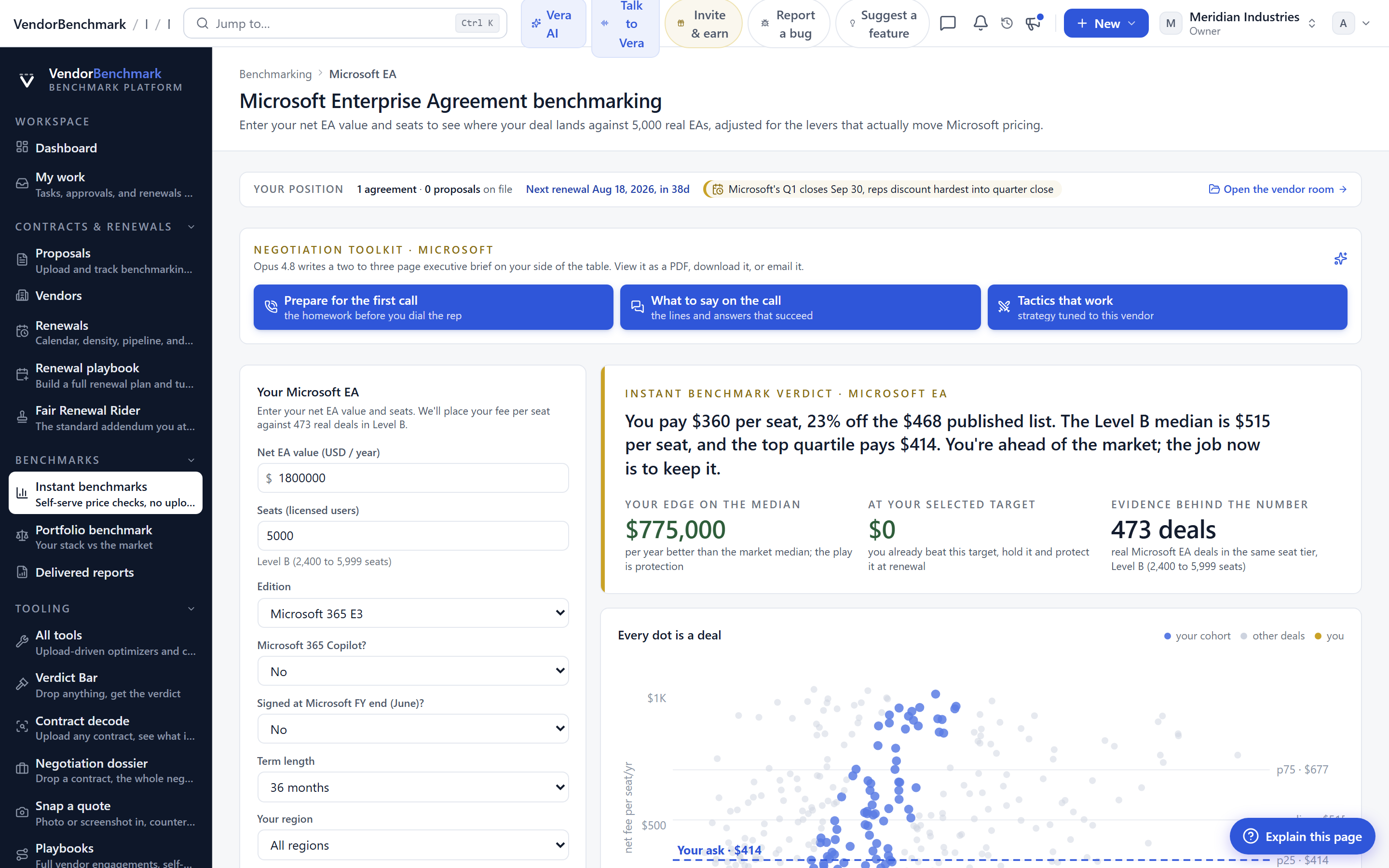
New units make it unusually hard to know whether the rate you are offered is good, which is precisely why benchmarking matters most on brand-new AI pricing. When a capability is a year old, there is no folk knowledge of what a fair per-action or per-conversation rate is, no colleague who negotiated one last quarter, so buyers accept whatever they are quoted for lack of a reference. But even new capabilities have a distribution: other enterprises are signing Agentforce deals, and their effective rates form a market you can benchmark against, turning "is this rate fair?" from a shrug into a placement.
This is where a lot of the negotiating room hides. On a mature product the discount is well understood and the room is small; on a new AI capability the vendor has wide latitude in what it quotes, which cuts both ways, and a buyer who can show where comparable Agentforce deals landed has leverage a buyer accepting the first quote does not. Benchmarking the rate also protects against the bundle move, where the AI layer is folded into a broader Salesforce renewal and its true cost is obscured; pulling it out and pricing it against the market keeps it an honest, separate line.
Keep it off the renewal autopilot
The specific danger with Agentforce is that it rides into your existing Salesforce agreement without a distinct decision. Salesforce would prefer the AI capability to be a natural addition to the renewal, its cost blended into a larger total that gets negotiated as one number and accepted as one number. Once it is folded in, it stops being a decision and becomes a line, and lines get renewed. Keeping Agentforce a separate, explicitly priced decision, benchmarked and sized on its own, is what prevents an AI commitment you never really evaluated from becoming a permanent part of your Salesforce spend.
The move is to treat the AI layer as its own negotiation even when it sits inside the broader deal. Size it from intent, benchmark the rate, decide the commitment deliberately, and only then let it join the total, with its cost visible and defensible rather than absorbed. A buyer who does this signs an Agentforce commitment they chose; a buyer who does not signs one Salesforce chose for them, sized to a growth story and priced at whatever the renewal total happened to hide.
Pricing the AI agent commitment
New units, familiar discipline
Agentforce may prove genuinely valuable, and this is not an argument against buying it, only against buying it blindly. AI agent capabilities are early, the pricing models are still settling, and the benchmark on a year-old category is thinner than on a decade-old one, so the placement is a guide rather than a verdict. Some of the uncertainty is irreducible, and a commitment on a fast-moving AI capability carries more risk than one on a mature product, which is a reason for margin, not paralysis.
What the discipline removes is the specific way new AI pricing separates buyers from money, which is the combination of a growth story, novel units, and a blended renewal. Size it from intent, benchmark the rate, and keep it a distinct decision, and Agentforce becomes a commitment you evaluated on its merits. The units are new; the trap is old, and so is the answer, which is to price what you are buying instead of accepting what you are told it is worth.
Morten brings two decades of enterprise and software procurement, with stints across Oracle, IBM, SAP, and Salesforce shaping how he reads a deal. He has led sourcing through hundreds of renewals, from mid market order forms to nine figure global agreements, and learned that the buyers who win are the ones who walk in knowing the market. He built VendorBenchmark to make that pattern recognition repeatable.
The week in enterprise software buying, in one email.
What shipped on the platform, and the pricing and licensing moves worth knowing before your next renewal. One email a week, to your work address. Unsubscribe any time.