Broadcom VMware: surviving the per-core repricing.
Broadcom retired perpetual VMware licenses, consolidated the catalog into per-core subscription bundles, and let renewal quotes land where they may, which for many estates has been multiples of the old bill. The negotiation is winnable, but only from your own numbers. Here is how to build them, and what to do when the vendor knows you are locked in.
The VMware acquisition rewrote the rules of one of enterprise IT's most entrenched relationships, and it did so on the vendor's terms. Perpetual licenses stopped being sold. The sprawling product catalog collapsed into a handful of subscription bundles, priced per core, whether or not you used everything in the bundle. Customers who had budgeted maintenance renewals discovered they were now negotiating a subscription for software they thought they owned.
It is worth being clear-eyed about why this works. Virtualization is the layer everything else stands on, migrations take years, and Broadcom knows both facts. The strategy is not subtle and does not need to be: concentrate on the largest accounts, price the bundles at what dependence will bear, and let the long tail decide whether to pay or leave. Complaining about it is a press release. Negotiating it requires the two things the strategy assumes you lack: an independent price position and a credible exit.
Start from your RVTools file, not their quote
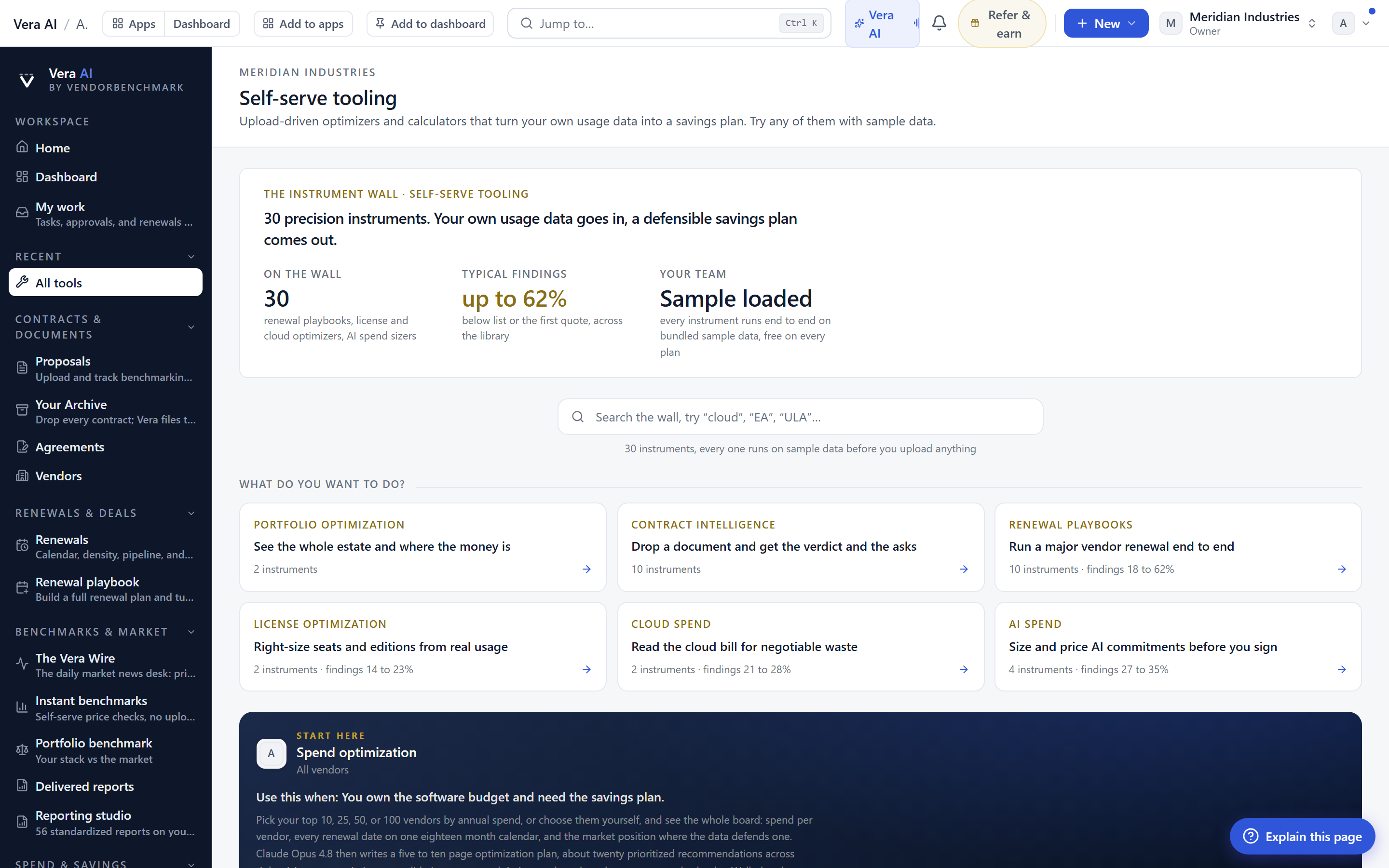
The renewal quote prices the estate Broadcom thinks you have, sized generously and bundled upward. Your first move is to price the estate you actually run. The platform's VCF calculator takes the RVTools export every VMware admin can produce in minutes and does the work that turns it into a position: the real core counts by cluster, the licensing minimums applied correctly, and three priced scenarios, the estate as it is, the estate consolidated onto fewer denser hosts, and the estate after the workloads that never needed vSphere have left.
The consolidation scenario deserves emphasis because per-core pricing changed the physics of hardware planning. Under the old model, spreading workloads across many modest hosts was harmless. Under per-core subscription, every idle core on every socket is a line item, and a hardware refresh onto fewer, denser, newer hosts routinely takes a meaningful bite out of the licensable base before the negotiation even starts. You are no longer negotiating the discount alone. You are negotiating the discount times the core count, and the core count is yours to shrink.
The scenarios then get benchmarked. The library tracks the post-acquisition reality, per-core subscription net ACV from modelled VCF cohorts, against known discount bands by deal size, so you can see where quotes like yours have actually been landing rather than negotiating against a rumor.
The walk away is real, partial, and slow. Price it anyway.
The uncomfortable truth is that full migration off VMware is a multi-year program, and Broadcom prices as if it knows that. The useful truth is that the walk away does not need to be total to work. It needs to be credible at the margin: the next tranche of renewal cores has somewhere else to go.
In practice that means segmenting the estate. Some workloads genuinely need vSphere's operational maturity, and paying for those is rational. But most estates carry a long tail that does not: the dev and test clusters, the stable single-purpose appliances, the workloads a hyperscaler or an alternative hypervisor would run without drama. Pricing that tail on the alternatives, with migration cost and timeline included, produces the number that changes the renewal conversation: not "we might leave," which every rep has heard, but "these 2,000 cores have a funded destination if the price does not move."
This is exactly what the credible alternative builder produces, an alternative with arithmetic instead of attitude. And because the term you sign locks the exposure, term strategy is part of the walk away: a shorter term costs more per year and buys you optionality at exactly the moment the alternatives mature. Whether that trade is worth it is a modelable question, not a gut call.
The renewal, in five moves
The playbook desk packages all of it, the calculator, the benchmark, the scenario math, and the negotiation sequence, into one guided workspace, with the brief ready for the CFO who is about to ask why the virtualization line tripled.
The honest close: some estates will simply pay more than they used to, because the dependence is real and the vendor priced it. What preparation changes is how much more, on which bundle, for which cores, and with what protection at the next cycle. In a repricing this aggressive, the gap between the prepared and unprepared outcome is not a rounding error. It is the largest single saving most infrastructure budgets will see this decade.
Morten brings two decades of enterprise and software procurement, with stints across Oracle, IBM, SAP, and Salesforce shaping how he reads a deal. He has led sourcing through hundreds of renewals, from mid market order forms to nine figure global agreements, and learned that the buyers who win are the ones who walk in knowing the market. He built VendorBenchmark to make that pattern recognition repeatable.
The week in enterprise software buying, in one email.
What shipped on the platform, and the pricing and licensing moves worth knowing before your next renewal. One email a week, to your work address. Unsubscribe any time.