Run the software estate like an investment book.
A CIO would never manage an investment portfolio the way most software estates are run, one position at a time, reviewed only when it expires. The whole stack belongs on one canvas, ranked and risk weighted. Here is how the portfolio view gets it there.
A CIO who ran an investment book the way most software estates are run would not last a quarter. Imagine a portfolio manager who looked at each holding only on the day it matured, never compared positions against the market, and kept the whole book in a spreadsheet that three people understood. That is, roughly, how a five hundred vendor software estate is managed at most companies. One renewal at a time, reviewed under deadline, with no view of the whole.
The software estate is a portfolio. It has positions of different sizes, different risk profiles, different distances from fair value, and different maturity dates. Managed as a portfolio, it behaves like one: you can rebalance it, hedge it, and prune it deliberately. Managed as a stack of expiring contracts, it just surprises you fifty two weeks a year.
The whole book on one canvas
The first thing an investment view gives you is the ability to see everything at once. The portfolio map puts every vendor on a single canvas, each one a tile sized by spend and colored by verdict, favorable, fair, or over market. A stack that lived in a four hundred line report becomes a picture you can read in a glance, and the expensive, over market positions are the large red tiles you cannot miss.
This is not decoration. A picture the executive team can absorb in ten seconds is what gets a consolidation program funded. The spreadsheet argues with itself. The map makes the case.
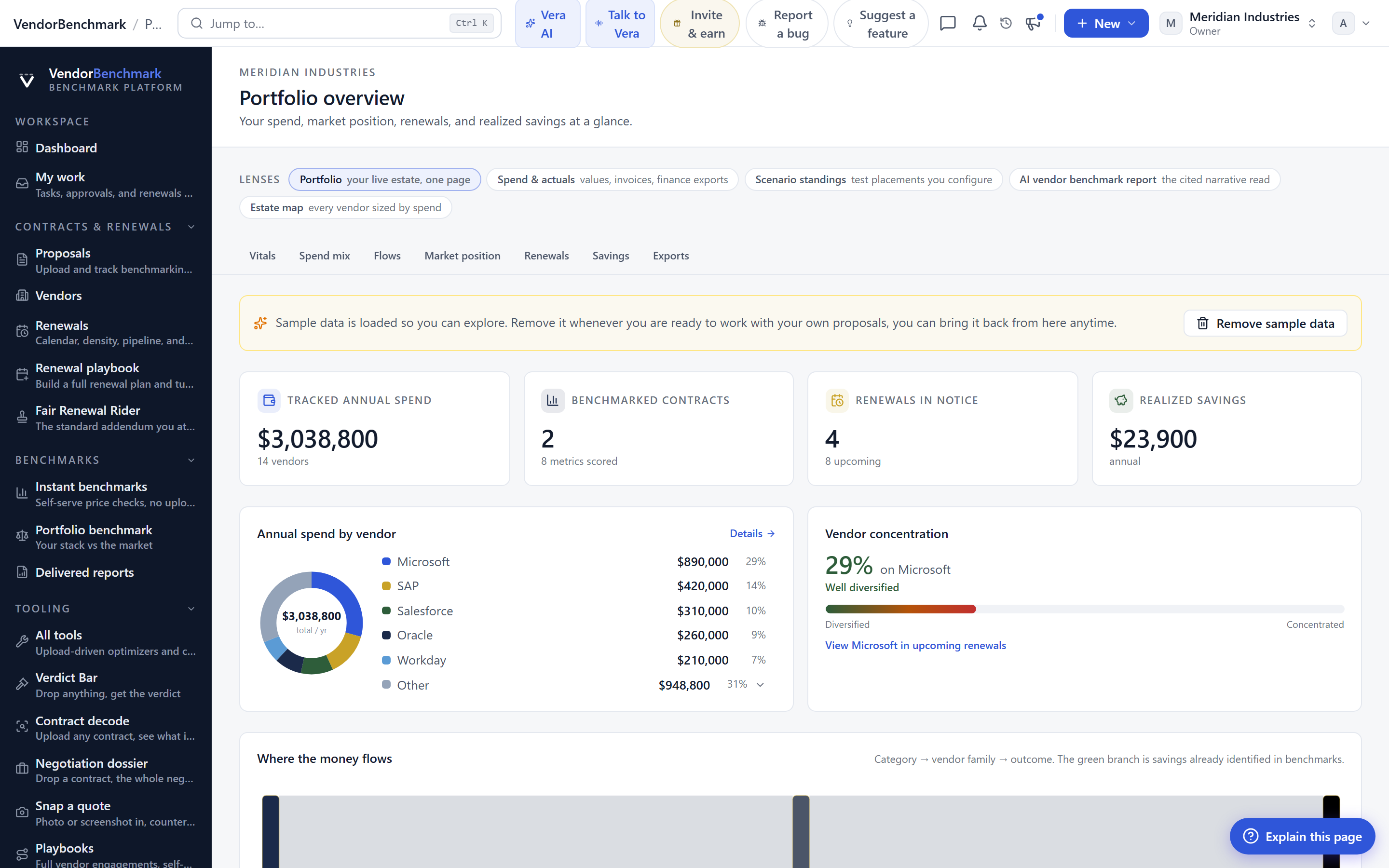
Against 1,471 vendors, each tile carries a real verdict rather than a feeling. Distance from market is measured against comparable deal cohorts, so "we think we overpay for that one" becomes "we are fourteen points above the cohort on that one," which is a sentence you can take into a boardroom or a renewal.
The canvas also fixes the reporting-line problem that dogs every large estate. In most companies the software spend is split across owners, business units, and budgets, so no single person has ever seen the whole book at once. The map is the first time it exists as one object. That shared picture is worth as much internally as it is against a vendor, because you cannot rebalance a portfolio that half the leadership team has never actually seen.
Strategy, consolidation, and the redundant position
A portfolio view surfaces the moves a single deal view cannot. Overlap is the obvious one. When two vendors do substantially the same job, the map shows them side by side and the strategy view prices the consolidation, the licensing you could retire, the leverage you gain by putting the survivors in competition. These are decisions that only exist when you can see the whole book at once.
The same view carries risk. Concentration in one vendor, contracts missing a price cap or an exit clause, renewals bunched into a single quarter that will overwhelm the team, all of it is portfolio risk, and all of it is invisible when you look at one contract at a time. Running the estate as an investment book means managing that risk on purpose, not discovering it under deadline.
Consolidation is where the book pays for itself twice. The first return is the licensing you retire when two overlapping tools become one. The second, larger and slower, is leverage: every vendor that knows it is the sole option prices like it, and every vendor that knows it is being compared prices like that too. A portfolio you actively prune is a portfolio whose suppliers all believe they can be replaced, which is the single most valuable belief a buyer can cultivate.
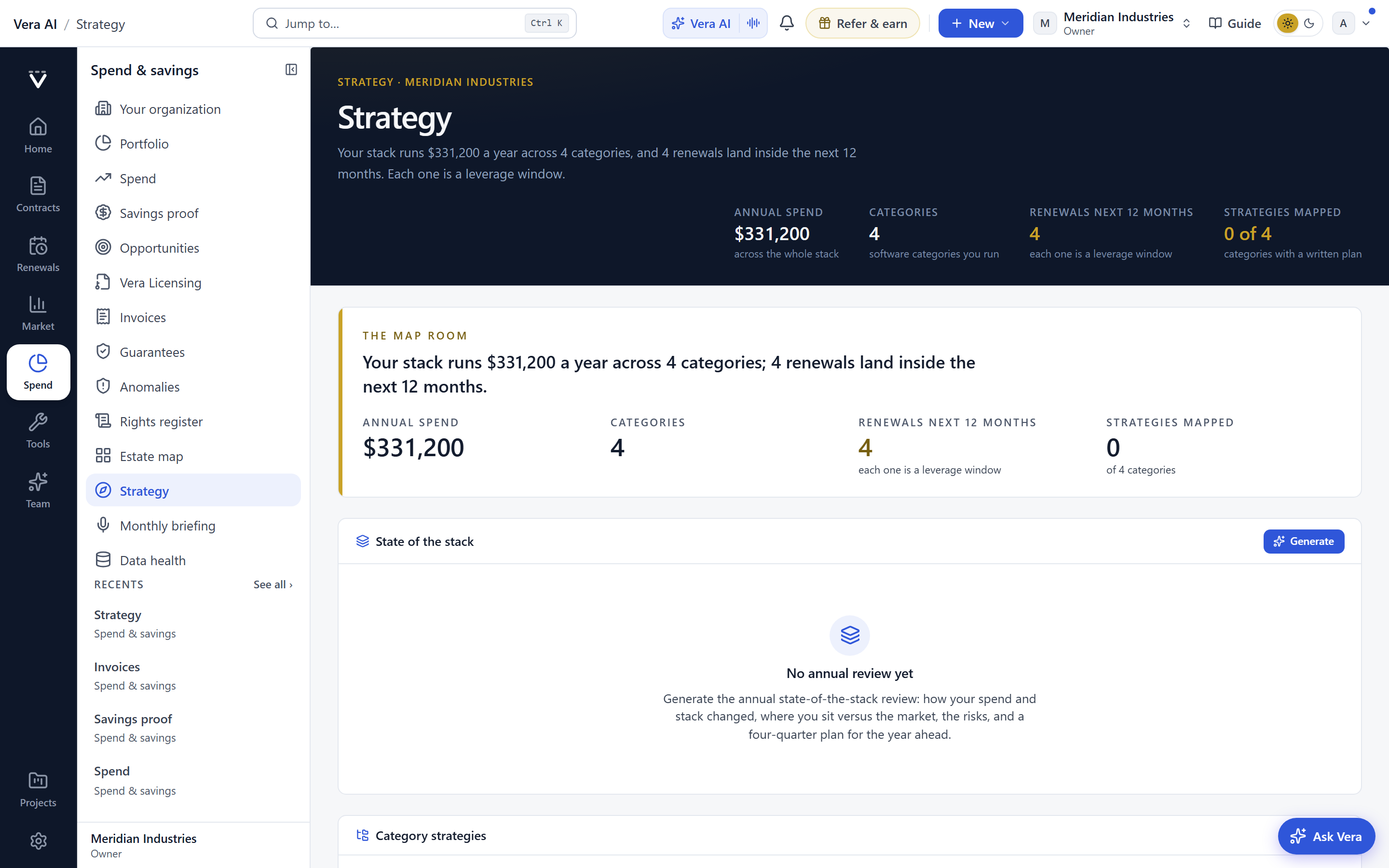
The CIO portfolio review, quarterly
The map informs the call, it does not make it
A portfolio view does not replace judgment, and distance from market is not the only thing that matters. Sometimes you pay above the cohort on purpose, for a vendor that is genuinely strategic, deeply embedded, or simply the best at something that matters more than price. The point of the book is not to minimize every line. It is to make every one of those trade offs a deliberate choice rather than an accident of neglect.
Run the estate as a portfolio and the CIO conversation changes. Instead of defending last year's spend, you are managing a book: rebalancing, pruning, and pricing risk, with the whole stack in view. That is the difference between owning the estate and being owned by its renewal calendar.
Morten brings two decades of enterprise and software procurement, with stints across Oracle, IBM, SAP, and Salesforce shaping how he reads a deal. He has led sourcing through hundreds of renewals, from mid market order forms to nine figure global agreements, and learned that the buyers who win are the ones who walk in knowing the market. He built VendorBenchmark to make that pattern recognition repeatable.
The week in enterprise software buying, in one email.
What shipped on the platform, and the pricing and licensing moves worth knowing before your next renewal. One email a week, to your work address. Unsubscribe any time.