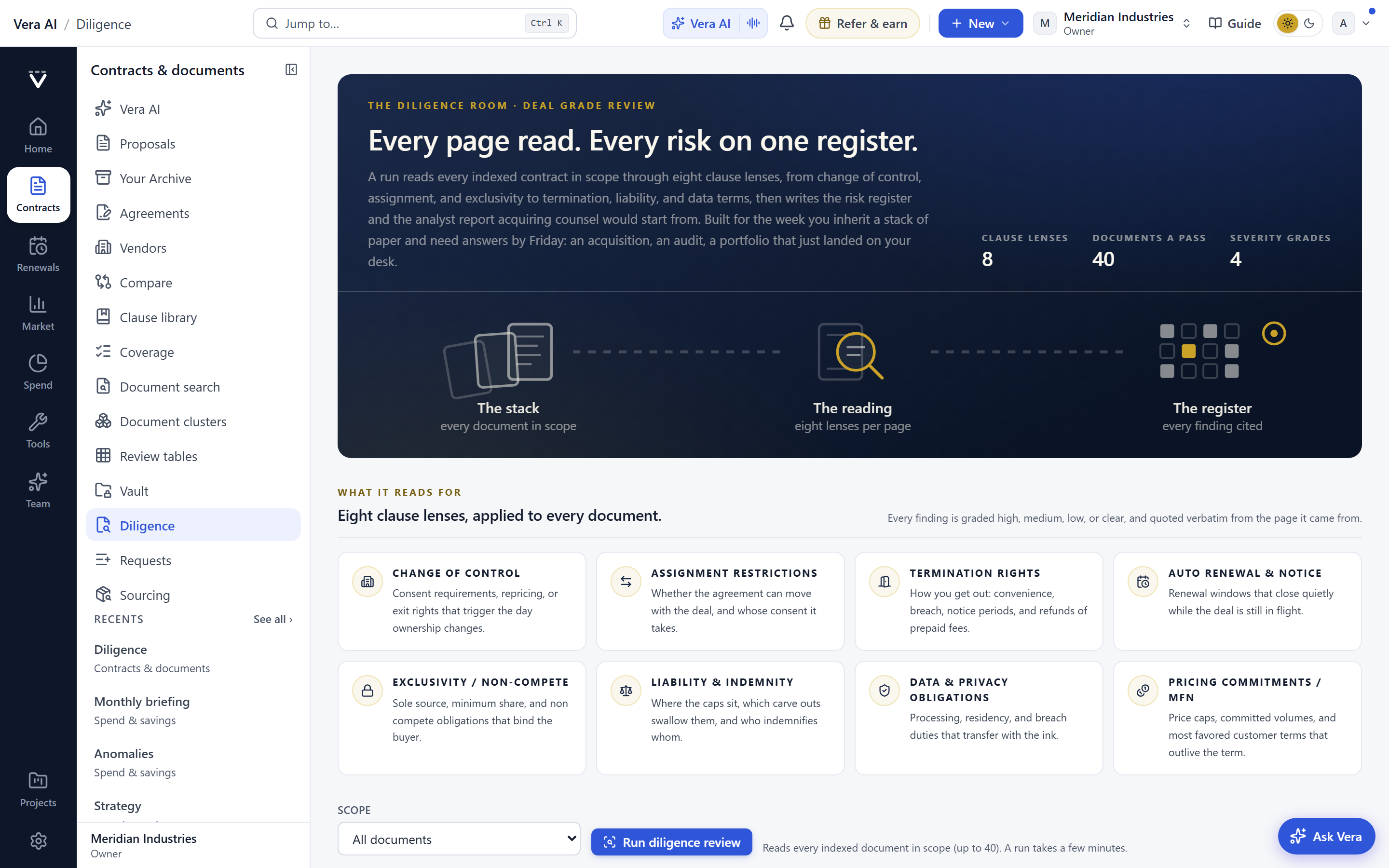
Diligence rooms: when the acquisition depends on reading the contracts.
In a deal, a target's software contracts are both the hidden liabilities and the promised synergies, and someone has to read all of them fast. A diligence room does it in a clean space, underwrites only the numbers it can defend, and burns the data down on a retention clock.
When one company buys another, the software estate is rarely in the headline, but it is almost always in the footnotes that matter. The target's contracts hold the liabilities nobody mentioned, the auto renewals, the uncapped uplifts, the change of control clauses that trigger a repricing the moment the deal closes, and the synergies everyone is counting on, the overlapping tools that consolidate, the volume that should command a better rate. Reading all of that, across dozens or hundreds of agreements, on a deal timeline, is not optional. It is the diligence.
A diligence room is a workspace built for exactly that pressure. Each deal gets its own clean room, isolated from everything else, where the target's contracts are loaded, read, and turned into a synergy memo the deal team can defend. The discipline that makes it useful is not how much it claims. It is how carefully it separates what it can prove from what it cannot.
A clean room, per deal, on a clock
Diligence data is among the most sensitive an organization handles, so the room is genuinely separate. Each engagement is its own isolated space, the deal team invited in by email, the target's documents loaded through signed uploads, nothing bleeding into the rest of the platform or into other deals. Two hundred documents can land in one stack without fanning out into two hundred routine workflows, because the intake is deliberately quiet: it enriches and indexes the contracts for reading, and skips the machinery meant for your own live estate.
The room also has an expiry built in. Diligence should not linger on a server after the deal is done, so each engagement carries a retention clock, and when it runs out the room is purged: the stored documents removed, the workspace deleted, and only a tombstone left to record that it existed and was destroyed. The clean room is clean on the way out as well as in.
Underwrite what you can defend, flag the rest
The temptation in a synergy memo is to make the number as big as the deal team hopes. A diligence room is built to resist it. It only underwrites a saving on a vendor it can actually place against a benchmark cohort, and it prices that saving conservatively, to the middle of the distribution as a base case, not the aggressive edge. A term improvement is only claimed where a real, calibrated lever exists and the timing supports it, and even then it is shrunk by how reliable that kind of prediction has proven.
Everything else is treated as a first class unknown rather than quietly assumed. A document it cannot parse is flagged as unparsed, not skipped and forgotten. A vendor with no license position behind it gets an exposure section that says, plainly, not assessed, instead of a fabricated figure. A synergy memo that admits what it does not know is worth far more in a boardroom than one that inflates the number and gets caught in confirmatory diligence.
What honesty looks like in a real stack
The difference between a defensible memo and a hopeful one shows up on real deals. Put a mixed stack in front of the room and it will underwrite the vendors it can benchmark and hold back on the ones it cannot. A vendor whose only market data is discount metrics, with no list price to anchor a stack against, is placed as reference tier and not pushed into a synergy claim it cannot support. The number that comes out is smaller than a broker's pitch and stands up to scrutiny, which is the only kind of number worth putting in front of an investment committee.
That restraint is the product. A diligence memo is read by people whose job is to find the hole in it, and the fastest way to lose credibility is one inflated line. By underwriting narrowly and flagging honestly, the room produces a synergy case that survives the room full of skeptics it was built for.
How a diligence memo stays defensible
The memo informs the deal, it does not price it
A diligence room reads contracts and underwrites the software synergies it can defend. It does not value the company, model the integration, or replace the confirmatory diligence a real transaction demands. Its numbers are a grounded, conservative read of one slice of the target, the software estate, produced fast enough to matter while the deal is live.
That slice is often larger and riskier than anyone expected, which is exactly why it deserves to be read properly rather than sampled. The room turns a stack of contracts that would take a team weeks into a defensible memo in a fraction of the time, honest about its own edges, and then it deletes itself. In diligence, that combination, fast, conservative, and self erasing, is precisely what you want.
Morten brings two decades of enterprise and software procurement, with stints across Oracle, IBM, SAP, and Salesforce shaping how he reads a deal. He has led sourcing through hundreds of renewals, from mid market order forms to nine figure global agreements, and learned that the buyers who win are the ones who walk in knowing the market. He built VendorBenchmark to make that pattern recognition repeatable.
The week in enterprise software buying, in one email.
What shipped on the platform, and the pricing and licensing moves worth knowing before your next renewal. One email a week, to your work address. Unsubscribe any time.