Proving procurement's value: the savings ledger the board believes.
Every procurement team reports savings. Every finance team quietly halves the number in its head, because a saving on a slide is a claim, not a fact. The way to be believed is to close the gap: reconcile every negotiated saving against the invoice that proves it.
There is a credibility problem at the heart of procurement, and everyone in the room knows it even when nobody says it. Procurement reports that it saved the company a large number this year. Finance nods, and then quietly discounts that number, because they have seen how it is calculated: a claimed saving is usually the difference between the price the vendor first proposed and the price finally paid, and the first proposal is a number the vendor made up specifically to be negotiated down. A saving measured against a fiction is itself a fiction, and finance treats it accordingly.
The result is that the function which most directly protects the company's money is the one least able to prove it. The fix is not better storytelling. It is verification. A negotiated saving becomes believable the moment it is reconciled against the invoices that actually arrive, so the number on the board slide is not what procurement claims it saved, but what the billing confirms it saved. That is a different kind of number, and it is the only one worth reporting.
The difference between claimed and confirmed
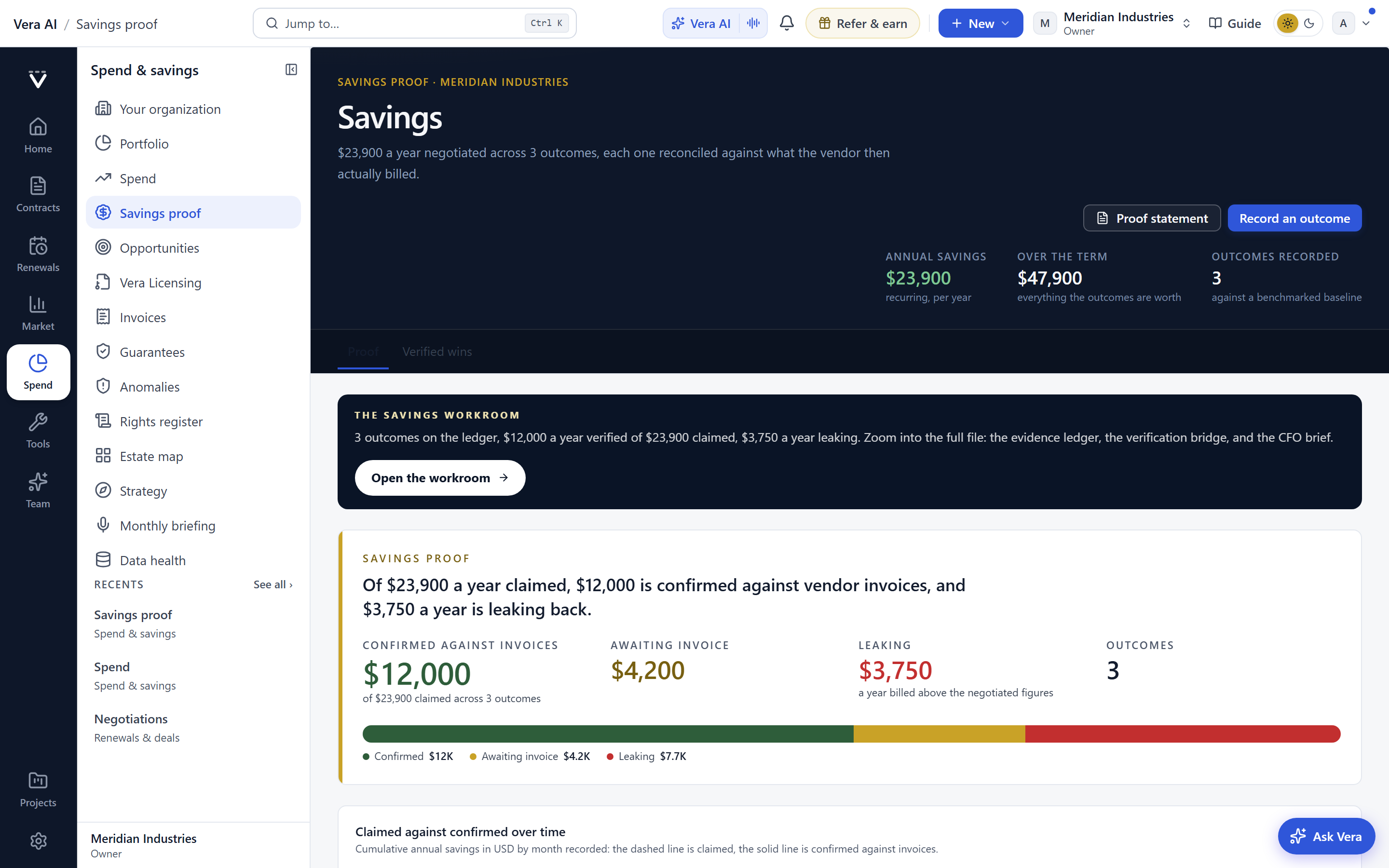
A savings ledger starts by taking every saving seriously enough to check it. For each negotiated saving, it finds the invoices that should reflect it, matched by vendor and period, and compares what you agreed to pay against what you were actually billed. The saving is then filed with a verdict: confirmed when the invoices come in at or below the negotiated level, pending when the bills have not yet arrived to prove it, and leakage when the billing has quietly drifted above what you negotiated and the saving is being eroded in real time.
That third category is the honest one most reporting hides. A saving is not a one time event that happens at signature, it is a promise the vendor makes and the invoices either keep or break. By tracking confirmed, pending, and leaking savings separately, the ledger reports the truth: not what you were promised, but what has actually shown up, and where a promised saving is being clawed back through billing you were not watching.
A number that survives the CFO's scrutiny
The value of a verified ledger is what happens when it is challenged. A claimed savings number falls apart under one question from the CFO: how do you know? A confirmed number answers it, because behind each confirmed saving sits the specific invoices that prove it, matched line by line. When finance asks whether the savings are real, the answer is not a methodology slide, it is the bills. That moves procurement from a function that asserts its value to one that can demonstrate it on demand.
It also changes the internal politics of the number. Finance stops discounting procurement's reported savings because they no longer have to take them on trust, the confirmation is theirs to inspect. The confirmed total becomes a figure both functions agree on, which is worth far more than a larger number one of them privately disbelieves. A smaller, proven number that the board acts on beats a bigger, doubted one that quietly gets ignored.
The leak you catch is the value you keep
Verification is not only about proving the wins, it is about protecting them. A saving that reconciles as leakage is a live problem: you negotiated a rate and the invoices are running above it, so the value you reported is being quietly returned to the vendor. Catching that in the ledger, priced and evidenced, turns a slow erosion into a recoverable dispute, and recovering it is itself a demonstration of the function's worth.
This closes an honest loop. Procurement negotiates the saving, the ledger confirms the ones that hold, flags the ones that are slipping, and the flagged ones become the next round of work. Over time the reported number is not a high water mark from signature day but a living figure that reflects what the company is actually keeping, which is precisely the number a board wants and rarely gets.
What makes a savings number believable
Proof is narrower than the story, and stronger
A verified ledger reports a smaller number than a claimed one, and that is the point, not a flaw. It counts only savings the invoices confirm, which excludes cost avoidance, softer value, and savings whose bills have not yet arrived. Some of that excluded value is real, and a good procurement narrative still has a place for it, honestly labelled as what it is.
But the headline number, the one the board acts on and the CFO defends, should be the one that cannot be argued with. By grounding it in the invoices rather than the vendor's opening bid, procurement trades a big number nobody believes for a smaller one everybody does, and a smaller number that is trusted and acted upon is worth incomparably more than a larger one that gets quietly halved on its way to the board.
Morten brings two decades of enterprise and software procurement, with stints across Oracle, IBM, SAP, and Salesforce shaping how he reads a deal. He has led sourcing through hundreds of renewals, from mid market order forms to nine figure global agreements, and learned that the buyers who win are the ones who walk in knowing the market. He built VendorBenchmark to make that pattern recognition repeatable.
The week in enterprise software buying, in one email.
What shipped on the platform, and the pricing and licensing moves worth knowing before your next renewal. One email a week, to your work address. Unsubscribe any time.