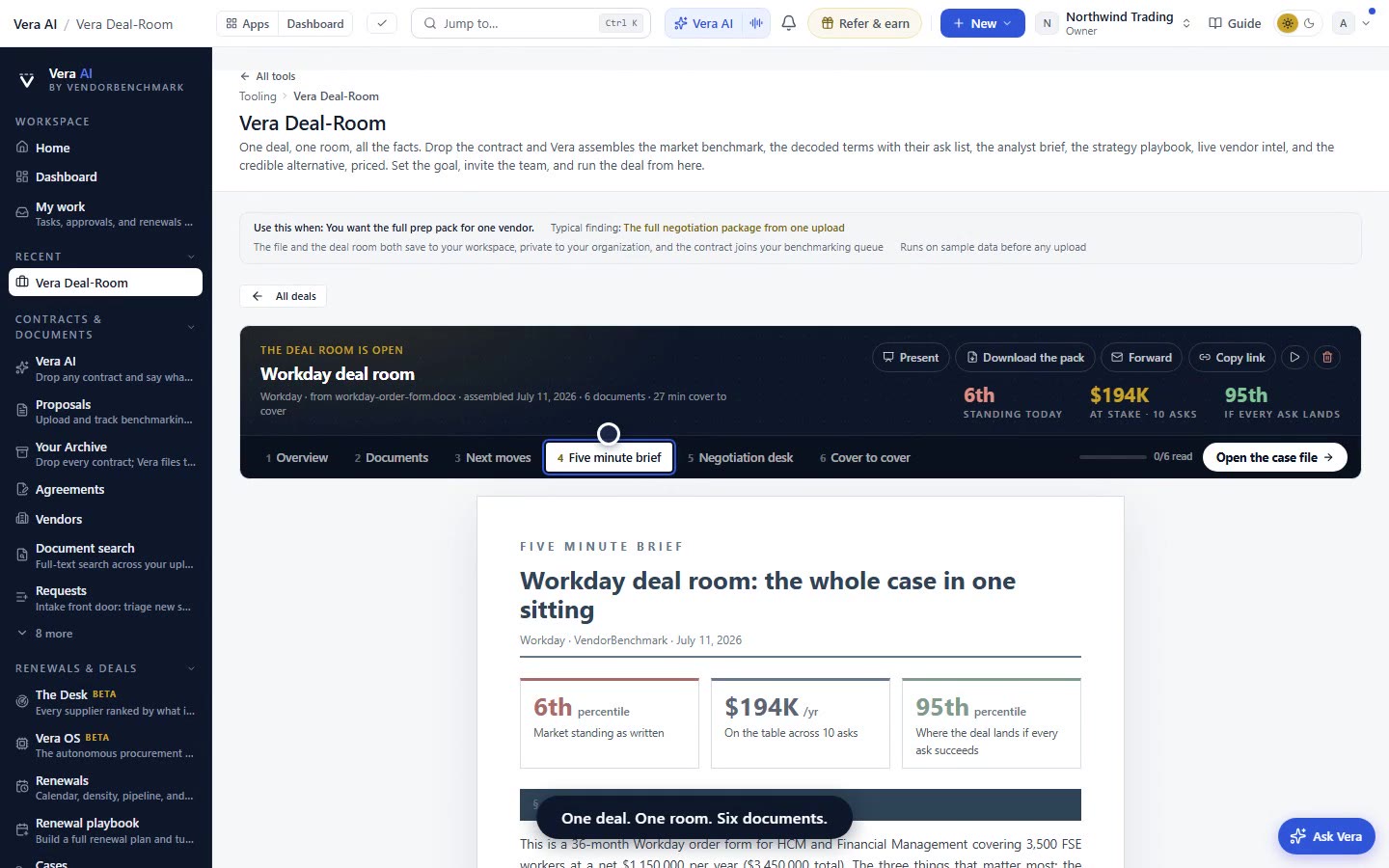
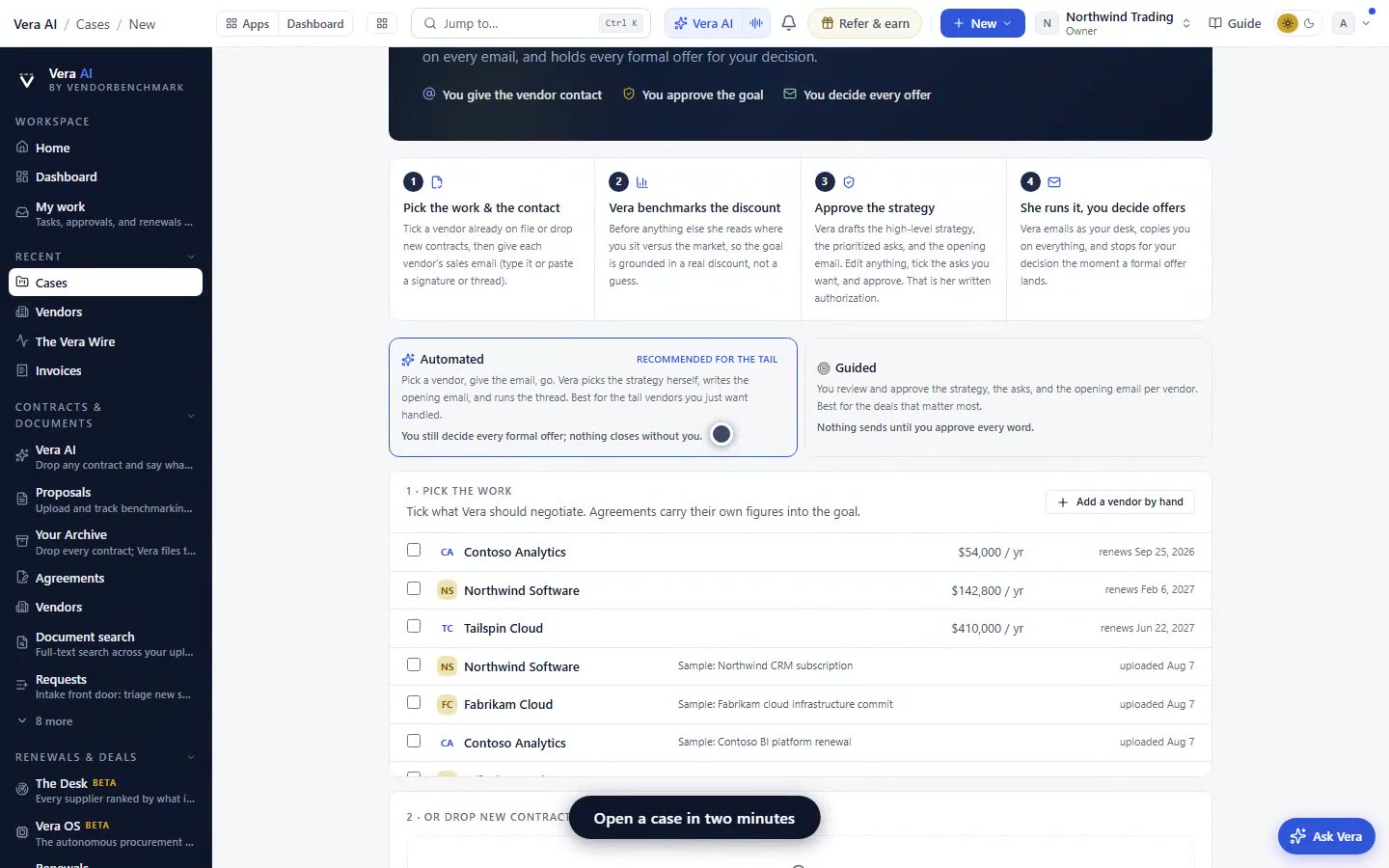
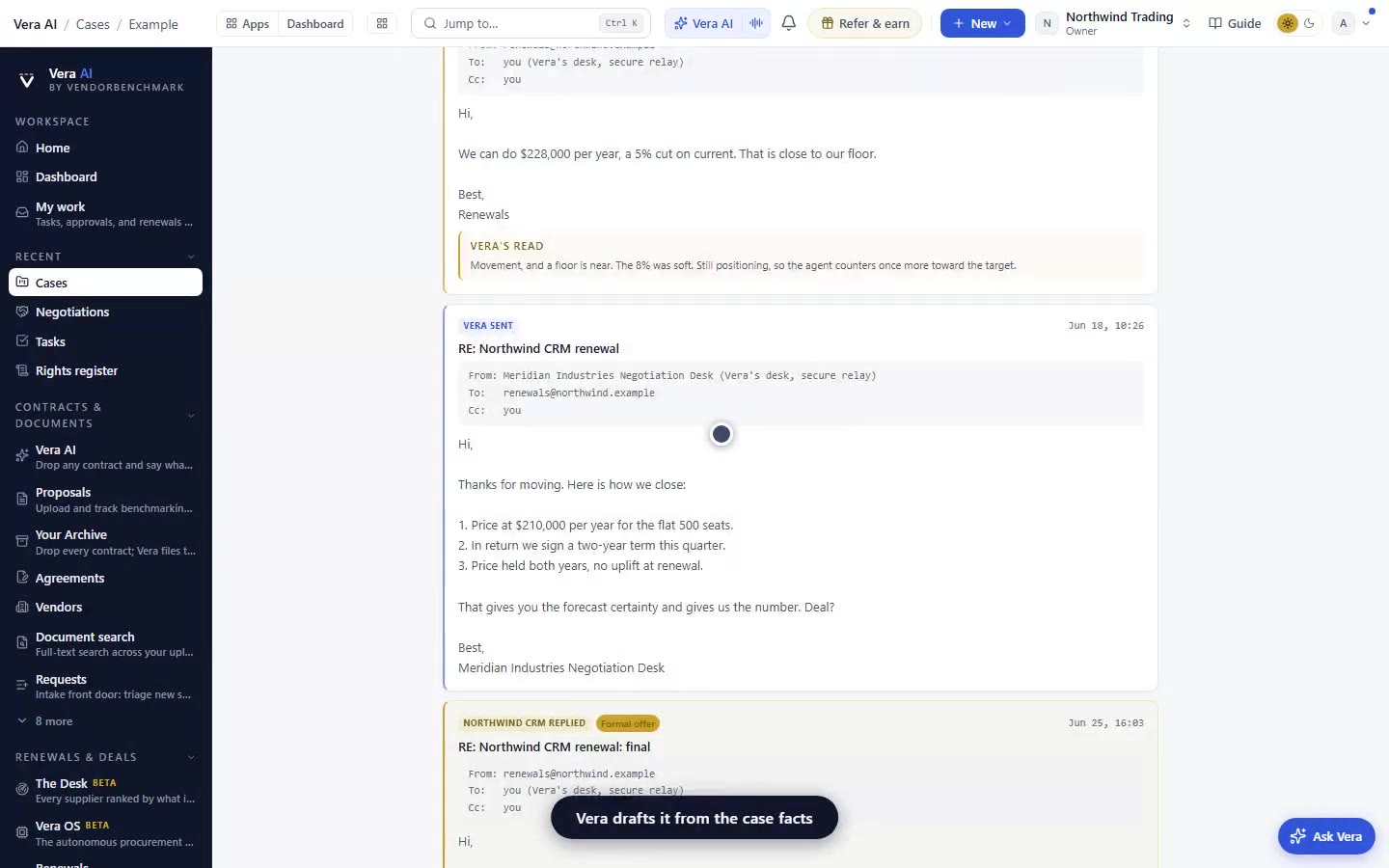
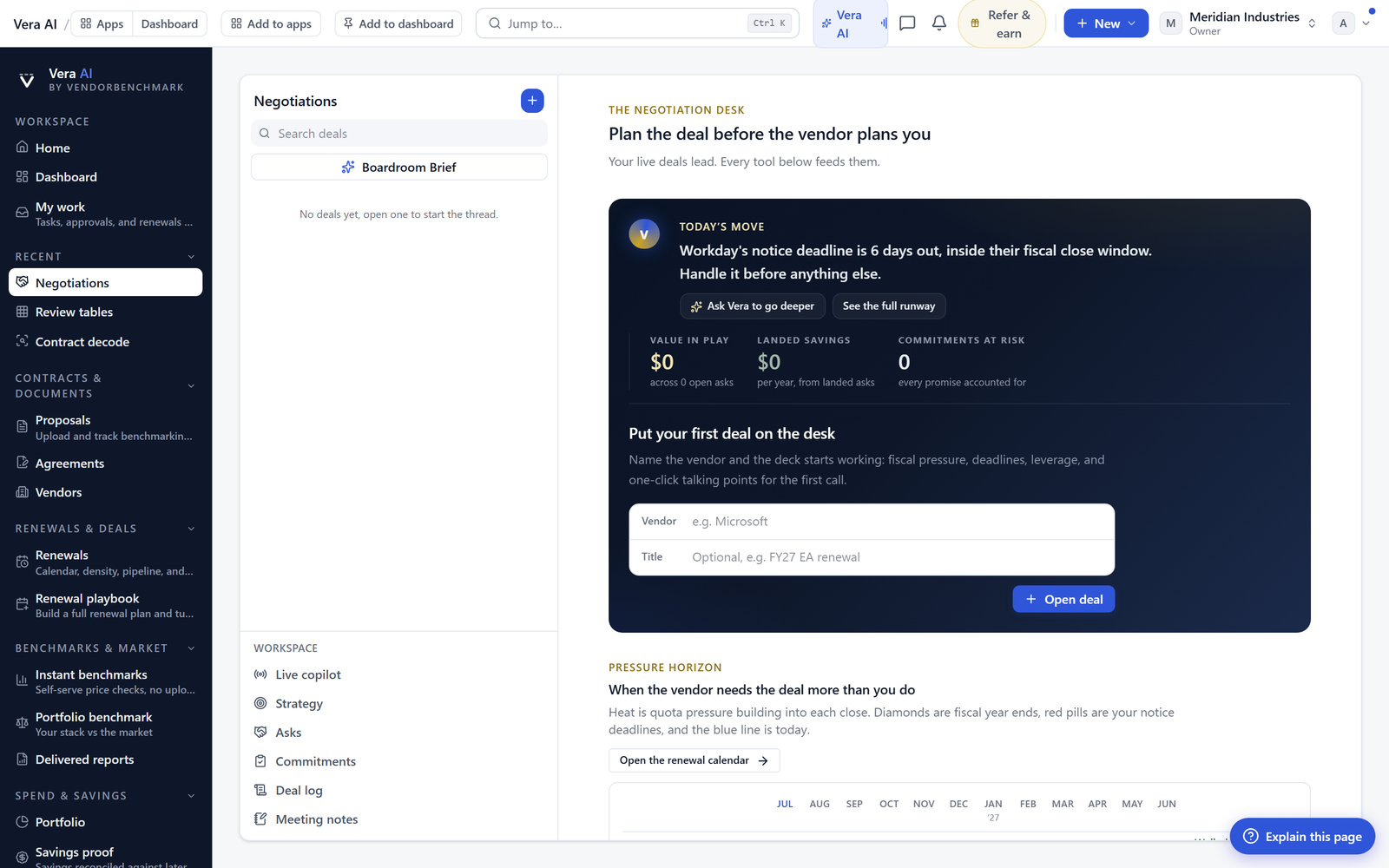
The negotiation room now opens on the morning brief
Open Negotiations from the brief and Vera has already ordered the day: one move per vendor, deadline first, evidence cited to the record it came from. Nothing sends to a vendor from the brief.
PRODUCT UPDATE · FROM THE ANALYST DESK. Most procurement teams do not lose money because they lack information. They lose it because the information arrives in the wrong order, on the wrong day, in a format that still needs four hours of work before anyone can act on it. You know the vendor is 14 percent above market. You know the notice window closes in six weeks. What you do not have, at 8:40 on a Tuesday, is a single instruction that says: this vendor, this move, this evidence, this draft, go. As of this release, that instruction is waiting for you when the brief opens.
The named problem: the queue that never opens
Call it the standing queue. It is the list of negotiations that are live in principle and dormant in practice. Every buyer has one. It lives partly in a renewal calendar, partly in a contracts folder, partly in the head of whoever owns the relationship. The queue does not fail loudly. It fails by attrition: a notice date passes unremarked, a price increase is absorbed because there was no time to build the counter, a benchmark that would have been decisive in March is quoted in June when the leverage has gone. The auto renewal clause is the most expensive symptom of the standing queue, but it is only a symptom. The cause is that opening a negotiation has always required a preparation project, and preparation projects lose to inbound work every single time. Our own read across customer desks is consistent: the deals that get worked are the ones where someone else did the first hour.
So the design question was not how to make the negotiation room better. It was how to make the first hour disappear, and how to put the result somewhere the buyer already looks. The morning brief is the only surface every user opens without being asked. That is where the queue now lives.
What is waiting when you press Open Negotiations
Press Open Negotiations on the brief and the move queue is already assembled. One prioritised move per vendor, not five, not a menu. Ordering is by consequence, which in practice means notice deadlines first, because a notice date is the only variable in a negotiation that cannot be recovered once it passes. Below the deadline set, the queue sorts on distance from market and contract value. You are looking at a short, ranked list of the actions that matter this week, with the reason for each ranking stated on the card.
Each move carries a six document case file. The move itself is built from your own records in seconds and is the only one written up front. It has four parts. The evidence is sourced line by line, so every claim points at the invoice line, order form clause or price list entry it came from. The commercial picture is presented as a verdict table rather than prose, so the position, the market band and the gap sit in adjacent columns. Where the move sends something, a ready draft is included. And every figure is cited to the record it came from, which means a colleague who did not build the move can audit it in about the time it takes to read it.
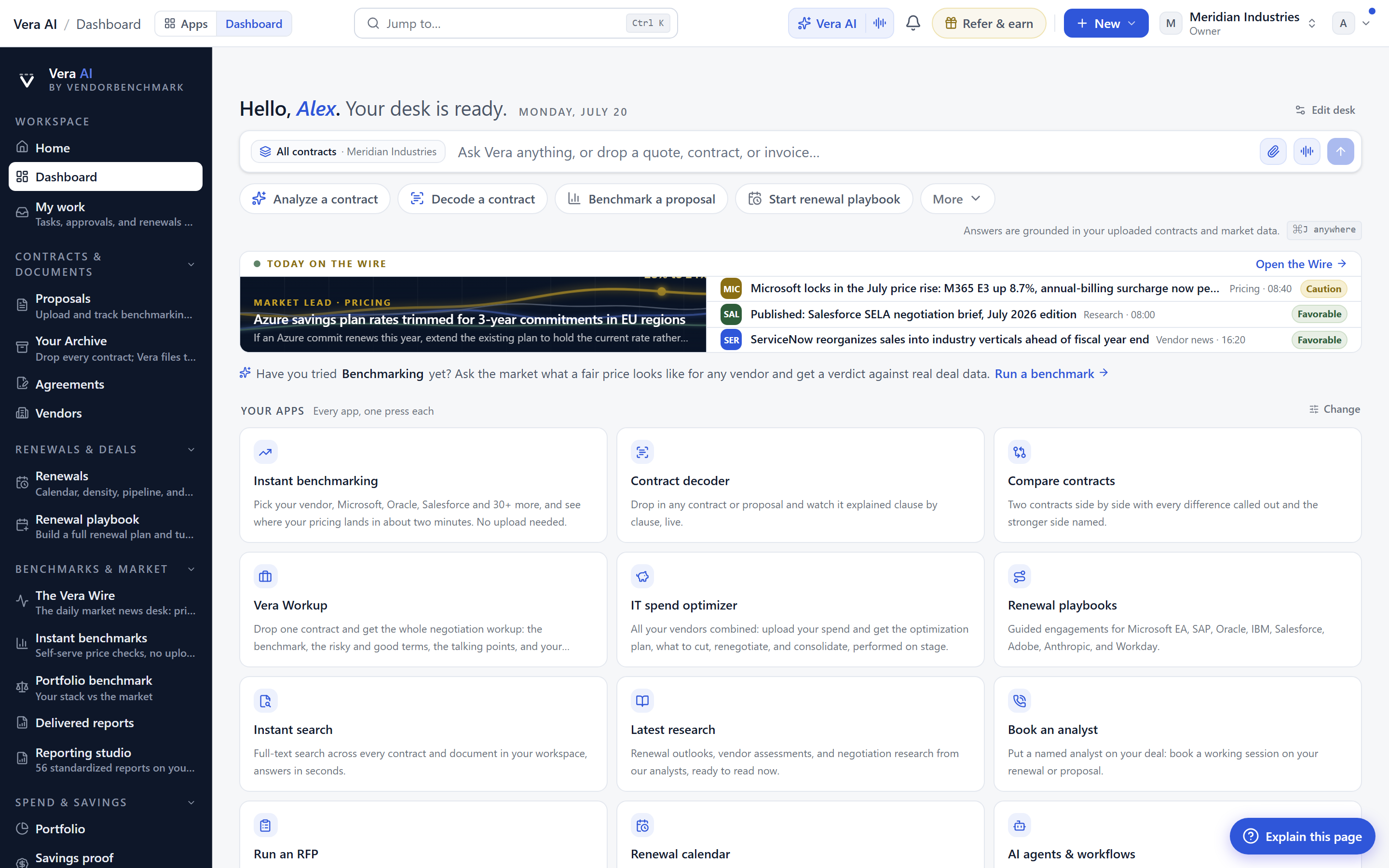
The other five documents, written on request
The remaining five documents are not pre generated, and that is deliberate. Vendor dossier, benchmark card, before you start, strategy and talking points are written by Vera on request, at maximum effort. Pre generating them would mean writing thirty documents a morning that nobody reads, and it would mean writing them cheaply. Writing them on demand means the strategy document for the vendor you are actually about to call gets the full compute budget, the full benchmark pull against the 1,483 vendors in the library, and the full pass across your contract set.
The rule that matters most in those documents is the missing data rule. Anything not on file is named as missing, never invented. If we have no signed order form for the 2024 uplift, the benchmark card says so in the place where the number would have been, rather than interpolating something plausible. If the vendor dossier cannot establish who holds signature authority on their side, it says the authority is unknown and tells you what to ask. This is the same discipline we described in what we will not let the AI do on your deals, and it is the reason these documents survive contact with a CFO. A named gap is a task. A fabricated figure is a liability you will discover on a call with the vendor's commercial director.
If you want the long form version of a case file, the Negotiation Dossier is still the full package, and the negotiation war room is still where mandate, concession ladder and landing zone get set for a large deal. The brief is not a replacement for either. It is the on ramp.
The dock, and the rule about sending
Every move ends at the dock with four choices: approve, edit, hold, skip. All four are legitimate outcomes and all four are recorded. Every choice files to the deal log with its reasoning, which means the log stops being a list of things that happened and becomes a record of decisions with their justification attached. Skip is as useful as approve, provided the reason is on file. Six months later, when someone asks why the November window was allowed to pass, the answer is in the log with the date and the rationale, not in somebody's memory.
There is one hard constraint. Nothing sends to a vendor from the brief. Where a move produces a draft, the draft is copied for sending from your own mail client, in your own name, from your own address. We considered outbound send and rejected it. The moment a system can email a vendor unattended, every approval chain in the business has to be redesigned around it, and the first misfire costs more credibility than the feature ever saved. Buyers send. The platform prepares. The classic desk stays one press away, so if you would rather work the portfolio view or the contract set directly, nothing about your existing habit has changed.
Honest limits
This feature is only as good as your record set, and we should be blunt about what that means. If your contracts are half uploaded and your invoice history stops in 2023, the move queue will rank on what it can see and will name the rest as missing. That is the correct behaviour, but it is not a substitute for a complete file. Buyers with thin records will find the first two weeks are mostly a data exercise. That exercise is worth doing, and the missing data notices tell you exactly what to chase, but it is work.
Second, one move per vendor is a constraint we chose. Complex multi entity negotiations with parallel tracks, a licence renegotiation running alongside a services dispute, will be represented by a single ranked move on the brief, and the rest of the picture belongs in the war room. If your deal has three tracks, treat the brief as the alarm clock and the war room as the desk. The mandate, concessions and landing zone work is unchanged.
Third, prioritisation is a judgement, not an oracle. Ranking on notice deadline, distance from market and contract value is defensible in most portfolios, but it will occasionally put a small vendor above a large one because the small vendor's window closes on Friday. That is usually right and sometimes annoying. Hold and skip exist for exactly this reason, and both are logged, so if the ranking is consistently wrong for your estate you will be able to prove it from your own deal log rather than argue about it.
Finally, none of this negotiates for you. The move is a prepared position with the evidence attached. The vendor still has a commercial director, a quarter end and a set of incentives of their own, and no amount of citation discipline changes the fact that leverage comes from your alternatives and your timing. What has changed is that the preparation is no longer the thing standing between you and the conversation. Open the brief, press Open Negotiations, and the first hour is already done.
Morten brings two decades of enterprise and software procurement, with stints across Oracle, IBM, SAP, and Salesforce shaping how he reads a deal. He has led sourcing through hundreds of renewals, from mid market order forms to nine figure global agreements, and learned that the buyers who win are the ones who walk in knowing the market. He built VendorBenchmark to make that pattern recognition repeatable.