On a call, find out if the number is any good
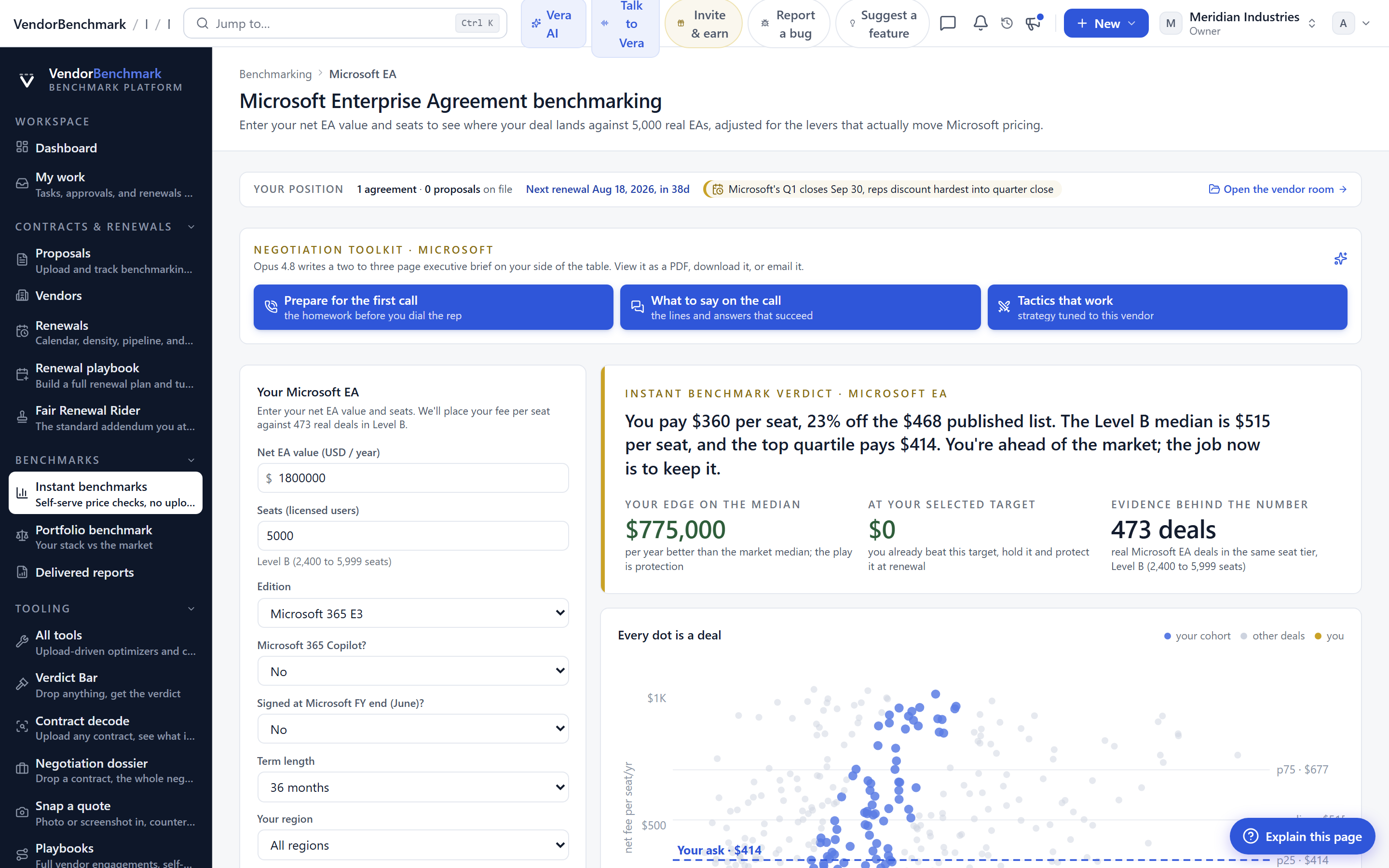
Type the discount they just said out loud. The room tells you whether it is Poor, Below market, At market, Good or Top of the market, and prices the gap over the term.
There is a moment on every vendor call that decides the outcome, and it lasts about four seconds. The rep says a number. Twenty two percent off list, capped uplift at seven, three year term. Then they stop talking and wait. In that silence you are supposed to know whether twenty two is generous or insulting, whether seven percent a year is a concession or a trap, and whether the term is buying you anything. Most buyers do not know, so they say they will take it back to the team, and the moment passes. We built this feature for that four seconds. The call room now answers the question you ask out loud in the middle of the call, and it answers it against the vendor's own reference set rather than a figure anyone invented.
The named problem: the number lands and you have nothing to weigh it against
The recognisable failure is not that buyers are bad at numbers. It is that the reference data lives somewhere the call does not reach. Your benchmarks are in a report. The comparable deals are in a spreadsheet a colleague built last quarter. The uplift cap you negotiated on the last renewal is buried in a contract PDF. During a live call none of that is in front of you, so the offer gets judged on tone of voice, and tone of voice is exactly what the rep controls. We have written before that discount off list is a trap, because the number that actually matters is net unit price, and the same problem shows up on a call in real time. You hear a percentage, you feel a small relief, and you have no way to test whether the relief is earned.
The other half of the problem is that the verdict has to move. A negotiation is not one number, it is a lever the rep slides while they watch your face. If your reference set only tells you about the opening offer, it is stale by the second counter. What changes on a call has to be scored on a call, or it is not scoring anything.
What the room now does, in the order you will use it
Type the discount they have just offered. The verdict appears at the top of your private line, the part of the call room only you see: Poor, Below market, At market, Good, or Top of the market. The range behind that verdict comes from the vendor's own reference set, drawn from comparable buyers of the same product. Where we hold no set for a vendor, the room says so plainly rather than guessing. A verdict you cannot trace is worse than no verdict, because it invites confidence you have not earned.
Then move the lever as they move. When the rep improves the offer, slide the number and the verdict moves with it. This is the part that matters on a live call, because the interesting question is rarely the opening number. It is whether the fourth counter has actually crossed from Below market into At market, or whether it is still theatre. Add what the deal is worth over the term and the gap is priced in money, so a two point difference stops being abstract and becomes the specific sum you are leaving on the table. The cap on the annual increase is priced beside it, because a good headline discount with an ugly uplift is not a good deal, and we have laid out why in what compounding does to three years.
Simple and Expert, one press either way, mid call included
The room also gained a Simple and Expert switch. Simple gives you the verdict and the money, which is often all you want when the rep is watching you and you have four seconds to react. Expert opens the reference distribution, the percentile position, and the uplift detail, for the moments after the call or the moments when the person on the other side has clearly done their homework and you need to match it. One press either way, and it works mid call, because the level of detail you need is not fixed for the whole conversation. You can start Simple, hit a hard counter, and go Expert without leaving the line. This fits alongside the rest of the call room, your analyst on the call and the memo written when you hang up, so the verdict you reached live is captured in what gets written afterwards.
Where it fits, and where it does not
This feature judges the number in front of you. It is not a substitute for knowing what you are buying, and it is not a substitute for the work you do before the call. The reference set can tell you that twenty two percent is At market for this product, but it cannot tell you that the bundle you are being sold contains two modules you will never deploy, or that the term is timed to the vendor's fiscal year rather than yours. For that, the pre call research still matters, and the budget you approved before anyone checked the market price is a different problem the call room cannot fix after the fact.
Honest limits
Be clear about three things. First, coverage. Where we hold a reference set the verdict is grounded, and where we do not the room says so, which means for some vendors and some product lines you will get an honest no data rather than a score. We would rather tell you than fill the gap with a guess. Second, the verdict is a market position, not a promise. At market means the offer sits where comparable buyers of the same product land. It does not mean you cannot do better, and it does not account for leverage you hold that others did not, such as reference logo value or a competitive displacement. Third, the room scores the number, not the fit. A Top of the market discount on the wrong product is still the wrong product, and no verdict bar will save you from that. Used for what it is, a live check on whether the number is any good, it turns the four second silence from the vendor's advantage into yours. Try it on your next call at the call room, and let the offer be the thing that has to prove itself, for once.
Fredrik has spent more than twenty years in enterprise software, with time at Oracle, IBM, SAP, and Salesforce before moving to the buy side. He structured and priced the kind of large agreements most buyers only see once or twice in a career, which taught him where the leverage sits and how far a vendor will actually move. He started VendorBenchmark to hand that knowledge to every sourcing team.