Run a vendor agent, get an Agent Room
Six agent roles, one vendor at a time, and a room that keeps every page the agent writes. The first page is your contracted position, assembled from your own records, and every AI written page after it carries a byline telling you what was checked and what is directional.
Every procurement desk has a vendor whose file exists, technically. There is a signed master agreement in the contract system. There is a quote from the last cycle sitting in someone's inbox. There is a spreadsheet with three years of invoice totals that one analyst maintains and nobody else trusts. And there is a set of half remembered notes about what the account team conceded in March, held by a person who has since moved teams. All of that is evidence. None of it is a document. When the renewal date arrives, somebody spends most of a week turning the scatter into something a CFO can read in four minutes, and then spends that week again at the next renewal, because the output was a slide deck and the slide deck was never a record.
The vendor file that never gets written
The reason the file never gets written is not laziness. It is sequencing. Writing a real vendor position requires reading the agreement, reconciling billing against it, checking the renewal mechanics and notice windows, then forming a view on price and timing. That is four different kinds of work, and on a desk carrying a few hundred agreements it competes with whatever is due Friday. We have written before about the arithmetic of that squeeze in 300 vendors, 52 weeks, one team: the renewal calendar problem, and about how a small desk can staff around it in Six agents and a ghost writer: staffing a procurement desk with AI. This release is the piece that was missing from both: somewhere for the output to live.
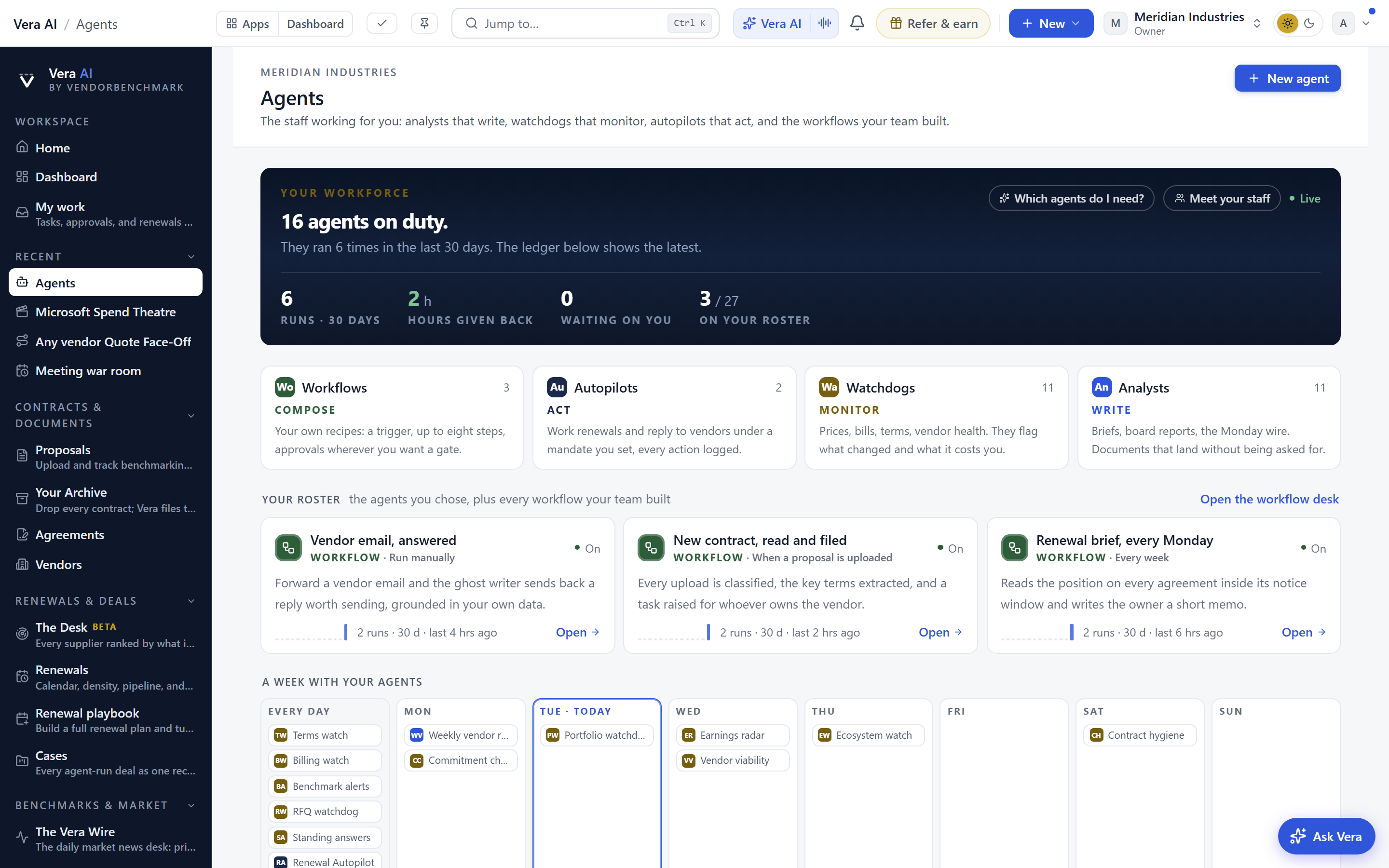
Here is the whole feature in one sentence. Pick one of your vendors, pick one of six agent roles, and the agent writes its documents one at a time into a single room that stays yours. The six roles are Vendor Watchdog, AI Research, Negotiation Prep, AI Negotiation Assistant, Vendor Deep Research, and Renewal War Room. You are not configuring a pipeline and you are not writing a prompt. You are choosing a vendor and choosing what kind of file you want on that vendor, and then reading pages as they land.
The first page is your position, not the model's opinion
The failure mode of AI in procurement is confident text with no anchor. A model will happily tell you that a discount of twenty two percent is standard for a vendor while having no idea what you currently pay. So the first page of every room is not written by the agent in the usual sense. It is assembled, exactly, from your stored agreements: contracted rates and quantities, term start and end, renewal mechanics, notice window, uplift caps where they exist, the contracting entity, and the amendments that changed any of it. If a field is not in your records, the page says the field is not in your records rather than filling it in.
That ordering matters more than it sounds. Everything the agent writes afterwards sits downstream of a page you can verify line by line against a PDF in your own file store. When the AI Negotiation Assistant proposes a counter position, it is proposing it against your stated renewal date and your stated unit price, not against a generic market shape. If you want the mechanics of how a contract turns into that kind of structured position, we walked through it in Decode any contract in a minute, and what to look for first.
Want to be updated when major licensing and pricing changes land? One analyst brief a week: the price rises, metric changes and audit campaigns that move software costs. Work email only.
Thirty specialist desks, and everyone else on the record
Depth is not uniform, and pretending otherwise is how buyers get burned. Thirty of the largest software vendors carry a specialist desk behind the agents. That desk holds the vendor's fiscal calendar, the contract watch points that recur in their paper, and the negotiation plays that have actually moved on that vendor's deals. When you run Negotiation Prep against one of those thirty, the agent knows that quarter end is not a generic concept and that timing is a lever with a date attached, a point we made in detail in Timing is leverage: vendor fiscal calendars and when discounts actually move.
Run an agent against any other vendor and it works from your stored records alone, and it tells you that in plain language on the page. No implied playbook, no borrowed pattern from a different vendor's paper. For a mid market observability tool or a regional payroll provider, your own contract history, invoice trail and internal usage are usually the strongest evidence available anyway. The value of the disclosure is that you know which kind of room you are reading before you quote it to a CFO.
The byline that tells you how hard to lean
Every AI written page in the room carries a byline. It either states that figures were checked against your stored data, or it states exactly how many figures on that page should be read as directional. Not a general disclaimer at the bottom of the document. A count, on the page, next to the numbers it applies to. If a Renewal War Room page carries eleven verified figures and two directional ones, you know which two you do not put in front of the CFO without a second source. This is the same discipline we described in The counter offer is a document: inside the Negotiation Dossier, applied to work an agent produced rather than work you commissioned.
What this does not do
The rooms are only as good as your stored records. If your contract store holds a signed master agreement but none of the four order forms that actually set price, the position page will be thin and will say so. That honesty is the right behaviour, but it is not a substitute for loading the paper. Buyers who get the most out of this feature are the ones who spent an afternoon first getting agreements and recent invoices into the system. Thin inputs produce a short room, and a short room is not a negotiation position.
Second, directional means directional. A byline that flags four figures as directional is telling you those numbers came from reasoning rather than from your data, and they should be treated as a hypothesis to test, not a fact to quote. Do not paste a directional figure into a board paper. Use it to decide what to ask the vendor or what to verify against benchmark data before the call.
Third, an agent room does not negotiate. It writes. It will not email the account team, will not commit to a position on your behalf, and will not tell you what the vendor is going to do, because nobody knows that. It produces the document you walk into the room with. The concessions still come from the conversation, and the conversation still depends on your willingness to hold a date and a number. Finally, the specialist desks cover thirty vendors. That covers a large share of most software estates by spend, but the long tail runs on your records alone, and the room will be less opinionated there by design. If your problem is breadth rather than depth on a single vendor, start with Benchmark the portfolio, not one deal at a time and come back to the rooms for the vendors that come out furthest from market.
The change we care about is small and specific. The work of building a vendor position used to evaporate the moment the renewal closed. Now it lands in a room, with the position on page one, a byline on every page after it, and a rerun button for the next time your position moves. That is the difference between doing the work and keeping it.
Fredrik has spent more than twenty years in enterprise software, with time at Oracle, IBM, SAP, and Salesforce before moving to the buy side. He structured and priced the kind of large agreements most buyers only see once or twice in a career, which taught him where the leverage sits and how far a vendor will actually move. He started VendorBenchmark to hand that knowledge to every sourcing team.