The Workup Theatre: your contract analysis opens as a show, not a spreadsheet.
Drop a contract into the lobby and the curtain rises on a staged walkthrough of what it says, what it should cost, and what to do about it: an overture, an ask ladder, a war plan, and a curtain call desk that drafts the emails before the lights come up.
Most analysis tools end with a dense page you scroll and a report you file. The Workup Theatre ends differently. Open Vera Workup and you arrive in a lobby: your latest finished workup waits on a marquee card with what is at stake and where you left off, the rest of your workups sit on a shelf, and a drop zone takes the next contract. Choose one and the curtain rises. What follows is not a dashboard, it is a staged walkthrough of the deal, screen by screen, built from your own document and the market data behind it.
The point is not spectacle. A contract workup has an argument: here is your position, here is what the market pays, here is what to ask for, and here is the order of moves between now and signature. A page of tiles buries that argument. A show walks it, one screen at a time, with the numbers animating as they enter and a ticker recomputing as the scenario changes. You can present it to your team exactly as you first saw it yourself.
From overture to ask ladder
The show opens with an overture: the contract, the vendor, the money at stake, and the verdict, stated plainly before any detail. From there the acts build. The documents act opens on a cover sheet that tracks what you have read, and every document screen carries its own toolbar to download, forward, link, or print, so the evidence is never more than one key away from the argument it supports.
The ask ladder is where the workup becomes a negotiation. It stages three scenarios side by side, from the safe ask to the full position, and recomputes the ladder live as you move between them. Instead of one number to defend, you leave with a sequence: what to open with, what to settle at, and what walking away is worth, each grounded in the benchmark evidence the earlier acts already showed.
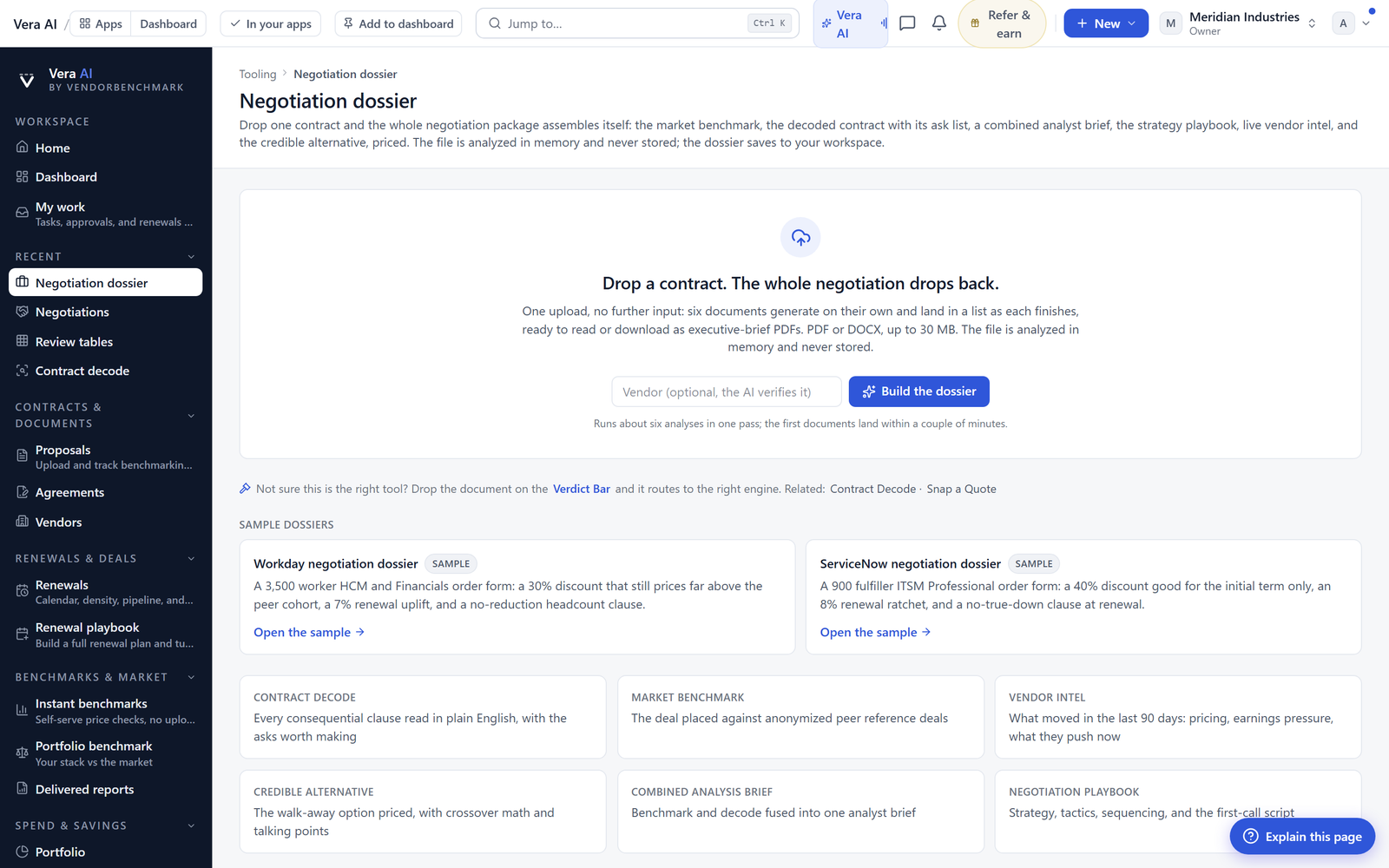
The workroom: a war plan you can check off
Analysis without a plan decays into a browser tab. So the theatre now lands you in a workroom, a What next board with three operable moves: reach out, report it, prepare. Behind it sits a war plan built deterministically from your renewal date, your first moves, and your top asks: four phases laid out as a timeline that fills in as you check items off. If the renewal is years out, the plan falls back to a 16 week runway, because a plan you cannot start this week is not a plan.
The desk remembers where you are. Your screen position, your chosen scenario, and your check offs persist per workup, so closing the tab on Tuesday and returning Thursday puts you back mid act, not back at the curtain. The lobby's marquee card reads the same state and offers to resume exactly there.
The curtain call is a desk
The final screen does not say thank you, it puts the position to work. The curtain call carries the full desk: Vera drafts the meeting request, the opening email to the vendor, and the internal brief from your live numbers, and a workshop email invites colleagues into the workup itself. You can forward the workup, copy a link, download the packet as a leave behind, hand the case to an advisory session, or rehearse the playbook before the real call.
The vendor facing drafts follow one hard rule: they carry your deployment facts and your asks, never your target or the corridor you would settle in. What you send is evidence; what you keep is strategy. That separation is enforced in the drafting, not left to your editing.
What you can do on the workup stage
The stage presents the case, you still make the call
The theatre does not decide anything. It stages what the workup found, and the workup is only as strong as the document you gave it and the benchmark evidence behind the verdict. Where the evidence is thin the show says so on the relevant screen rather than glossing over it, and an unmatched benchmark is presented as information, not dressed up as a finding.
If you prefer the classic desk, it is one click away and always has been: the backstage view keeps every workup in the familiar flat layout, and deleting or managing workups works there too. The stage is the default because the argument lands better staged, not because the desk went anywhere.
Fredrik has spent more than twenty years in enterprise software, with time at Oracle, IBM, SAP, and Salesforce before moving to the buy side. He structured and priced the kind of large agreements most buyers only see once or twice in a career, which taught him where the leverage sits and how far a vendor will actually move. He started VendorBenchmark to hand that knowledge to every sourcing team.
The week in enterprise software buying, in one email.
What shipped on the platform, and the pricing and licensing moves worth knowing before your next renewal. One email a week, to your work address. Unsubscribe any time.