The sourcing desk: the whole pipeline in one window
The desk reads the same rows as your stage pages but keeps them all in one view, so a weight change and a target discount move the ranking, the close and the award together.
Most sourcing tools ask you to hold the pipeline in your head. You open the requirements page, then the bid comparison, then a spreadsheet, then the drafted award letter, and each of those pages knows about a different version of the deal. Change a category weight in one and the others stay stale until you retype the consequence. We shipped the sourcing desk to close that gap. It opens as its own window, fourteen rooms over the pipeline you already run, and every room reads the same rows the stage pages read. This post explains what changes for a buyer, how it fits the workflow you have, and where it stops.
The problem: the pipeline lives in fragments
A sourcing event is one object, but you edit it as a dozen disconnected screens. The requirements sit in one document. The invitations and bids sit in another. The weighted matrix is usually a spreadsheet that nobody dares touch after the scoring meeting, because touching one weight means retyping the ranking, then reworking the margin, then rewriting the evaluation memo to match. So the analysis freezes early. You pick weights once, defend them once, and the moment a stakeholder asks what happens if we care more about implementation than list price, you are back in the spreadsheet doing arithmetic by hand.
That fragmentation is the same failure we described when the budget number was approved before anyone checked the market. Decisions get locked before the analysis is live, because keeping the analysis live is too much manual work. The desk removes the manual work.
The floor and the rooms
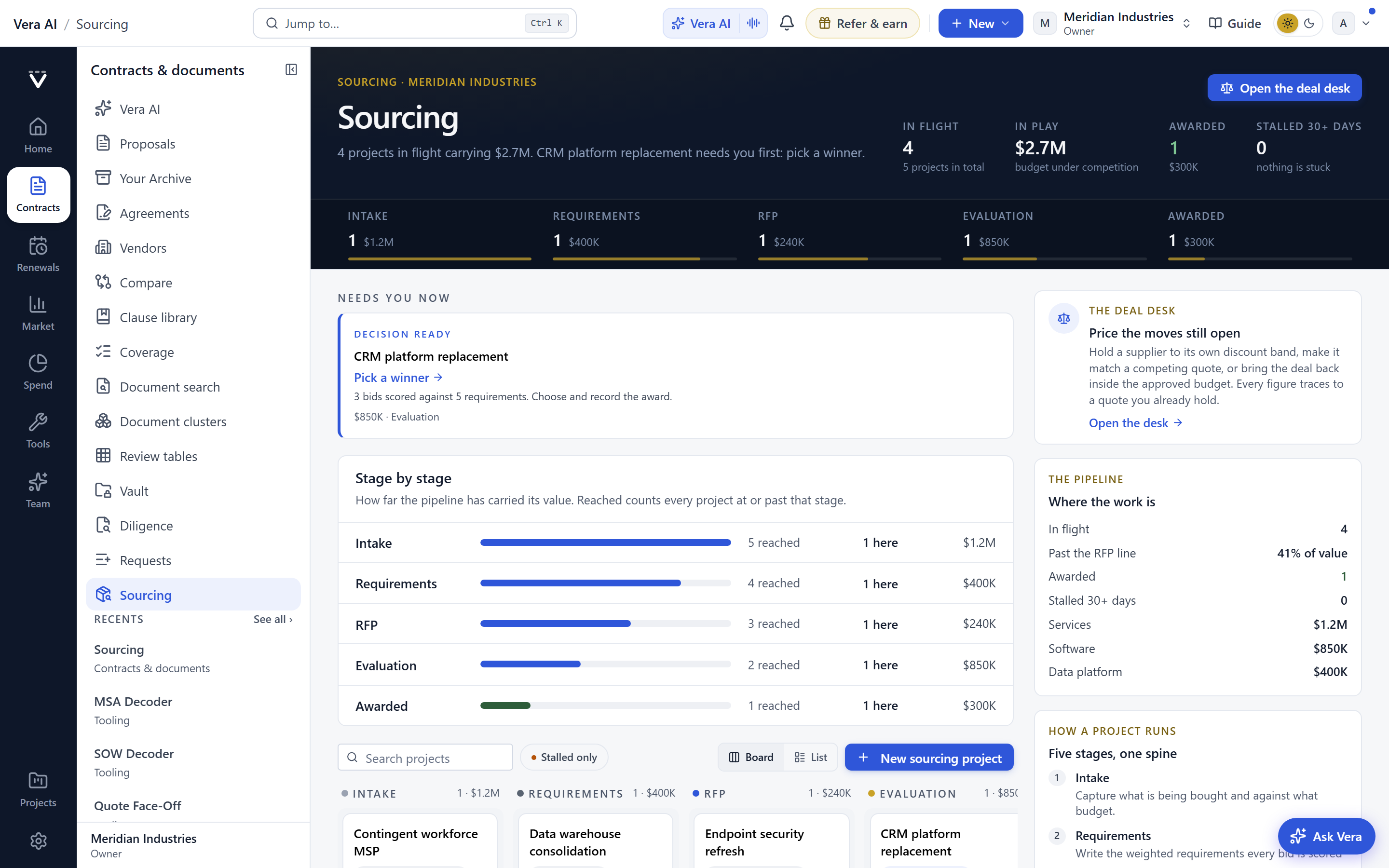
The desk opens on the floor. Every purchase sits on one runway with today drawn as the gold line, so you see what is early, what is late, and what is crowding the same approval window. From there you walk fourteen rooms in the order the work actually happens. Intake prices the overlap before anyone approves it, which is the discipline we argued for in the request that never states the cost of doing nothing. Then requirements, the field one of our six specialist agents researched, the invitations, the bids, the weighted matrix, the pricing walk, the strategy, the drafted letters, the live evaluation memo, the close, and the award.
The important part is what the rooms do not do. They do not own separate copies of the deal. They read the same rows the stage pages read, and the stage pages keep the heavy edits. So the desk is a reading and steering surface, not a second system of record. Nothing you do in it diverges from the pipeline underneath. This is the same principle behind working a whole contract without leaving the archive: one source, many views.
Two levers that rewrite the analysis without writing anything
The desk runs on two levers, and neither asks you to type. The first is category weight. Drag a weight and the ranking, the margin and the memo rederive together. If you decide implementation risk matters more than headline list price, you move the weight and the leaderboard reorders, the margin math follows, and the evaluation memo already reads the new order. There is no retyping and no stale narrative.
The second lever is the target discount. Hold a target discount against the leader's stated list and the close price and the award scenarios move with it. You are testing what a given concession does to the shortlist in real time, against the leader's own quoted list, not against a number you invented. This is where the desk earns its keep in a live negotiation, because you can walk into the room already knowing which discount flips which vendor into the lead.
A gate is not a weight, and the desk knows it
There is one rule the levers cannot override, and it matters. A bid that misses a mandatory gate stays struck at every weight, because no weight cures a gate. You cannot weight your way past a vendor who failed a must-have. This is deliberate. It is the antidote to the failure we described in everything is mandatory, so nothing is negotiable, where must-have and nice-to-have collapse into one flat list and the scoring quietly rewards a vendor who never met the floor. Here the gate holds. A struck bid stays struck no matter how you drag the weights, and the memo says why.
The other thing worth knowing on day one: an empty pipeline does not open empty. It offers the fully worked sample estate, a complete sourcing event you can walk end to end. So the desk is worth opening before you have loaded a single real deal, because you can see exactly how the levers behave against a finished example first.
Honest limits
The desk steers analysis. It does not invent inputs. If your requirements are vague, the weighted matrix will faithfully rank vague inputs and the memo will read exactly as vague as you wrote it. The levers make the consequences of a decision visible, they do not make the decision for you. That remains a judgment call, and it should.
Two more boundaries. The target discount lever works against the leader's stated list, so its quality depends on having a real quoted list to hold it against. When a vendor is coy about list price, the scenario is only as honest as the number you can pin down. And the gate logic only strikes what you have marked as a mandatory gate. If a genuine must-have is filed as a preference, the desk will treat it as one. It enforces your structure precisely, which means it also inherits any looseness in your structure. The desk is a faithful mirror, not a corrective, and on a well-specified event that is exactly what you want it to be.
Fredrik has spent more than twenty years in enterprise software, with time at Oracle, IBM, SAP, and Salesforce before moving to the buy side. He structured and priced the kind of large agreements most buyers only see once or twice in a career, which taught him where the leverage sits and how far a vendor will actually move. He started VendorBenchmark to hand that knowledge to every sourcing team.