The Fair Renewal Rider: one addendum that ends re-arguing the same terms.
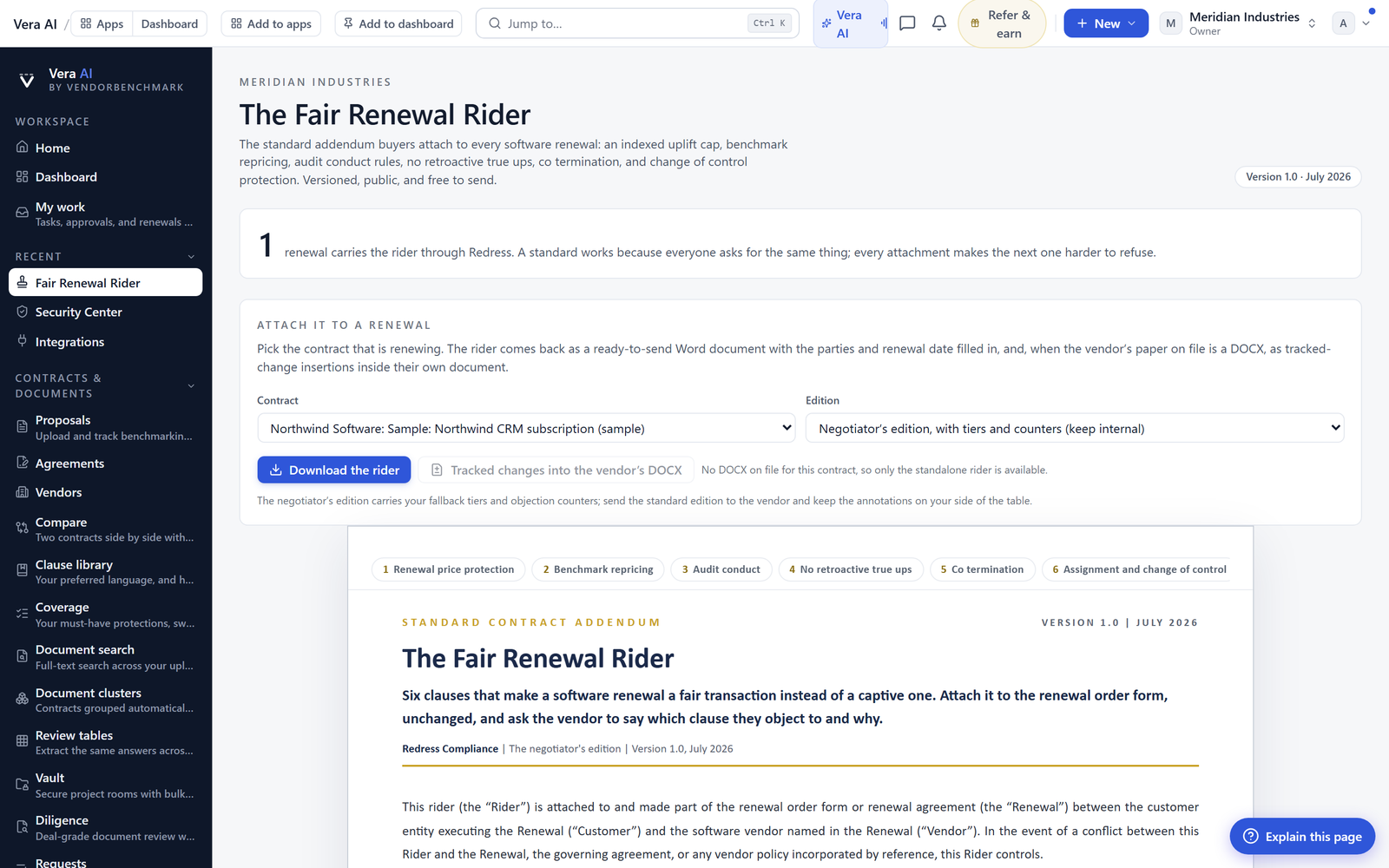
Every renewal in your estate renegotiates the same five protections from scratch, on the vendor's paper, under the vendor's deadline, and most of them lose by omission rather than argument. The Fair Renewal Rider is the fix: your standard terms, versioned and maintained once, merged into any renewal as tracked changes.
Watch a year of renewals go through a typical company and a strange asymmetry appears. The vendor side runs on standard paper: the same order form, the same terms, the same fallback positions, refined across thousands of customers and updated by a legal team whose whole job is the template. The buyer side starts every one of those renewals from a blank page. The uplift cap that legal fought for at the Salesforce renewal in March simply does not exist at the ServiceNow renewal in June, because nobody carried it over. Institutional learning on the sell side compounds. On the buy side it evaporates between deals.
The result is that most renewal protections are lost by omission. Not argued and rejected, never requested. The renewal lands two weeks before the deadline, the quote gets negotiated, and the terms ride through untouched because opening the terms conversation from scratch costs more time than anyone has. Vendors do not need to win the argument about audit conduct or repricing rights. They need you not to start it, and the blank page guarantees you will not.
The five families of protection in the rider
The uplift cap. Renewal price increases bounded by a hard percentage or a published index, never "then-current list." This is the single clause worth the most money over a contract's life, and the compounding arithmetic of its absence is the reason the rider exists.
Benchmark repricing. The right to have the renewal price reviewed against market evidence, so a deal that has drifted far from the cohort has a contractual path back instead of a begging letter. Vendors resist the strong version; even the weak version changes the renewal conversation, because it makes the market officially relevant.
Audit conduct. Notice periods, frequency limits, agreed tooling, scope discipline, and cost allocation, negotiated now, while relations are good, rather than in the week the audit letter arrives. Audit clauses are the clearest case of terms that cost nothing to grant on a sunny day and everything to lack in a storm.
Notice and renewal discipline. Mutual renewal notice with the new price stated in advance, notice windows a calendar can actually manage, and auto-renewal converted from a trap into a convenience.
Change of control and assignment. Price protection and exit rights when the vendor is acquired, its product is discontinued, or your own company divests a unit. Anyone who watched a virtualization estate get repriced after an acquisition knows exactly what this family is for.
Deployment: tracked changes, not a treatise
The rider's practical trick is how it arrives. It does not ask the vendor to adopt your master agreement, which is a quarter-long legal project nobody staffs for a renewal. It merges into the vendor's own renewal document as tracked changes, produced by the platform against whatever paper the vendor sent. The account team opens a familiar order form with a dozen precise, pre-approved modifications, each one your standard language, each one visible and individually negotiable. That format matters: redlines on their paper get processed by their deal desk's normal machinery, while a separate legal document gets parked.
Versioning is the other half. The rider is maintained once, centrally, the way the vendor maintains its template. When legal improves the audit clause or the market teaches a new lesson, the version increments, and every future renewal carries the improvement automatically. Your negotiating position finally compounds the way the vendor's always has, and it stays consistent across every deal owner, including the agents, whose reviews and drafts argue from the rider's language rather than generic best practice.
Expect partial acceptance, and design for it. A vendor may take the cap but push back on repricing, accept notice discipline but haggle the audit terms. That is the system working: every accepted clause is a permanent upgrade you did not have to invent that quarter, every rejection is explicit and logged in the war room rather than silent, and the acceptance rate itself becomes vendor intelligence, because who signs fair terms without a fight tells you something about who plans to behave.
Rolling it out, one renewal cycle at a time
The honest limit: the rider standardizes positions, not outcomes. A flagship vendor with a rigid template will still reject clauses smaller vendors sign without blinking, and a rider deployed with no negotiating attention behind it is just polite decoration on the vendor's paper. What it removes is the omission tax, the protections lost because nobody had time to ask. Asking is now free, on every deal, in your best language, forever. It is remarkable how much of fair treatment turns out to be simply having a standard way to request it.
Morten brings two decades of enterprise and software procurement, with stints across Oracle, IBM, SAP, and Salesforce shaping how he reads a deal. He has led sourcing through hundreds of renewals, from mid market order forms to nine figure global agreements, and learned that the buyers who win are the ones who walk in knowing the market. He built VendorBenchmark to make that pattern recognition repeatable.
The week in enterprise software buying, in one email.
What shipped on the platform, and the pricing and licensing moves worth knowing before your next renewal. One email a week, to your work address. Unsubscribe any time.