Drop the contract, get the whole first-call file
Six documents, one run, and nothing leaves your tenant. Here is what changes for the buyer walking into a first call, and where the file still needs your judgment.
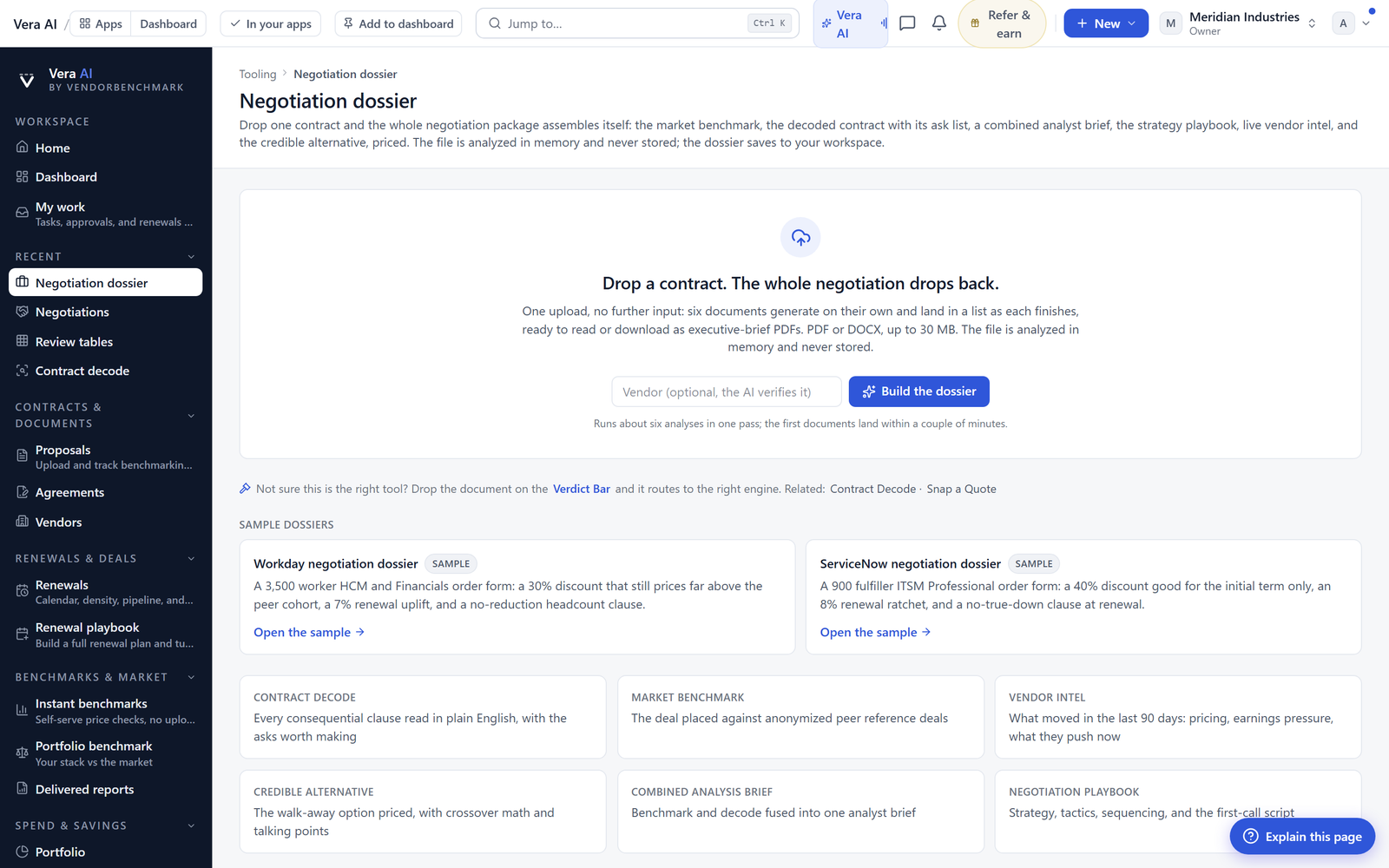
There is a familiar gap between getting a contract and being ready to talk about it. The document lands in your inbox, the vendor wants a call this week, and the work that would make you dangerous in that call is spread across four tools and a folder of last year's threads. Most buyers close the gap the honest way: they read the paper, they ask a colleague who negotiated with this vendor before, they build a rough sense of whether the number is good, and they show up with a position that is mostly instinct. This update collapses that gap into a single upload. Drop the contract, and you get the whole first-call file back.
The problem is not the reading, it is the assembly
Reading a contract is the part everyone thinks is the work, and it is the part we already automated. Every upload gets the two minute read, so you know what is in the paper before you have finished your coffee. But knowing what the contract says is not the same as knowing what to do about it. The real labour is the assembly. You have to translate the terms into a grade, the grade into asks, the asks into a sequence, the sequence into a plan for when the vendor says no, and all of that into words you can say out loud on Thursday. That assembly is what used to eat a week.
The new run produces six documents from one contract, and it treats them as one deliverable rather than six separate tools you have to visit. First, how good the deal actually is, stated as the discount you are being offered against what comparable buyers land, and where that sits as a percentile. Second, what to renegotiate, every term priced and written as an ask you could paste into an email. Third, the strategy, with the concession ladder and your floor on each trade. Fourth, the competitive scenario: who else could do this job, the honest switching bill, and three scenarios priced against staying. Fifth, the research brief on how this vendor negotiates, when they audit, and which analyst films to watch first. Sixth, the talking points for the call, scripted.
The grade is a percentile, not an opinion
A deal grade is worthless if it is a feeling. This one is not. The discount you are being offered is placed against what comparable buyers landed, drawn from the benchmark library, and stated as a percentile so you know whether you are being treated well, treated the same as everyone, or being asked to subsidise the vendor's quarter. When the run says your offer sits in the bottom third of comparable deals, that is not an adjective, it is a position you can defend in the room.
The asks that follow are priced the same way. Each term you should renegotiate comes with a target, a floor, and language you can paste into an email without rewriting. This is the same discipline behind the counter offer as a document: an ask is only useful if it is specific, sourced, and sayable. Vague asks get vague answers. A priced ask with a percentile behind it gets a real conversation.
The competitive scenario, priced honestly
The weakest hand in most negotiations is the one that cannot walk. The competitive section of the file names who else could do this job, then prices the honest switching bill, migration, retraining, dual-running, and the sunk cost of your current estate, so you are not bluffing about an alternative you never measured. This matters because the vendor has already priced your lock-in, and if you have not, you are negotiating with a number only one side of the table can see. We wrote about that asymmetry in measuring switching costs before the vendor prices them for you.
The three scenarios are all measured against staying, because staying is the real default, not an idealised switch. One scenario might be renewing on improved terms, one might be a partial move, one might be a full switch. Each carries a number so you can compare the cost of pressure against the cost of departure. Most buyers who run this find that the credible threat is worth more at the table than the switch is worth in practice, which is exactly the point.
The vendor brief and the script
The research brief covers how this specific vendor negotiates, when in their fiscal cycle they audit, and which analyst films to watch before the call so you recognise the plays when they arrive. It draws on the negotiation playbooks, so the behaviour you are warned about is behaviour that has actually shown up in comparable deals, not a generic caution. When the vendor opens with a discount that expires Friday, you will have read that this is their standard close, and you will not flinch.
Then the script. The talking points are written for the call, not for a memo, so they are short, ordered, and phrased the way you would actually speak. If the vendor sends a follow-up email you did not expect, the ghost writer will turn their message into a counter in your voice, and if you want a second read while the call is live, the call copilot sits in your ear. The first-call file is the preparation. Those two are the follow-through.
How it fits the workflow
The run starts when you upload the contract, and it sends nothing to anyone. That last part is not a footnote. The file is built inside your tenant, the vendor is not notified, no email leaves, and nothing is filed anywhere your legal or security team would object to. The output lands on the analyst desk as a package you open, read, and edit before a single word reaches the other side. It slots into the workflows you already run, so a first-call file can trigger downstream: the war room for the strategy, the sign-off chain for approvals, the renewal calendar for the next cycle.
The honest limits
The file is a first draft of your position, not a mandate. The percentile grade is only as relevant as the comparability of the deals behind it, and while it draws on modelled cohorts across 1,471 vendors, a genuinely novel product or an unusual contract structure will have thinner comparables, and the run will say so rather than pretend. Treat a thin cohort as a caution, not a verdict.
The switching bill is an estimate built from what the contract and your estate reveal, and it cannot know internal costs you have not recorded, such as the political price of a migration or a dependency buried in a team's tooling. The scripted talking points are a starting point in a neutral voice; they do not know your relationship history with the account manager, and they will occasionally push harder or softer than your situation warrants. And the run reads what you upload. If you feed it the marketing quote instead of the executed paper, it will grade the marketing quote. The judgment about what your organisation actually needs, and how far you are willing to go, stays with you. The file just makes sure that when you make that judgment, you are making it with the whole picture in front of you instead of half of it.
Want to be updated when major licensing and pricing changes land? One analyst brief a week: the price rises, metric changes and audit campaigns that move software costs. Work email only.
Morten brings two decades of enterprise and software procurement, with stints across Oracle, IBM, SAP, and Salesforce shaping how he reads a deal. He has led sourcing through hundreds of renewals, from mid market order forms to nine figure global agreements, and learned that the buyers who win are the ones who walk in knowing the market. He built VendorBenchmark to make that pattern recognition repeatable.


