The Monthly Briefing is back, your portfolio as a five minute spoken brief
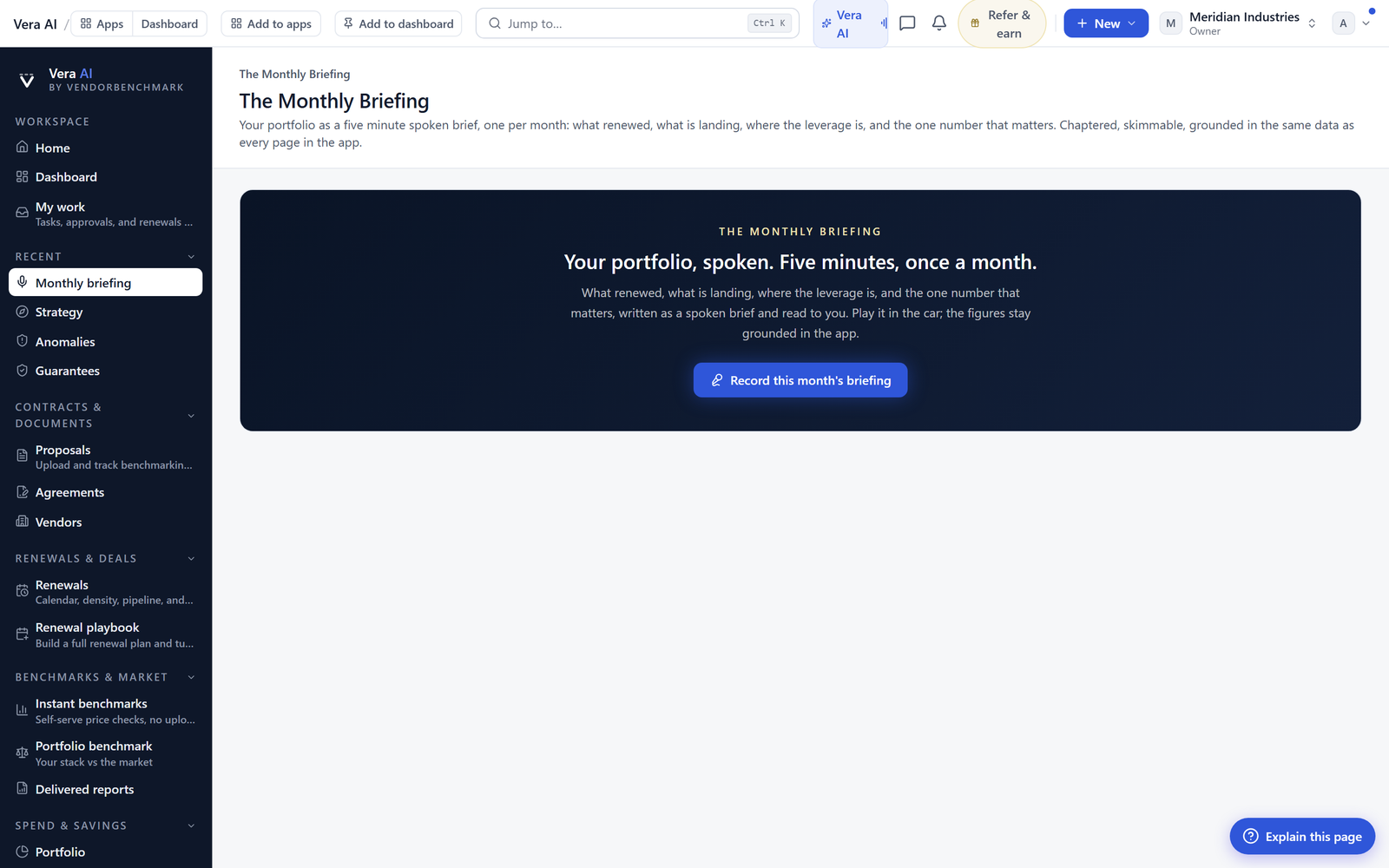
A five minute spoken brief on your vendor estate, recorded on the 2nd of each month, chaptered so you can skip to the part you need. The ready note stays strictly opt in.
You know the state of your estate on the day you last looked at it. The problem is that the last look was three weeks ago, and since then two renewals moved inside the window, one supplier pushed a price list change, and a deal you thought was settled slipped a quarter. The month turned over and nobody sat you down to say what actually happened. The Monthly Briefing is our answer to that gap, and it is back. It is a five minute spoken brief on your portfolio: what renewed, what is landing next, and where the leverage sits, chaptered so you can jump straight to the part you care about.
The named problem, month end drift
Call it month end drift. Nothing failed. No alert fired. But the picture in your head is stale, and the cost of that staleness is small decisions made on old facts. You approve a renewal at last quarter's price. You walk into a QBR without knowing a comparable deal just closed cheaper. You treat a supplier as settled when their price list moved underneath you. The information exists, scattered across the renewal calendar, the contract records, the benchmark library, and last week's email. Assembling it into one coherent read is a chore, so it does not happen every month. It happens when something breaks.
The Monthly Briefing removes the assembly step. On the 2nd of each month, the agent records a fresh brief for your portfolio and posts it to its own page. You press play, or you skip to the chapter you want. Five minutes, spoken, current.
What the brief actually covers
The brief has three fixed movements, and the chapters map to them. First, what renewed, the deals that closed since the last brief and how they landed against market. Second, what is landing next, the renewals inside your forward window with the days remaining. Third, where the leverage sits, the vendors furthest from market price and the moments where a comparable deal or a price list change gives you a position. Each figure in the spoken brief traces back to a source, so nothing is asserted without a line you can check.
The leverage chapter draws on the same benchmarking that answers the are we overpaying question. When the brief says a supplier sits above market, it is reading from the benchmark library, not from a hunch. That matters when you take the brief into a room and someone asks where the number came from.
The workroom beside the recording
The page keeps the latest recording on the left and the workroom on the right. The workroom holds three things: the full script, so you can read rather than listen when you are on a call; the chapter ledger, which lists every chapter with its start point and the vendors it names; and the provenance, where each figure came from. If the brief says a renewal lands in 41 days, the ledger shows you the contract record it read. If it names a market position, the provenance points to the benchmark. This is deliberate. A spoken brief is easy to consume and easy to distrust. The workroom is how the brief earns its trust, by refusing to hide its arithmetic.
If a figure in the brief prompts a deeper question, the workroom is the jumping off point. From a named contract you can open the record and decode the clauses before the renewal conversation. The brief tells you where to look. It does not pretend to be the whole file.
The ready note stays opt in
We built a companion to the brief called the ready note, a short written prompt that can go out when the recording is ready. It stays strictly opt in. We are not going to add another automated message to your month without you asking for it. If you want the note, you turn it on, per portfolio. If you do not, the brief simply sits on its page waiting for you, and nothing is sent. This is the same restraint we apply to the morning brief and its send rules. A brief that nags is a brief you learn to ignore.
Honest limits
The brief is a summary, and summaries drop detail by design. Five minutes cannot carry the full nuance of a complex negotiation, so treat the leverage chapter as a pointer to a position, not the position itself. The brief is only as current as the last data sync, so a change that landed the morning of the 2nd may catch the next month's recording rather than this one. It reads your portfolio as configured, so vendors outside your tracked estate will not appear. And it does not make decisions. It tells you what changed and where the pressure is. What you do with a renewal that sits above market is still yours to judge, ideally with the negotiation disciplines in front of you. The Monthly Briefing narrows the gap between the last time you looked and now. It does not close it, and it does not pretend to.
Fredrik has spent more than twenty years in enterprise software, with time at Oracle, IBM, SAP, and Salesforce before moving to the buy side. He structured and priced the kind of large agreements most buyers only see once or twice in a career, which taught him where the leverage sits and how far a vendor will actually move. He started VendorBenchmark to hand that knowledge to every sourcing team.