The CFO's software question: are we overpaying, answered in one page.
Every CFO eventually asks it, usually in budget season, usually after reading about someone else's software audit: are we overpaying? The traditional answer is a six week project that is stale by the board meeting. The better answer is a page that already exists and stays current on its own.
"Are we overpaying for software?" is a fair question that almost never gets a fair answer, because of how it has to be answered. Someone assembles the vendor list from three systems that disagree. Someone requests contracts nobody can find. A consultant benchmarks the top ten agreements against whatever data they have, and six weeks later a deck reports that the company is "broadly in line with market, with opportunities." By then two of the numbers have renewed and the question has moved on to next year's budget.
The structural problem is that the question is continuous but the answering machinery is episodic. Software spend moves every month, renewals reprice the estate every week, and a snapshot commissioned in March describes a company that no longer exists in September. Finance does not need a better project. It needs the answer as infrastructure.
The page: every vendor's distance from market
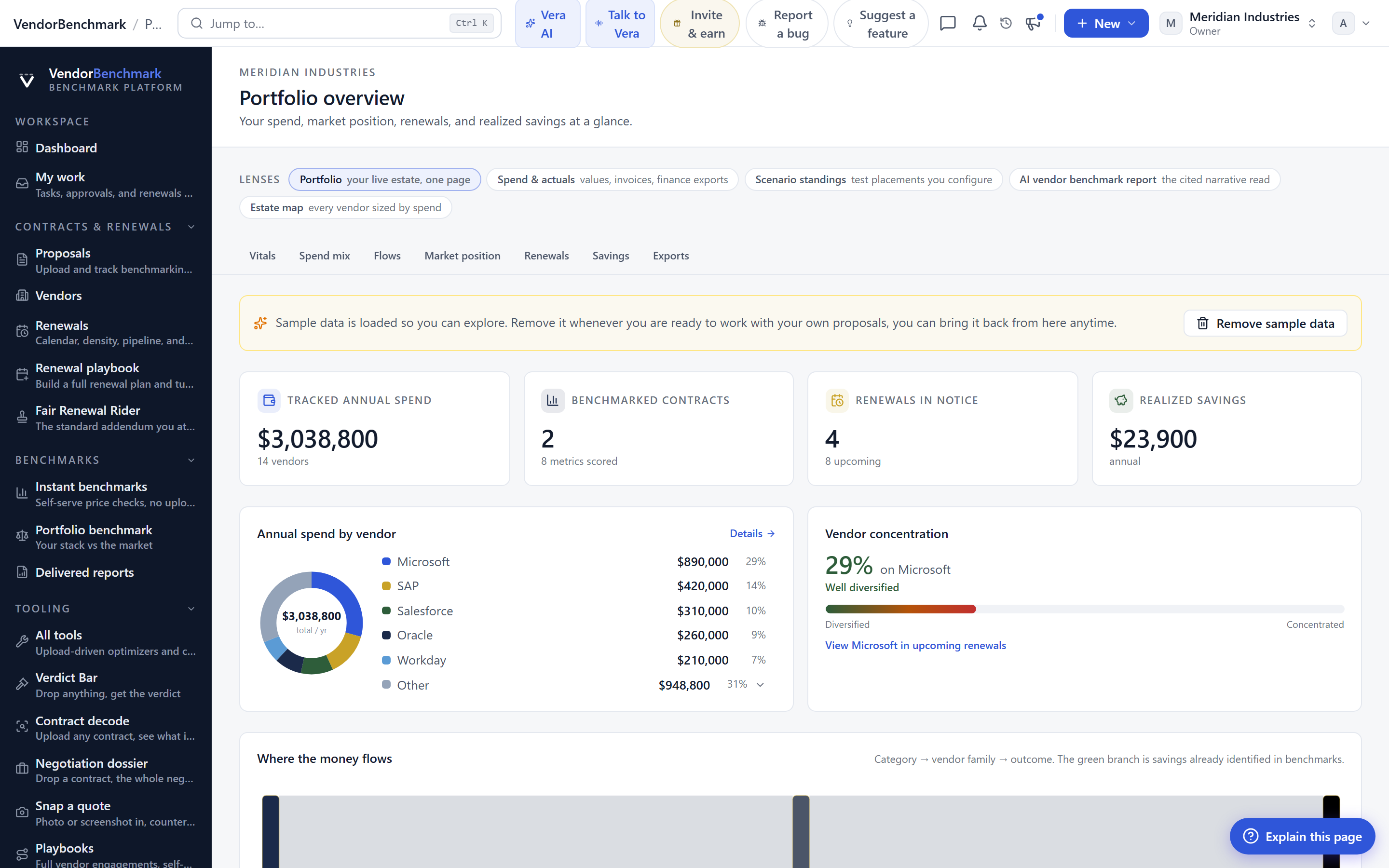
The portfolio view is the one page answer. Every vendor in the estate, its annual spend, and its position against the market: the percentile your price sits at within the comparable deal cohort, drawn from the library of 1,471 vendors benchmarked on modelled deal cohorts. Vendors above the median are ranked by what the gap is worth in dollars, and each line links to the renewal date that gives you the chance to close it.
That last part is what makes the page a plan rather than a grievance. "We are overpaying Vendor X by roughly $180K a year" is interesting. "The window to fix it opens in February, the notice deadline is November 30, and the benchmark brief is already drafted" is a work item with a date on it. The page reads top to bottom as: here is the recoverable money, here is the order the calendar will let us recover it in.
Want to be updated when major licensing and pricing changes land? One analyst brief a week: the price rises, metric changes and audit campaigns that move software costs. Work email only.
The two questions that follow, answered the same way
"What will it cost next year?" The 24 month forecast projects spend per vendor with each contract's actual uplift terms applied, capped where you negotiated caps, at the vendor's stated rate where you did not. It exports in the format finance budgets in, which retires the annual ritual of procurement and FP&A rebuilding the same spreadsheet from different sources. When a renewal lands differently than projected, the forecast moves the same day, not at the next planning cycle.
"Did the savings actually happen?" The savings ledger records every negotiated outcome, and Savings Proof reconciles each claim against the invoices that arrive afterward. Savings that survived contact with billing show as verified; savings that quietly eroded, the discount that lapsed, the seats that crept back, get flagged instead of forgotten. This is the difference between a savings slide and a savings number the audit committee can lean on, and it survives the departure of whoever negotiated the deal.
When the page needs to become a document
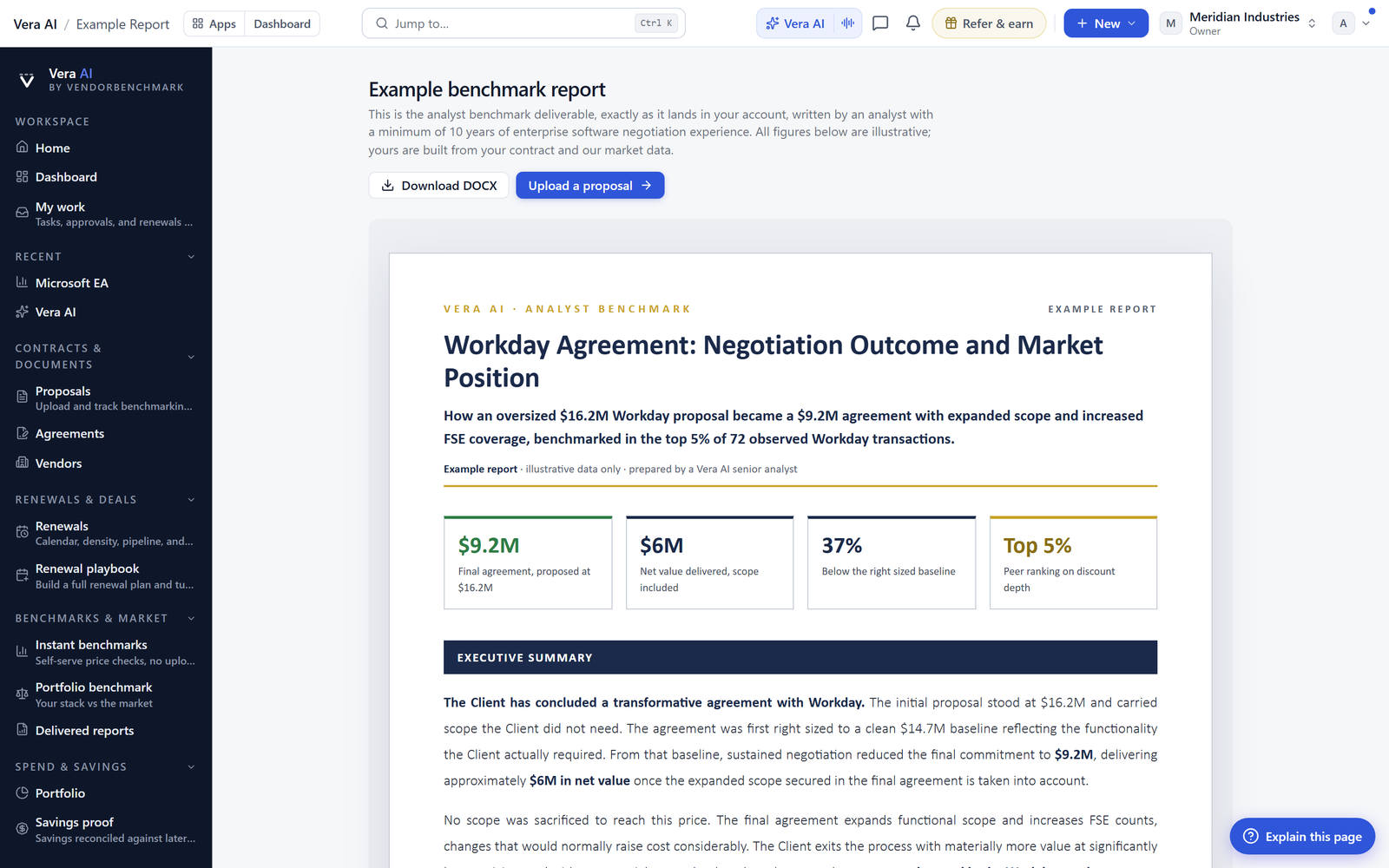
Board packs want narrative, not dashboards. One click generates the portfolio report as an analyst grade brief: the market position, the material gaps, the recovery plan sequenced against the renewal calendar, and the verified savings to date, every figure grounded in the stored data and citation tagged. It exports to Word, PDF, or PowerPoint in the house exec-brief style, and because it is generated from the live estate, the version presented in October describes October.
Three numbers from this page tend to change the conversation with the CEO and the board. The distance from market in dollars, because "we are at the 68th percentile on our top ten vendors" lands harder than any anecdote about a bad deal. The forecast delta, what next year costs if nothing is negotiated versus if the flagged renewals hit their benchmark targets. And the verified savings run rate, because a finance organization that can prove last year's savings gets believed about next year's.
The honest limit is the usual one: a page cannot negotiate, and closing the gaps it reveals still takes the renewal work the rest of the platform exists for. What the page changes is the starting point. "Are we overpaying?" stops being a research question and becomes a management question: here is where, here is by how much, and here is when we fix each one. That is a conversation a CFO can run a budget on.
Fredrik has spent more than twenty years in enterprise software, with time at Oracle, IBM, SAP, and Salesforce before moving to the buy side. He structured and priced the kind of large agreements most buyers only see once or twice in a career, which taught him where the leverage sits and how far a vendor will actually move. He started VendorBenchmark to hand that knowledge to every sourcing team.
The week in enterprise software buying, in one email.
What shipped on the platform, and the pricing and licensing moves worth knowing before your next renewal. One email a week, to your work address. Unsubscribe any time.