The Quote That Answers The Wrong Spec Perfectly
Responsiveness is not fit. When a quote answers the spec line by line, the spec itself goes unexamined, and the gap between what you asked for and what you needed gets priced in.
Last month a vendor sent back a quote that answered every line of your requirements document. Each capability you listed had a price against it. The commercial team called it responsive, and it was. The problem is quieter than a bad quote. The requirements you wrote were never checked against what the business actually needs, so the vendor answered a question nobody had verified. You are now holding a perfectly responsive quote to a spec that may be wrong, and responsiveness feels like progress. It is not the same as fit.
Why a responsive quote feels finished when it is not
A quote that maps cleanly to your requirements creates a strong illusion of completeness. Every line ties out. Nothing is missing on the page in front of you. The reviewer's eye runs down the two columns, requirement and price, and finds no gaps. The trouble is that the review only tests one relationship: does the quote answer the spec. It never tests the relationship that actually decides value, which is whether the spec answers the business.
This is where scope padding lives. A vendor pricing against your words has every incentive to price generously against the words that are loosest. If your requirement says enterprise-grade reporting, they will scope a reporting tier, and it will be priced, and it will be responsive, and you will have no idea whether the business needed that tier or the one below it. The document you handed over becomes the ceiling and the floor of the conversation at the same time.
Why the spec goes unchecked in the first place
The requirements document is usually the least examined artefact in the whole deal, and it decides the most. It gets written under time pressure, often by the person with the least time, and it inherits assumptions that nobody restates out loud. Sometimes the request arrives already naming a product, so the spec is reverse-engineered from a chosen answer rather than built from a need.
Once the document exists, it acquires authority it did not earn. Legal reviews against it. The vendor prices against it. Approvers sign against it. Every downstream party treats the spec as settled truth because questioning it would reopen work everyone considers closed. The spec is never wrong on purpose. It is wrong because no step in the process was designed to test it, and the quote arriving on top of it only hardens it.
The difference between responsive and fit
Responsiveness is a property of the quote. Fit is a property of the match between the business and the quote, and the spec sits in the middle as the thing that is supposed to carry the need across. When the spec is unvalidated, that carrier is broken, and a responsive quote simply delivers you a faithful answer to a corrupted question. The vendor did nothing wrong. The mechanism did.
Two failure modes hide inside a responsive quote. The first is scope padding, where the quote answers more than the business needs because the requirement was loose enough to permit it. The second is misfit, where the quote answers exactly what the spec said and the spec described the wrong thing, sometimes because it was written to fit the incumbent. Both pass a line-by-line responsiveness check. Neither survives a requirement-back check.
The motion that surfaces misfit before signature
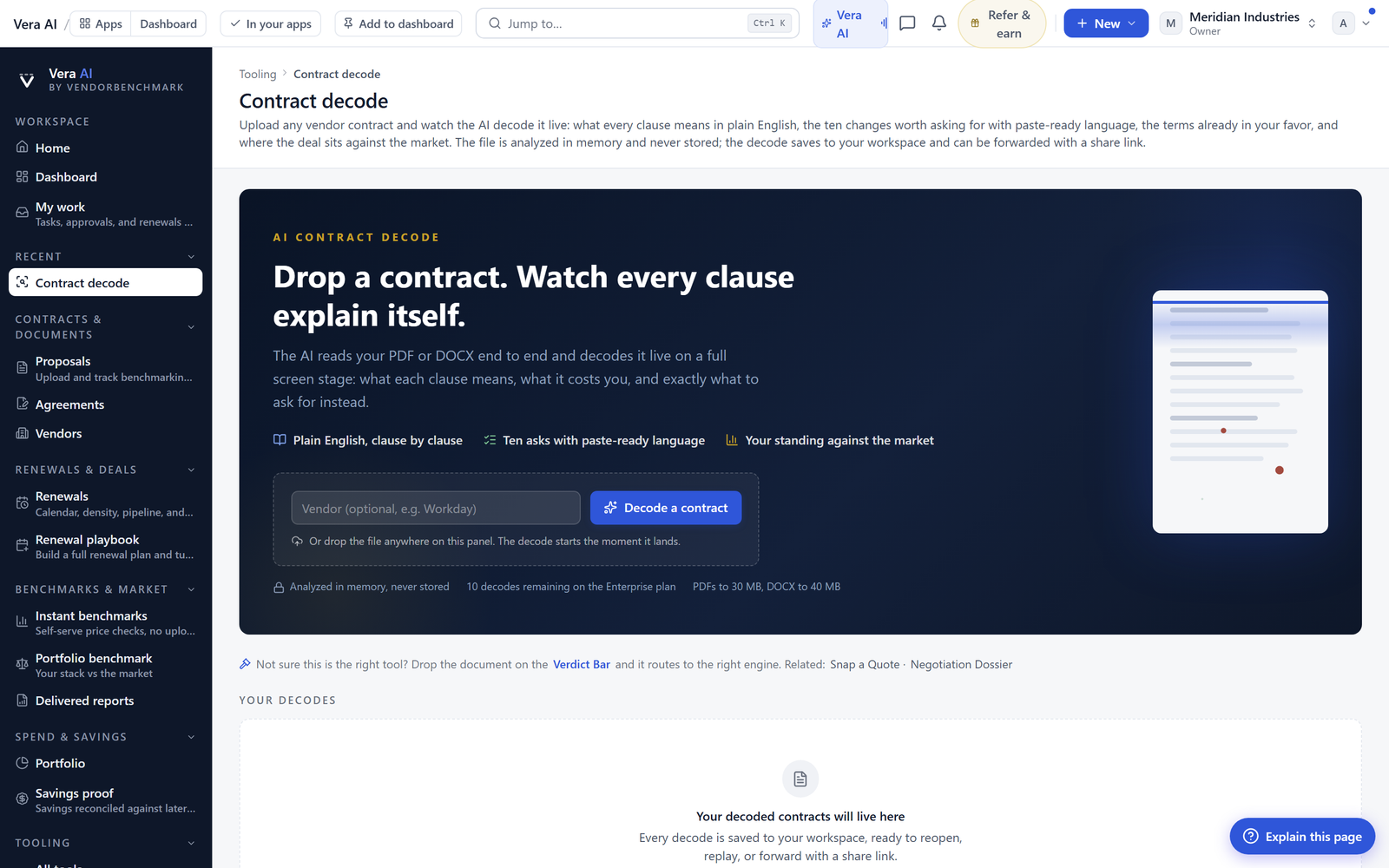
Quote decoding reverses the direction of the review. Instead of reading the quote to see whether it answers the spec, it reads each priced line back to the requirement that justifies it, and then tests that requirement against validated market patterns drawn from comparable deals. A line with no requirement behind it is padding. A requirement with no business validation behind it is misfit. Both get flagged before the number ever reaches an approver.
The platform runs this with six specialist agents and ninety nine background jobs, so the mapping, the benchmark lookup, and the flagging happen in parallel rather than as a manual spreadsheet exercise. Vera answers with cited figures when you ask why a given line looks padded, and the comparison sits alongside the benchmark library so you can see whether the priced tier matches what similar buyers actually bought. When three quotes need reconciling, the quote face-off board puts them on one benchmarked view.
What this does not solve
Quote decoding tests whether a priced line traces back to a validated requirement. It cannot invent the validation for you. If the business genuinely does not know what it needs, the platform will show you that the requirement is unsupported, but it will not resolve the internal disagreement that made it unsupported. That work still belongs to the people who own the outcome, and where stakeholders have never agreed, the flag is a prompt for a conversation, not a substitute for one.
It also cannot see needs that were never written down at all. A requirement that was skipped, such as a compliance control that never made it into intake, will not appear as padding or misfit because there is no line to trace. Quote decoding validates what is on the page. Making sure the right things reach the page is a discipline the platform supports but does not replace. What it removes for certain is the false comfort of a responsive quote. After the decode, you will know which lines earn their price and which ones only answered your document, and you will know it before you sign rather than after.
Fredrik has spent more than twenty years in enterprise software, with time at Oracle, IBM, SAP, and Salesforce before moving to the buy side. He structured and priced the kind of large agreements most buyers only see once or twice in a career, which taught him where the leverage sits and how far a vendor will actually move. He started VendorBenchmark to hand that knowledge to every sourcing team.