The renewal that re-bought a spec nobody could explain
The reason you scoped 400 seats and a premium support tier is not written down anywhere. So next year you renew all of it, because nobody can prove which parts you still need.
Here is the meeting you had last month, or will have next month. A renewal lands. Someone pulls up the current contract: 400 seats, premium support, a data residency add-on, a three year term. The question goes round the table. Do we still need the premium tier? Nobody remembers who asked for it. Do we still need 400 seats when active usage looks like 280? Nobody remembers whether the extra 120 were a growth assumption, a stakeholder demand, or a rounding error from three years ago. So the deal renews at roughly the same shape, because re-buying what you already have is the only option that nobody can argue with. That is not laziness. It is the absence of a record.
The problem is not the first purchase. It is every purchase after it.
Muddy intake gets treated as a first-purchase problem. It is not. The first time you buy something, the requirements are at least fresh in someone's head, even if they never get written down. The damage arrives later. A renewal without a decision record forces the team to reconstruct intent from artefacts that were never designed to carry it: an old invoice, a Slack thread, a quote with line items and no reasoning. You end up doing archaeology on your own past decisions, and archaeology is slow and unreliable, so people skip it and renew the shape they inherited.
This compounds. Renewal one re-buys the original scope because the original reasoning is missing. Renewal two re-buys renewal one, now with an extra layer of nobody-remembers on top. By the third cycle the deal has calcified into something the vendor understands better than you do, because the vendor kept records and you did not. We wrote about the mirror image of this in the spec that was reverse-engineered from a deal that already happened. The renewal version is quieter but more expensive, because it repeats.
Why the record never gets written
The obvious fix is to write down why you scoped a deal the way you did. Everyone knows this. It still does not happen, and it is worth being honest about why. Intake is a fast, distributed, half-verbal process. A budget owner names a number, a business unit names a feature, security names a constraint, and the person running the buy holds most of it in their head and never externalises it. When the deal closes, the pressure that would have forced documentation evaporates. The record that mattered most, the reasoning behind the shape, is exactly the part that lives nowhere durable.
There is also a conflict problem. Requirements at intake are often contradictory, as we covered in the piece on stakeholders who never met. Finance wants the floor, the business wants everything, and the spec pretends they agree. When intake papers over that tension rather than recording it, the renewal inherits a scope with no trace of the trade-offs that produced it. You cannot re-negotiate a compromise you cannot see.
The motion: intake decisions live in the deal record
The fix is not a discipline campaign asking humans to document more. Those fail because they add work at the exact moment pressure disappears. The fix is to make the record a by-product of the work already happening. The AI analyst captures intake decisions as the deal is scoped and negotiated, and writes them into the deal record where they persist. The seat count, the support tier, the residency add-on: each carries the reasoning that produced it, the stakeholder who required it, and the benchmark it was checked against at the time. You can work the entire history of a relationship without leaving it, which we described in working a whole contract without leaving the archive.
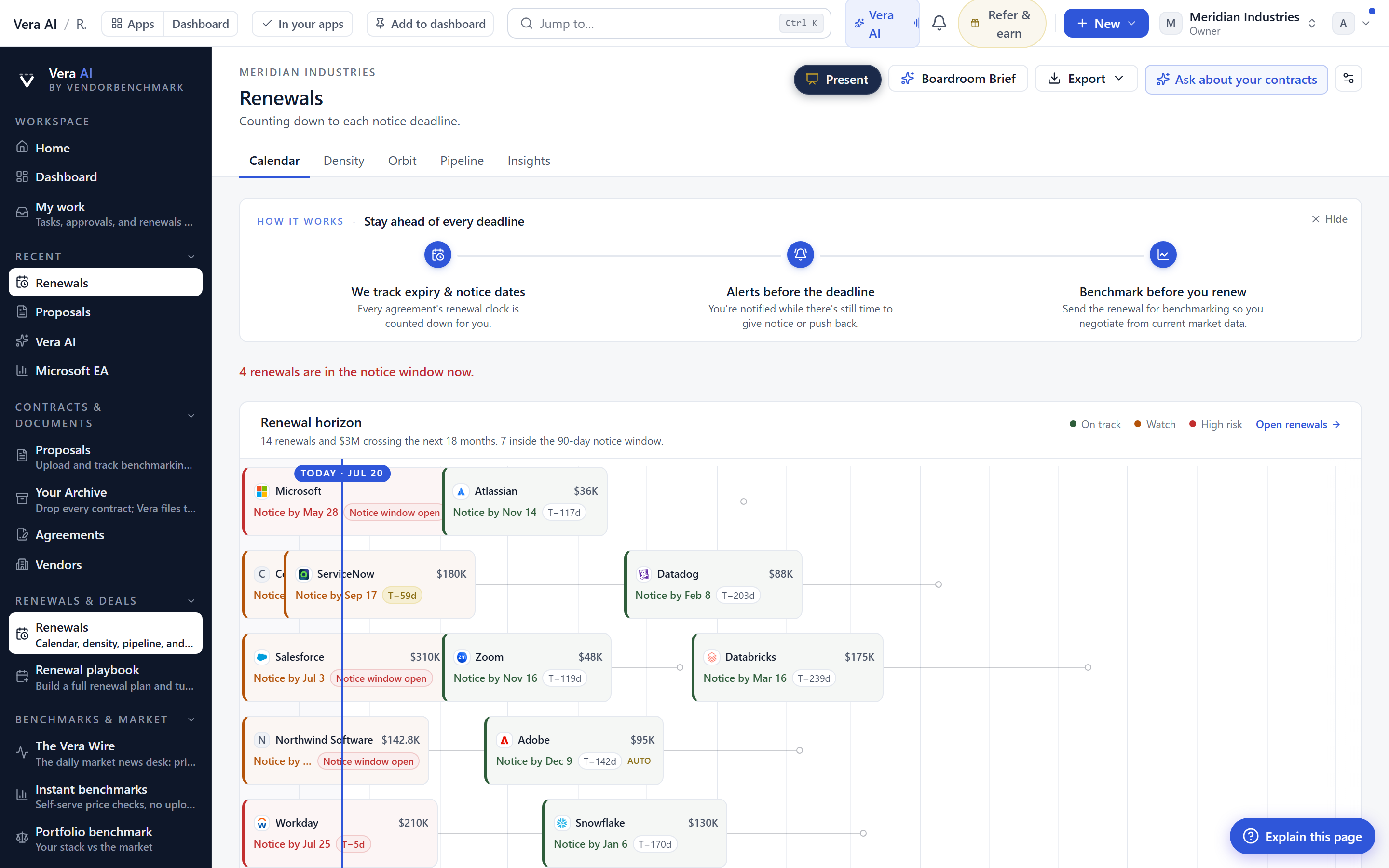
Then timing does the second half of the job. A decision record is worthless if it surfaces after the renewal is signed. The renewal calendar surfaces the preserved intake decisions before the window opens, so the review happens while you still have leverage. This is the difference between a record and a live record. We laid out the timing mechanics in 300 vendors, 52 weeks, one team, and the shape of it is simple: the deal reappears far enough ahead that you can act on what it tells you.
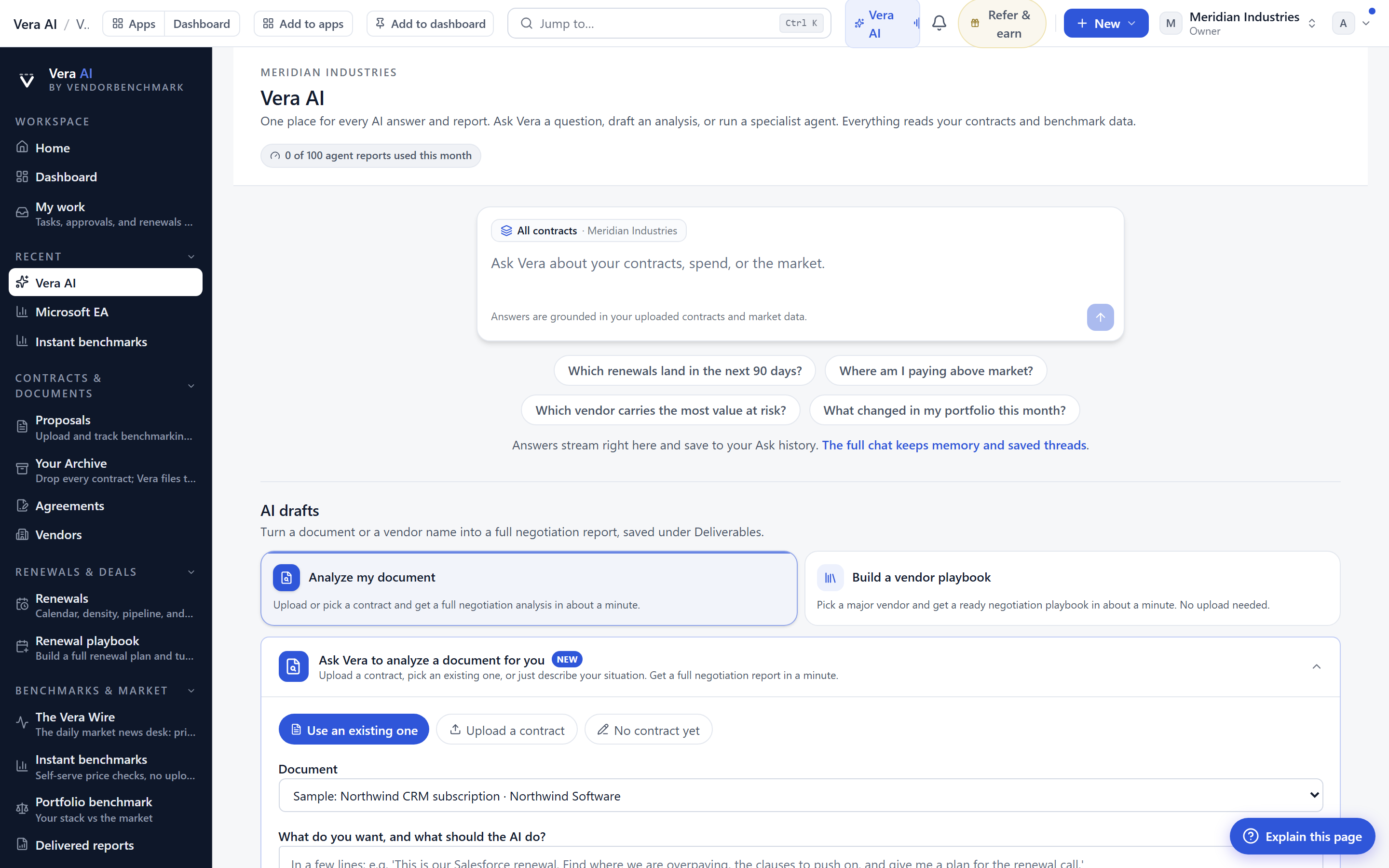
With the record in place, the renewal starts from a different question. Not what did we buy, which the invoice already answers, but why did we buy it and does that reason still hold. The analyst can tell you the premium tier was added at intake because a specific team needed a named feature, and whether that team still uses it. It can tell you the 400 seats assumed a hiring plan that did or did not happen. Six specialist agents and the benchmarking library do the checking against 1,471 vendors, so the drop-or-keep decision is grounded, not a guess.
What a documented renewal actually gives you
What this does not solve
Be clear about the limits. The analyst can preserve every intake decision perfectly and it still cannot fix a decision that was bad when it was made. If someone scoped 400 seats on a hiring plan that was fantasy, the record will faithfully carry forward a fantasy. What it gives you is the ability to see that the assumption was an assumption, and to test it against reality at renewal. That is a large improvement over inheriting the number blind, but it is not the same as good judgement at intake.
It also cannot document what was never decided. If a requirement entered the original deal through a rushed, unexamined channel, the record captures that it entered that way, but there is no hidden reasoning to recover because there never was any. That is a governance question about how intake flags urgency, and we covered its failure mode in the intake flag that hands the deal to the vendor calendar. The platform makes the absence of reasoning visible, which is honest, but visibility is not the same as retroactive justification.
And it does not remove the conversation. The renewal still needs a human to look at the ranked drop-or-keep list and make the call, and to have the trade-off discussion with the stakeholders who asked for each piece. The platform changes what you walk into that conversation holding. Instead of guesswork and an old invoice, you hold the documented need. That is the whole point. Each renewal starts from why, not from what you happened to buy last time.
Fredrik has spent more than twenty years in enterprise software, with time at Oracle, IBM, SAP, and Salesforce before moving to the buy side. He structured and priced the kind of large agreements most buyers only see once or twice in a career, which taught him where the leverage sits and how far a vendor will actually move. He started VendorBenchmark to hand that knowledge to every sourcing team.


