The requirements were copied from last year, and last year is not this year
Copying a prior spec carries forward needs that no longer apply and misses ones that now do. The fix is benchmarking against current closed deals and a fresh intake, not against your own memory.
You opened last year's requirements document because starting from a blank page felt wasteful. You renamed the file, changed the date, swapped the project code, and told yourself you would review every line before it went out. Then the sponsor asked when the RFP was landing, and the review became a skim, and the skim became a send. Now a spec written for the problem you had eighteen months ago is out in the market, and vendors are answering it precisely.
The lines that survived are the dangerous ones. A capacity requirement sized for a headcount you have since cut. A data residency clause you added for a customer who churned. An integration you no longer run. And the quiet absence of the things that actually matter now, the compliance posture your security team hardened this spring, the usage pattern that shifted when the product team changed direction. The document is efficient to produce and expensive to answer.
Why recycling feels efficient and is not
Reuse is a rational instinct. Writing requirements from scratch is genuinely slow, and last year's document represents real work that mostly held up. The problem is not that you reused the structure. The problem is that requirements are not just a template, they are a snapshot of a moment: a specific need, a specific budget, a specific market price. Reuse the structure and you save time. Reuse the snapshot and you benchmark this year's deal against last year's problem.
This persists because the cost is invisible at the moment you pay it. The stale line does not raise its hand. It sits in the document looking exactly as authoritative as the fresh lines around it, and it gets quoted, negotiated, and signed with the same seriousness. You only discover it later, when the capacity you specified goes unused or the requirement you forgot resurfaces in a review. By then the timeline is committed and the leverage is gone.
The two ways a recycled spec goes wrong
Stale requirements fail in two directions and both are costly. The first is the requirement that is still in the document but no longer true. It inflates the ask, so vendors quote to a scope you do not need and you pay for headroom you will never touch. The second is the requirement that should be there and is not, because the world changed after the last spec was written. That gap tends to surface downstream, often in security or legal review, where a missed compliance need resets the whole timeline.
Both directions share a root cause: the document is being measured against your memory rather than against the market. Memory is exactly the wrong benchmark, because it is anchored to the last time you did this. What you need instead is a comparison to what buyers like you are requiring and paying right now. That is a difference in kind, not degree. It is the same reason survey benchmarks flatter everyone while researched closed-deal evidence does not.
The platform motion that removes it
The fix has two moves that work together. The first is a refreshed intake interview. Rather than accepting the carried-forward document as given, the intake questions each requirement against present state: is this capacity still sized correctly, is this integration still live, does this clause still map to a real obligation. It treats last year's spec as a draft to be interrogated, not a baseline to be trusted.
The second move is the benchmark. The platform compares your draft against current closed deals in the same category, drawing on a live pool of comparable transactions. Where a requirement in your spec no longer appears in comparable deals, it flags a candidate for removal. Where a requirement is now standard among peers and missing from yours, it flags a candidate for addition. You are no longer guessing which lines aged badly. You are seeing them against the present market, and freshness is the point, because freshness beats volume when the market has moved since March.
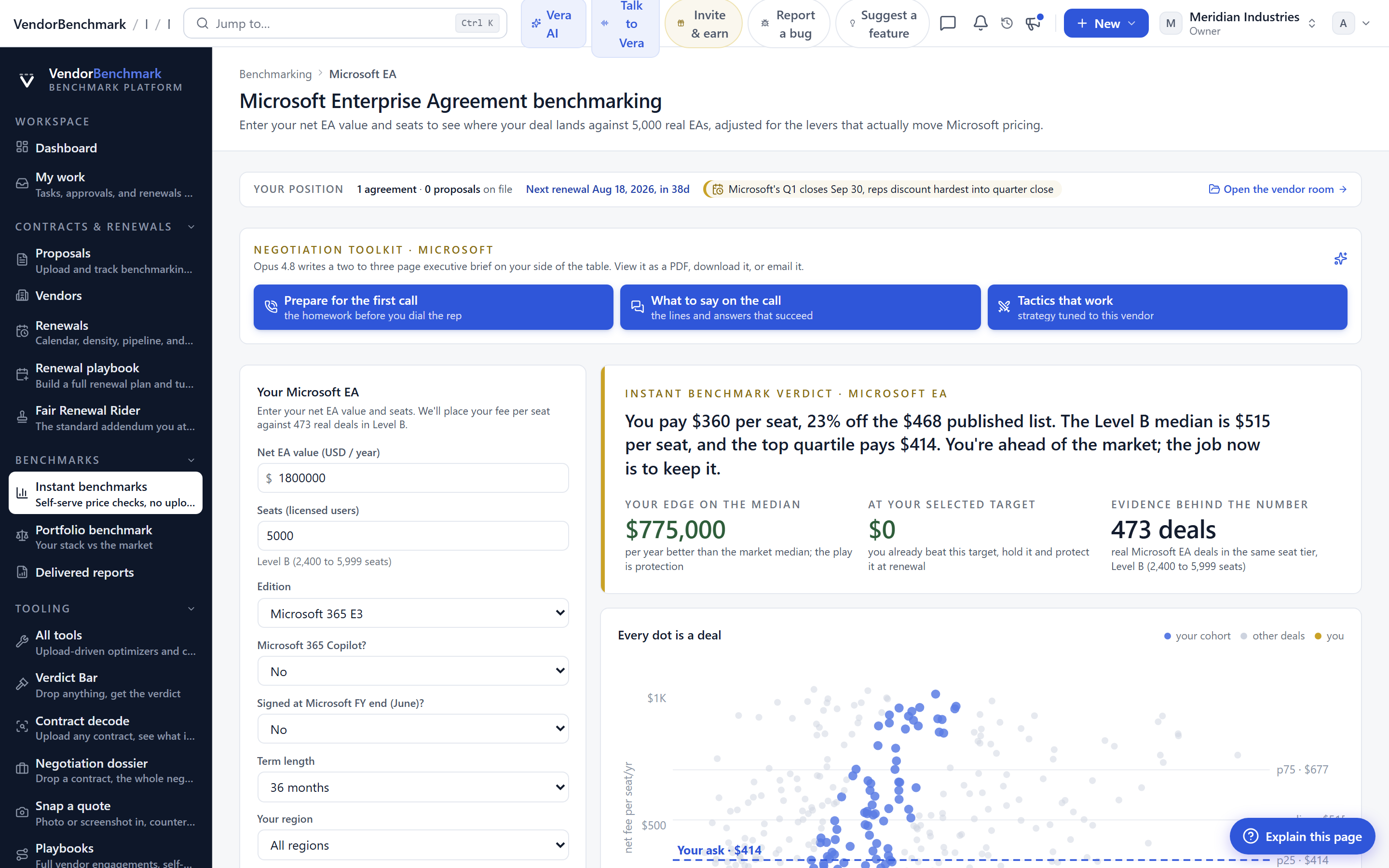
Under the surface, this runs across the same machinery that powers the rest of the desk: six specialist agents and a set of background jobs that keep the comparison pool current rather than frozen at the moment you last looked. The output is not a verdict. It is a marked-up spec where every carried-forward line has been tested against present need and present price, and where you make the final call on each flag.
What changes when the spec reflects now
What this does not solve
Be honest about the boundary. The platform flags requirements that drifted from the market, but it does not know your strategy. If your organisation is deliberately ahead of the market, requiring something peers have not yet adopted because you know where your product is heading, the benchmark will flag that line as unusual and it will be right to flag it and wrong to remove it. That judgment is yours. The flag is a prompt, not an instruction.
It also cannot fix a requirement that is genuinely novel and has no comparable deals behind it yet. If you are buying something the market has barely priced, there is little to benchmark against, and you are back to first principles. And a refreshed spec at intake does not stop the need from moving mid-project. When it does, that is a different problem, the one where the RFP froze but the need kept moving, and it needs its own discipline. What the platform removes is the specific, common, avoidable waste of shipping last year's snapshot as this year's spec. That alone is worth the thirty-five minutes.
Want to be updated when major licensing and pricing changes land? One analyst brief a week: the price rises, metric changes and audit campaigns that move software costs. Work email only.
Morten brings two decades of enterprise and software procurement, with stints across Oracle, IBM, SAP, and Salesforce shaping how he reads a deal. He has led sourcing through hundreds of renewals, from mid market order forms to nine figure global agreements, and learned that the buyers who win are the ones who walk in knowing the market. He built VendorBenchmark to make that pattern recognition repeatable.