One desk, eight spend categories, switched from the header
The platform was built around IT and software, and everything else you buy borrowed an IT desk. Now eight standard indirect categories each get their own view, switched from the header.
If you run indirect spend for anything other than software, you already know the tax you have been paying. The tools were built for IT and software, and every other category you owned was borrowing that desk. A freight buyer walked the same alphabetised vendor list as a licence renewal. A facilities manager uploaded a cleaning contract and watched it file under Other. The workspace was correct for one category and merely tolerant of the rest. This update fixes the ownership problem at the level where you actually work, which is the category, not the vendor.
The problem you recognise: one desk pretending to serve eight jobs
Indirect procurement is not one discipline. A travel programme is negotiated on booking fees and adoption. A professional services engagement is negotiated once on rate and then leaks away through scope. An MRO contract lives on consumption tiers. When all eight of these share a single IT-shaped workspace, the buyer does the translation in their head, every time. You open the benchmark window and scroll past 400 software vendors to reach the three that matter for travel. You open the upload picker and it offers you licence and subscription shapes when what you are filing is a freight agreement. None of this is fatal. All of it is friction, and friction across a 300-vendor book compounds into lost hours and misfiled contracts.
So we added a category chip to the header, beside your organization. It holds the eight standard indirect categories: Information Technology and Software, Facilities and Office Services, Professional Services, Marketing and Advertising, Human Resources and Workforce, Travel and Entertainment, MRO and Consumables, and Logistics and Fleet. Pick one and the workspace arranges itself around it. Nothing you filed moves, and every benchmark stays reachable from every category. It is a lens, never a gate.
The benchmark shelf leads with the vendors your category actually buys from
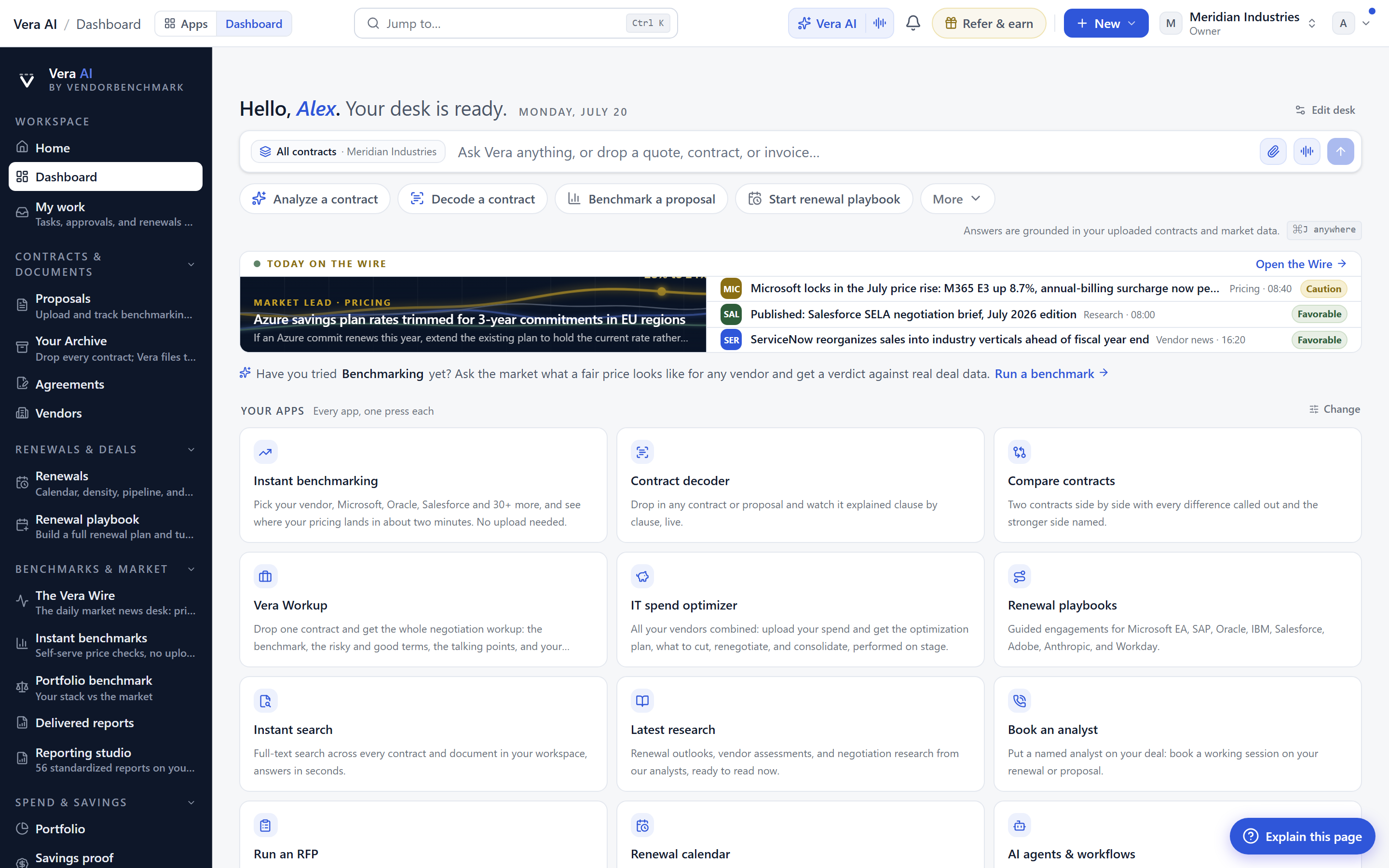
The most visible change is in the benchmark window. Switch the chip to Travel and Entertainment and the shelf opens on Navan, Amex GBT and Expensify, rather than making you walk the alphabet to reach them. Switch to Logistics and Fleet and it leads with your carriers. This is not a filter you have to construct. It is the default ordering of the shelf, reset to the category you have selected. The full benchmark library stays open behind it, so if a travel desk needs to check a software curve, nothing is hidden. The shelf is simply ordered for the job in front of you first.
For categories that reprice quickly this matters more than it sounds. We wrote recently about how the curve library now prices the AI coding tools, a category that moves under you between one renewal and the next. Leading the shelf with the right vendors means you see the movement without hunting for it. It is the same principle that turned instant benchmarks into the benchmark library: put the relevant evidence where the buyer's hand already is.
The upload picker knows your contract shapes and your real suppliers
The second change is in filing. The upload picker now offers the category's contract shapes and its real suppliers. A freight agreement with Kuehne+Nagel files under its own name. A cleaning contract with ISS files as a facilities agreement, not as Other. This sounds small until you consider what Other costs you later. A contract misfiled at upload is a contract you cannot find at renewal, cannot benchmark against its peers, and cannot pull into a review table. Getting the shape and the supplier right at the moment of filing is the cheapest correction in the whole workflow, because every downstream tool inherits it.
This pairs naturally with the desktop filing work described in give the Desk a folder and it files what lands there. When the category is set, the folder and the picker agree on what a document is, and the archive stays legible. A logistics buyer never has to argue with a software-shaped taxonomy again.
The tools that lead the desk change with the category
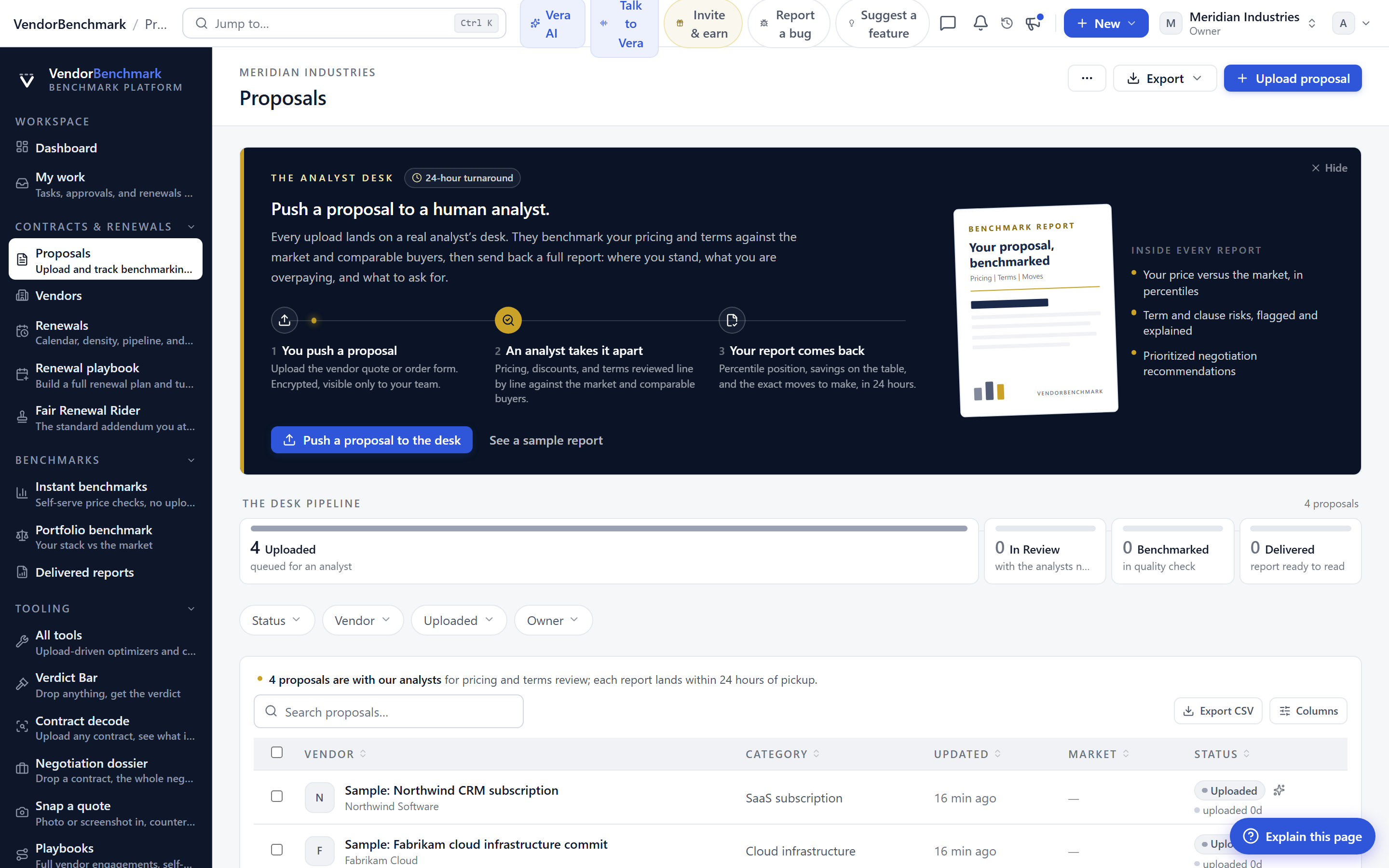
The third change is subtler and, for some categories, the most useful. The tools that lead the workspace change with the category. Professional Services opens on the SOW and MSA decoders, because that is where the money leaks. A consulting rate is negotiated once and then quietly drifts through scope changes, rate cards, and undefined deliverables. Leading the desk with the decoders puts the risk in front of the buyer before signature, not after the third change order. If you have read rights you already paid for, the logic is familiar: the leverage is in the terms you have already agreed to, and the tool's job is to surface them at the right moment.
For each category, the leading tool answers the question that category asks first. Travel leads with adoption and fee benchmarks. MRO leads with consumption tiers. The desk stops being a general-purpose surface you configure and starts being a category-specific one that opens correctly. The six specialist agents and the analytical work behind them do not change; what changes is which lens they present through by default.
Honest limits: what the lens does not do
Be clear about the boundaries. This is an organising lens, not a source of new data. The category chip reorders and pre-selects; it does not create benchmarks that do not exist. If your category has thin coverage in a niche supplier, the shelf still leads with the vendors it has, and you will see fewer of them. The lens makes the existing evidence faster to reach; it does not manufacture evidence.
Second, the eight categories are the standard indirect set, not a custom taxonomy. If your organization splits Facilities from Real Estate, or runs Fleet as its own book separate from Logistics, you will map your internal structure onto these eight. That mapping is your call, and for most indirect books it is a clean fit. For unusual structures it is an approximation, and you should treat it as one.
Third, because it is a lens and never a gate, it will not stop a buyer from working across categories, and it should not. A misfiled contract from before this update stays where you filed it until you move it. The lens improves what happens next, not what already happened. If you want the AI to reason across the whole archive rather than one category, that still works exactly as it did, and the constraints we hold to are unchanged, described in what we will not let the AI do on your deals.
The honest summary is that this update removes a tax rather than adding a capability. The evidence, the agents, the decoders, and the library were all already there. What was missing was a desk that opened correctly for the category you actually run. Now it does, and the switch takes one click in the header.
Fredrik has spent more than twenty years in enterprise software, with time at Oracle, IBM, SAP, and Salesforce before moving to the buy side. He structured and priced the kind of large agreements most buyers only see once or twice in a career, which taught him where the leverage sits and how far a vendor will actually move. He started VendorBenchmark to hand that knowledge to every sourcing team.