Savings proof: the number the board hears is the number billing confirms.
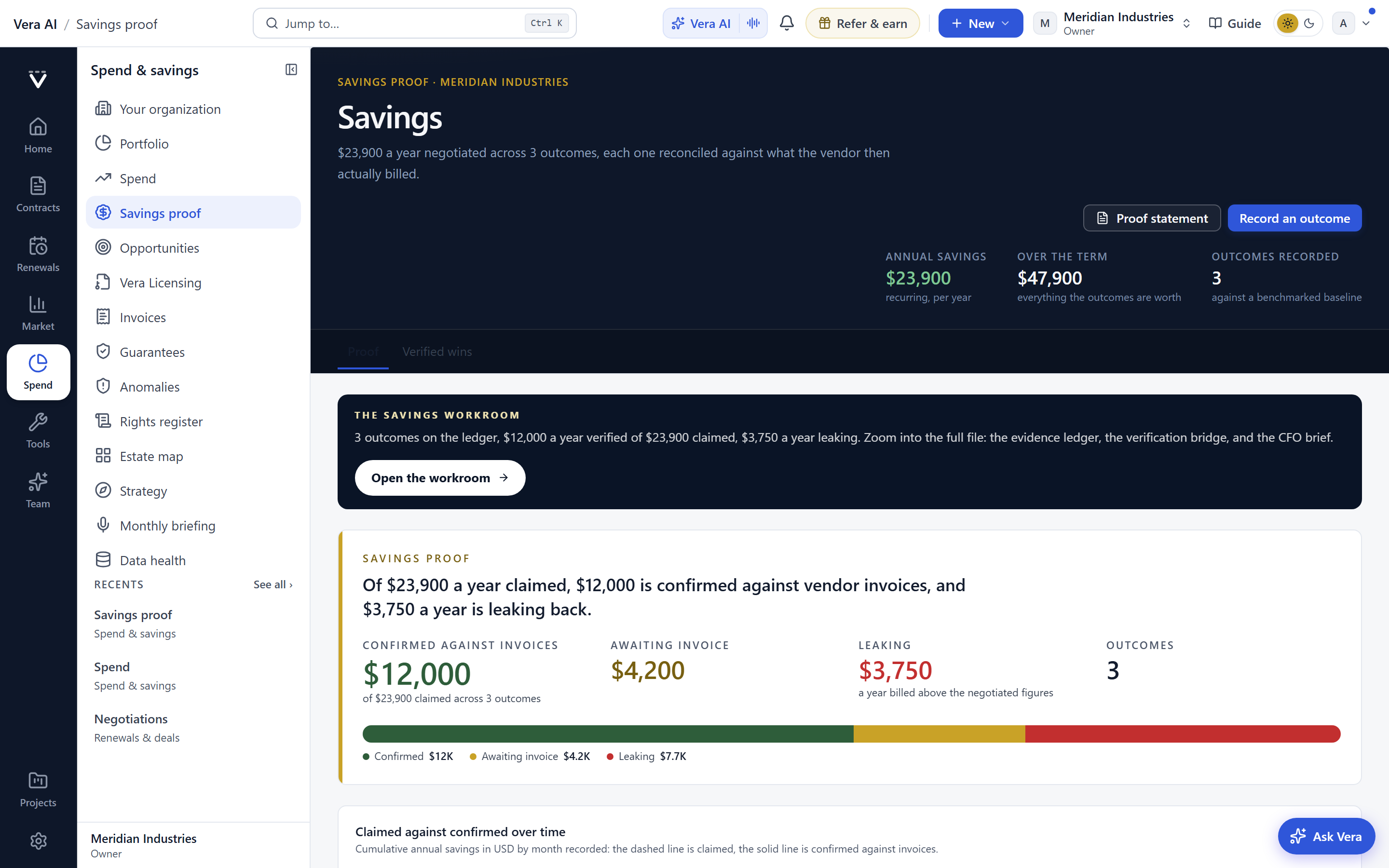
Every procurement team reports savings, and every finance team quietly discounts the report, because claimed savings and paid invoices are reconciled almost nowhere. Savings Proof closes that loop: each negotiated outcome is recorded at signature and checked against the invoices that arrive afterward, so the savings program runs on evidence instead of applause.
Here is the uncomfortable lifecycle of a typical procurement saving. A renewal closes 14 percent below the vendor's opening quote and the win is announced. A slide is made. The slide compounds into a year-end number, the number goes to the board, and everyone moves on. Meanwhile, out in the billing system, the discount gets applied to a smaller base than the one the percentage was calculated on, two quarters later an "operational adjustment" claws back a third of it, seat growth quietly reprices the deal, and nobody ever looks, because the person who negotiated the saving has six other renewals and the person who pays the invoices was never told what to check.
Finance teams know this lifecycle intimately, which is why procurement savings numbers get the polite nod reserved for marketing metrics. The problem is not dishonesty. It is that claiming happens at signature and reality happens on invoices, months apart, in different systems, owned by different people. Any savings program that does not bridge those two moments is reporting intentions.
The loop: claim at signature, verify on the invoice
The claim is recorded when the deal closes, with its baseline attached. When a negotiation settles in the war room, the outcome lands in the savings ledger with everything a skeptic would ask for: the baseline it is measured against, the vendor's opening quote, the prior contract rate, or the benchmark median, the negotiated result, the term, and the evidence trail from the deal itself. Baselines are the honesty test of any savings program, and recording them at signature, while the documents are fresh, is what makes the later verification mean anything.
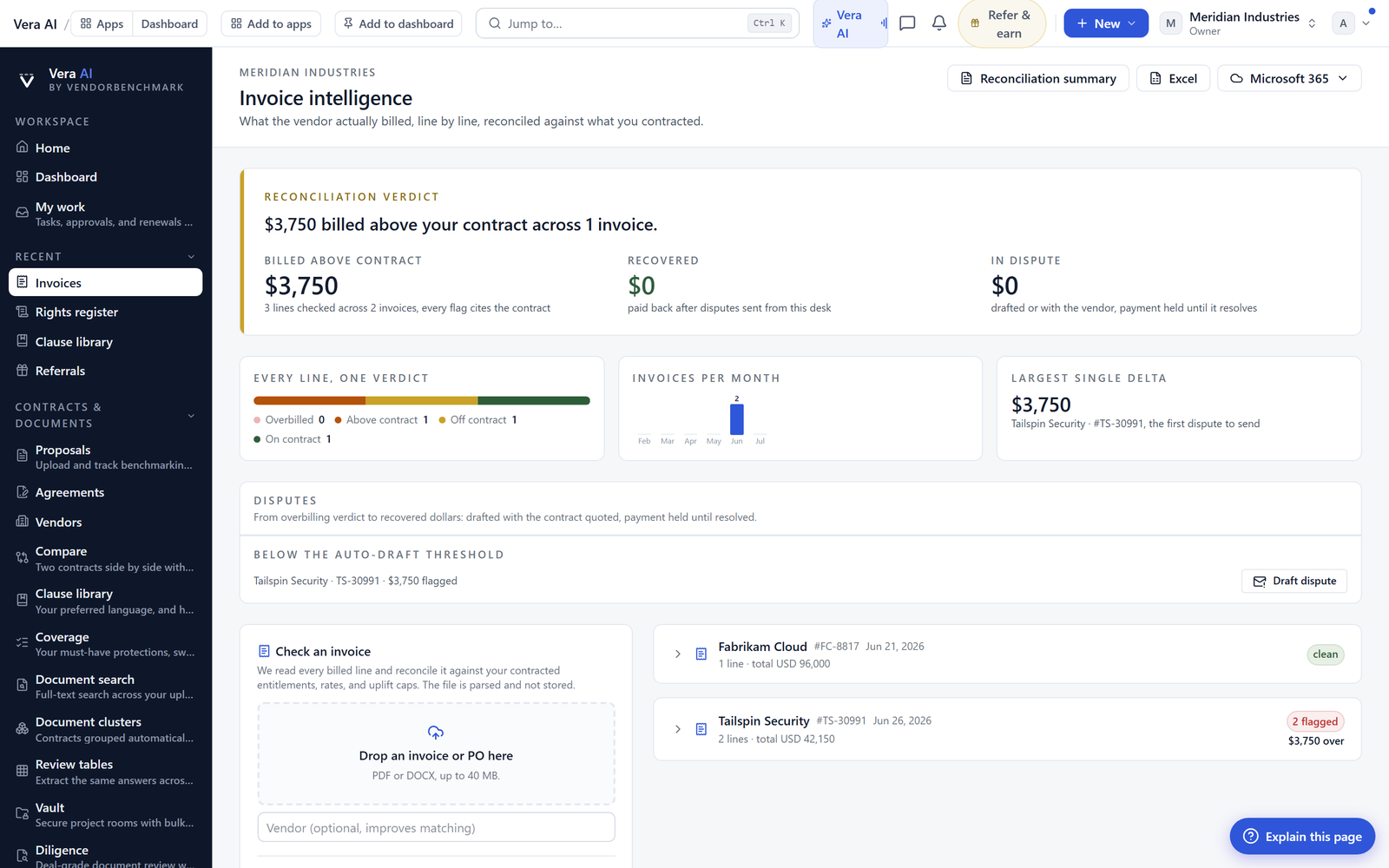
The invoices verify it, automatically. As bills arrive, the same line-by-line reconciliation that catches billing errors checks each claimed saving against what the vendor actually charged. A saving that survives contact with billing moves to verified. A saving that erodes, the lapsed discount, the repriced growth, the clawed-back credit, gets flagged with the delta and the invoice that broke it, while there is still a contract clause to enforce and a vendor conversation worth having.
The ledger keeps score across time and turnover. Verified, pending, and eroded savings accumulate per vendor, per negotiator, per year. When the person who closed the deal leaves, the record of what was won, against what baseline, on what evidence, stays. Institutional memory for savings has historically been a person. Now it is a table.
Want to be updated when major licensing and pricing changes land? One analyst brief a week: the price rises, metric changes and audit campaigns that move software costs. Work email only.
What a verified number buys you
Credibility that compounds. The first time procurement presents a savings number labeled "verified against invoices," the conversation with finance changes permanently. The CFO's portfolio page shows the verified run rate next to the market position, and a team whose last-year number held up gets believed about next year's target, which is worth more than any single deal.
Erosion becomes recoverable instead of invisible. Most eroded savings are contract enforcement problems, not negotiation failures: the discount that lapsed had a term, the growth that repriced had a rate protection, the credit that vanished is in the commitment log. Caught within a quarter, each is an email citing a clause. Caught never, each is a permanent donation.
The incentive structure gets honest. When only verified savings count, the game stops being inflated baselines and starts being durable outcomes: caps that hold, discounts that survive growth, terms that protect the next cycle. It is the same logic that prices Managed Renewals, where our fees apply only to savings your invoices later confirm. We built the proof loop because we bill on it, and it turns out a savings number solid enough to invoice against is exactly the number a board wants.
Running a credible savings program, in four rules
The honest limit: proof cannot settle every definitional argument. Whether cost avoidance counts, how to treat a saving against a price increase, and what happens when volumes change are policy choices finance and procurement still have to make together, once, and write down. What the ledger removes is the part that was never a policy question: whether the money actually stayed saved. That answer now arrives with an invoice number attached, and it is remarkable how much shorter the year-end savings meeting gets when it does.
Morten brings two decades of enterprise and software procurement, with stints across Oracle, IBM, SAP, and Salesforce shaping how he reads a deal. He has led sourcing through hundreds of renewals, from mid market order forms to nine figure global agreements, and learned that the buyers who win are the ones who walk in knowing the market. He built VendorBenchmark to make that pattern recognition repeatable.
The week in enterprise software buying, in one email.
What shipped on the platform, and the pricing and licensing moves worth knowing before your next renewal. One email a week, to your work address. Unsubscribe any time.