The stakeholder wishlist that walked into the RFP as a mandatory requirement
Every unchallenged wishlist item you mark mandatory is money you pay for shelfware. The fix is a weighting step at intake, not a cull at evaluation.
Look at the requirements matrix you sent to market last month. Somewhere in the mandatory column is a line that reads something like multi-language admin console, or native mobile approval workflow, or in-app video conferencing. Ask the person who owns the business case whether anyone will use it in the first year, and the honest answer is often no. It arrived as a wish from a stakeholder who attended one intake call, nobody had grounds to argue with it in the room, and so it travelled the whole distance from casual preference to hard requirement without a single challenge. Now three vendors are pricing it, and you are about to pay for all three answers.
How a preference becomes a mandate
The mechanism is almost never malicious. A stakeholder describes their ideal tool. Intake captures it faithfully, because capturing faithfully is what intake is trained to do. The requirement then loses its provenance. By the time it reaches the spec, nobody can tell which lines came from the business case and which came from a hallway conversation, so the safest move for whoever is drafting is to mark everything mandatory. That is how the nice-to-have and must-have collapse into one flat list, and once they are flat, the list can only grow. Removing a line means telling a named colleague their idea did not make the cut, and there is no budget line that rewards you for that conversation.
There is a second reason the problem persists: nobody at intake can see the price of a requirement. A capability sounds free when it is a sentence. It stops being free when a vendor scopes an implementation module against it, staffs the integration, and adds it to the license tier that unlocks it. The person marking the line mandatory and the person reading the six figure quote are usually different people, weeks apart, looking at different documents. The cost signal never reaches the moment of decision.
Why an unused mandatory line is pure shelfware
A mandatory requirement does three things to a deal, and none of them are neutral. It narrows the field, because vendors who cannot meet it are excluded even when they are stronger everywhere that matters. It inflates the quote, because the vendors who remain must price the capability whether or not you use it. And it locks the tier, because the feature that unlocks your wish is frequently the feature that only exists in the enterprise plan. You do not just pay for the capability. You pay for everything bundled beside it.
This is where the wishlist quietly changes the shape of your shortlist. When everything is mandatory, nothing is negotiable, and vendors know it. A requirement you would happily trade away in a negotiation is instead a fixed constraint they price against and never discount. The same dynamic explains why the quote is scoped to a specification procurement never validated. The vendor answered your spec perfectly. The spec was the problem.
Weighting at intake, and pricing the premium
The fix is not a cull at evaluation, when the quotes are already scoped and the field is already narrowed. The fix is a weighting step at intake, before a single vendor sees the list. Vera takes each requirement and holds it against the stated business outcomes for the purchase. A line that supports a named outcome keeps its weight. A line that supports nothing, or that duplicates a preference already covered, gets challenged in plain language, and the challenge is put to the requirement owner rather than buried. This is the same discipline you would apply to conflicting requirements from stakeholders who never met, applied one step earlier.
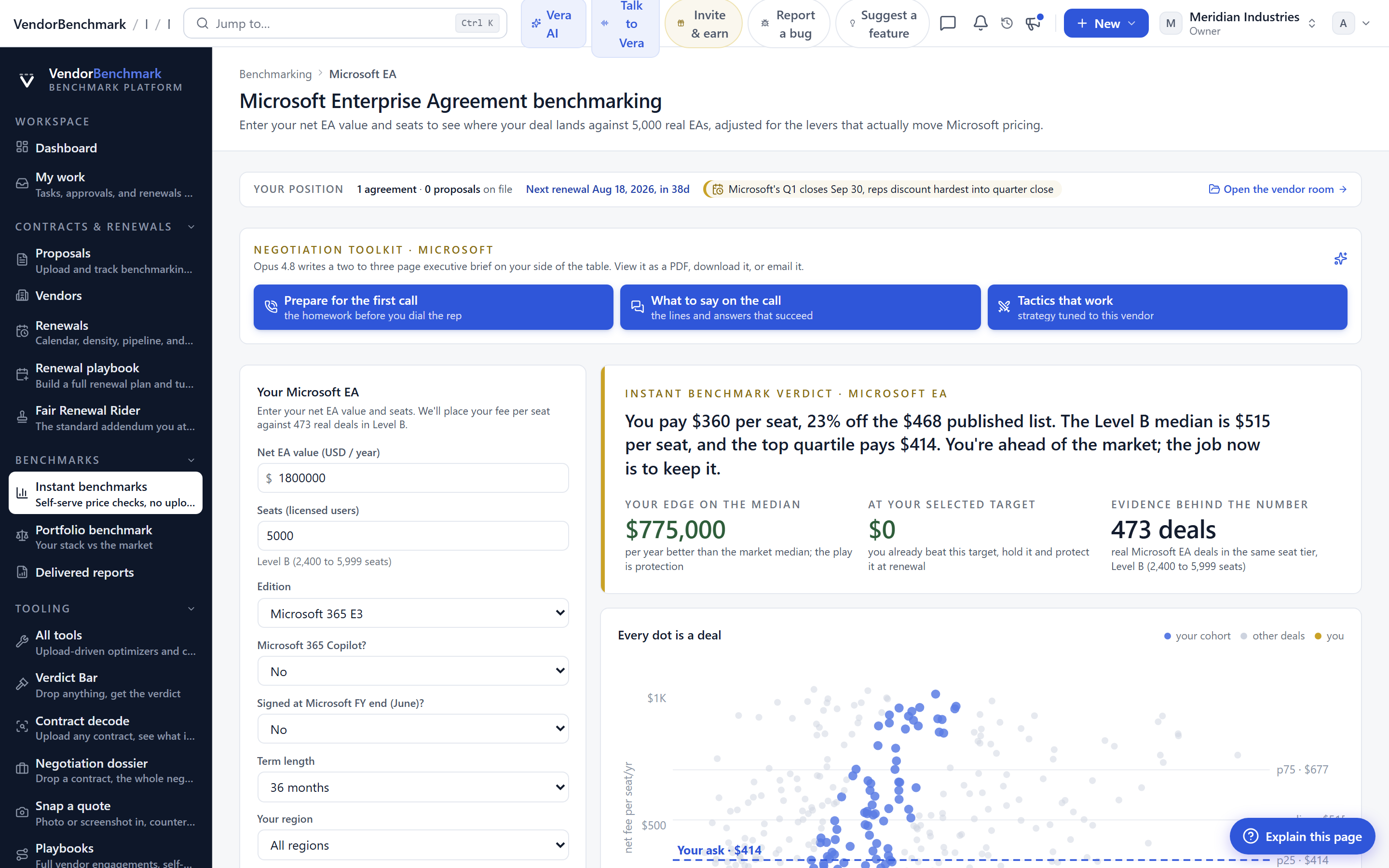
The second half is the number that intake has always been missing. Benchmarking shows the price premium a low-value mandatory requirement adds to a comparable deal. Drawing on benchmarks across 1,471 vendors, Vera can tell you that insisting on a given capability moves the median closed price by an observable amount. When the premium is trivial, keep the line and stop debating. When the premium is material and the outcome is thin, you now have the one thing that intake never had before: a cost signal at the moment of decision.
None of this requires you to strip ambition from the requirements. It requires you to know which lines you are paying for and why. A well-run intake that carries the price of each requirement is also the intake least likely to be blindsided later, the way a spec that skipped security and legal requirements never in the intake resets the whole timeline downstream.
What changes in the requirements you send
What this does not solve
Be honest about the edges. Vera can show that a requirement carries a price premium and no supporting outcome, but it cannot overrule a stakeholder who has the authority to insist on the line anyway. Some mandatory requirements are political, and no benchmark closes that argument. What the platform changes is that the argument now happens with a number attached, in daylight, before the RFP leaves the building, rather than as a quiet surprise in a quote three weeks later.
It also cannot reconstruct outcomes you never wrote down. The weighting is only as good as the business case behind it. If the intake is a list of features with no statement of what the purchase is meant to achieve, Vera can flag the gap but not fill it for you. That work is yours, and it is worth doing before the call. If you want to pressure test a requirements list first, talk it through with Vera before the call, and treat the intake as the last cheap place to change your mind.
Want to be updated when major licensing and pricing changes land? One analyst brief a week: the price rises, metric changes and audit campaigns that move software costs. Work email only.
Morten brings two decades of enterprise and software procurement, with stints across Oracle, IBM, SAP, and Salesforce shaping how he reads a deal. He has led sourcing through hundreds of renewals, from mid market order forms to nine figure global agreements, and learned that the buyers who win are the ones who walk in knowing the market. He built VendorBenchmark to make that pattern recognition repeatable.