The Architect Pulled In Late Who Reopens Everything You Already Settled
When the security lead arrives in week six, they do not inherit your reasoning. They reopen it. The fix is a record they can read, not a meeting they can attend.
You had it settled. Six weeks in, the evaluation criteria were agreed, the shortlist was down to two, and the group had stopped relitigating the integration question. Then the security lead got assigned, or the enterprise architect was finally freed from another program, and they joined the standup with a reasonable request. Walk me through why we ruled out the other option. And because nobody could hand them the reasoning, they got the reasoning the only way available: by reopening the meeting. What took the group three weeks to converge on got put back on the table in forty minutes.
This is not the late joiner being difficult. It is the late joiner being responsible. They are accountable for a decision they were not present to shape, and the only artifact they were given was a shortlist with no attached logic. If you had a written record of what was weighed and discarded, they would read it. You did not, so they rebuilt it out loud, and the whole group paid the tax again.
The decision record lives in people's heads
Most sourcing decisions are never written down as decisions. They are written down as outcomes. The shortlist exists. The scoring sheet exists. The vendor responses exist. What does not exist is the connective tissue: we dropped the third vendor because their data residency answer failed the German subsidiary requirement, and we accepted a higher unit price on the winner because the migration cost on the cheaper option erased the saving over two years.
That reasoning lived in four people's memories, distributed unevenly. The procurement lead remembered the commercial logic. One business sponsor remembered the residency objection. Nobody held the whole chain. So when a newcomer asks a single question, no one person can answer it completely, and the group reconstructs the answer by talking, which means re-deciding, which means the settled thing is unsettled until the room agrees again.
This is the same failure mode we described in the renewal that re-bought a spec nobody could explain. When the why is not durable, the what becomes fragile. Anyone with standing can knock it over, and late joiners always have standing.
Why the problem persists even on organised teams
You might think a disciplined team writes decisions down. Some do. But the record decays for structural reasons that have nothing to do with discipline. First, decisions get made in the medium of conversation, in calls and threads, and the summary that lands in the shared drive strips the reasoning to save space. Second, the reasoning that matters most is the reasoning about roads not taken, and people rarely document why they rejected something. They document what they chose.
Third, and this is the one that bites late joiners hardest, the people who joined late are precisely the ones whose concerns were never in the intake. A security lead arrives with objections the original group never scored, which is the exact overlap with the spec that skipped compliance. The newcomer is not reopening a settled question. From their seat, the question was never asked. Both things feel identical in the meeting, and both cost you the timeline.
The platform motion: a dossier that stays current
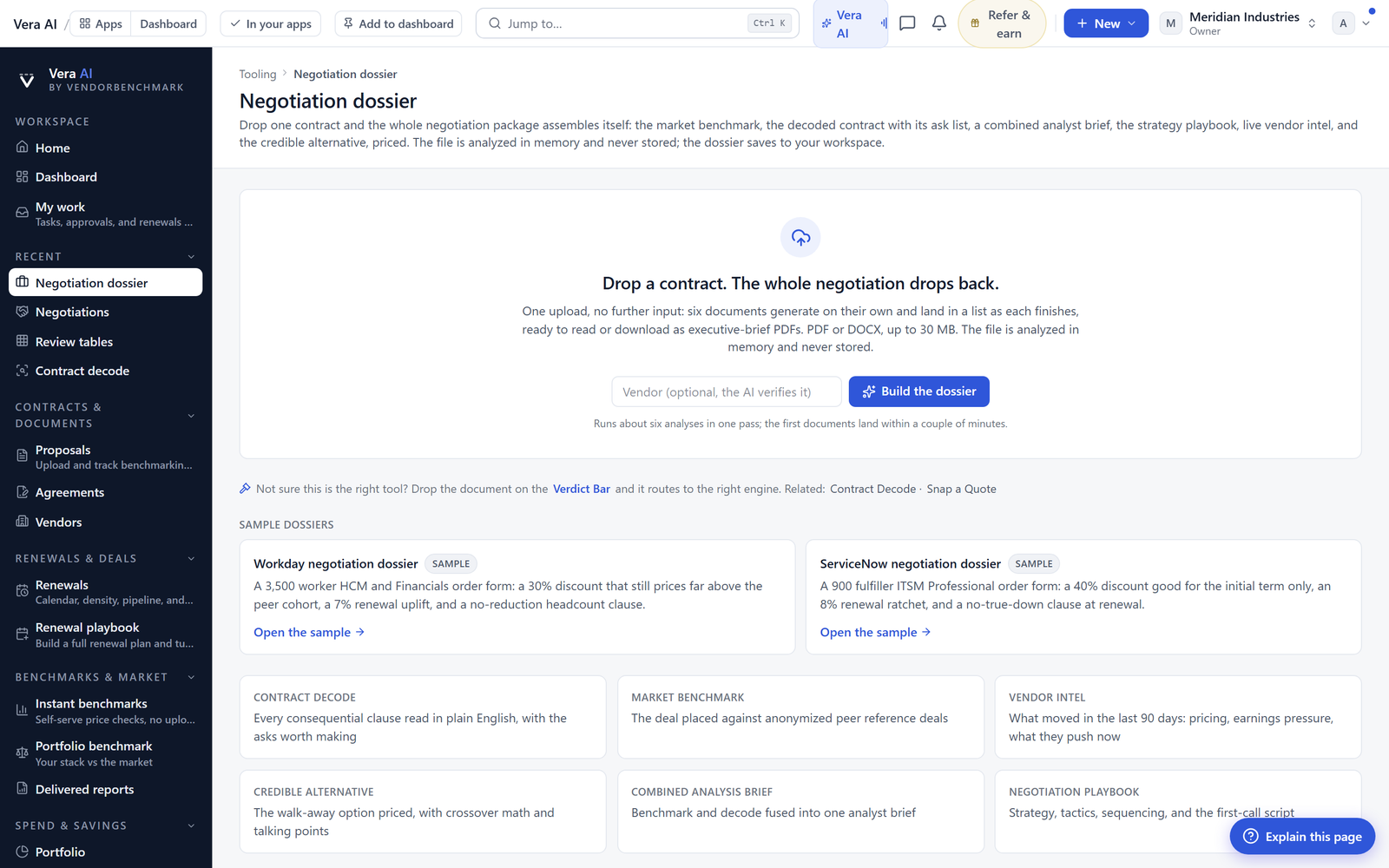
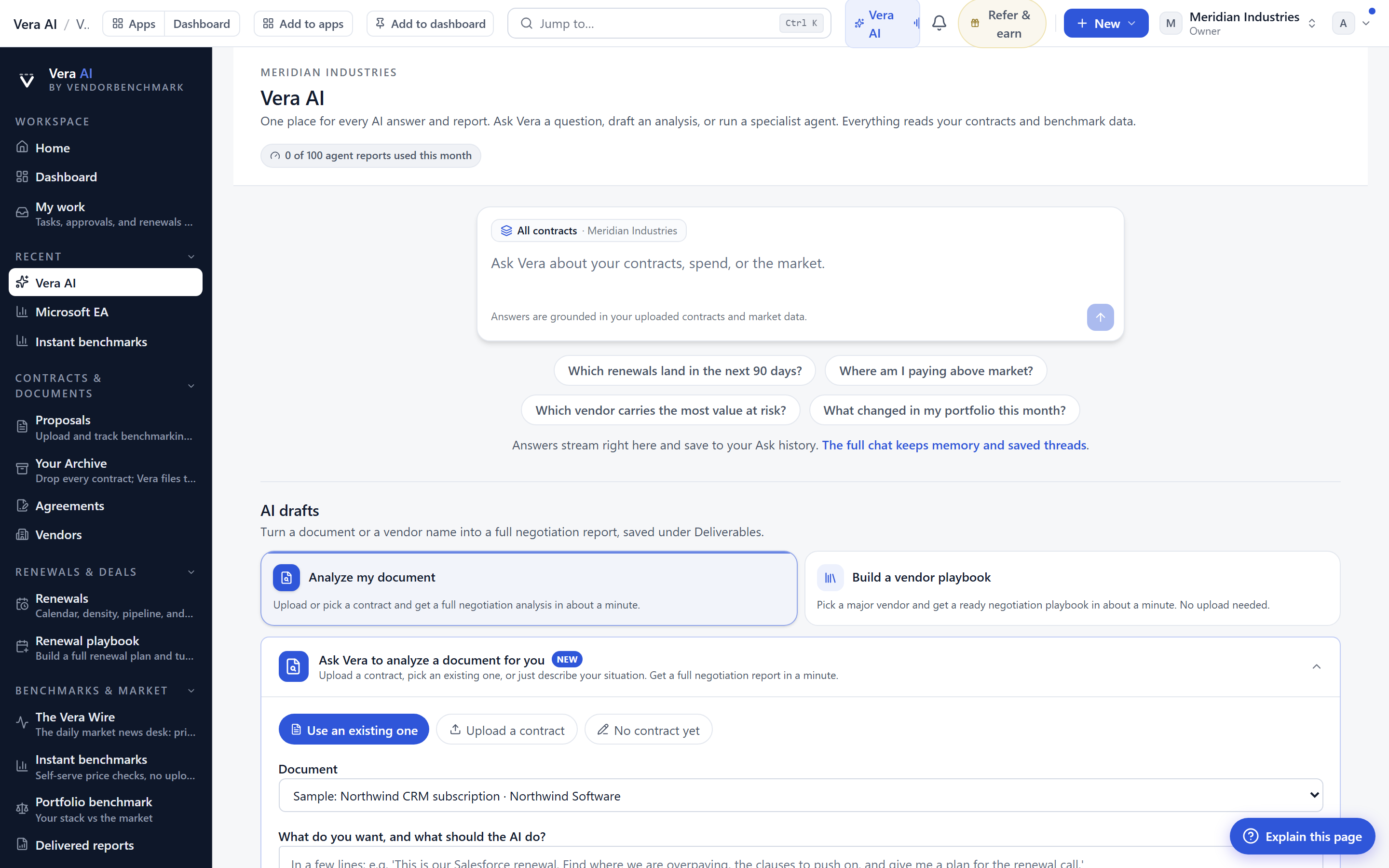
The AI analyst maintains a running dossier from the moment intake begins. Every decision that gets made, the criteria that were set, the vendors that were cut and the reason each was cut, the commercial logic on the survivor, all of it accumulates in one record that updates as the sourcing progresses. It is not a summary someone remembered to write. It is the running state of the decision, kept current in the background by the same six specialist agents and thirty background jobs that keep your benchmarks fresh.
When the architect joins in week six, you do not schedule a catch-up call. You send them the dossier. They read what was decided and why in an afternoon. If they have a specific question, they ask Vera directly and get a cited answer rather than a group discussion. You can talk it through with Vera before the call, which means the newcomer arrives at the next standup already caught up, ready to add their concern to a live process instead of stopping it to understand it.
The distinction that matters: reading a record is a solo, asynchronous act that costs the late joiner an afternoon and costs the group nothing. Reopening a meeting is a synchronous act that costs everyone their time and, worse, invites the whole group to reconsider. A durable record contains the newcomer's catch-up to one person's afternoon. Everything else stays settled.
What a good catch-up leaves intact
What the dossier does not solve
Be honest about the edges. A dossier makes reasoning readable. It does not make a genuinely new objection wrong. If the security lead surfaces a data residency failure the group never considered, that concern is legitimate and the process should absorb it, even at the cost of the timeline. The dossier does not exist to silence late input. It exists to ensure that only genuinely new input reopens anything, and that everything already settled stays settled.
The dossier also cannot force a late joiner to read it. Some stakeholders will still prefer the meeting, and no record changes a person who wants to be walked through it out loud. What the record does is remove the excuse. When the reasoning is available and cited, reopening the decision in a meeting becomes a choice the newcomer is making, not a necessity the group imposed on them. That shift in accountability is most of the win.
And the dossier is only as good as the decisions it records. If the group made a choice without articulating why, the dossier captures the choice and flags the missing reasoning, but it cannot invent logic that was never stated. It surfaces the gap early, while there is still time to fill it, rather than at week six when the architect finds it for you. That is the honest bound: it makes your reasoning durable, it does not make weak reasoning strong.
For the late joiner, the goal was never to lock them out. It was to let them join a decision in progress instead of restarting it. A record they can read in an afternoon does exactly that, and it is the difference between a program that absorbs three late stakeholders without slipping and one that reopens consensus every time a new badge shows up in the room.
Want to be updated when major licensing and pricing changes land? One analyst brief a week: the price rises, metric changes and audit campaigns that move software costs. Work email only.
Morten brings two decades of enterprise and software procurement, with stints across Oracle, IBM, SAP, and Salesforce shaping how he reads a deal. He has led sourcing through hundreds of renewals, from mid market order forms to nine figure global agreements, and learned that the buyers who win are the ones who walk in knowing the market. He built VendorBenchmark to make that pattern recognition repeatable.