Twelve new benchmarks, and seventy seven negotiation documents
Twelve vendors now have a benchmark page and a discount curve banded on their real billing meter. The research library gained the negotiation half at the same time.
Here is a problem most procurement teams recognise. You get a quote from a vendor you have never bought before, the discount reads generous against list, and you have nothing to test it with. You know the category, you might even know two peers who bought it, but you cannot say whether the number in front of you is a market clear, a soft anchor, or a floor the seller will defend to the last hour of the quarter. The gap is not effort. It is a missing reference point, and a missing script for the conversation that follows.
This release closes that gap for twelve vendors at once and adds the negotiation half of the library alongside the numbers. Anthology Blackboard, Bitwarden, Celigo, Crusoe, Decagon, DigitalOcean, Dremio, Druva, eClinicalWorks, EcoVadis, Equinix and eSentire each now have a benchmark page and a discount curve. Every curve is banded on the meter the vendor actually bills, not a tidy fiction we invented. The research library gained forty one playbooks and thirty six call script briefs at the same time. Below is what changes for a buyer, how it fits the workflow, and where it stops.
Banded on the meter the vendor actually bills
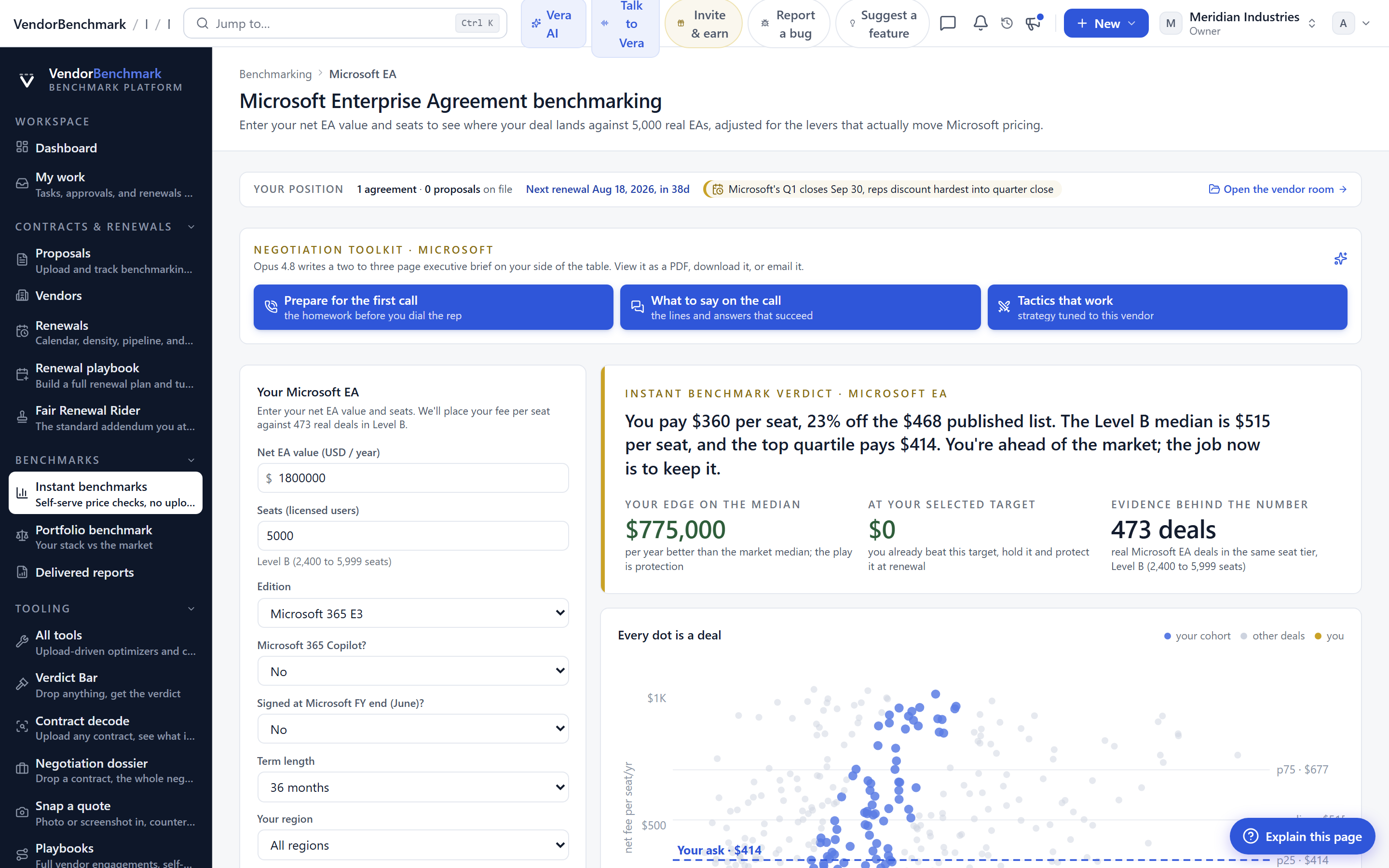
A discount curve is only useful if it is priced on the unit the invoice charges you. Druva bills protected assets. Crusoe and Equinix negotiate committed power. Bitwarden, Anthology Blackboard and eClinicalWorks meter licensed users. DigitalOcean and Dremio move on credits and consumption. EcoVadis prices per supplier assessed. eSentire, Decagon and Celigo sit on providers, seats and connected apps respectively. If you benchmark all of them on a single generic axis, you flatten the exact thing that determines your net unit price. So we did not. Each of the twelve pages carries bands on its own meter, and the curve shows where discount steepens as commitment rises.
This matters because the headline discount is the wrong number to fixate on. As we argued in discount off list is a trap, the figure that decides your budget is net unit price, and net unit price only makes sense against the meter you are billed on. A forty percent discount on committed power is a different animal from forty percent on a burst credit rate.
The negotiation half arrived with the numbers
A benchmark tells you where the market clears. It does not tell you what to say at nine minutes into the second call when the account executive reframes your ask as a scoping problem. That is why this release shipped the negotiation documents at the same time as the curves, not months later. The library now holds forty one playbooks, one per vendor or category, and thirty six call script briefs with word for word openings, counters and closes for the first, second and third call.
The playbooks carry the position: which levers move on this vendor, what they defend, where the concession usually lives. The call scripts carry the language. Each brief is structured by call sequence because the conversation is not one event. The first call sets the anchor and gathers meter detail. The second tests the floor. The third closes or walks. If you want the reasoning behind treating the counter as a written artefact rather than a live improvisation, the Negotiation Dossier post lays it out.
How it fits the workflow you already run
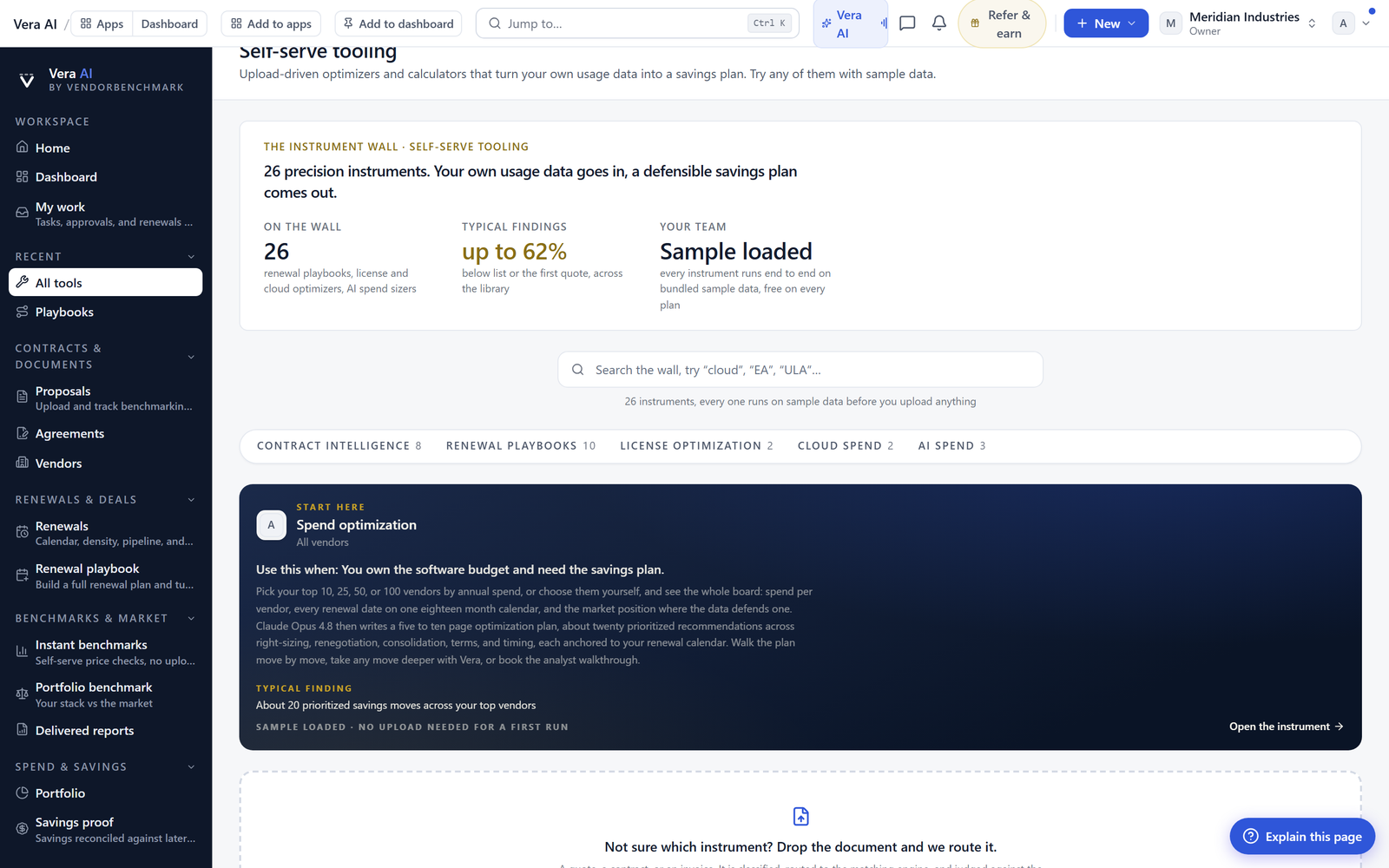
Nothing here asks you to change your process. The benchmark page is where you check a quote. The playbook is what you read before the call. The call brief is what you keep open during it. If you record the call, the meeting record and the brief line up afterwards, which is the point we made in ask your meetings what was said. The evidence, the position and the language stay in one place instead of scattered across a shared drive, an email thread and someone's memory of the last renewal.
For the twelve vendors specifically, the fit is direct. If you are pricing Crusoe or Equinix committed power against a capacity plan, the curve and the brief carry the same meter, so your ask and your evidence speak the same language. If you are renewing Bitwarden or Druva on a per user or per protected asset basis, the bands tell you which percentile your renewal sits at before the seller frames it as a rounding exercise.
Where this stops, honestly
A curve is a distribution of prices other buyers have reached. It is not a promise you will reach the same one. Your leverage depends on volume, term, timing in the vendor's quarter, incumbency and how much they need the logo. The twelve curves narrow the range you are negotiating inside. They do not replace the judgement about where within that range you can credibly land given your specific situation.
The call scripts are drafted for the common shape of these conversations, not for your exact counterpart or the exact objection they will raise. Read them as a starting position and a set of tested phrasings, then adapt. A script you deliver without owning the reasoning behind it is brittle the moment the seller steps off the expected path. The Negotiation Craft work exists precisely so the discipline sits with you, not only in the document.
Two more limits worth naming. First, these are twelve vendors added to a library of 1,471 vendors. If your vendor is not here yet, the curve is not here yet either, though the broader library and the analyst may still help you triangulate. Second, benchmarks reflect the market as it was at the point the underlying deals closed. Fast repricing categories move, which is why we treat the curves as living reference points and refresh them, a point we made about the AI coding tools category. Check the freshness before you anchor a hard number to it.
The honest summary is this. Twelve vendors moved from guesswork to a priced curve, and the negotiation language moved from your head to a written brief. That does not win the negotiation for you. It removes the two excuses a seller relies on most, that you cannot see the market and that you have not prepared what to say. You can start with the twelve on the benchmarking library and work outward from there.
Fredrik has spent more than twenty years in enterprise software, with time at Oracle, IBM, SAP, and Salesforce before moving to the buy side. He structured and priced the kind of large agreements most buyers only see once or twice in a career, which taught him where the leverage sits and how far a vendor will actually move. He started VendorBenchmark to hand that knowledge to every sourcing team.


