Run every purchase to award from one window.
Sourcing runs a purchase from the first list of needs to the signed contract in six sections: Dashboard, Intake, Compare results, Benchmark, Choose a winner, and Messaging.
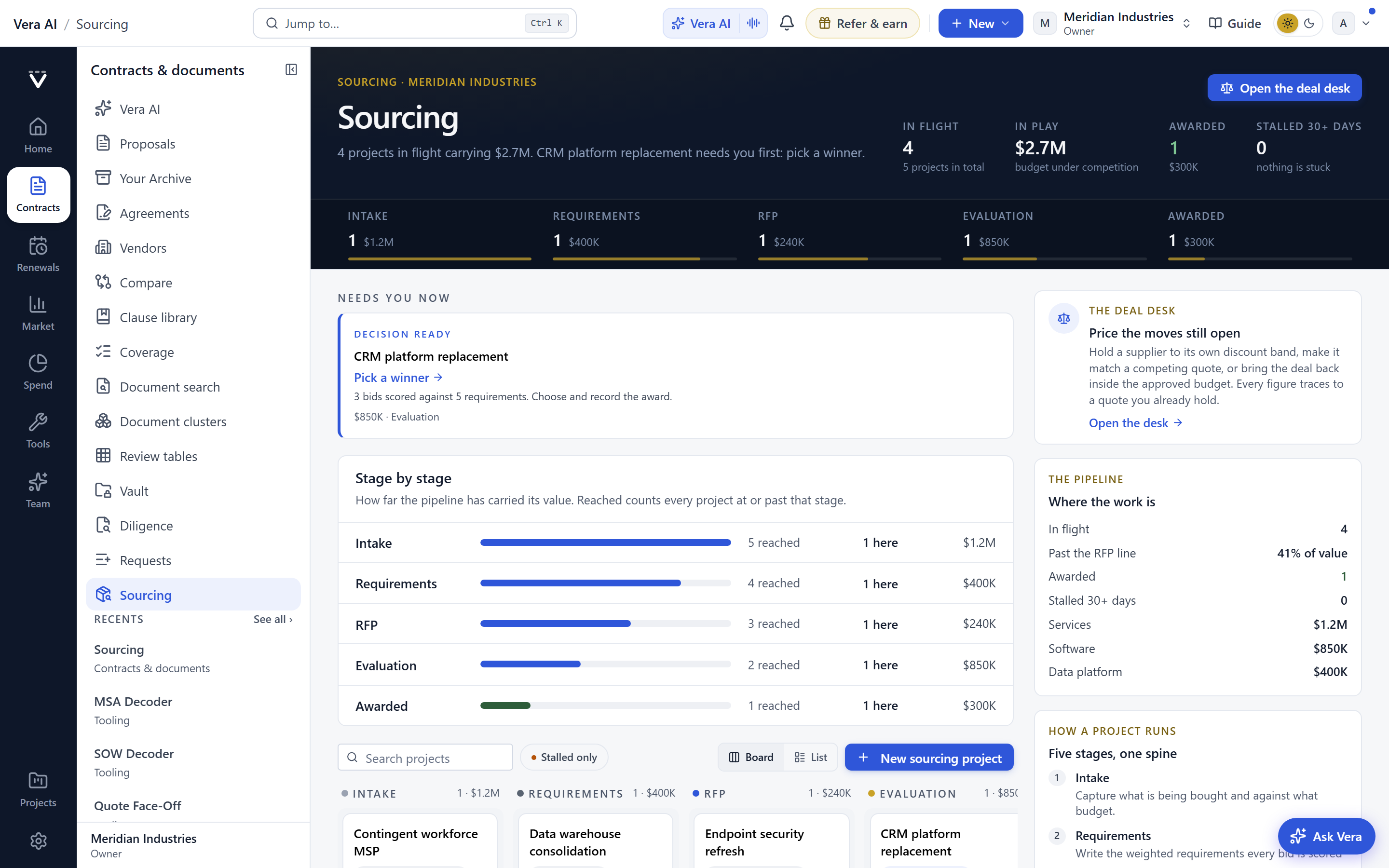
A competitive sourcing event lives in a dozen email threads, a scoring spreadsheet, and someone’s memory of who still owes a bid. Things slip between the cracks between stages. Sourcing puts the whole event in one window the team reads together, and drafts the email each stage needs.
Intake to award, without the event living in your inbox.
One front door for new spend, one window to run the whole thing.
By form or email, with AI triage: net-new, renewal, duplicate, or over threshold. Catch the duplicate tool request before the second contract gets signed.
Your purchases with the step each is on and when bids close, what needs a person this week, and when the next responses are due. Run every purchase to award from one window.
One click scores every waiting bid against your weighted requirements, each score anchored to a quote from the bid document. A folder of supplier PDFs becomes a ranked, defensible matrix in minutes.
Every letter the purchase needs, drafted by Vera from its own figures, and nothing sends until you send it: kickoff, invitations, the Q&A broadcast, chases, the recommendation memo, award and decline notes.
It scores the bids and writes the stage’s email.
The AI reads every bid against your weighted requirements and anchors each score to a specific quote in the document, so the ranking is defensible, not a gut call. Then Messaging drafts the email each stage needs from the purchase’s own numbers, so a stage closes in two clicks.
Built to run a real event, together.
Sourcing is an operations surface, grounded and shared, not a form workflow.
The timeline, the sent letters, the priced sheets, and the approvals stay with each purchase, so the window shows where value sits and the event survives an audit.
The whole team works the same purchase in the same window, so a sourcing event survives a handoff without losing the thread.
Bid scoring quotes the passage each score came from, so the evaluation is auditable and defensible to a losing supplier or an internal reviewer.
Requests are classified at the front door as net-new, renewal, duplicate, or over threshold, so duplicates and renewals are caught before a second contract is signed.
The stage emails are drafted and sent from Messaging inside Sourcing, grounded in the purchase’s numbers, so the correspondence never leaves the record for a personal inbox.
Close a stage and send the right email in two clicks.
Chasing bids, building the scoring matrix by hand, and writing every kickoff and decline note is the slow, thankless middle of a sourcing event. Sourcing ranks the bids and writes the emails, so the event moves.
Estimate your own hours →An operations room, not an intake form.
Procurement suites and shared drives both leave the running of the event to email and memory.
A source-to-pay suite tracks the request through approval gates. It does not score the bids against your weights, draft the stage email, or show the money in play on one board.
The event living in threads and a scoring sheet is exactly where bids get missed and stages stall. Sourcing is the shared window that keeps it moving.
A consultant runs the event and takes the method with them. Sourcing hands the method to your team, event after event, with the scoring and the emails built in.
Business value, and the operational value under it.
One line for the board paper, and the day to day the team actually feels.
- A defensible award: bids scored on your weights, anchored to quotes, auditable to a losing supplier.
- Duplicate and overlapping purchases caught at intake, before a second contract is signed.
- Faster events, so value is captured while the leverage of a live competition still exists.
- The sourcing method owned by your team, not rented from a consultant per event.
- The whole event in one window the team reads together, surviving handoffs.
- A ranked scoring matrix from a folder of PDFs in minutes.
- The email each stage needs already drafted from the live numbers.
- Bid close dates on every purchase, so nothing stalls unnoticed.
Run the whole event from one window.
Scored bids, the benchmark, and the stage email already written.