Every deal from the notice date to the signature, in one window.
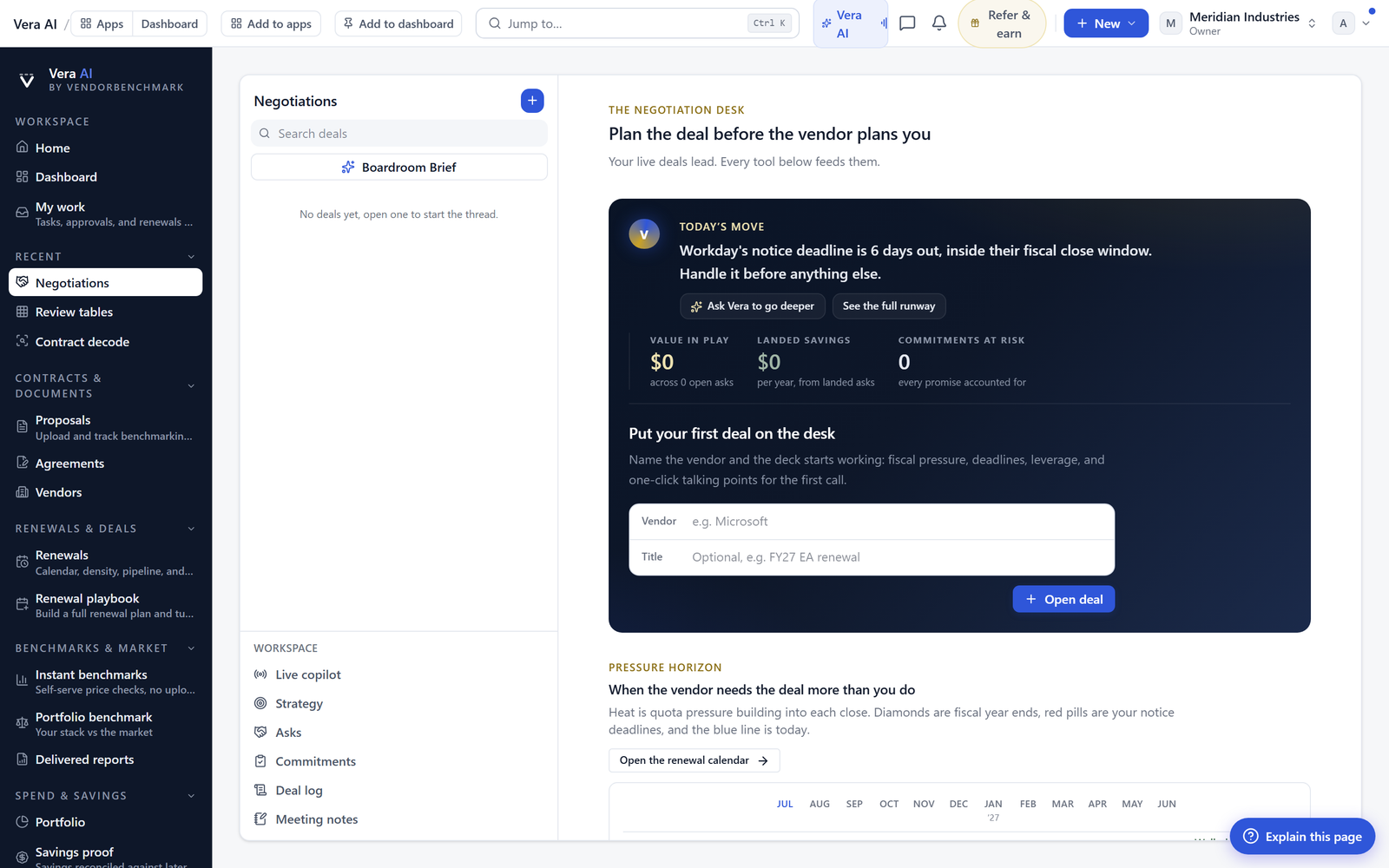
The Deal Agent holds every renewal and negotiation: Today, Board, Calendar, Notices, Vera’s desk and Documents. Pick a deal and it runs through Read, Benchmark, Plan, Terms, Negotiate and Close, with the mandate, the concession ledger and the landing zone in one thread, counters drafted in your voice, and Vera on the vendor call when you want her there.
Vendor negotiators run this play for a living and remember every concession you gave last cycle. You run it a few times a year, from a scattered email thread and a half-remembered spreadsheet. The workspace evens the memory, and the AI evens the reps.
From the vendor’s first email to a signed, better deal.
The workspace remembers everything; the AI does the drafting and the reading.
Read, Benchmark, Plan, Terms, Negotiate and Close: the mandate, the concession ledger, the commitments, the counter queue and the landing zone sit on the deal’s steps. Nothing falls out of the thread between calls.
Send a vendor email to a private address. The AI classifies the tactic, logs the concession, and drafts the counter-reply in your voice with full thread memory. You approve and send.
Paste a Zoom, Teams, Google Meet or Webex link and Vera or a vendor specialist joins as a named participant: taking notes, answering when asked, or negotiating for you, with the minutes filed when it ends.
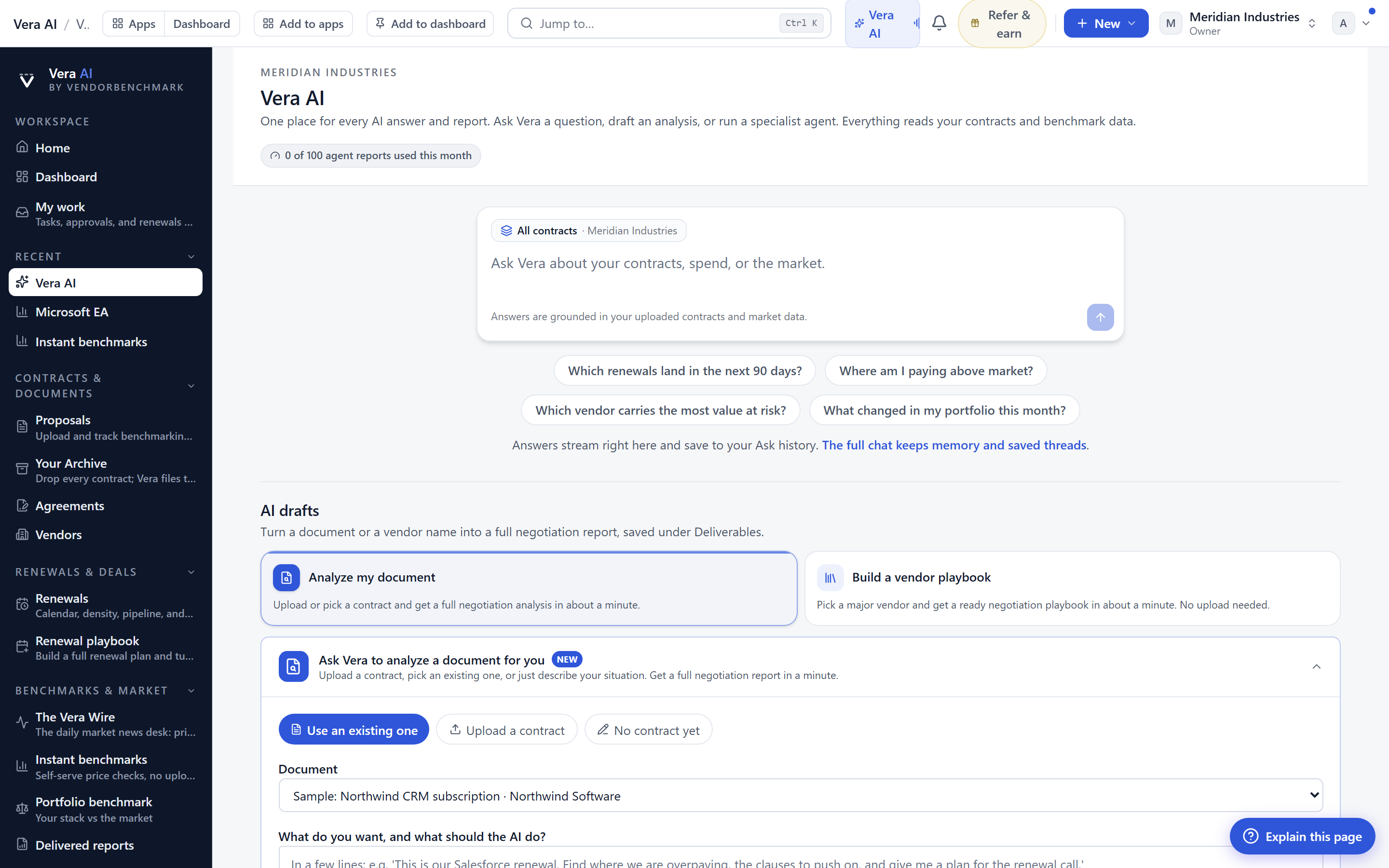
Hand a renewal to Vera and she negotiates by email inside the limits you set, then brings every offer back. You approve the mandate and decide every offer.
It negotiates from your playbook, not generic advice.
Every draft and every prompt is grounded in your stored benchmarks, your contract history, and the language in your contract policy. The AI classifies what the vendor is doing, remembers what they have already conceded, and writes toward your position, not a textbook one.
Grounded, logged, and yours to steer.
The negotiation surface is built on the same buyer-side data and controls as the rest of the platform.
Your standard, redline language, fallback, and walk away line per term drive every AI draft, so the counter argues your standard, not a generic best practice.
Each org gets private addresses that are signature-verified, malware-scanned, and deduplicated. Forwarding a vendor email is the whole integration; no connector to install.
Every offer and promise is captured in one thread with a post-mortem, so the next cycle starts from what really happened, not memory.
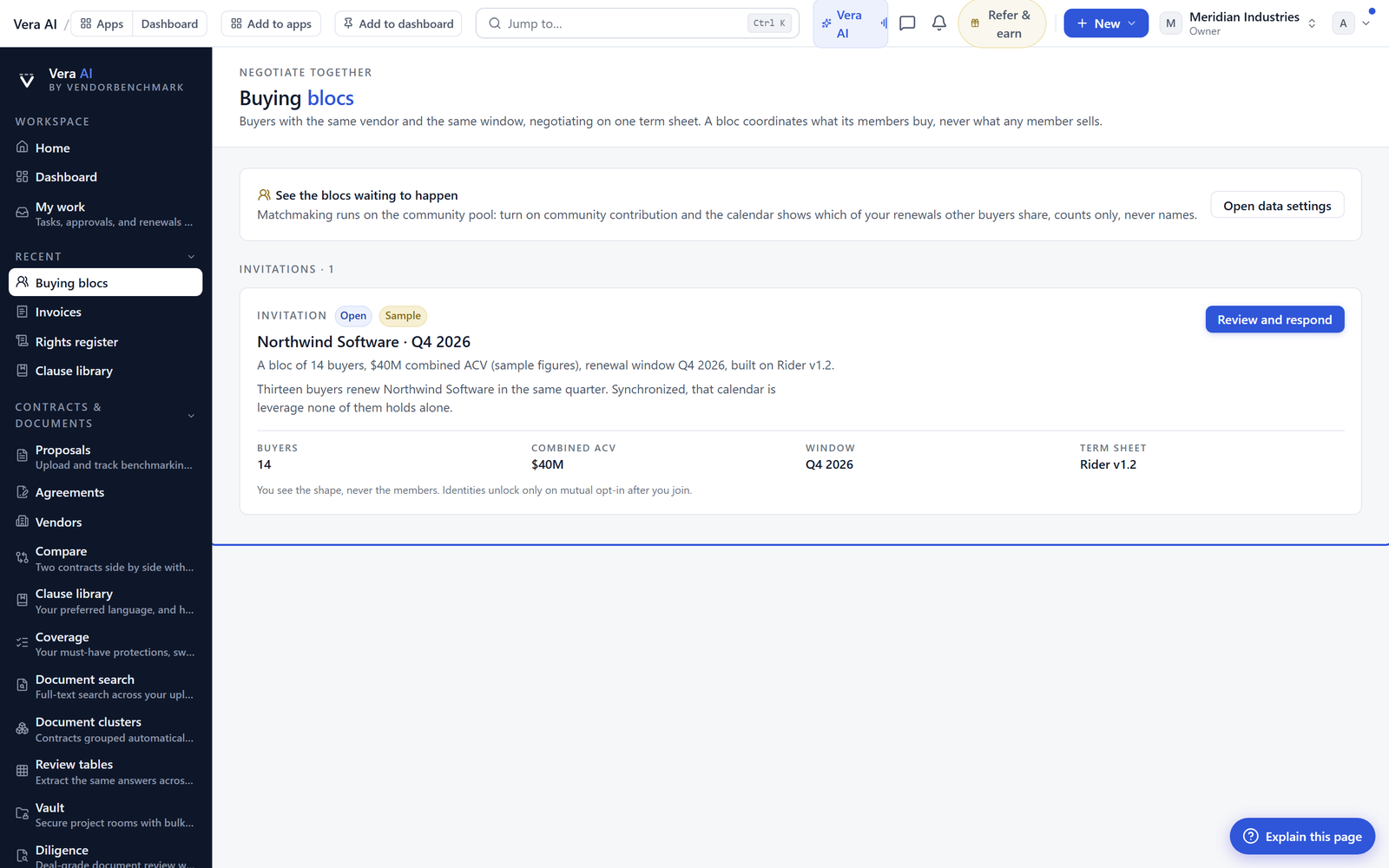
Opt-in vendor blocs pool leverage with peers on the same vendor under one shared term sheet and window, anonymous until both sides choose to reveal, so you never expose your own numbers.
When an agent runs a round under the Agent Negotiation Protocol, every move is written to a tamper-evident ledger you can audit and hand to legal.
The counter is drafted before your coffee cools.
Reading the tactic, checking the benchmark, and writing a measured reply used to eat an afternoon per exchange. Now you forward the email and approve a draft that already cites your position.
Estimate your own hours →A negotiation system, not a chatbot with a prompt.
Generic AI writing tools have no memory of the deal and no idea what fair looks like. This does.
A generic model will write a polite email, but it does not know what the vendor conceded last week or what the market clears at. Every draft here is grounded in the ledger and the cohort.
A consultant costs a fee and keeps office hours. Vera joins every call and the ghost-writer answers every email, at the moment the vendor gets difficult.
Contract lifecycle tools manage the document after the terms are set. This platform is built to change the terms before they harden.
Business value, and the operational value under it.
One line for the board paper, and the day to day the team actually feels.
- Better landing zones because every counter is anchored to a real benchmark and your own pre-approved position.
- Institutional memory that survives turnover: the concession history and post-mortems outlast the person who ran the deal.
- Pooled leverage through buying blocs without ever exposing your numbers.
- A signed, auditable record when an agent runs a round, defensible to legal and the board.
- A drafted counter in minutes instead of an afternoon per exchange.
- Vera on every vendor call without adding headcount.
- One thread the whole deal team reads, so no promise or concession gets lost between people.
- Scenario math on demand, so you never propose a term before you have priced it.
Walk into the call with the counter already written.
The Deal Agent, Vera’s desk, and Vera on the call, on your paper.