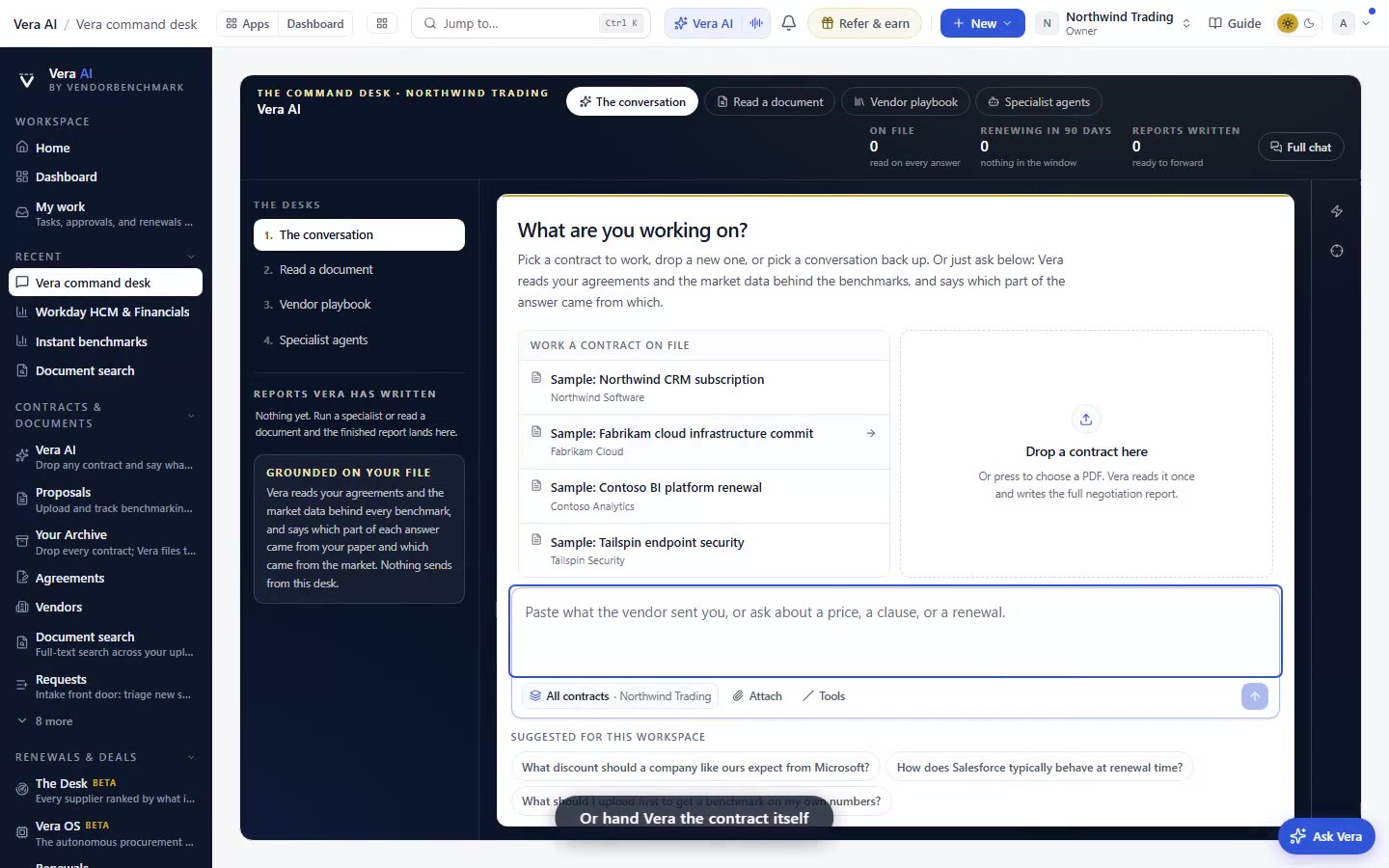
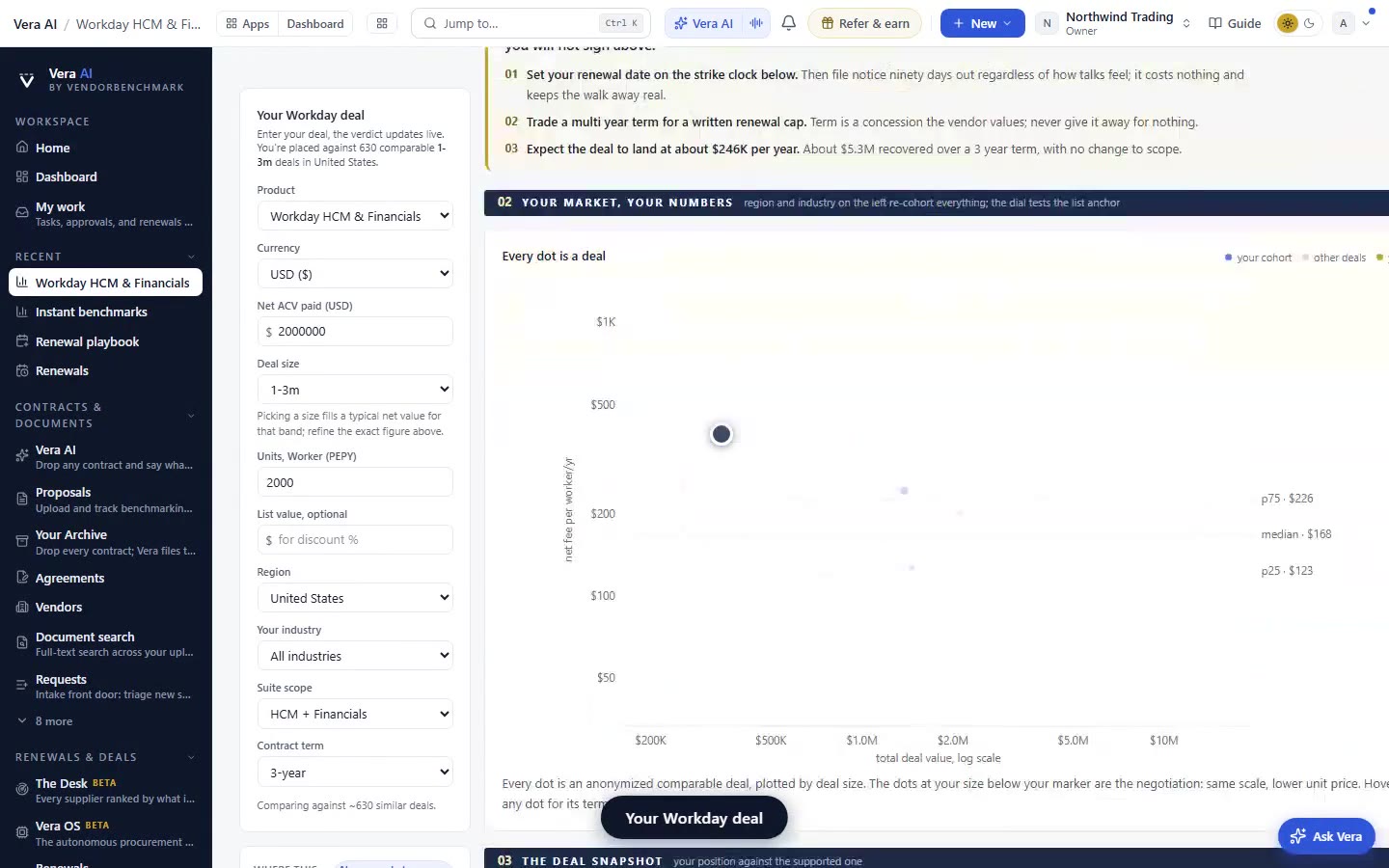
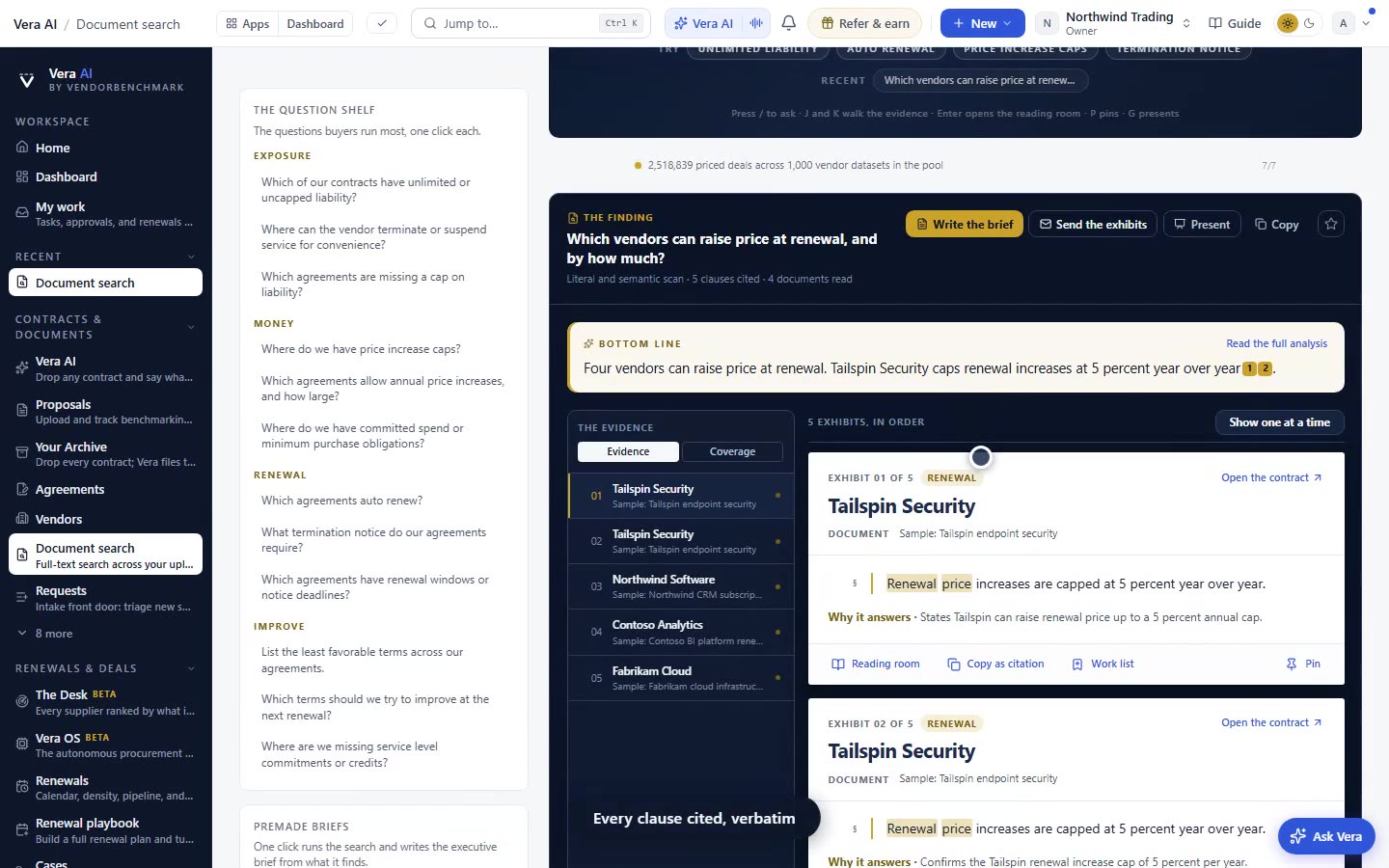
The benchmark window has a rail: the book, the answer, your estate
The answer you already know is unchanged. What is new is the frame around it, the renewal book on the rail and the standing stated in a word before you read a line.
Every buyer knows the moment. You open a benchmark to check where a vendor sits before a renewal call, you get the answer, and then you close the window and go somewhere else to find out when the contract actually expires. The number lived in one place, the timing lived in another, and the estate lived in a third. This update closes that gap. The benchmark window now has a rail down its left edge, and the rail carries the book your renewals desk reads, your estate, and the settings that shape how you read. The answer in the middle is unchanged. What changed is everything around it.
The problem: the answer had no context around it
When we first shipped the benchmark as a window, the win was that a benchmark stopped being a report you exported and became a live surface you could stand in front of. That was the right shape for the answer. But the answer sat alone. A buyer preparing for a Tuesday call would read the standing, then alt tab to a renewal calendar to confirm the date, then open a spreadsheet to remember which other vendors renew in the same window and might be pooled. Three surfaces, three contexts, one decision. The rail exists because the decision was always the same one, and the surfaces should not have been three.
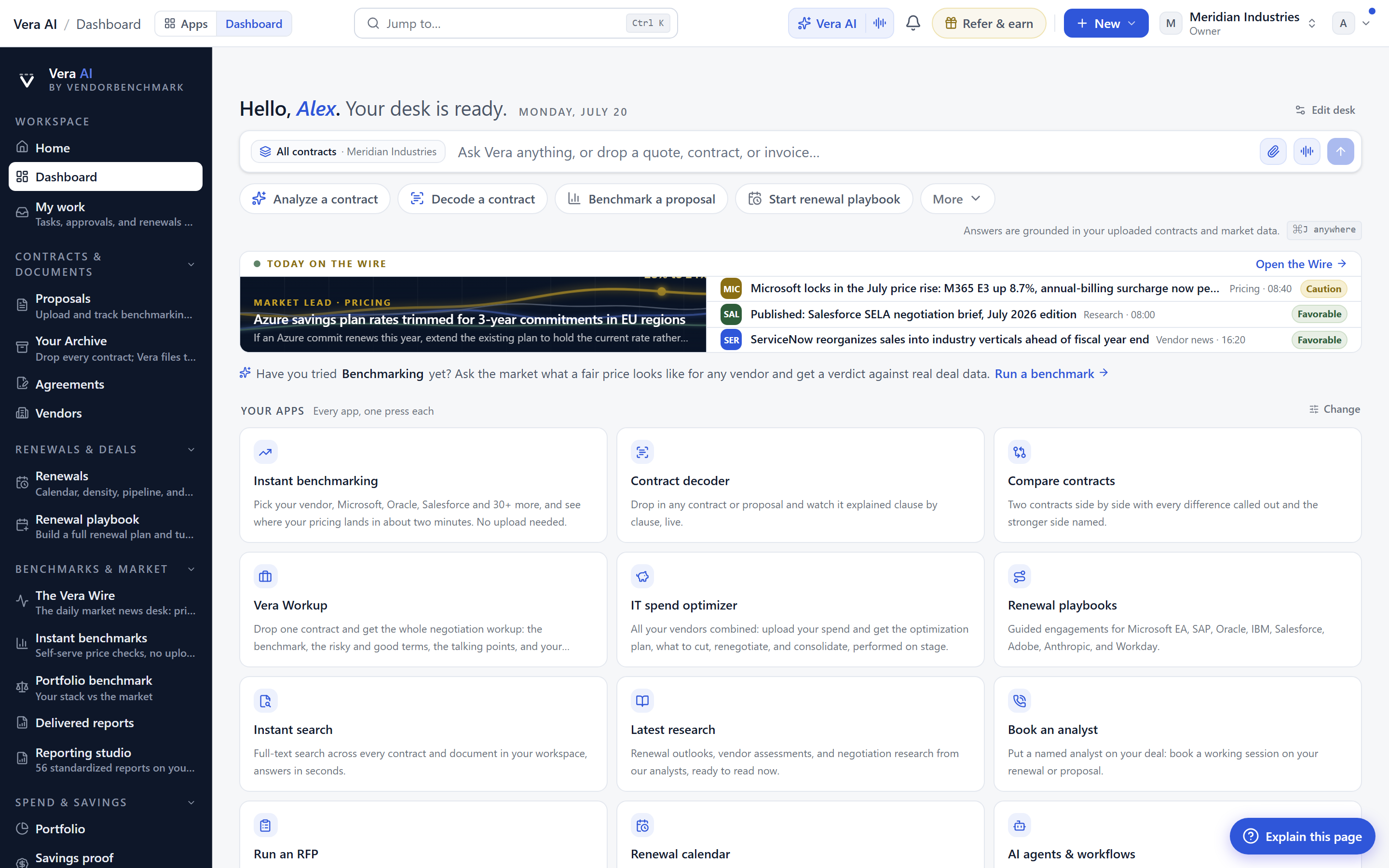
The book: your renewals, nearest first
The book is the genuinely new object on the rail, and it is the one your renewals desk already reads. It lists every vendor you hold a contract with, ordered by nearest renewal first, with the days left shown against each line and the standing where a benchmark is on file. This is not a fresh list you have to maintain. It is the same book that runs under the Benchmark Library reading your whole book, now surfaced on the rail of any single benchmark you happen to be reading. The effect is that you are never one vendor deep. You are one vendor deep with the queue behind it visible, so you can see that the contract you are reading renews in 40 days and the one below it renews in 47, and decide whether to prepare them as one conversation.
For teams that already live in the renewal calendar, this is the same intelligence in a tighter frame. The timing desk remains the place to plan a quarter across all of it. The book on the rail is the place to keep your hand on the queue while you read a single standing. The library covers 1,483 vendors, so for most estates the standing on the line is already on file rather than something you have to commission.
The estate moved onto the rail
Your estate used to be a destination you navigated to. Now it lives on the rail, alongside the book and the answer. This matters because the estate is the argument context for the standing. A benchmark tells you a vendor is above market. The estate tells you what else you hold, what it costs together, and where the leverage sits if you were to pool a renewal into a wider conversation. Keeping the estate on the rail means the standing and the leverage are read side by side rather than in separate sittings. If you want the full canvas, the estate map is still where the whole stack lays out on one surface. The rail carries the working slice of it, next to the vendor you are looking at now.
Settings in one place, and the standing stated up front
Settings used to be scattered across the reading surface. Dark mode was one place, the inspector was another, boardroom mode was somewhere else, and the keys were their own trip. All four now gather in Settings on the rail. Dark mode is for the long reading session. The inspector is for the buyer who wants to see how a figure was reached before quoting it. Boardroom mode is for when the same benchmark has to go up on a screen in front of a committee. The keys are for the teams wiring this into their own tools. One place, four controls, no hunting.
Above the sheet, the window now states the standing in a single word and shows the four figures across the top. The point worth making here is that those figures are read from the same function the sheet itself reads. The header is not a separate summary that can drift from the body. It is the same computation surfaced early, so the word at the top and the detail below it can never disagree. If you want the reasoning behind the reading rather than the header, the verdict reading remains the fuller version of the same judgement.
Honest limits
Three things this does not do, stated plainly. First, the book on the rail is only as complete as the contracts you have loaded. A vendor you hold but have not recorded will not appear in the queue, and the days left it shows are only as good as the expiry date on the record. If your document archive is thin, the book will be thin. Second, the standing is only on file where a benchmark exists. The library is broad at 1,483 vendors, but where a vendor sits outside it, the line shows the renewal timing without a standing, and you should treat that gap as a prompt to commission the read, not as a verdict.
Third, the rail brings context to the answer, it does not make the decision. Seeing that a vendor is above market and renews in 40 days next to three neighbours that renew in the same window is a better place to think from. It is still your judgement whether to pool them, hold firm, or let the smaller line pass. The rail is built to shorten the distance between reading and deciding. It is not built to decide for you, and you can read more about how the standing itself is arrived at on our benchmarking page. What you should notice, after a week, is that you stop closing the window to go and check the date. That single habit, gone, is the whole point of the rail.
Want to be updated when major licensing and pricing changes land? One analyst brief a week: the price rises, metric changes and audit campaigns that move software costs. Work email only.
Morten brings two decades of enterprise and software procurement, with stints across Oracle, IBM, SAP, and Salesforce shaping how he reads a deal. He has led sourcing through hundreds of renewals, from mid market order forms to nine figure global agreements, and learned that the buyers who win are the ones who walk in knowing the market. He built VendorBenchmark to make that pattern recognition repeatable.