The renewal record is a room in the desk now, and Vera takes a case from inside it
Every renewal record now opens as a working room inside the desk. The stage, the terms, the paper, the benchmark and the run sit together, and Vera can take the whole thing into a case without a single tab change.
You know the pattern. A renewal record is a summary page. It tells you the vendor, the date, the value, maybe a status pill. To actually work the thing, you leave. You open the contract in one place, the benchmark in another, the last negotiation in a third, and the checklist lives in a spreadsheet somebody built in 2022. The record was a signpost, not a place to stand. Today that changes. Press 2 on the renewal desk and the selected agreement opens in full, in place, as a room. This continues the direction we set when Vera opened as a command desk and when every screen started keeping your work.
The problem: a record that points everywhere and holds nothing
The named problem is tab archaeology. A renewal buyer opens the record, reads a line of summary, then reconstructs the deal by hand across five surfaces. The contract paper is over here. The forecast and the should cost are a separate calculation. The proposals and the benchmark sit in a library. The playbook is a document. The activity from last time is in email. None of these disagree exactly, but none of them are in the same frame at the same moment, so the buyer becomes the integration layer. That is the tax. It is not dramatic on any single renewal, it is expensive across a portfolio, because you pay it every time you re-open a deal you already understood last quarter. We wrote about the downstream cost of this in the renewal that re-bought a spec nobody could explain.
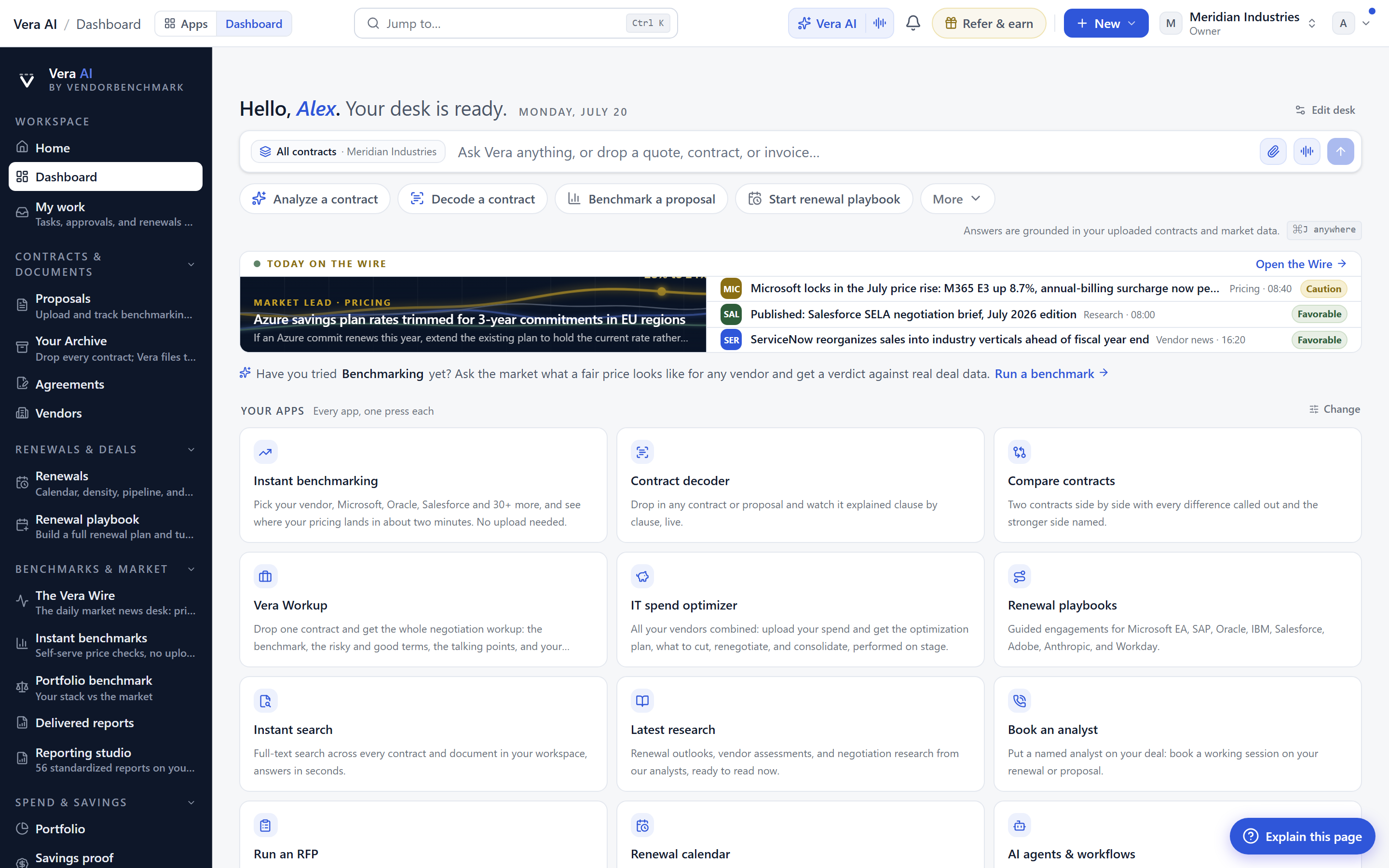
What the room actually holds
The room is the full agreement, not a preview of it. The stage sits at the top as a control, so moving the renewal forward is an action you take in place, not a status you update elsewhere. The terms are listed with the hand that edits each one, so a change is a direct edit rather than a note to yourself. Alongside them sit the forecast and the should cost, the paper itself, the proposals and the benchmark, the playbook, the checklist, the autopilot, the run, last time, and the activity. Everything that used to be a destination is now a panel in the same place. This is the same move we made when every vendor benchmark opened as a window, applied to the renewal record.
Have Vera run it, without leaving the desk
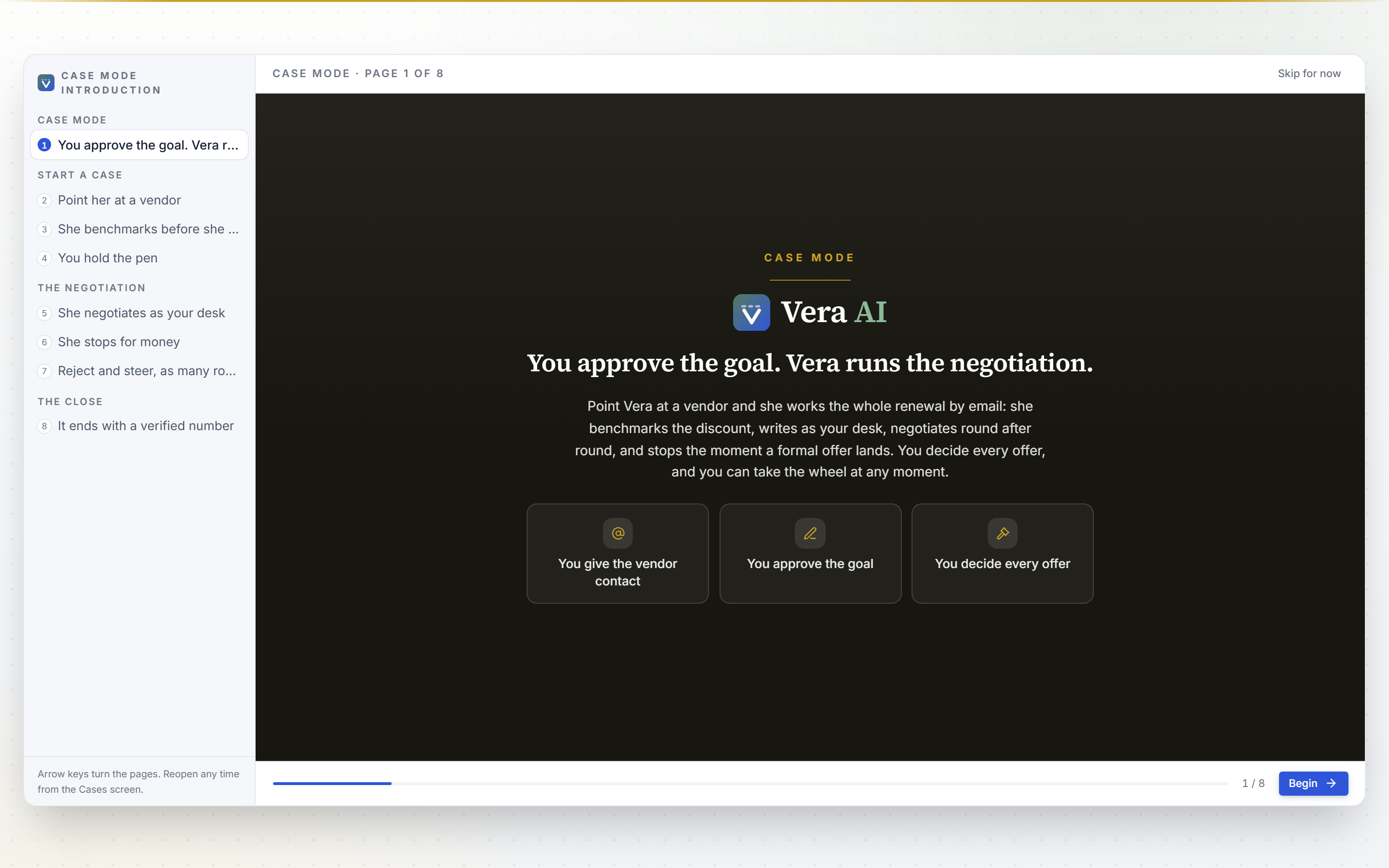
Inside the room there is a single action: have Vera run it. That opens case intake as a sheet in the desk, guided or automated, on the same launch the Cases area uses. This matters for two reasons. First, you are not exporting the renewal into a different tool and losing the frame. The case is born from the agreement that is open in front of you, with its terms, its benchmark, and its history already attached. Second, it is the same intake, not a parallel copy, so a case you start from a renewal room behaves identically to one you start in Cases. One of the six specialist agents does the assembly, and the guided path lets you steer it clause by clause if the deal warrants that.
Nothing sends until an owner authorizes it
The guardrail is deliberate and worth stating plainly. The autopilot can assemble the case, populate the terms, and stage the run, but nothing leaves the building until an owner authorizes it. The automation removes the assembly labour, not the judgement. That separation is the whole point. You want the drudgery of reconstruction gone and the decision to commit firmly in a human hand. If you standardise what you are willing to authorize, the Fair Renewal Rider pairs well here, because it turns the recurring terms into an addendum you stop re-arguing every cycle.
Honest limits
Three limits, stated straight. First, the room is only as good as the paper behind it. If a renewal record has no executed contract attached, the terms panel and the should cost will be thin, and Vera will tell you so rather than invent the gap. Second, guided and automated are not interchangeable for every deal. High-stakes or unusual renewals still deserve the guided path and your reading, because the automated route optimises for the common shape, not the exception. Third, the authorization gate is a feature, which means the last mile is still yours. Vera will not send. If your bottleneck is getting an owner to look, the room shortens the preparation but it does not chase the approver for you. For deals where the leverage is collective rather than individual, read buying blocs, because a room is a place to prepare a position, not a substitute for having one.
Net for a buyer: the renewal record stops being a page you read and becomes a room you work in, and the case you start from it is the same case Cases would have made, only born with its context already attached. Open one from the renewal desk and press 2.
Fredrik has spent more than twenty years in enterprise software, with time at Oracle, IBM, SAP, and Salesforce before moving to the buy side. He structured and priced the kind of large agreements most buyers only see once or twice in a career, which taught him where the leverage sits and how far a vendor will actually move. He started VendorBenchmark to hand that knowledge to every sourcing team.


