Every benchmark now carries a human, an AI agent and the whole library
The benchmark sheet answered the three questions in a second. Now it hands you a route to act on the answer, three ways.
PRODUCT UPDATE · FROM THE ANALYST DESK. Here is the problem you know well. You open a benchmark, you read the answer, you know where the vendor sits against peers, and then you stall. The finding is clear but the next move is scattered. The analyst who could sanity check it is in a different tool. The negotiation prep lives in a slide deck someone made last quarter. The renewal guide, the research paper, the recorded session, all of it is filed somewhere else. So the number that took a second to read takes another two weeks to turn into an email. We built the benchmark sheet to close that gap, and this update is about what now sits under the answer. If you want the earlier work, every vendor benchmark opens as a window and the sheet already works like an application.
The answer was the easy part
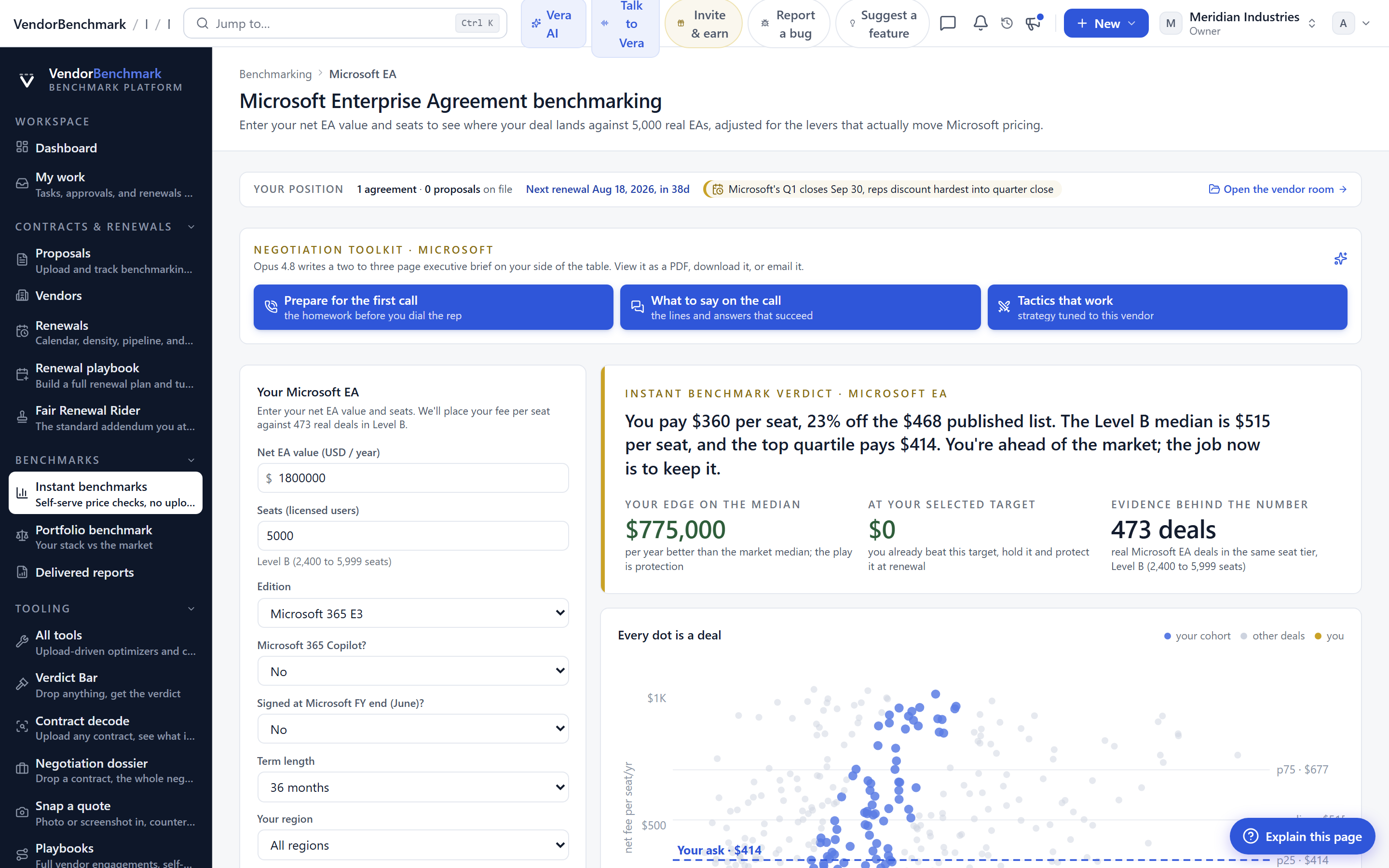
The benchmark sheet answers the three questions from the curve in a second. Where does this vendor sit, what is the peer range, and what is the money on the table. That much has been true across the library, which now covers 1,483 vendors. The honest limitation was always downstream. An answer is not a decision, and a decision is not a sent email. What we shipped adds three doors under the answer, each one a different way to act on it without leaving the sheet. Read the number, then choose your route.
Door one, a human analyst you can brief in one press
Press the first door and the human benchmark window opens with the ten questions already answered from the sheet. The finding is carried straight into the analyst's brief, so the context is not retyped. Your job shrinks to the three questions only you can answer, the ones the estate does not hold, then you send. This is the deliberate design. The sheet does the parts that are on the record, you supply the parts that are in your head, and a real analyst reviews the finding rather than reconstructing it. If you want to understand how the verdict itself is drawn before you brief anyone, second opinion draws the verdict on the vendor's own curve.
Door two, the vendor's own AI negotiator on video
The second door is the one that surprises people. The vendor's own AI negotiator can talk it through with you on video, and it sits down with the same figures you have. Your discount, the peer range, the supported ask and the money on the table are all in front of it, and four openers are ready to start the conversation. This is rehearsal, not the real table. You get to test the openers, hear the standard rebuttals and find the weak points in your ask before it costs you anything. It draws on the same negotiation craft the platform teaches elsewhere, and if you want the discipline behind the openers, Negotiation Craft works ten disciplines on real 2026 vendors.
Door three, the whole shelf in one searchable place
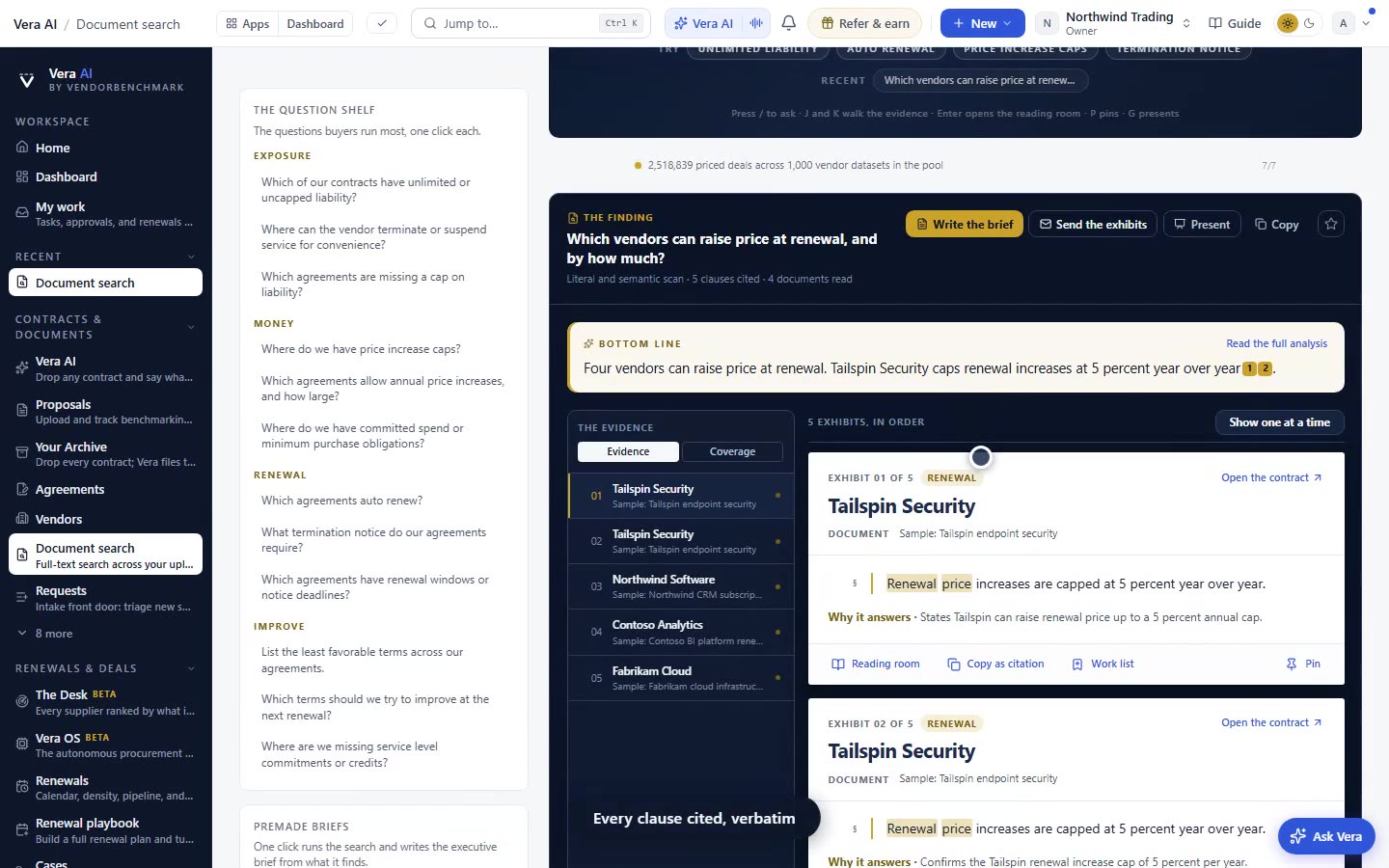
The third door is quieter and, over time, the one you use most. Everything the estate holds on that vendor now sits on the sheet in one searchable shelf. The analyst films, the recorded sessions, the podcast, the negotiator's guide, the research papers, the renewal guides and the articles. No more hunting across drives for the thing you know exists. The shelf is why the earlier work matters. The renewal library gives two pages per vendor on how their renewal actually behaves, and the negotiator's guide already opens across dozens of sheets, as covered in the piece on thirty seven benchmark sheets. All of it now surfaces in one place, under the answer, filtered to the vendor in front of you. You can read the full library approach on our benchmarking page.
The honest limits
Three things to be plain about. First, the AI negotiator is a rehearsal partner, not the vendor's actual account team. It reflects known positions and standard rebuttals, and it is excellent for pressure testing your ask, but the real person across the table will improvise in ways it cannot fully predict. Treat it as a sparring session, not a script. Second, the human door is only as good as the three answers you supply. The sheet answers everything on the record, but the deal specific facts, your internal deadline, your walk away point, the political cost of switching, are yours to add, and the analyst review is weaker without them. Third, the shelf shows what the estate holds. Coverage is deep but not uniform. Some vendors carry a film, a podcast and a renewal guide, others carry the research paper and little else. Where the shelf is thin, the human door is the better route. Used together, the three doors turn a one second answer into a sent email in about twenty five minutes. That is the whole point.
Fredrik has spent more than twenty years in enterprise software, with time at Oracle, IBM, SAP, and Salesforce before moving to the buy side. He structured and priced the kind of large agreements most buyers only see once or twice in a career, which taught him where the leverage sits and how far a vendor will actually move. He started VendorBenchmark to hand that knowledge to every sourcing team.