The buy that gets re-explained at every desk it crosses
Every time a deal changes hands, the next person reconstructs what the last one already knew. That rebuild is where your cycle time quietly disappears.
Here is your last month. A requester files an intake ticket with three lines and a link. The desk picks it up and spends a morning working out what the business actually wants, because the ticket did not say. Legal receives the file and asks the same discovery questions the desk already asked. Finance opens the thread last and cannot find the number anyone agreed to, so it reopens the whole conversation. Nobody did anything wrong. The context simply did not survive the handoffs. Each person rebuilt what the previous person already knew, and that rebuild is the part of the cycle nobody times.
The tax you never see on the invoice
Cycle time reports measure the wrong thing. They measure how long a deal sits at each stage, which makes it look like the delay lives inside legal review or inside finance approval. It does not. A meaningful share of the delay lives in the seam between two stages, in the hour or the day where the receiving stakeholder reads back through an email chain to work out what has already been decided. That work produces nothing. It restores a state that already existed one desk earlier.
We call this a hidden tax because it never appears as a line item. No stakeholder logs two hours against reconstructing the requirement. They log it as review, or research, or waiting on the business. But if you interview the people in the chain, they will tell you the same thing: the first thing they do when a deal lands is figure out what they inherited. On a mid-sized software buy touching four functions, that reconstruction can absorb the better part of a week across the group, and none of it moves the price or the terms.
Why the context keeps dying
The problem persists because email is the default carrier and email does not carry state, it carries messages. Each forward is a snapshot, not a record. The moment a decision is made in a reply, it is buried under the next twelve replies. The receiving stakeholder does not get the current state of the deal, they get a pile of correspondence and the job of inferring the state from it. That inference is the rebuild.
It persists for a second reason. The person with the most context is almost always the person with the least time to hand it over. The requester who understands the requirement moves on to their day job the moment the ticket is filed. We wrote about this specific failure in the stakeholder with the most context has the least time to give it, and it compounds every handoff: the richest source of context is the one least available to explain it, so each desk downstream reconstructs from partial evidence.
And it persists because handoffs are also single points of failure. When the one person who understood the deal steps away, the whole thread stalls, which is exactly the pattern in the deal that only one person could carry. If the state lives only in one head and one inbox, every handoff is a bet that the head stays in the building.
The motion that removes the rebuild
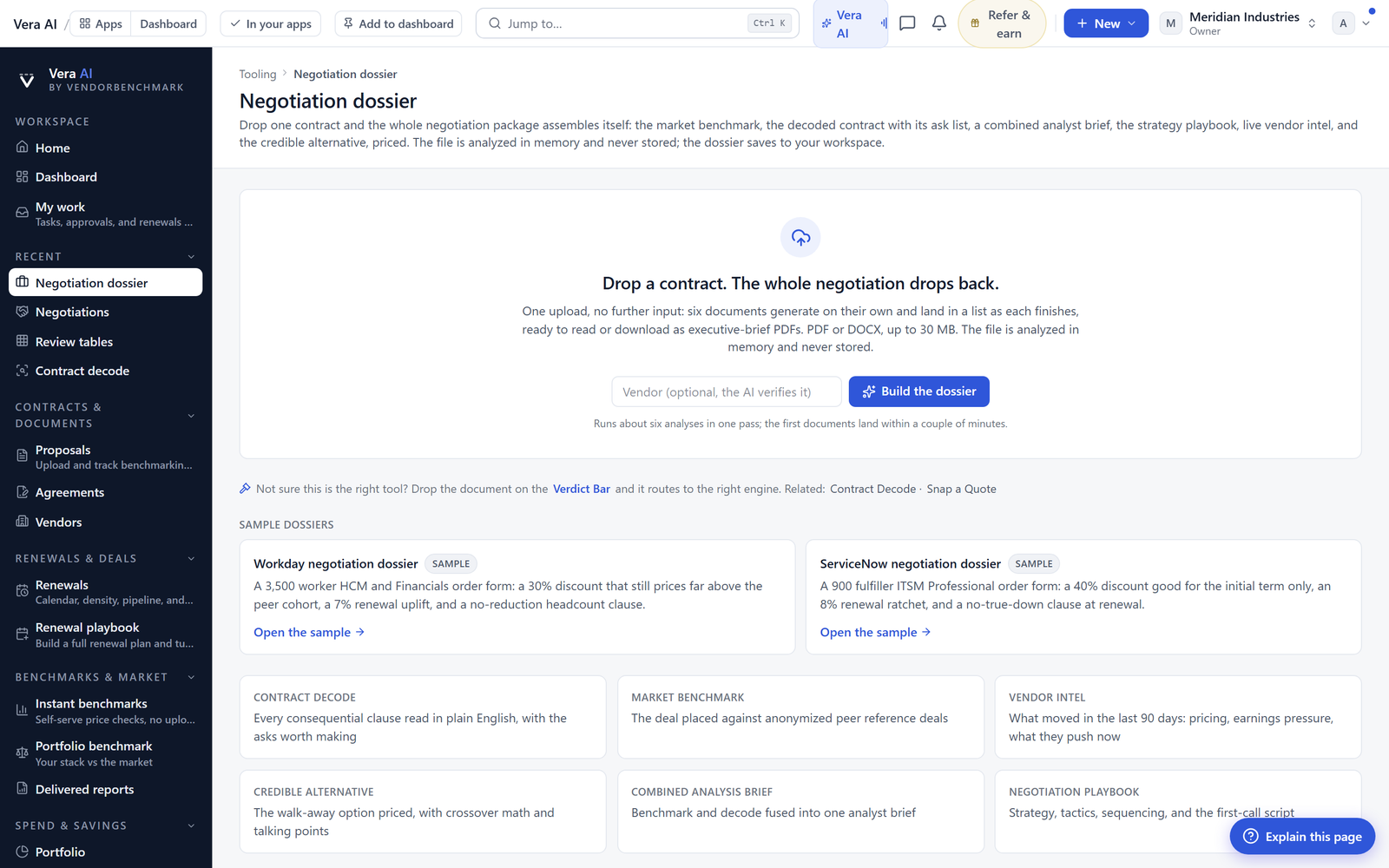
The fix is structural, not behavioural. You do not fix context loss by asking people to write better handoff notes, because the person best placed to write them is the one with no time. You fix it by making the record travel with the deal, so the state is the artifact and every stakeholder inherits it whole. That is what the negotiation dossier is: a single carried record that holds the intake, the scope, the benchmark figures, the terms in play, and the decisions already made, with their basis attached.
When the desk finishes its work, it does not write a summary email. The dossier already contains the work. Legal opens the same record and sees what was decided and what remains open, without asking. Finance opens it last and finds the agreed number and the reasoning in place, not scattered across a thread. The benchmark evidence comes from the library that covers 1,483 vendors, so the figures in the dossier are cited rather than remembered. Nothing gets reconstructed because nothing was lost.
This is also what protects the renewal, which is the handoff nobody plans for. A renewal inherits whatever the original buy left behind, and when that is an empty ticket, the team re-buys a spec it cannot explain. We covered that trap in the renewal that re-bought a spec nobody could explain. A carried record turns the renewal from an archaeology project into a read of the last dossier.
What the carried record actually changes
What the dossier does not solve
Be honest about the limits. A carried record removes the rebuild, but it does not resolve disagreement. If finance wants the floor and the business wants everything, the dossier shows you the conflict clearly and early, it does not decide it for you. That reconciliation is human work, and we treat it as its own problem in the spec that pretends the stakeholders agree.
It also does not compress the parts of the cycle that are genuinely governed by the vendor. If the vendor takes ten business days to return a redline, the dossier does not shorten that. What it does is make sure you are never the reason for the wait, because your side of the handoff carries itself. And it does not populate itself: the value depends on capturing the intake and the decisions in the record rather than in side channels. If half the conversation still happens in a private thread, half the context still dies. The record is only as complete as what your team routes through it.
None of this is a promise of a faster market or an easier counterparty. It is a narrower claim, and a defensible one. The rebuild between your own desks is waste you control. Removing it is the cleanest cycle time you will recover this quarter, because it costs the vendor nothing and asks nothing of them. It simply stops your organisation from re-explaining a deal to itself, one handoff at a time.
Fredrik has spent more than twenty years in enterprise software, with time at Oracle, IBM, SAP, and Salesforce before moving to the buy side. He structured and priced the kind of large agreements most buyers only see once or twice in a career, which taught him where the leverage sits and how far a vendor will actually move. He started VendorBenchmark to hand that knowledge to every sourcing team.